

Agentic AI may remove Finance from the decision chain. Explore how FP&A can shift from insight...

Beyond the Dashboard: Headless FP&A and the Rise of Conversational Budgeting — Part 1 of 2
June 16, 2026

Part 1 of a series exploring how Agentic AI and decoupled architectures are transforming enterprise financial planning.
The Fragmented Enterprise
Enterprise data ecosystems are deeply fragmented. Revenue pipelines, procurement records, and payroll data each live in isolated silos — making unified financial planning a persistent challenge for finance teams worldwide. At present:
Revenue pipelines and sales forecasts reside within Customer Relationship Management (CRM) platforms, disconnected from finance.
Procurement records stay isolated in specialised tools, creating blind spots in spend visibility and budget accuracy.
Payroll data is scattered across multiple regional HR platforms, complicating workforce cost consolidation.
Finance teams continue to struggle to consolidate disparate data into a unified EPM tool for budgeting and forecasting. The fundamental issue is that modern budgeting and forecasting demands a level of agility that rigid, legacy EPM architectures simply fail to deliver. Consequently, static reporting is gradually making way for AI-driven, real-time scenario modelling.
This article explores the transition toward a "Headless FP&A" architecture, examining how Agentic AI can resolve persistent bottlenecks in finance — most notably, the notorious "Zero-Data Problem" inherent to annual planning.
The Monolithic Bottleneck in Traditional FP&A
The fundamental issue is that modern budgeting and forecasting demands a level of agility that rigid, legacy EPM architectures simply fail to deliver. This manifests in three compounding problems.
The Capacity Crisis
Data gathering, processing, and reconciliation consume up to 75% of an FP&A team's capacity — a figure corroborated by the Association for Financial Professionals (AFP) [2]. This leaves precious little time for the analysis that actually drives decisions. Only a quarter of FP&A capacity remains for the strategic insight work that drives real business value.
The Aggregation Problem
Standard financial architectures force the forecasting tool to function simultaneously as a database and a calculation engine. Raw data must undergo heavy aggregation before it can be used — a process that inadvertently destroys the granular signals that machine learning models require to function effectively.
The Insight Gap
When the majority of team capacity is consumed by data wrangling, strategic analysis suffers. Finance becomes a reporting function rather than a forward-looking business partner. This is the structural trap that Headless FP&A is designed to escape.
Introduction to Headless FP&A
Static reporting is gradually making way for AI-driven, real-time scenario modelling. According to Deloitte's third-quarter 2023 CFO Signals™ survey [1], over 40% of CFOs are actively experimenting with Generative AI to make this shift — pointing toward a fundamentally new architecture for finance. This evolution follows a clear three-stage maturity curve:
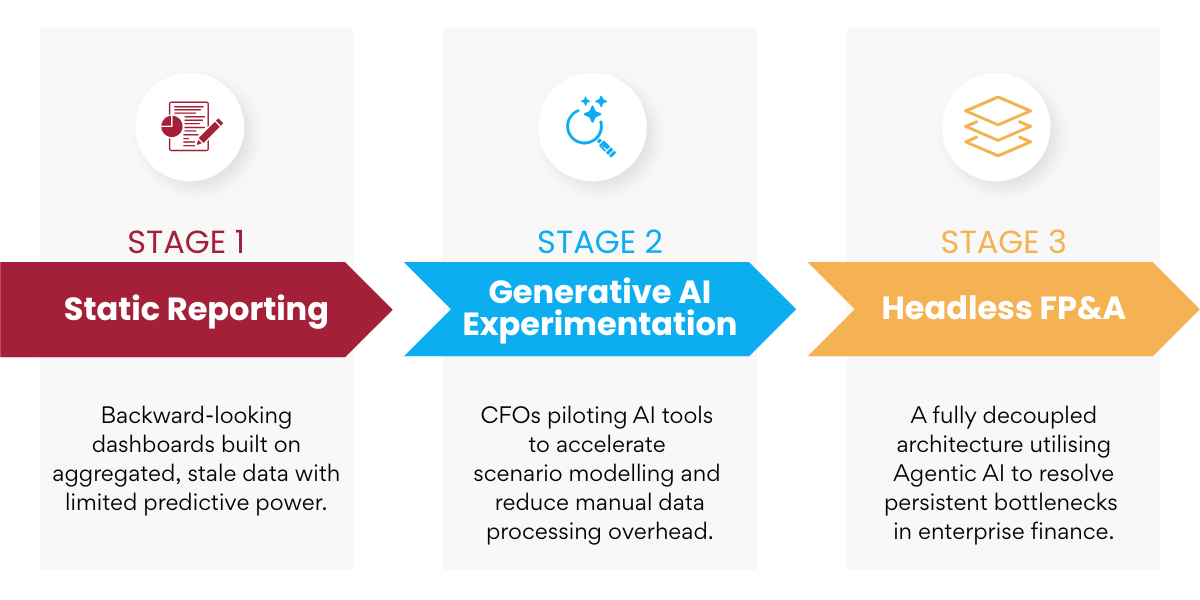
Figure 1. The Three Stages of FP&A Maturity
The term "Headless FP&A" refers to an architecture in which the budgeting and forecasting engine is fully decoupled from the user interface, enabling AI agents to operate directly on raw, granular data without the constraints of legacy EPM systems. The contrast with traditional EPM architecture is stark:
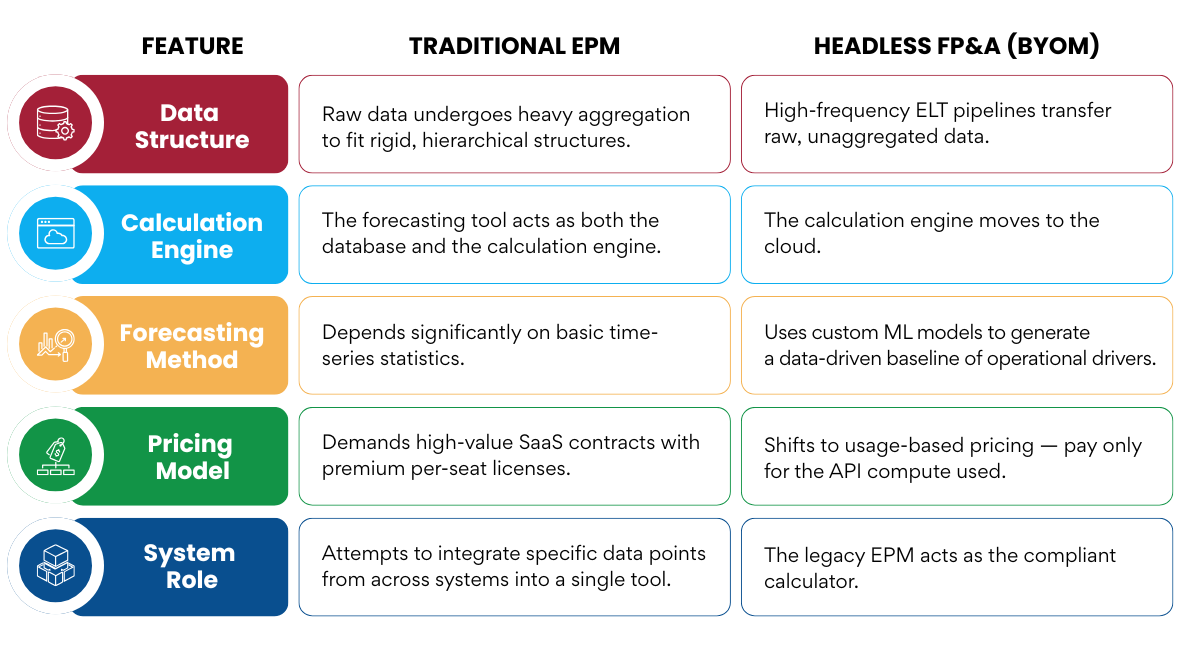
Figure 2. Comparing Traditional EPM and Headless FP&A Architecture
The Decoupled Architecture
True predictive capability requires a fundamental architectural shift: the budgeting and forecasting engine must be separated from the user interface. This unlocks the full power of AI on raw, unaggregated enterprise data.
In this model, raw, unaggregated data from across the entire tech stack is piped via high-frequency Extract, Load, Transform (ELT) pipelines into a centralised cloud data warehouse. A single custom AI engine is applied directly to this raw data — outside the EPM entirely. The legacy EPM is then utilised strictly as a compliant calculator, receiving AI-generated drivers via API and processing them through auditor-approved formulas to calculate the final General Ledger impact.
The five components of this architecture work in concert:
Centralised Ingestion: Raw, unaggregated data from across the tech stack (CRM, ERP, HCM) is piped via high-frequency ELT pipelines into a centralised cloud data warehouse — preserving every granular signal.
Custom AI Engine: Instead of deploying disjointed, individual AI agents that work in silos, a single custom AI engine is applied directly to this raw data outside the EPM, generating a highly accurate, data-driven baseline of operational drivers — predicted pipeline conversion rates, historical attrition, and more.
Agentic Intent Capture (The Conversational Feed): The Conversational AI conducts natural-language interviews with business leaders to capture "Zero-Data" strategic pivots — future intentions with no historical precedent. The AI structures these into formatted operational drivers, for example: delaying three engineering hires to July.
Data Transfer to EPM (API Push): Following human review and approval, the AI pushes consolidated operational drivers via API into the legacy EPM.
The Compliant Calculator (EPM): The legacy EPM receives these drivers and processes them through auditor-approved formulas to calculate the final General Ledger impact.
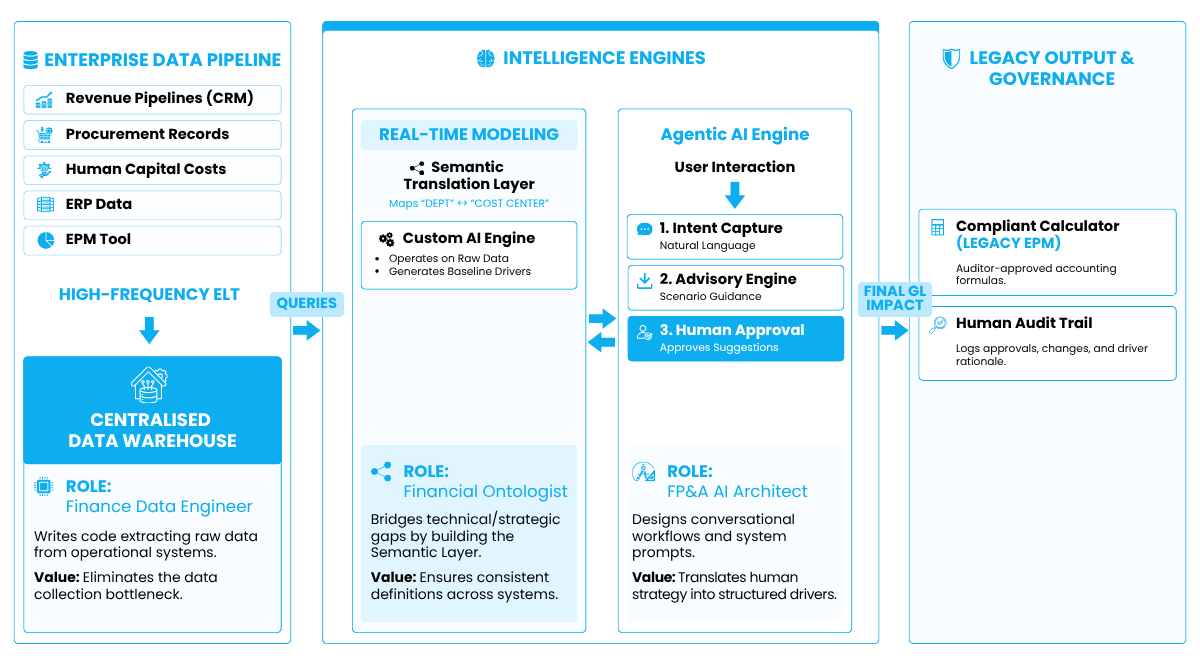
Figure 3. Headless FP&A Architecture
As shown in Figure 3, the Headless FP&A model separates three critical layers: data ingestion, AI-driven driver creation, and final financial calculation within the EPM system. This decoupling allows AI to operate directly on raw, unaggregated data while preserving governance, auditability, and control within the finance function. The legacy EPM is not replaced — it is reassigned to the role it performs best.
ELT Pipelines
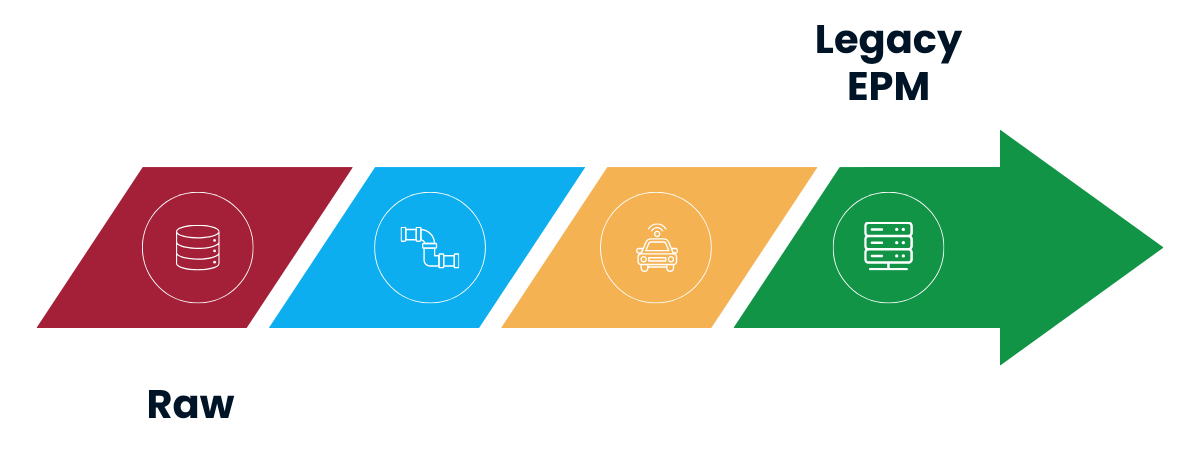
Figure 4. The ELT Pipeline
The ELT pipeline, illustrated in Figure 4, serves as the foundation for the entire architecture. Unlike traditional ETL processes that transform data before loading, thereby introducing aggregation loss, the ELT approach transfers data in its raw state first, preserving every signal that AI models need to build accurate, multi-variable forecasts.
The three components that power this layer are:
Cloud Data Warehouse: Centralised, raw, unaggregated data from every system in the enterprise tech stack.
Custom AI Engine: A single, unified AI model applied directly to granular data — no siloed agents, no aggregation loss.
Legacy EPM as Calculator: The EPM receives AI-generated drivers via API and applies auditor-approved formulas for GL compliance.
The Semantic Layer and Data Alignment
Modern financial planning relies on enterprise-wide data, but disparate business systems frequently utilise conflicting terminology. Resolving this discrepancy is a prerequisite for trustworthy AI-generated forecasts. Different systems across the enterprise use different labels for the same underlying concept:

Figure 5. Aligning Data Terminology Across Enterprise Systems
Four different labels. One underlying concept. Without alignment, AI models produce inconsistent, unreliable outputs that no auditor or business leader can trust.
To resolve this, organisations must establish a central data translator, the Semantic Translation Layer, which maps every conflicting term across all systems to a single, canonical definition. This ensures that data flowing into the AI engine is perfectly aligned before any model is applied. Standardising data upfront ensures the AI delivers correct, board-ready numbers for every business leader, regardless of which source system the data originated from.
A Practical Example: Capturing the Data Signal
Consider how this architecture applies in a real planning scenario — and how the AI moves beyond passive reporting to actively challenge assumptions in real time.
A product leader plans a 5% legacy price increase and submits it to the planning workflow as a budget driver. In a traditional EPM, this assumption is accepted at face value, entered into a template, and rolled up into the plan. The AI engine in a Headless FP&A architecture responds very differently — working through four steps:
Product Leader Submits Assumption: A product leader plans a 5% legacy price increase and submits it to the planning workflow as a budget driver.
AI Queries Historical Billing Data: The AI engine instantly queries granular historical billing records stored in the cloud data warehouse — data that would have been destroyed by aggregation in a legacy EPM.
AI Surfaces a Behavioural Pattern: The model identifies that a 5% price increase has historically triggered a 2% churn spike — a signal invisible to traditional forecasting tools.
Conversational Challenge and Scenario Modelling: Rather than silently accepting the assumption, the AI proactively challenges it:
"Historically, a 5% price increase triggers a 2% churn spike. Should I model a 2% volume offset for safety?"
This conversational challenge presents the business leader with a more conservative, risk-adjusted forecast scenario before the assumption is locked into the plan. The leader reviews the AI's recommendation, approves or adjusts it, and only then does the driver flow through the API into the EPM for final calculation.
This is the critical distinction between AI as a passive analytical tool and AI as an active planning partner. The architecture does not just accelerate reporting — it improves the quality of decisions made before the numbers are ever committed.
Looking Ahead
This transition toward a decoupled, highly responsive architecture paves the way for solving one of the most stubborn challenges in annual planning. The architectural foundations described in this article — decoupled data ingestion, custom AI engines, the Semantic Translation Layer, and the compliant EPM calculator — are the prerequisites for everything that follows.
Every year, finance teams face a problem that no amount of historical data can fully resolve: when a company launches a new product, enters a new market, or restructures its workforce, next year's drivers do not yet exist in any database. They live exclusively in the minds of department leaders. This is the Zero-Data Problem.
In Part 2, we will explore how Agentic AI conducts structured, conversational interviews with business leaders to capture these strategic intentions, how the AI translates human language into structured financial drivers, and how the architecture handles the multi-variable complexity of real enterprise cost control — with the governance, explainability, and human oversight that auditors and CFOs require.
"AI's highest value in finance is no longer just automated math — it is the seamless, secure, and explainable translation of business strategy into structured financial reality."
References
- Deloitte CFO Signals™ Survey, Q3 2023: https://deloitte.wsj.com/cio/what-does-generative-ai-ready-look-like-for-finance-93a5b7da
- Association for Financial Professionals (AFP): https://www.financialprofessionals.org/training-resources/resources/articles/Details/five-practices-of-highly-effective-fp-a-teams
- Gartner (2024), Finance AI Survey: https://www.gartner.com/en/newsroom/press-releases/2024-06-27-gartner-survey-shows-66-of-finance-leaders-think-generative-ai-will-have-most-immediate-impact-on-explaining-forecast-and-budget-variances1
- McKinsey Global Institute: https://www.mckinsey.com/~/media/mckinsey/featured%20insights/digital%20disruption/harnessing%20automation%20for%20a%20future%20that%20works/mgi-a-future-that-works-full-report-updated.pdf
The full text is available for registered users. Please register to view the rest of the article.
Related articles

Headless FP&A shows how AI, governed data architecture, and human oversight can turn business intent into...

In this article, the author explains why agentic AI adoption in FP&A depends less on technology...

This article outlines how an organisation could create a data-driven planning architecture and practical steps to...

In this article, discover how Agentic AI is revolutionising FP&A by automating forecasting, budgeting, and variance...

In this article, discover how Agentic AI is revolutionising FP&A business partnering by automating routine tasks...
+
Subscribe to
FP&A Trends Digest

We will regularly update you on the latest trends and developments in FP&A. Take the opportunity to have articles written by finance thought leaders delivered directly to your inbox; watch compelling webinars; connect with like-minded professionals; and become a part of our global community.