
How Headless FP&A and Agentic AI are reshaping budgeting through real-time scenario modelling, conversational planning, and...

From Architecture to Action: How Headless FP&A Works in Practice — Part 2 of 2
June 18, 2026

Part 2 of a series exploring how Agentic AI and decoupled architectures are transforming enterprise financial planning.
As discussed in Part 1, legacy EPM architectures no longer suit today’s planning cycles. We introduced the Headless FP&A model — a decoupled architecture where AI works directly with enterprise data. Now, we turn from architecture to execution, exploring how Generative AI captures forward-looking drivers, how multi-variable engines enhance forecasting, and what these require commercially, technically, and organisationally.
1. Generative AI and the "Zero-Data Problem"
The Annual Planning process presents a "Zero-Data Problem". Historical data becomes obsolete the moment a company launches a new product or restructures its workforce. Next year's drivers live exclusively in the minds of department leaders. To extract and digitise these mental drivers, conversational AI interfaces act as the bridge, allowing leaders to naturally articulate their plans. Business leaders now interact with a custom AI interface rather than rigid spreadsheet templates.
For example, if a sales leader projects a 15% volume growth in Q3 while holding the travel budget flat, the AI instantly cross-references the T&E system. It then challenges the assumption:
"Historically, a 10%+ jump in regional sales volume has always required a proportionate 8% increase in travel spend. Should I model an additional $40,000 in the travel budget to support this growth objective?"
2. Moving Beyond the Black Box: Multi-Variable Expense Control
A common misconception is that Machine Learning in FP&A simply looks at historical expenses and draws a trendline into the future. That is not AI; that is basic time-series statistics. Time-series models offer zero strategic help to a department leader trying to manage their costs under a strict new target.
True AI in a Headless FP&A architecture acts as a Multi-Variable Connection Engine, revealing hidden relationships across multiple data systems to optimise expenses.
This concept is illustrated in Figure 1 below, showing how AI connects multiple operational variables to generate actionable cost decisions.
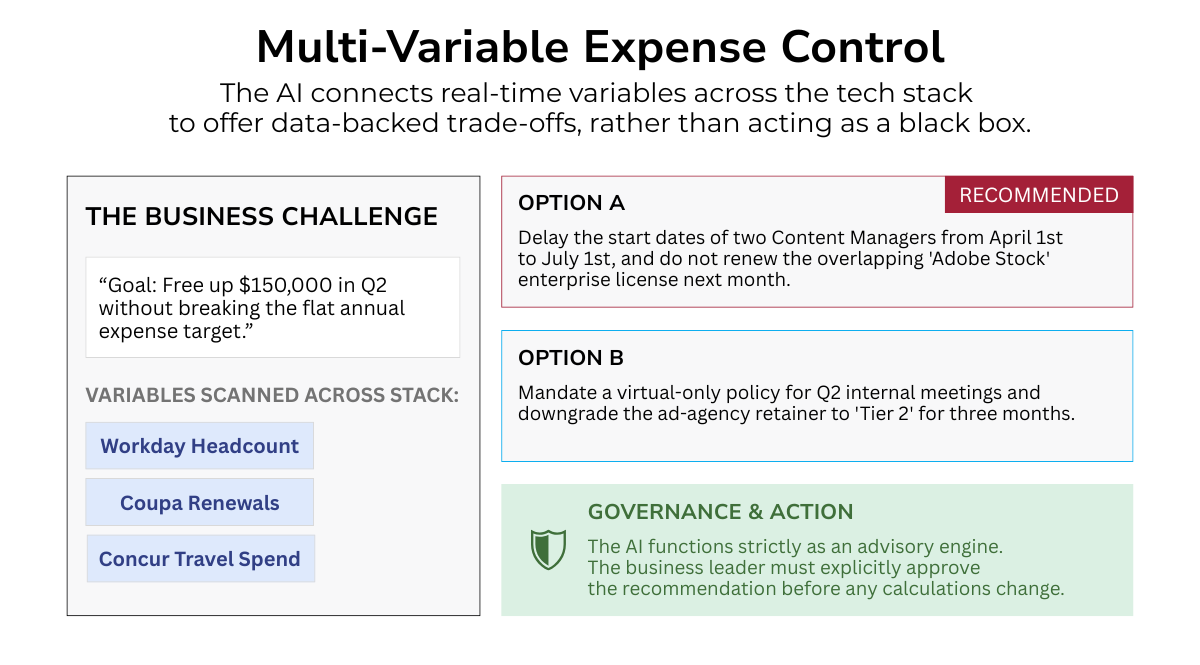
Figure 1
To support this approach, several enabling capabilities are required:
Continuous learning is enabled by a Financial Knowledge Graph, that tracks how changes in one department affect others over time.
Explainable AI (XAI) provides transparency, allowing users to question and understand AI-driven budget decisions. This aligns with Gartner’s [1] findings, which show that 66% of finance leaders expect Generative AI to have the most significant impact on explaining forecast and budget variances.
A dedicated Finance SPOC (Finance Ontologist) oversees the knowledge graph, differentiating true operational causes from mere correlations.
Human oversight is essential to validate AI outputs before they affect live budget negotiations.
3. From Fixed SaaS Costs to Variable AI Value
Legacy finance tools (EPMs) are built on expensive, rigid seat licenses. While standard AI tools are popular, they are "non-deterministic", meaning they can provide inconsistent or "hallucinated" numbers, which creates unacceptable risk during budget negotiations.
The Commercial Challenge: The "SaaS Tax" vs. Better Economics
Legacy EPMs: You pay for a "per-seat" license every month, whether the team uses the tool or not.
The Solution: By plugging foundational AI models into a private, custom framework, costs shift from high annual contracts to variable cloud consumption. You pay only for the processing power used during a task, eliminating high fixed costs per user. This works best for organisations with uneven planning cycles — heavy use during quarterly close and annual planning, lighter use in between. Always-on, high-volume use cases may not see the same savings, so the economics need to be modeled against your actual usage pattern.
The Technical Challenge: Accuracy Risk vs. Reliable Data
Standard AI: General AI tools are too unpredictable for the precision required in FP&A.
The Solution: Custom frameworks force AI to use "Compliant Calculators" — locked, deterministic rules-engines rather than probabilistic language models. This ensures every figure is accurate, repeatable, and backed by a clear audit trail.
4. Security, Compliance, and the Human-in-the-Loop
Security and SOX compliance are paramount in enterprise finance. Auditors are generally unwilling to certify opaque ML models for core financial consolidation. The legacy EPM remains the system of record.
The Human Audit Trail: The AI never alters financial numbers directly based on statistical correlation. It functions strictly as an advisory engine. The business leader must review and approve the suggestion before any driver is pushed to the EPM. This human approval mechanism creates the audit trail. A time-stamped text log proves a human leader explicitly reviewed and approved the AI's operational suggestion before it impacted the General Ledger.
Row-Level Access and Continuous Synchronization: The AI must enforce strict Row-Level Security (RLS). It seamlessly adopts the strict security permissions of the active user to prevent cross-departmental data leaks. When central administrators update global assumptions, the AI immediately recalculates the localised departmental impact and alerts the specific budget owner.
5. The New Talent Equation
Deploying a new FP&A architecture requires embedding new, highly technical resource profiles directly within the CFO's organisation. The evolving FP&A talent model is illustrated in Figure 2 below, highlighting the new roles required to support a Headless FP&A architecture.
In practice, this means expanding the traditional FP&A team with new capabilities:
The Finance Data Engineer writes code to extract raw data from operational systems, ensuring access to clean, real-time data.
The Financial Ontologist aligns business definitions across systems to maintain consistency and acts as a gatekeeper.
The FP&A AI Architect bridges finance and technology by designing conversational workflows and determining how business inputs are translated into structured financial drivers.
Together, these roles enable FP&A teams to move from data consolidation to insight generation.
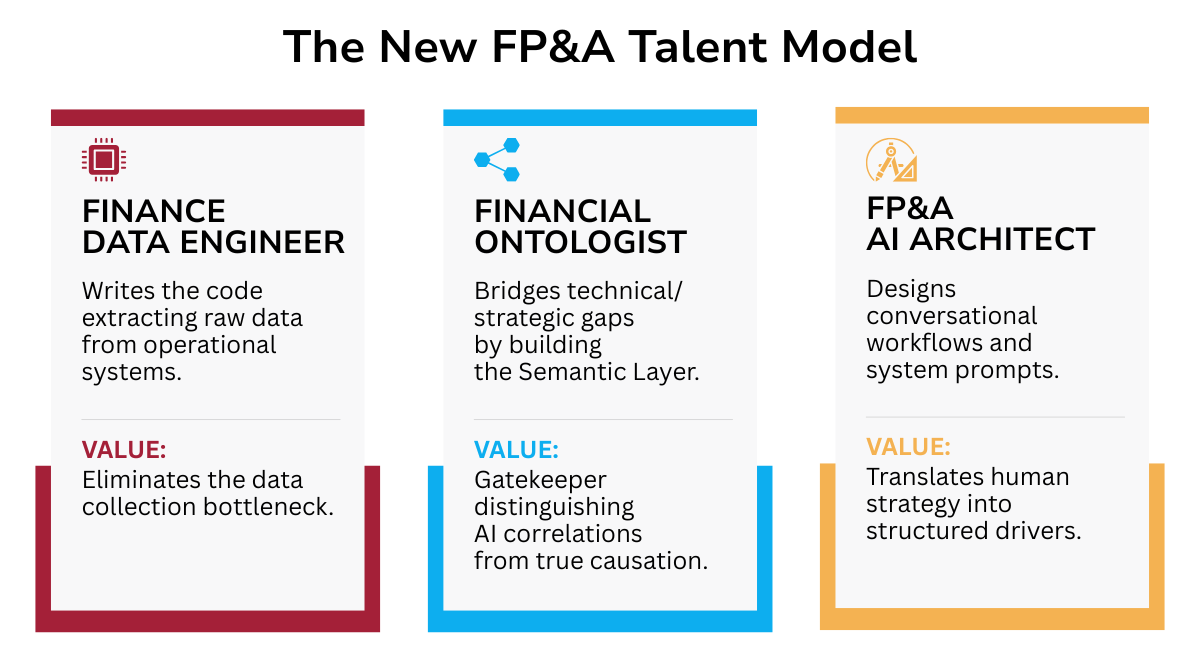
Figure 2
6. Implementation Roadmap
Building this ecosystem is a 9-to-12-month* enterprise integration project structured into distinct, agile phases.
Establish a single automated cloud data warehouse powered by high-frequency ELT pipelines. The Finance Data Engineer automates raw data extraction; the Financial Ontologist begins building the Semantic Layer business dictionary.
Deploy custom predictive models to establish historical baselines and map cross-functional trade-offs via dependency trees. The Financial Ontologist acts as gatekeeper, ensuring the system understands true operational causation — not random correlations.
Connect organised data to a conversational LLM API so business leaders can capture intent and test scenarios. The FP&A AI Architect designs conversational workflows and system prompts to translate human strategy into structured operational drivers.
Build secure API pushes connecting the AI ecosystem back into the legacy EPM. The technical finance team finalises Role-Based Access Control and mandatory human audit trails, ensuring the legacy EPM remains the final compliant calculator.
*Timeline suited for mid-sized enterprises with reasonably mature data infrastructure. Larger or more fragmented organisations should plan for longer, with the first production use case live in that window and the broader rollout phased after.
Conclusion
The future of FP&A is about architectural decoupling that elevates foundational financial systems. AI should not replace the EPM, but sit around it as an intelligent, governed planning layer that strengthens forecasting, business input, and decision support. By deploying centralised Agentic AI across the enterprise data ecosystem, finance teams can reduce data collection bottlenecks, avoid redundant model training, and improve the foundations of forecast quality. According to the 2025 FP&A Trends Survey, 73% of organisations using AI/ML rate their forecasts as great or good, compared with 42% of non-users; dynamic or fully driver-based models show a similarly strong relationship with forecast quality [2]. Ultimately, this transition ensures AI's highest value: the seamless, secure, and explainable translation of human business strategy into structured financial reality.
References
- Gartner (2024), Finance AI Survey. Available at: https://www.gartner.com/en/newsroom/press-releases/2024-06-27-gartner-survey-shows-66-of-finance-leaders-think-generative-ai-will-have-most-immediate-impact-on-explaining-forecast-and-budget-variances1
- FP&A Trends Group (2025), FP&A Trends Survey 2025: From Ambition to Execution — How Leading FP&A Teams Turn Insights into Impact. Available at: https://fpa-trends.com/fp-research/fpa-trends-survey-2025-ambition-execution-how-leading-fpa-teams-turn-insights-impact
The full text is available for registered users. Please register to view the rest of the article.
Related articles


Agentic AI may remove Finance from the decision chain. Explore how FP&A can shift from insight...

In this article, the author examines how FP&A teams can implement trustworthy agentic AI by matching...

In this article, the author explains why agentic AI adoption in FP&A depends less on technology...

In this article, discover how Agentic AI is revolutionising FP&A by automating forecasting, budgeting, and variance...

In this article, explore how FP&A teams are using AI-powered forecasting models like Prophet and XGBoost...
+
Subscribe to
FP&A Trends Digest

We will regularly update you on the latest trends and developments in FP&A. Take the opportunity to have articles written by finance thought leaders delivered directly to your inbox; watch compelling webinars; connect with like-minded professionals; and become a part of our global community.