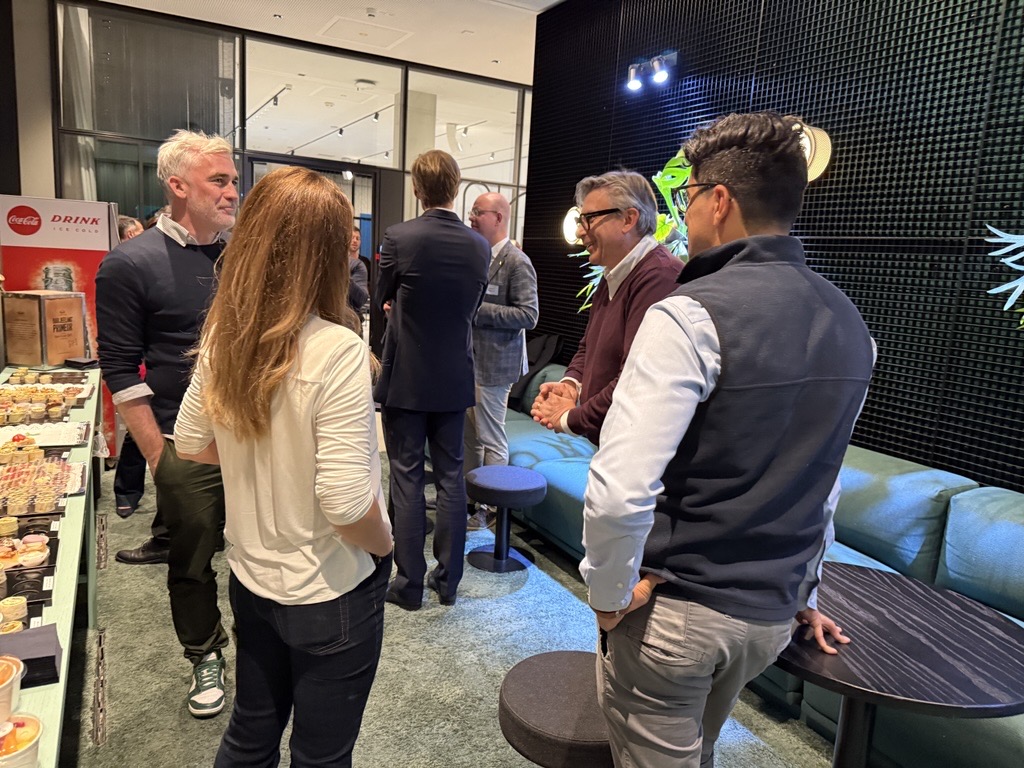

On 22 September 2026, the 7th Munich FP&A Board and the 304th International FP&A Board meeting globally brought finance professionals together to discuss “Leading FP&A Change in the AI Era.”
The meeting was sponsored by SAP and EY and held in partnership with Page Executive.
The fundamental purpose of FP&A remains unchanged: to support better business decisions. However, the environment in which FP&A operates is changing rapidly. Automation, advanced analytics and AI are creating new possibilities, while organisations continue to face familiar challenges around data, processes, skills and adoption.
The meeting combined research, practical transformation experience, emerging AI capabilities and interactive group discussions around one central question: What does it take to make change actually stick?
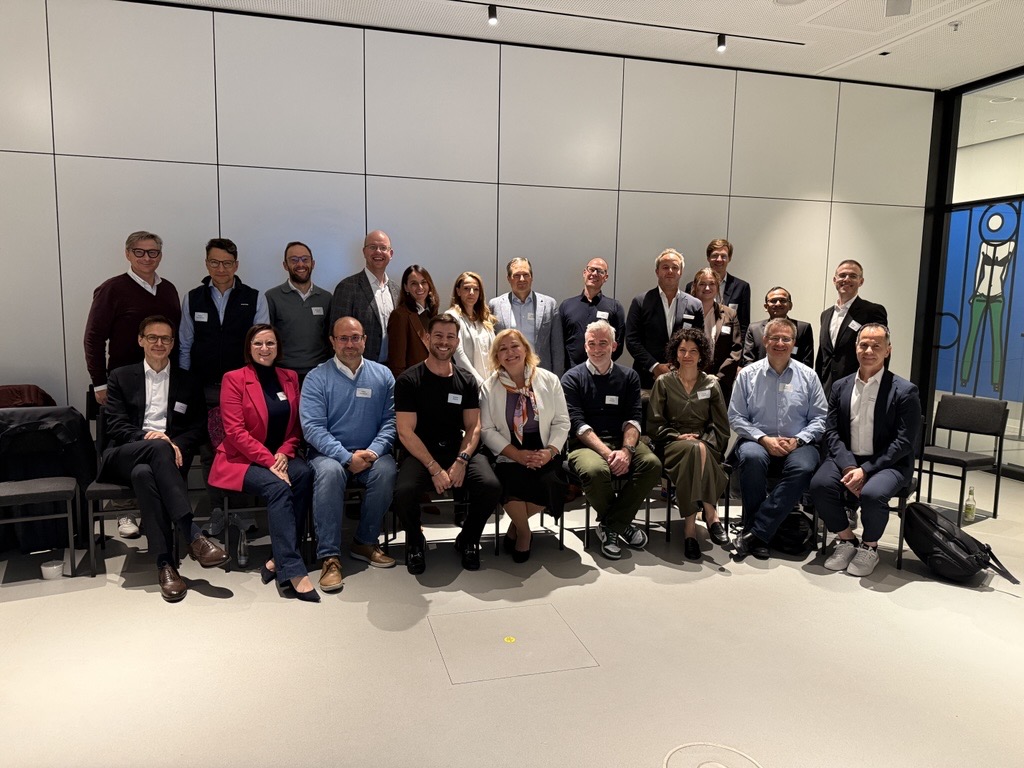
What Stops Change from Sticking?
The evening started with a simple question:
“In one word, what most often stops change from sticking?”
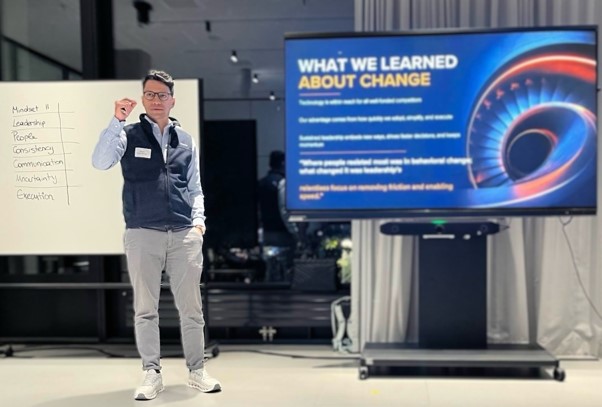
Participants discussed the question in small groups before sharing one word with the Board:
Mindset. Leadership. People. Consistency. Communication. Uncertainty. Execution.
None of them was technology.
This set the direction for much of the discussion that followed. Organisations can implement new systems and introduce AI capabilities, but sustainable transformation depends on whether people understand the purpose of the change, trust the new way of working and are able and willing to adopt it.
The Transformation Paradox
FP&A has changed significantly over the past decades. Scenario planning and rolling forecasts increasingly complement fixed budgets, dedicated planning systems have replaced parts of Excel-based processes, and automation and AI offer new opportunities to reduce manual activities.
Nevertheless, according to the 2026 FP&A Trends Survey, 47% of FP&A time still goes into collecting and validating data, the same proportion as in 2020.
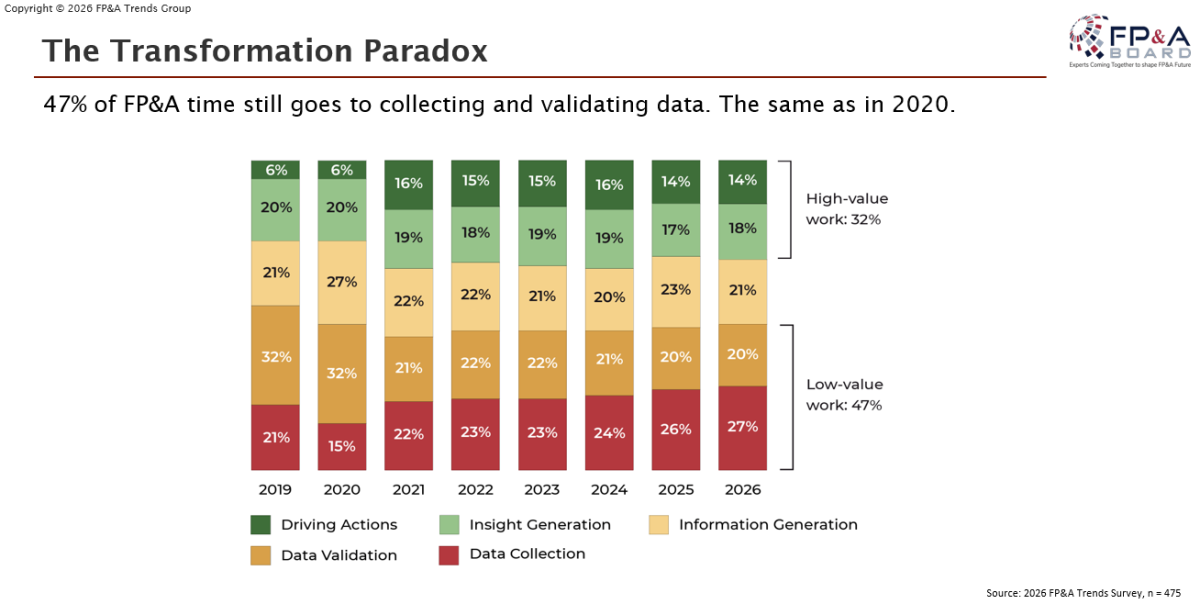
Figure 1
Poor data quality, fragmented processes and manual work continue to consume capacity that could instead be used for analysis and business partnering.
At the same time, transformation is still often approached primarily as a technology initiative. The challenge is that implementation does not automatically mean adoption.
An FP&A Trends webinar poll showed that 62% of identified adoption barriers were people-related: skills gaps accounted for 30%, resistance to change for 23%, and unclear accountability for 9%.
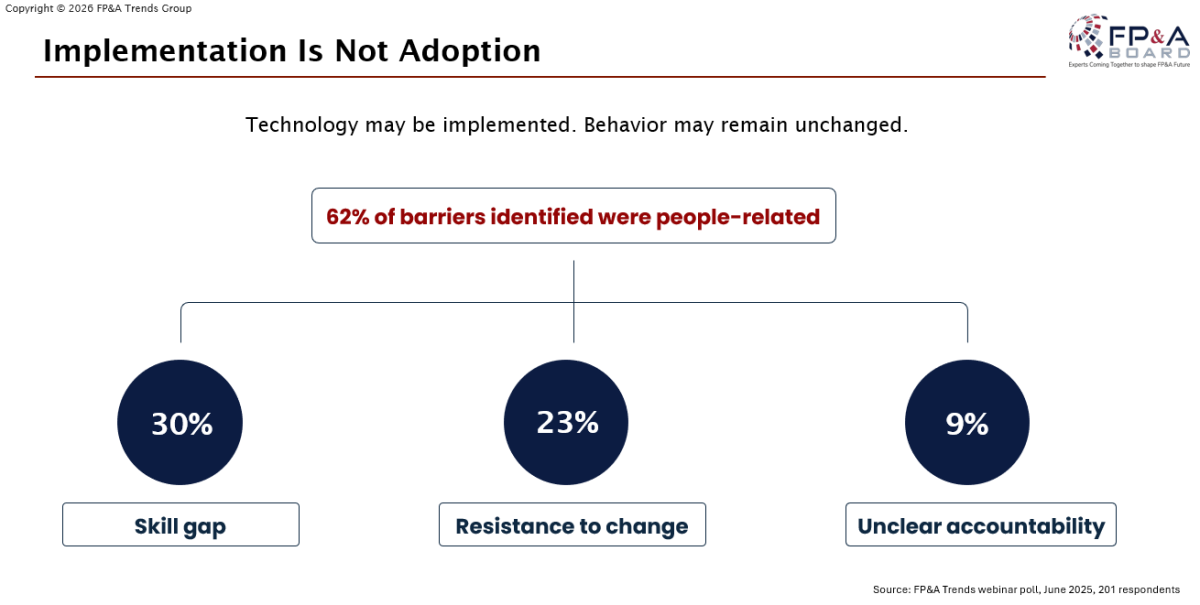
Figure 2
The discussion returned several times to the importance of giving people a clear picture of the future, explaining the milestones and making the benefits of change tangible. Employees also need to understand what the transformation, and increasingly AI, will mean for their own work.
The FP&A Change Leadership Framework
The FP&A Change Leadership Framework provided a structure for discussing why transformations lose momentum.
One of the critical phases is the “dangerous middle”: the point at which initial enthusiasm declines, the new way of working is not yet fully established and employees may start returning to familiar processes and tools.
Research presented during the meeting showed that 96% of transformations experience at least one turning point, 75% of turning points occur during planning or early implementation, and organisations are twelve times more likely to come through stronger when leaders act early and systematically.
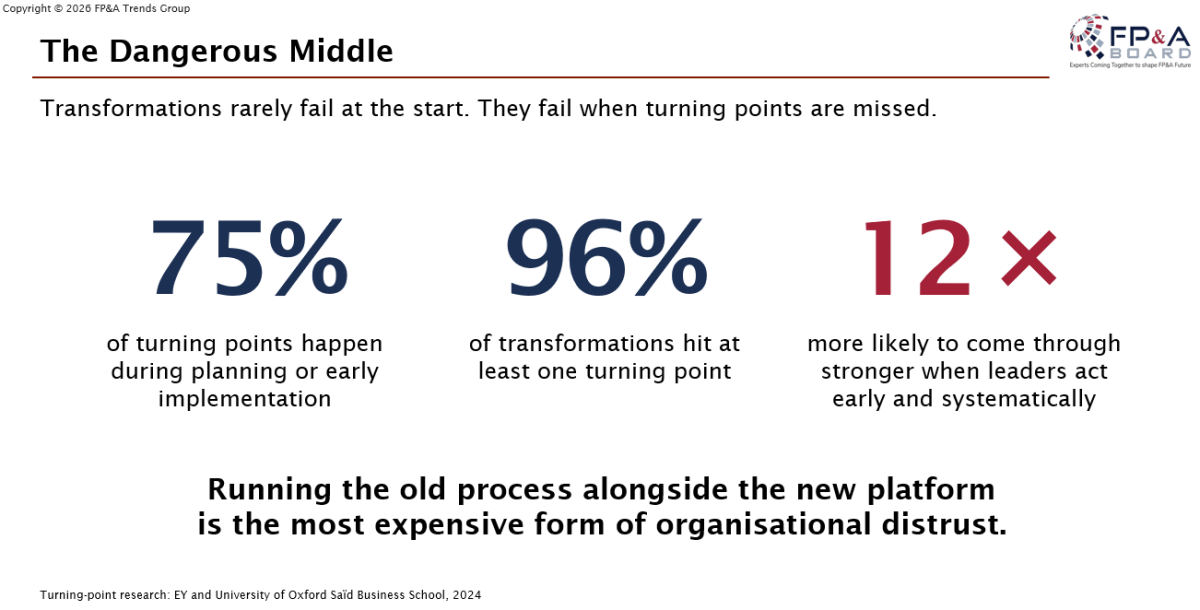
Figure 3
Running the old process alongside the new one is one of the clearest signs of this problem. A new platform may be available, but teams keep maintaining their Excel models. A new reporting process may be in place, while management still asks for the same old presentations.
The discussion also touched on professional identity. For many finance professionals, expertise has long been linked to mastery of particular tools and processes. Moving away from them can involve more than learning a new system. It may also require people to rethink how they create value in their role.
AI Adds New Questions Around Trust and Accountability
AI makes the people dimension of transformation even more important. According to the 2026 FP&A Trends Survey, 98% of respondents expect AI to affect FP&A, while only 19% currently have formal AI policies.
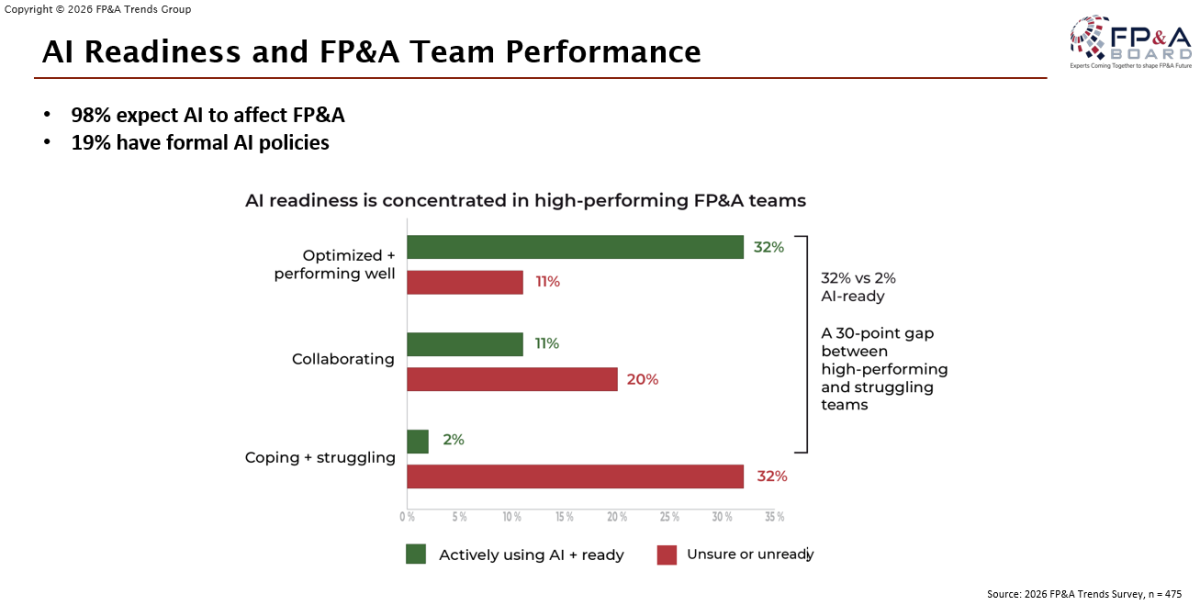
Figure 4
Trust came up repeatedly. Rather than expecting AI to produce perfect results, organisations need to understand the nature and materiality of possible errors, how they can be detected and where human review is still needed.
Accountability is just as important. If an AI-supported process produces a budget or forecast that is later missed, who owns the result?
The discussion was clear on this point: AI can support judgement, but accountability remains with people. Humans still define the objective, determine assumptions, challenge the output and make the final decision. One participant compared AI agents with employees. Both need clear responsibilities and instructions. The quality of the context and task definition directly affects the quality of the result.
This does not make professional expertise less relevant. If anything, experienced FP&A professionals are better placed to ask the right questions, challenge outputs and spot results that do not make business sense.
During the session, Stefano Vega Mazzeo, Regional CFO at Avantor, provided a practical perspective on transformation in a large organisation. He highlighted how faster finance cycles, more frequent forecasting and increasingly integrated systems can support better decision-making, but stressed that the biggest friction is often not the process itself, but people and established ways of working. Technology can be implemented, but adoption depends on behaviour, leadership and the willingness to change long-standing habits. Early wins, clear accountability and visible leadership support are therefore critical to building confidence and making new ways of working stick.
The discussion then moved to how AI is changing FP&A in practice. A demonstration from SAP and EY illustrated how emerging AI capabilities can support planning and analysis through natural-language interaction, scenario simulation and forecasting.
A special thank you to Pascal Prassol and Florian Neuhann-Hess for sharing their perspective on navigating the new normal with autonomous finance and adding a practical technology dimension to the discussion.
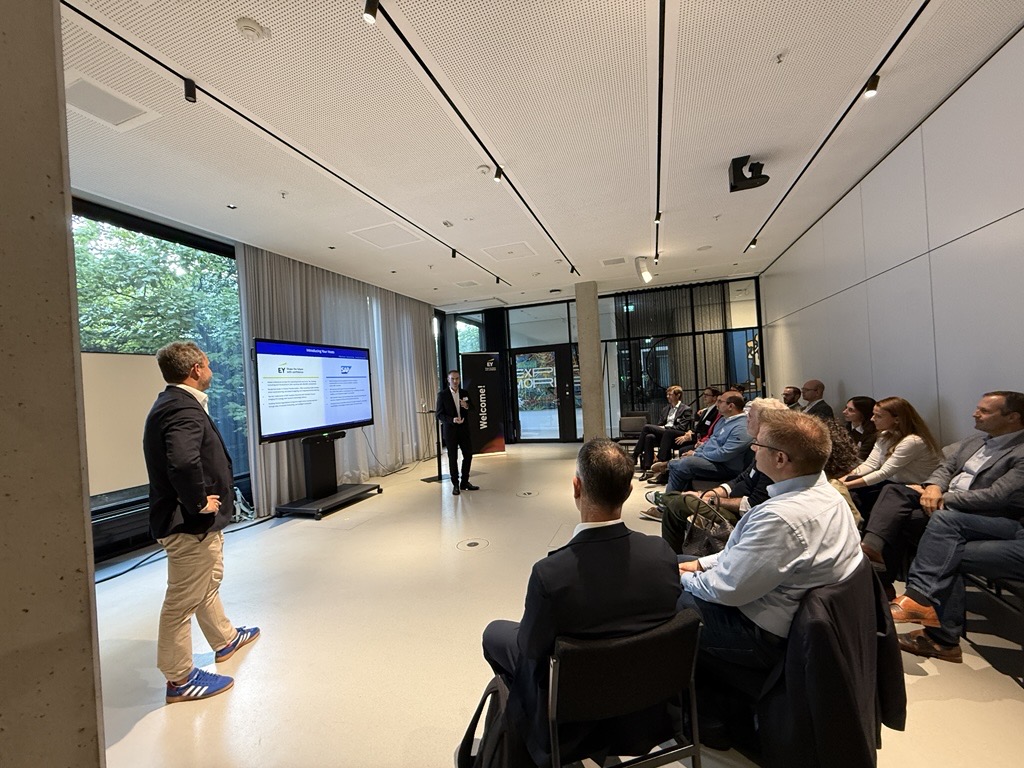
The session reinforced a broader theme of the meeting: value is created when new capabilities improve how FP&A analyses information, challenges assumptions and supports decisions.
From Change Intent to Adoption: Enable, Execute, Reinforce
The final part of the meeting focused on practical actions. Participants worked in three groups around three elements of implementation:
Enable — what needs to be built in people before they can work in the new way.
Execute — what makes people use the new approach rather than fall back into old habits.
Reinforce — how to measure whether adoption has happened and what to do when it starts to slip.
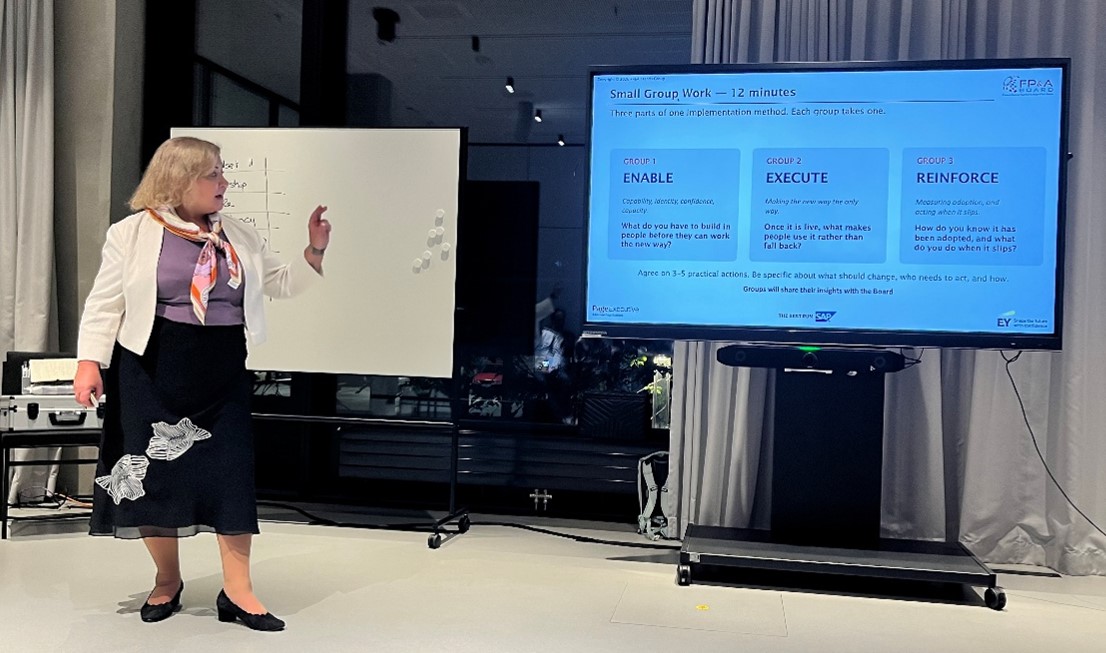
Group 1: Enable
The first group focused on capability, identity, confidence and capacity.
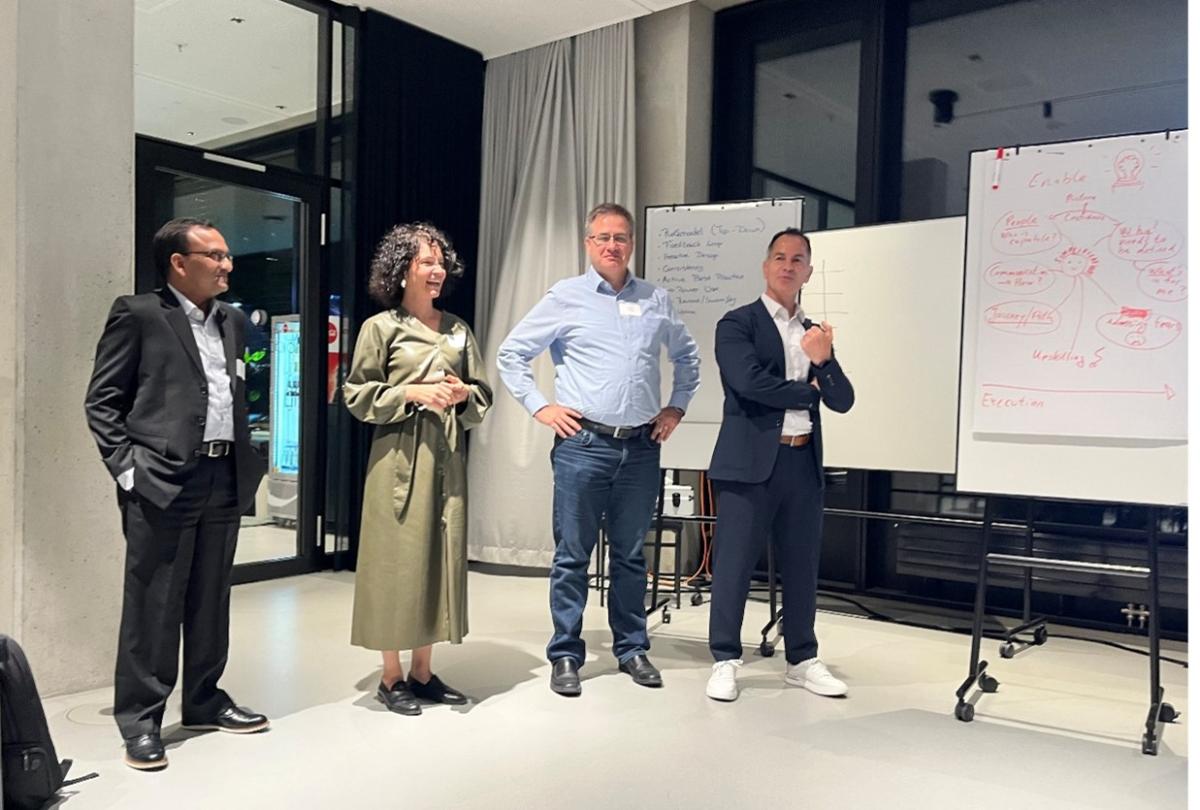
Participants highlighted the importance of explaining the why behind the transformation and answering the individual question: “What‘s in it for me?”
People need a clear picture of the future and an understandable journey towards it. If AI changes an employee's work, the organisation should explain how, address fears and provide opportunities to build the required skills.
The group also stressed that developing AI skills takes time and practice. People need space to learn, including room to make mistakes along the way.
Group 2: Execute
The second group discussed what is needed to make the new way of working the default.
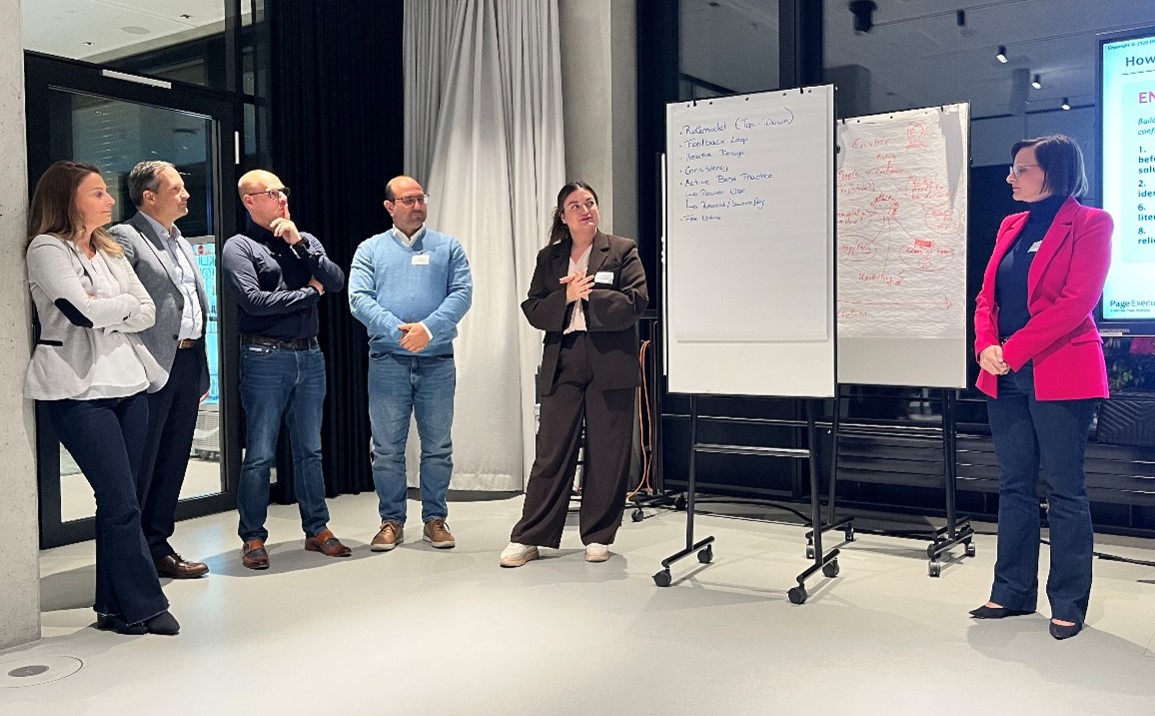
Leadership behaviour was identified as particularly important. One participant shared an example from her organisation. A new CEO stopped a long-established practice of preparing hundreds of PowerPoint slides and instead asked teams to present their results directly from Power BI.
The change saved a significant amount of preparation time. At the same time, it provided a strong example of leadership changing its own behaviour rather than merely asking employees to work differently.
Participants also mentioned the importance of continuous feedback loops, iterative implementation, consistency, power users and visible success stories.
Group 3: Reinforce
The third group focused on how adoption can be made measurable and sustained.
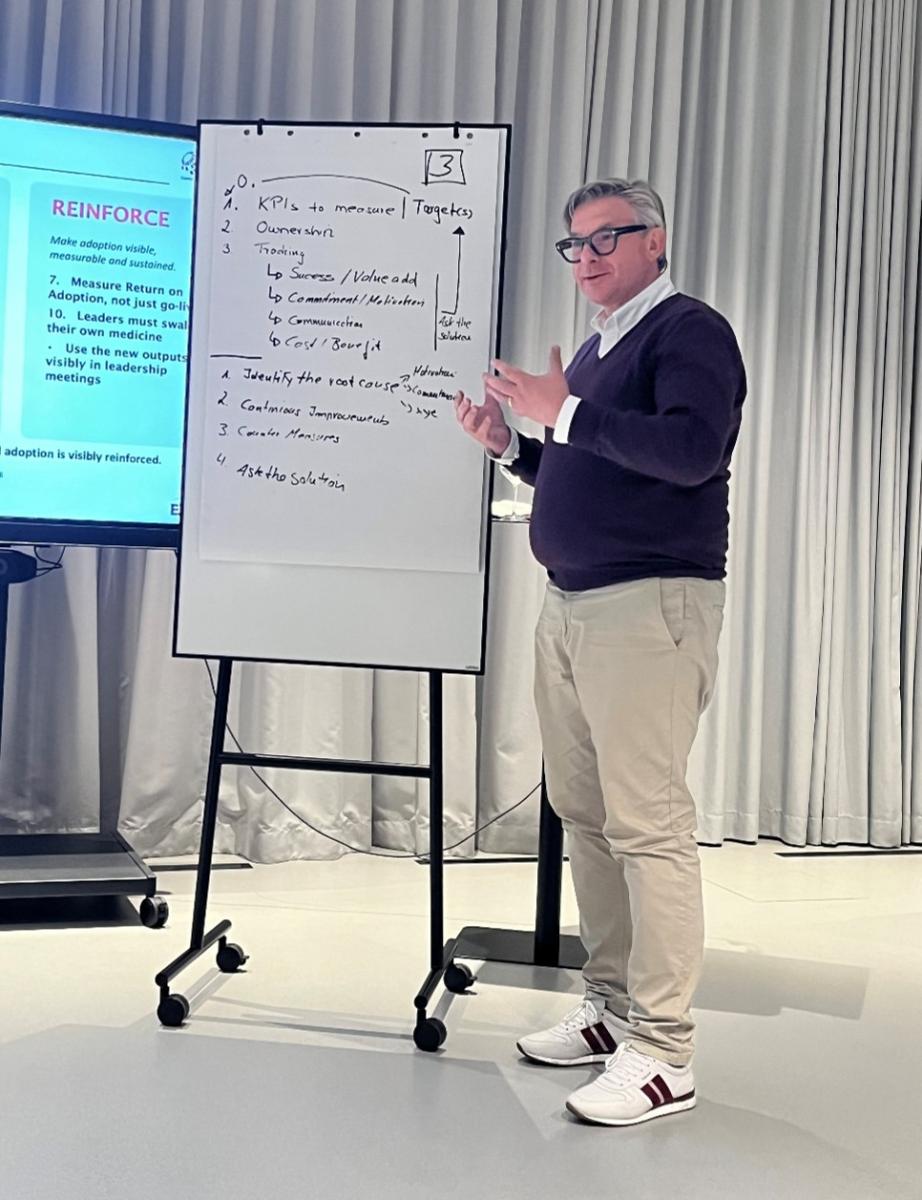
Ownership was one of the central themes. It should exist at every level of the change process. Organisations also need appropriate KPIs and targets to understand whether a new way of working has actually been adopted and whether it is creating the expected value.
When adoption starts to decline, participants stressed the importance of identifying the root cause and applying appropriate countermeasures rather than automatically returning to the old process.
Across the three groups, the same logic emerged: organisations need to build capability and confidence, make the new way of working the normal way of working, and reinforce adoption through leadership, ownership, feedback and measurement.
This closely reflected the FP&A Trends framework: change sticks when people are enabled, the old way is removed and adoption is visibly reinforced.
Tools-Behaviors Gap
Technology can enable automated processes, integrated planning, dynamic scenarios, connected data and faster decision support. Yet organisations may continue to operate through manual validation, local assumptions, static cycles and shadow models.
The value is realised only when new capabilities change the way people plan, collaborate, challenge and make decisions.
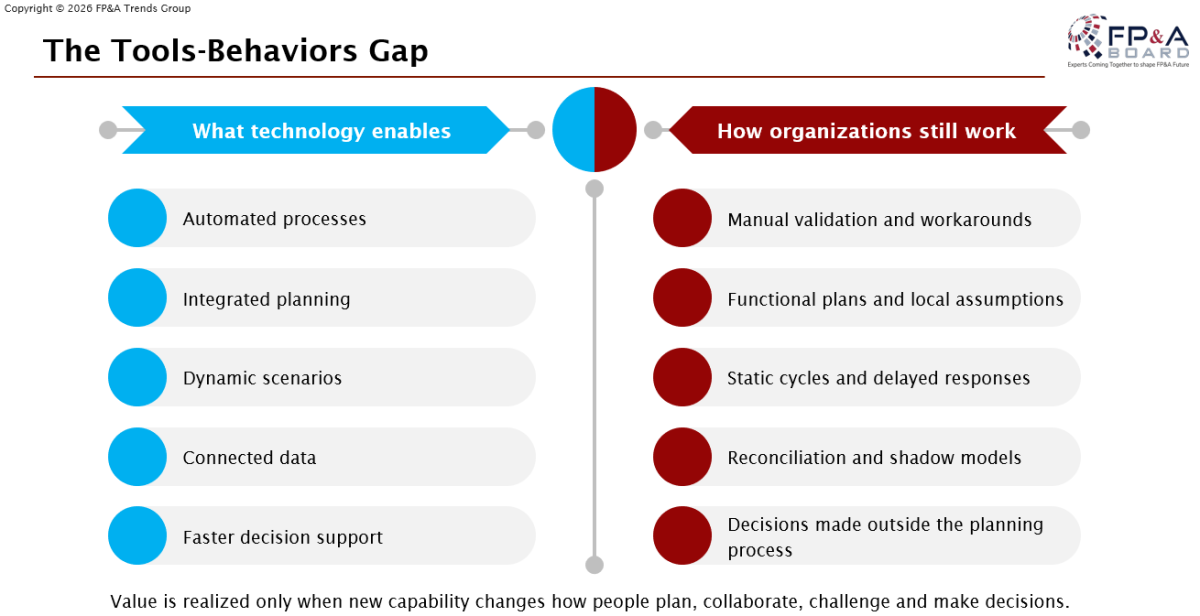
Figure 5
Ownership was one of the central themes. It should exist at every level of the change process.
Organisations also need appropriate KPIs and targets to understand whether a new way of working has actually been adopted and whether it is creating the expected value. When adoption starts to decline, participants stressed the importance of identifying the root cause and applying appropriate countermeasures rather than automatically returning to the old process.
Across the three groups, a common implementation logic emerged: organisations need to build capability and confidence in people, make the new way of working the normal way of working, and reinforce adoption through leadership, ownership, feedback and measurement.
This closely reflected the FP&A Trends framework: change sticks when people are enabled, the old way is removed and adoption is visibly reinforced.
Conclusions and Recommendations
Several practical conclusions emerged from the Munich FP&A Board discussion:
Start with the business problem and the decision to be improved, not with the technology.
Create a clear picture of the future. People need to understand why the change is happening, where the organisation is heading and what it means for their own work.
Invest in capability and capacity. New skills require time to learn and opportunities to practise.
Make leadership behaviour consistent with the transformation. Leaders should visibly use and support the new processes and outputs.
Remove the easy route back to the old way of working. Parallel processes and shadow spreadsheets can significantly slow adoption.
Keep accountability clear. AI can support forecasts, scenarios and recommendations, but people remain responsible for decisions.
Measure adoption, not just implementation. Go-live is not the end of a transformation; feedback, measurement and continuous improvement are needed to make the change sustainable.
Munich was the first stop for this FP&A Board theme. The discussion will continue across other FP&A Board locations, bringing additional experiences and perspectives into the conversation.
The message from Munich was clear: technology can enable transformation, but sustainable change depends on whether people understand it, adopt it and make the new way of working part of how decisions are made.