

Can Artificial Intelligence transform FP&A if the underlying foundations remain fragile? This was the central question explored during the FP&A Trends webinar “2026 FP&A Trends Survey: Where AI Meets FP&A Reality”. Based on the 10th annual FP&A Trends Survey, with 475 respondents in 2026 and 3,361 participants since 2017, the discussion revealed a profession standing at an important crossroads.
The appetite for AI is high, but the readiness gap is equally visible. FP&A teams are expected to support faster, better and more forward-looking decisions, yet many remain constrained by data issues, disconnected planning processes and manual work. This article explores the key survey findings, the practical implications for AI adoption, and what FP&A leaders should do now to move from interest to impact.
AI Readiness Starts with FP&A Maturity
Michael Coveney, Analytics Thought Leader and Author, Head of Research, FP&A Trends Group, presented the core findings of the 2026 FP&A Trends Survey and placed them in the context of FP&A’s broader evolution. His central message was: AI will not compensate for weak FP&A maturity. Instead, it will expose where the function is ready to scale and where it is still held back by structural constraints.
The survey shows that FP&A performance has barely changed over the past five years. Only 22% of respondents describe their teams as optimised or performing well, while 32% say they are struggling. At the same time, only 41% see FP&A as fully embedded or acting as a trusted business partner, despite business partnering remaining the most important hiring skill, cited by 48% of respondents.
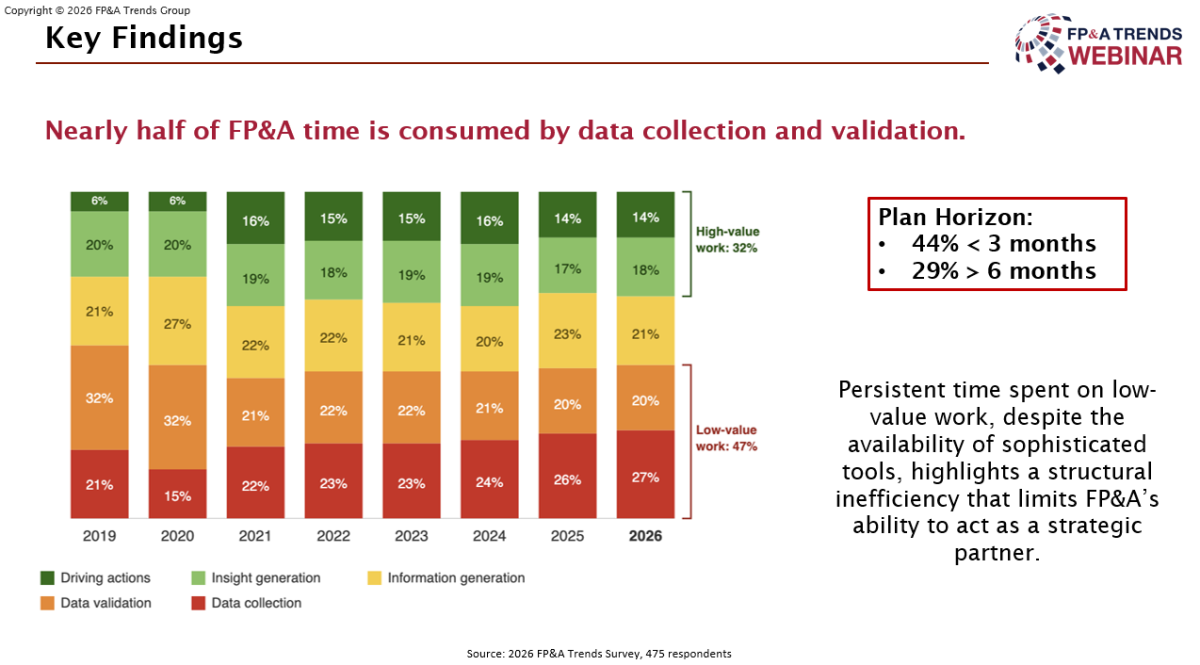
Figure 1
A major reason for this gap is the way FP&A still spends its time. Nearly half of the function’s effort, 47%, is consumed by data collection and validation, while only 32% is dedicated to insight generation and driving action. This is particularly problematic in an environment where the planning horizon is shortening: 44% of teams can see less than three months ahead with confidence, while only 29% can see more than six months ahead.
Michael identified three barriers that account for most planning and forecasting challenges: data, processes and systems. Processes were the largest issue at 43%, followed by data at 37%, systems at 16%, and other factors at 4%. This finding is important because it suggests that technology alone is not the primary constraint. The deeper issue is whether organisations have the data quality, process discipline and integrated planning architecture required to support faster decision-making.
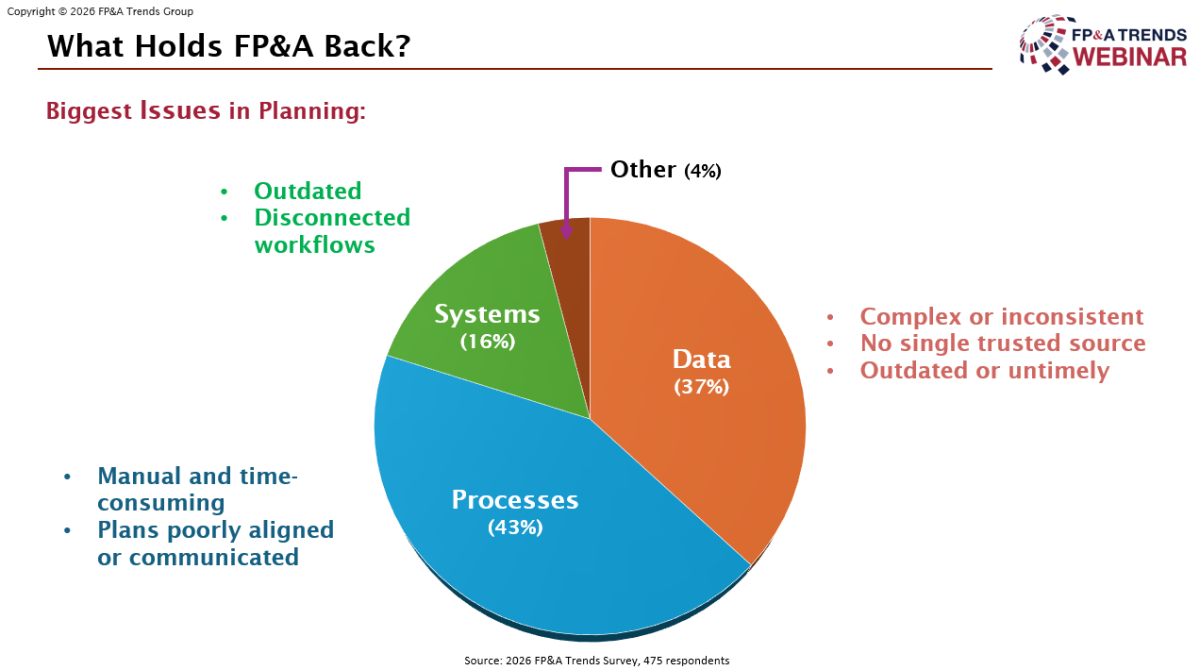
Figure 2
The survey findings on data were particularly revealing. Although 81% of respondents say data is central to all or most decisions, only 19% rate their data quality as advanced. Low or poor data quality has improved over time, falling from 40% in 2021 to 22% in 2026, but the top end has not progressed at the same pace. Timeliness is also an issue: only 11% of organisations have real-time access to data, while a large proportion still rely on monthly data cycles.
The impact of high-quality data is striking. Among organisations with strong data quality, 53% rate FP&A as optimised or performing well, compared with only 2% among those with low-quality data. They also spend significantly more time on insight generation and decision support. In other words, data quality is not an operational hygiene factor; it is a direct driver of FP&A effectiveness.
Process maturity shows a similar pattern. Only 10% of organisations fully integrate strategic, financial and operational planning, and fewer than half integrate the P&L, balance sheet and cash flow. Driver-based modelling is progressing, with 19% now using mature models that automatically identify and apply drivers. However, 40% still rely on basic or non-driver-based approaches, limiting their ability to connect forecasts and scenarios to the levers that actually shape business performance.
The system's picture reinforces the same point. Spreadsheets remain the dominant planning tool, modern cloud-based planning platforms are used by only 19% of respondents, and nearly half of organisations have not upgraded their systems in the last three years. This does not mean technology is unimportant. Rather, technology creates value only when the surrounding data, process and planning foundations are strong enough to support it.
Poll Results
The first audience poll asked participants where they see the strongest potential value from AI in FP&A. The leading answer was simulation of scenarios, selected by 29% of respondents, followed closely by better insight into drivers at 27%. Automated reporting and commentary attracted 21%, better forecasts 19%, and only 4% said they did not plan to use AI.
These results suggest that FP&A professionals increasingly see AI as more than a reporting efficiency tool. While automated commentary remains a practical and relatively safe entry point, the audience placed greater emphasis on higher-value activities: understanding business drivers and testing scenarios. This aligns with the wider shift from retrospective reporting towards decision support and business steering.
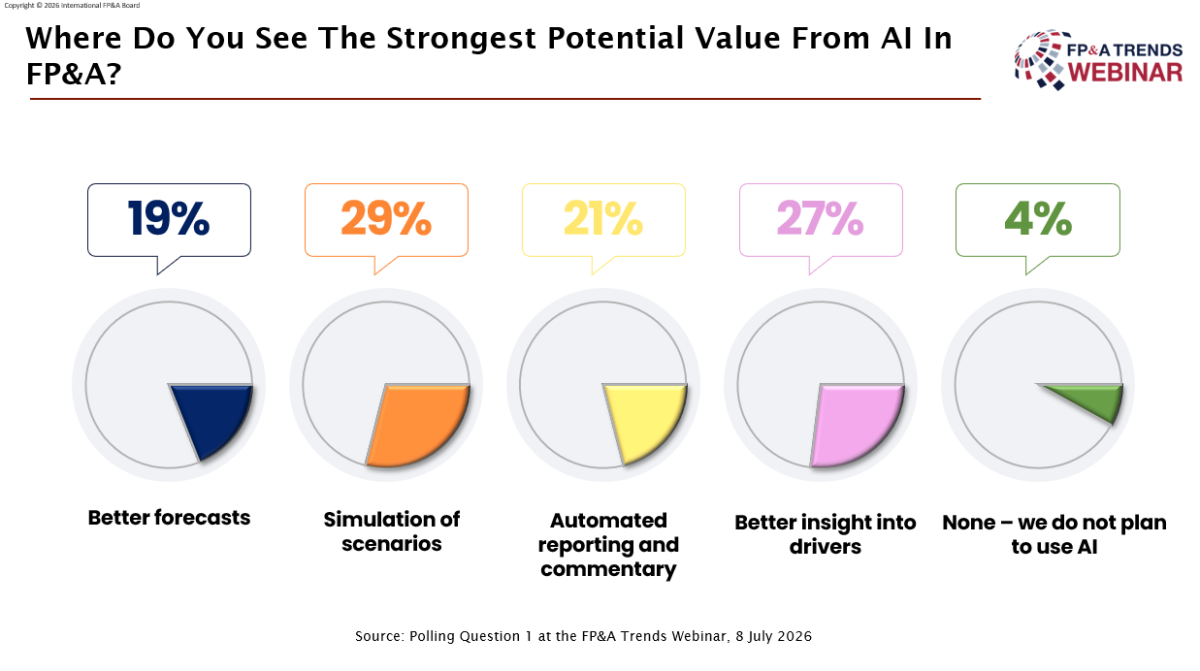
Figure 3
Technology in Practice: Do Not Bolt AI onto a Weak Foundation
Pras Chatterjee, Global Product Marketing Director, OneStream Software, translated the survey findings into a practical technology perspective. He argued that finance is “betting more on a weaker foundation”: relying more heavily on data, planning and technology while the underlying structures are not always becoming stronger.
Pras highlighted one of the main contradictions in this year’s survey. Data dependence is at an all-time high: 81% of teams use data in most decisions, yet only 19% describe their data quality as advanced. Meanwhile, 47% of FP&A time is still absorbed by collecting and validating data. For highly skilled finance professionals, this represents a substantial “structural tax” on the function’s capacity.
His warning was that AI cannot fix this problem on its own. Teams using AI already outperform non-users across several measures: forecast quality, team performance and data-driven decisions. But, according to Pras, they are not winning because they added AI to a broken process. They are winning because they already had stronger data and connected planning, allowing AI to compound an existing advantage.
The recommended sequence was therefore deliberate: first unify the data, then connect planning, and only then embed AI and agents into the workflow. A fragmented landscape of point solutions, interfaces and duplicate data movements merely adds weight to the cracks. By contrast, a unified platform gives AI a trusted environment in which it can reason across finance and operations.
Pras illustrated this with a large privately held US enterprise using AI agents within a governed finance environment. Three use cases showed clear productivity gains: an ad hoc finance report fell from 10 minutes to one minute, a finance documentation search fell from eight minutes to 30 seconds, and large document analysis reduced processing time by between 67% and 98%. The lesson was not that agents are a starting point, but that they deliver value when deployed on a trusted foundation.
Poll Results
The second poll asked which AI readiness area is currently weakest in participants’ FP&A functions. Process design was the clear leader at 40%, followed by data quality at 30%, people and skills at 17%, and technology platform at 13%. This is a telling result. It indicates that many teams recognise that AI readiness is not primarily about buying another tool; it is about redesigning how work gets done.
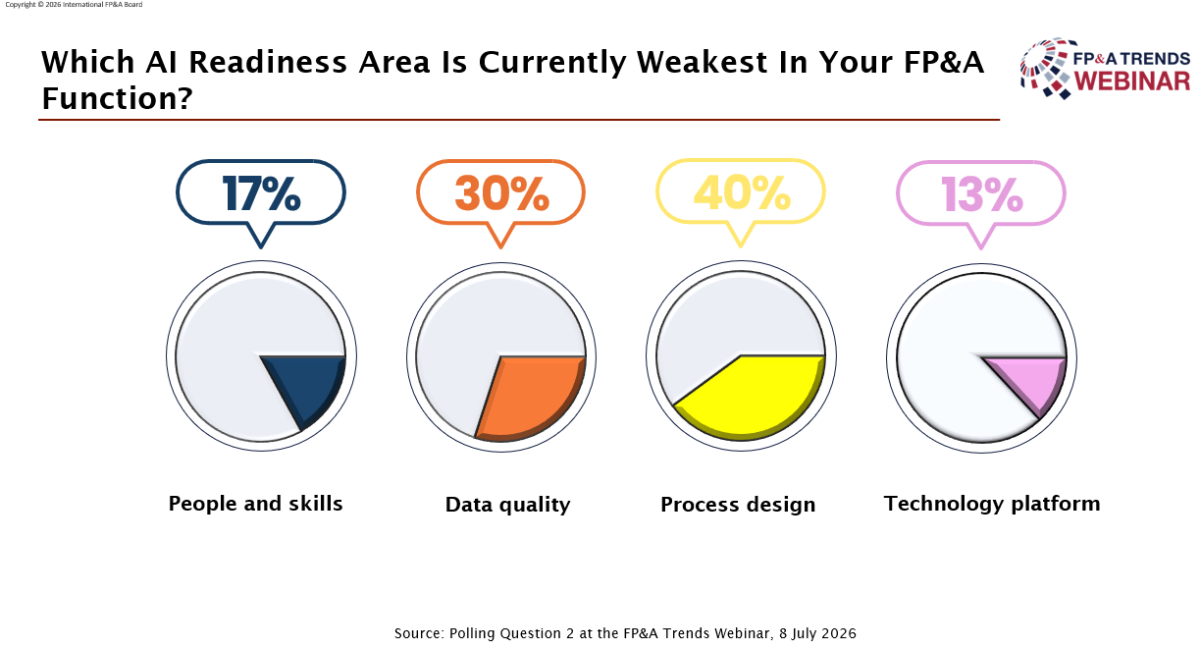
Figure 4
Conclusion
A key trend highlighted in the webinar was the expected rise of AI agents. The survey found that 98% of respondents believe AI will impact their role over the next few years, while 15% expect to use AI agents within the next six months and 51% expect to use them at some point in the future. This indicates that the question is moving from whether AI will matter to how it should be governed and applied.
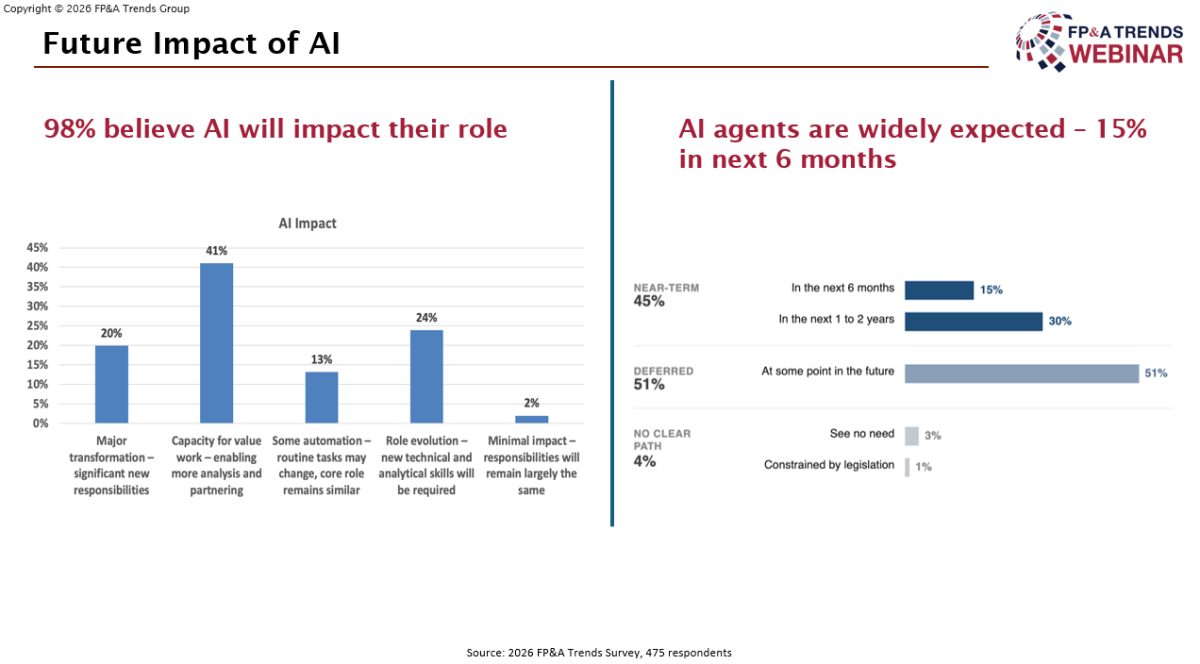
Figure 5
The 2026 FP&A Trends Survey points to a clear conclusion: AI readiness is, in reality, FP&A readiness. The teams best positioned to benefit from AI are not necessarily those experimenting with the newest tools, but those that have built trusted data, integrated planning, strong driver-based models and credible business partnerships.
For FP&A leaders, the priority is to avoid the temptation of starting with technology. Instead, they should use AI as a catalyst to fix what has long needed attention: data ownership, process design, planning integration and the role of FP&A as a trusted decision partner. AI can create speed, scale and capacity, but only finance professionals can provide the judgement, challenge and influence needed to turn insight into better business decisions.
Watch the full webinar recording when available to explore the discussion in more detail and review the complete 2026 FP&A Trends Survey findings. The full survey report is available here: 2026 FP&A Trends Survey Report
Subscribe to
FP&A Trends Digest

We will regularly update you on the latest trends and developments in FP&A. Take the opportunity to have articles written by finance thought leaders delivered directly to your inbox; watch compelling webinars; connect with like-minded professionals; and become a part of our global community.