

This article shows how FP&A leaders can apply a multi-level investment framework to align strategy, risk...

What Applied AI Actually Is: The Scoping Conversation FP&A Should Lead Before Any Vendor Evaluation
September 8, 2026

I hope a CFO would go to their FP&A leader and ask, “What are we doing about AI?” The pressure is cascading from every boardroom. The vendors are pitching. The consultants are pitching. The FP&A function's first job in this conversation is not to recommend a tool. It is to make sure the organisation asks the right question.
This article outlines the scoping conversation FP&A should lead before any vendor evaluation begins. It explains why FP&A — leading the evaluation working in partnership with technology, project management, and external advisers where needed — is the right function to frame the business question, define the scope, challenge assumptions, and protect the organisation from under-specified AI investments.
FP&A has evolved into the brain of Strategic Finance, connecting technology, data, analysis, and business judgment at a speed that earlier finance models could not support. In the AI cycle, this role becomes even more important. Before the organisation compares vendors or approves investment, FP&A should define what Applied AI is expected to do, where it will operate, how the operating model will change, and how value will be measured.
This Is the Latest Wave. Not the First.
Anyone who has been in finance long enough to have lived through an enterprise resource planning (ERP) implementation, a business intelligence rollout, or a robotic process automation program will recognise the pattern of the current AI cycle. A new technology arrives with demonstrably new capabilities. Vendors arrive with packaged offerings. Consultants arrive with frameworks. The board hears about it. Today, CFOs have FP&A functions that are well placed to bring discipline to this conversation. The function is then expected, often with limited time and depth of specialist expertise, to evaluate the technology, the vendor landscape, the business case, and the implementation plan.
Applied AI is the latest wave of this pattern, not the first and not the last. What makes it feel different is the capability of the underlying technology and the speed of the vendor cycle around it. Generative models can produce text, structured data, and analysis at a level that previous waves could not. But the discipline FP&A should apply has not changed. The same fiduciary questions that mattered for ERP investment in 2008 and analytics investment in 2015 matter again now. Applied AI is also a change-management decision with significant financial implications: capital allocation, headcount rightsizing, reskilling, upskilling, and total cost of ownership. In many cases, it also touches core value-generation processes such as procure-to-pay and order-to-cash, with direct implications for working capital, controls, and accountability.
That is why the sequence matters: scoping first, strategy before tooling, total cost of ownership before licensing comparisons, realistic expectations before board approvals, and stage gates before scale.
The Structural Vagueness Most AI Conversations Carry
The recurring problem in the AI conversations FP&A is being pulled into is that the conversations do not specify what the AI is supposed to do. A vendor pitch describes the technology. A consultant pitch describes the framework. A peer-network conversation describes what other organisations are exploring. None of these provides the specifications the FP&A function needs to build a defensible business case.
The specification the function needs has three parts. It must name the work the AI will do — a specific output, in a specific operational process, replacing or augmenting a specific current activity. It must name the scope of the deployment — a function, a process, a geography, a customer segment. It must name the operating model after the deployment — who does what, who governs what, who reports what, and what changes for the people doing the work today. Without these three, the FP&A function is being asked to build a business case based on a description of a technology rather than a project specification.
The first move of the FP&A function in any AI conversation should be to demand the specification or requirements. This is not a technical demand. It is a fiduciary one. Without it, no capital allocation decision can be defensible to the board, no realistic expectations can be set, and no benefit realisation can be tracked. The vendor and the consultant may not have the specification because the organisation has not produced it. The function's job is to surface that gap and to insist it be closed before the conversation proceeds.
The Scoping Question: AI-Native Transformation or AI Vertical?
The most important question the FP&A function should ask early — earlier than any technical evaluation, earlier than any vendor short-list — is whether the organisation is undertaking an AI-native transformation or an AI vertical deployment. These are two different projects with distinct cost structures, timelines, risk profiles, and governance requirements. Confusing them is the single most expensive mistake an organisation can make in this cycle.
Scoping question | AI-native transformation | AI vertical deployment |
|---|---|---|
| What is being rebuilt | The way the enterprise operates end-to-end. Data architecture, decision processes, operating model, and the technology stack are reimagined. | A specific process inside a specific function. The rest of the enterprise operates as before. (should generate output efficiency and accuracy) |
| Typical timeline | Three to seven years to full realisation, with material capability and culture shifts along the way. (might vary depending on the size of the organisation) | Six to eighteen months to production. Benefits are measurable within a single budget cycle. |
| Capital profile | Large up-front infrastructure (including an orchestration layer) and platform investment (relative to the size of the organisation). Heavy organisational change costs, multi-year operating expense ramp. | Moderate licensing and integration cost (might require an orchestration layer). Targeted reskilling. Defined operating expense step-change at deployment. |
| Governance requirement | Board-level (or equivalent) program oversight, cross-functional steering committee. Ethics, responsibility, and risk frameworks established before scale. | Functional sponsor. The function manages stage gates. Existing risk and audit framework extended to cover the new use case. |
| Where FP&A engages | Strategic partner to the program office, owning capital allocation discipline, scenario modelling, and benefit realisation across the enterprise. | Owner of the business case, the stage gates, and the benefit realisation for the specific deployment. |
Table 1. Scoping Applied AI: Transformation vs Vertical Deployment
The reason the question matters is that vendors and consultants frequently propose what looks like a vertical deployment but carries the cost profile of a transformation. The FP&A function discovering this six months into implementation is the textbook value-loss scenario in this cycle. Discovering it during scoping prevents the loss. The function should refuse to advance any business case to the board until the answer is named.
The Hype-Cycle Reading: What AI Is Doing Today, What It Is Not
The framework worth grounding this reading in is the Gartner Hype Cycle, introduced in 1995 to plot the expectations attached to an emerging technology against the time it takes to mature. It traces five stages: the Innovation Trigger, the Peak of Inflated Expectations, the Trough of Disillusionment, the Slope of Enlightenment, and the Plateau of Productivity. For the FP&A function, the value of the curve is not the expectations line itself. It is the gap between that line and a second one — what the technology is actually delivering in production. The chart below plots both. The solid line is the expectations curve from the Gartner Hype Cycle framework; the dashed line is production reality, which accumulates more slowly and does not crash at the Trough. The shaded area between them is the expectations gap, and it is the single feature of the AI landscape that the function must read correctly. The business cases that fail are the ones built on the expectations line. The business cases that hold are the ones scoped against the reality line.
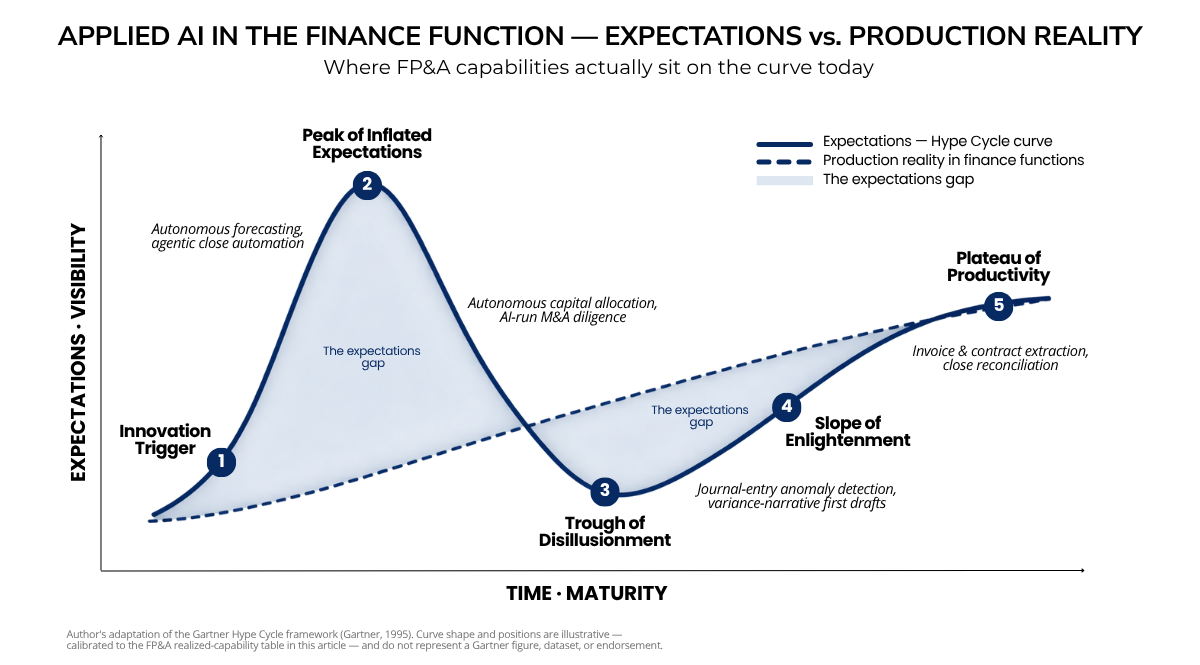
Figure 1. Applied AI in Finance: Expectations vs Production Reality
Author’s adaptation of the Gartner Hype Cycle framework (Gartner, 1995). Expectations versus production reality across the five stages, calibrated to FP&A capabilities; positions are illustrative and are not a Gartner figure, dataset, or endorsement. [1]
Grounded expectations matter. Vendors will present a wide range of AI capabilities, often with similar confidence and similar language. FP&A’s role is to separate what can be tested today from what still belongs in the category of promise.
The point is not to decide whether AI is “ready” in general. That question is too broad to be useful. The better question is more specific: is this use case mature enough, narrow enough, and governed well enough to support a defensible business case?
The table below gives FP&A a practical starting point.
Category | Today's state | What the FP&A function should require |
|---|---|---|
| Document extraction and structured data capture from PDFs, invoices, and contracts | In production at a material scale. Standard accuracy now exceeds traditional optical character recognition. | Proof of accuracy on the organisation's actual document set. Define the exception workflow before approval. |
| Reconciliation automation in the close cycle | In production in multiple large finance functions. Measurable reduction in close-cycle time documented. | Define which reconciliations are in scope. Audit trail and explainability of automated matches. |
| Anomaly detection in transactional data and journal entries | In production with measurable false-positive reduction. Integrated into continuous-monitoring environments. | Calibrate against the organisation's risk tolerance. Define escalation path for flagged items. |
| Narrative drafting for variance commentary and management reports | In production for first-draft generation. Human review required before publication. | Set style, accuracy controls and approval workflow. Make clear who owns the final message. |
| Autonomous decision-making on capital allocation or strategic forecasting | Not in production. Vendor claims of autonomous decision capability should be treated with scepticism. | Hard requirement for human decision authority. Decision-support framing only. |
| Judgment-intensive analysis — M&A diligence, restructuring scenarios | Not in production. Augmentation possible; replacement not demonstrated. | Use an analyst-in-the-loop model. Do not build a business case on full automation. |
Table 2. Applied AI in Finance: Today’s State and FP&A Requirements
The Pattern Case
The CFO asks an FP&A director to evaluate three vendor proposals for an AI forecasting tool. A peer has told the CFO that the function should move to AI and has set a board update for the following quarter. The three vendor proposals describe the technology, the benchmark accuracy improvements, the licensing structure, and the implementation timeline. None of the three specifies whether the proposed deployment is a vertical replacement of the current forecasting process or the first step in a broader AI-native transformation of the planning function. None specifies the operating model after deployment, especially the frontier LLM models, month-by-month billing and operating strategies, or investment to optimise that spend. No one names what changes for the people doing the work today.
The director's first move is not to score the three proposals against each other. The first step is to return the conversation to scoping. The director schedules a session with the CFO before the vendor short-list discussion and walks the CFO through the scoping question, the three-part specification, and the realistic-state table from the publicly available evidence on what AI is and is not delivering in forecasting today. The director recommends that the function commit to a vertical deployment in one named forecasting process — sales-volume forecasting at the regional level, for example, with a clear specification, a defined operating model after deployment, and a twelve-month benefit realisation target. The proposed scope is the only one the function is willing to put in front of the board with a defensible business case in the next quarter.
The CFO accepts the recommendation. The vendor evaluation is rescoped. The board update is reframed from "AI strategy" to "AI deployment commitment in regional sales-volume forecasting," with a path to broader rollout if the deployment delivers. The capital allocation that would have been committed to one of three under-specified proposals is redirected to a deployment with the specification, operating model, and benefit realisation plan in place.
This is the work the FP&A function should be doing in the first sixty days of any AI conversation in the enterprise. The function is not slowing the project down. The function ensures the project can be defended to the board, executed on the committed timeline, and tracked against a benefit case that the function will report against.
Why FP&A Is the Right Place for This Conversation
The work described above is integration work. It is not project management. The project management function will run the implementation once the specification, operating model, and business case are agreed. It is not pure financial work. The CIO's team can evaluate the technology in isolation, but it will not naturally connect that evaluation to capital-allocation discipline or to operating-model implications across functions. It is not external consulting work by default. An external integrator may add value at a particular stage, but the strategic ownership of the scoping conversation, the guardrails, and the benefit case sits internally if the function can carry it.
FP&A is the function in most enterprises that already operates at the intersection of commercial reality, operating model, and capital discipline. The function understands the operations enough to interrogate what a proposed deployment will actually do to the process. The function understands the financial discipline enough to defend the capital allocation. The function reports to the CFO with the level of trust required to challenge a vendor pitch or a board-level commitment. If the organisation has not hired an external integrator for the AI conversation — and most organisations have not — the FP&A function is the candidate. The function should accept the role with the authority that comes with it: to scope, to set guardrails, to demand grounded expectations, to refuse to put under-specified business cases in front of the board, and to own the realisation plan post-approval. This is the integration the work requires.
The Takeaway
The first AI decision is not which tool to buy — it is what question the organisation is actually answering, and that decision belongs to FP&A. Scope before strategy. Strategy before tooling. A named answer to ‘AI-native transformation or AI vertical?’ before a single vendor is scored. In this cycle, the value is won or lost before the first license is signed — in the room where the work is defined, not the one where the software is chosen. FP&A should own that room and accept the authority that comes with it.
What Comes Next in This Series
Two pieces follow, both inside the same discipline. Article two walks the CFO and board through the decision once scoping is complete: the total-cost-of-ownership model, including the human-resources transition line and the orchestration-layer cost, which most vendor cases omit — the board pack for the audit committee, and the kill criteria written into the approval. Article three walks implementation and value realisation: the stage gates, the guardrail questions, and the operating model commitments that decide whether the deployment delivers what the business case promised.
Source
1. VALCORE AI Industry Atlas, 2026.
The full text is available for registered users. Please register to view the rest of the article.
Related articles

This article presents a practical framework for FP&A leaders to drive disciplined internal capital allocation decisions...

Discover how FP&A professionals can optimise working capital through actionable strategies, aligned KPIs, and a cash-focused...

The article is not only about AI cost. It argues that FP&A gatekeeping, business-case approval, cost...

A provocative analysis of why finance fragmentation, siloed specialisation, and disconnected governance continue destroying enterprise value...

In this article, Ashok Manthena reflects on what 2025 really delivered for AI in FP&A —...
+
Subscribe to
FP&A Trends Digest

We will regularly update you on the latest trends and developments in FP&A. Take the opportunity to have articles written by finance thought leaders delivered directly to your inbox; watch compelling webinars; connect with like-minded professionals; and become a part of our global community.