

Agentic AI may remove Finance from the decision chain. Explore how FP&A can shift from insight...

AI in Margin Management: Why Profitability Is a Decision System — Part 4 of 7
August 11, 2026

Part 3: AI in Working Capital: From Visibility to Intervention showed why greater cash visibility creates value only when it leads to accountable intervention. This fourth article turns to the decision system behind profitability.
From visibility to intervention across pricing, customers, products and cost-to-serve
Many organisations can see where the margin is eroding before they manage to stop it. They track declining product margins, rising discounts, unfavourable mix effects, customer profitability gaps and increasing cost-to-serve. Yet visibility alone rarely changes behaviour. This is the margin visibility trap.
A dashboard may show that a product line remains revenue-stable while profitability declines. It may reveal higher discounts, smaller orders, fulfillment exceptions, or service costs that absorb margin. What it cannot decide is who should intervene — Sales, Pricing, Product, Operations, Finance or a cross-functional margin forum.
This distinction matters because profitability is not primarily a reporting problem. It is a decision-system problem: management value arises only when indicators are connected to financial outcomes, decision rights and accountable action (Simons, 1995; Ittner and Larcker, 2003).
The same logic applies to price realisation. A company may set an economically sound list price and still lose margin through discounts, rebates, payment terms, freight concessions, special conditions or service promises. The pocket price waterfall shows where list-price intent turns into realised margin loss (Marn, Roegner and Zawada, 2003).
AI-enabled analytics can help surface such patterns earlier, especially when pricing, order, customer, product and fulfilment data are connected. Evidence from data-driven demand forecasting and price optimisation shows that firms can use granular product and demand signals to support more adaptive pricing decisions (Ferreira, Lee and Simchi-Levi, 2016), while dynamic-pricing research links pricing decisions to demand estimation and learning in data-rich environments (den Boer, 2015). That makes margin issues more visible, but not yet actionable. Predictive value becomes management value only when FP&A links the signal to driver logic, decision rights and a defined intervention test (Shmueli, 2010).
The implication is clear: AI creates value in margin management only when margin signals are translated into governed intervention.
Profitability Is a Decision System
Margin management is often reduced to pricing. That is too narrow. Pricing is a critical margin lever, but it covers only part of the path from price setting to realised profitability. Margin management governs whether intended economics are actually realised after discounts, rebates, commercial terms, service promises and operating complexity.
Margin erosion rarely respects organisational boundaries. Sales may grant discounts to protect volume, Pricing may define corridors that are not enforced, Product may keep low-margin variants to support revenue or retention, and Operations may absorb service exceptions that were never priced. Each decision can appear rational locally. The problem is that local rationality does not necessarily create enterprise profitability.
Rational decision-making makes this problem visible. Simon’s concept of bounded rationality and Cyert and March’s behavioural view of the firm explain why organisations do not decide under perfect enterprise-wide optimisation, but under limited information, competing goals and local routines (Simon, 1955; Cyert and March, 1963). A discount may be rational for Sales if it protects a customer relationship, but weak for the enterprise if it reinforces price leakage, increases cost-to-serve or undermines future margin discipline.
For FP&A, the conclusion is operational: margin management should be treated as a decision system, not as a reporting category. A useful margin decision system connects five elements: signals that show where margin leakage appears; driver logic that explains whether price, mix, cost, service, complexity or terms are changing; trade-off transparency that clarifies what is gained and lost; ownership that defines who has authority to act; and intervention and learning that test whether realised profitability improves or the problem merely shifts elsewhere.
AI can strengthen this system by surfacing margin patterns that aggregate reporting may hide, provided the underlying commercial and operational data are sufficiently connected. It can flag discount drift, customer margin decline, product profitability issues, cost-to-serve anomalies and mix effects before they become normalised. These patterns matter because they make margin erosion discussable earlier. The limitation is equally important: detecting a pattern does not define the right intervention.
Prediction, explanation and prescription are different management tasks. Predictive models can identify where a margin problem is likely to occur, but they do not necessarily explain the causal business logic behind it (Shmueli, 2010). Prescriptive analytics can recommend actions under uncertainty, but it still depends on objectives, constraints and assumptions (Bertsimas and Kallus, 2020). In margin management, this means that AI may flag a customer, product or channel as less profitable and even suggest a price, discount or service-level response. It cannot decide on its own which customer relationship is strategic, which volume risk is acceptable, or which trade-off the business is willing to make.
There is also a causal challenge: margin interventions change behaviour. Reducing discounts may improve unit margin but lower volume; changing service levels may reduce cost-to-serve but affect retention; rationalising the portfolio may improve average margin while weakening strategic accounts. FP&A must therefore distinguish between predicting a margin problem, estimating the likely effect of an intervention and governing the decision itself (Fernández-Loría and Provost, 2022).
The trade-off remains managerial, not technical. Analytical systems can show where margin is leaking, which drivers may matter and which interventions are possible. But they cannot decide which customer relationship is strategic, which volume risk is acceptable or which economic compromise the business is willing to make. FP&A’s role is therefore to govern the decision logic that links margin signals to accountable intervention across Sales, Pricing, Product, Operations and Finance.
Where Margin Leakage Happens
Margin leakage does not appear in one place. It can begin in pricing, continue through discounting and commercial terms, become hidden in customer or product profitability, and finally emerge through cost-to-serve and operational complexity. This is why margin management needs an integrated view of realised profitability, not a narrow view of gross margin or list-price discipline.
The first leakage point is price realisation. A company may define a sound list price and still lose margin through discounts, rebates, payment terms, freight concessions, special conditions or non-standard service promises. The pocket price waterfall makes this leakage visible: margin is not protected by the list price, but by the price and margin the company actually keeps after all deductions (Marn, Roegner and Zawada, 2003). Value-based pricing reinforces the same point from a commercial perspective. Pricing is not a mechanical calculation, but a decision process for creating and capturing customer value under competitive and organisational constraints (Hinterhuber, 2004; Nagle, Hogan and Zale, 2016).
However, even strong pricing logic can fail in execution. Sales may protect volume through discounts, managers may approve quarter-end exceptions, and freight or service concessions may be absorbed as relationship costs rather than treated as explicit margin trade-offs. Some discounts are economically justified: they may defend strategic volume, protect a key customer or support market entry. The issue is not whether discounts exist. The issue is whether they are intentional, economically transparent and governed.
The second leakage point is customer and product profitability. Revenue can hide weak economics. A high-volume customer is not necessarily a profitable customer, and a product with stable demand is not necessarily profitable. Customers, products and transactions consume operational resources differently, and these differences are often hidden in average-cost views. Activity-based costing and time-driven activity-based costing are relevant because they show how products, customers and transactions consume activities and capacity differently (Cooper and Kaplan, 1988; Kaplan and Anderson, 2004). Customer profitability research makes the same point: companies need to understand the economics of individual customers, not only the revenue they generate (Kaplan and Narayanan, 2001).
For FP&A, average margin is a weak decision basis when customer behaviour, product complexity and service intensity differ materially. A product category may show an acceptable gross margin, while individual variants may require small batches, engineering changes, manual handling, or high return effort. Two customers may generate the same revenue while creating very different economics. One orders predictably, accepts standard lead times, has low claims intensity and pays within agreed terms. Another negotiates similar prices but places smaller orders, requests expedited delivery, needs special packaging, generates more claims and often asks for payment extensions. In a revenue report, both customers may look equally important. In a margin decision system, they are not equivalent.
The third leakage point is cost-to-serve. Some margin erosion is not visible in the price waterfall because it is created in the operating model. A customer may receive an acceptable price and still be economically weak if the cost of serving that customer is too high. Cost-to-serve shifts the margin conversation from what the company sold to what it cost to fulfill what was promised. It makes logistics, service and process costs visible at the customer level and is therefore central to customer profitability management in complex operating settings (Guerreiro, Bio and Merschmann, 2008).
Consider a distributor that keeps a strategically important customer on standard pricing because the account generates high revenue and supports market share. Over time, the customer shifts from monthly bulk orders to frequent small orders, requests next-day delivery, requires customised labelling, generates more returns and expects dedicated support. The sales price and discount level have not changed. Yet realised profitability declines because cost-to-serve has changed. If FP&A only reviews price and gross margin, the problem remains hidden. If FP&A connects order patterns, fulfilment effort, service intensity and customer profitability, the issue becomes actionable.
The answer may not be a price increase. It may be a minimum order quantity, a revised delivery policy, a paid service tier, a packaging surcharge, a contract renegotiation, portfolio simplification or customer resegmentation. In some cases, the right decision may be to keep the service level for strategic reasons. But that choice should be visible, priced where possible and owned.
A fourth leakage point is the mix and portfolio. A business may report a stable average margin while the underlying margin quality deteriorates. Growth may shift towards lower-margin products, smaller customers, more complex variants or service-intensive channels. In aggregate reporting, the business still appears stable. In a margin-decision system, the question is different: which part of growth is economically attractive, which is dilutive, and which portfolio choices reinforce the pattern?
AI can help connect these leakage points: price, discounts, mix, customer behaviour, product complexity, fulfilment patterns and service intensity. Its value is not that it automatically identifies the correct answer, but that it can narrow the diagnostic field and make competing explanations visible. FP&A still has to test whether margin erosion is a pricing issue, a customer economics issue, a product complexity issue or an operational cost-to-serve issue. Weak realised profitability should not be averaged away, normalised as flexibility or hidden behind revenue growth. Revenue explains commercial scale. Realised profitability explains economic quality.
The FP&A Margin Intervention System
The previous sections show why margin management cannot be reduced to visibility, pricing or profitability reporting. Margin erosion can appear in discounts, commercial terms, product mix, customer behaviour, service intensity, operational complexity or fulfilment economics. AI can help make these signals visible earlier and at greater granularity when commercial and operational data are connected. But visibility becomes valuable only when it is connected to intervention.
FP&A, therefore, needs a margin intervention system. Its purpose is not to centralise all margin decisions in Finance. Sales, Pricing, Product, Operations, and Supply Chain each play an important role in the margin equation. FP&A’s role is to govern the decision logic that connects margin signals to accountable action.
A practical FP&A margin intervention system follows six steps:
Detect → Explain → Quantify and Prioritise → Assign → Intervene → Learn.
Detect identifies where margin leakage becomes visible, such as discount drift, customer margin decline, product profitability issues or cost-to-serve anomalies. Explain separates the drivers into price, mix, volume, cost, service, complexity, and commercial terms. Quantify and prioritise estimates margin impact, recurrence, controllability, strategic relevance, volume risk and trade-offs. Not every margin signal deserves executive intervention; the relevant question is whether the leakage is material, repeated, influenceable and economically meaningful. Assign clarifies who owns the decision across Sales, Pricing, Product, Operations, Supply Chain, Finance or a cross-functional forum. Intervene changes behaviour through price, discount, contract, portfolio, service-level or process decisions. Learn tests whether realised profitability improved sustainably or whether the problem merely shifted elsewhere.
The challenge is therefore not only to detect margin leakage, but to translate signals into a repeatable intervention process. Figure 1 summarises the decision loop FP&A can use to move from visibility to accountable action.
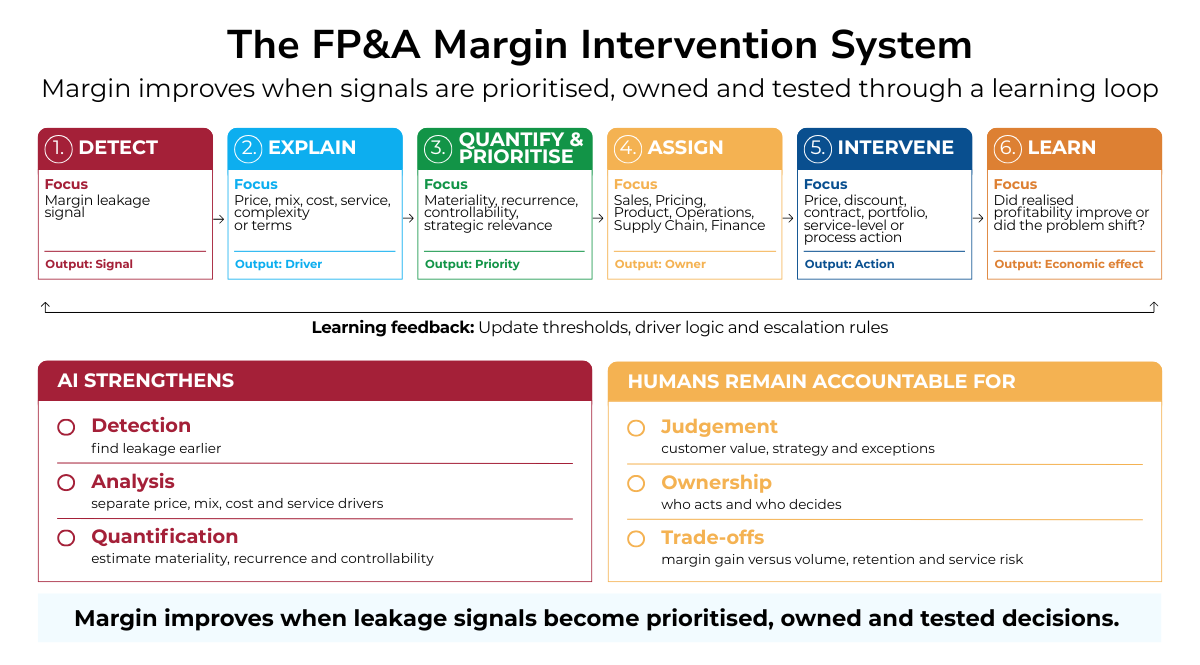
Figure 1
Figure 1 illustrates that margin management is not a single decision but a governed sequence of detection, explanation, ownership, intervention and learning.
The loop is necessary because margin problems often get stuck between functions. Sales may see the customer relationship, Operations the service burden, Product the portfolio logic and Finance the margin impact. Unless the signal is translated into ownership and intervention, the organisation may keep observing the same profitability problem from different angles.
Consider a recurring discount pattern. AI may detect that one region grants higher discounts than comparable regions for similar deal sizes and customer segments. It may also show that the region protects volume but underperforms on realised margin. That is useful, but incomplete. FP&A must help structure the decision: whether the discount is commercially justified, whether the margin loss is offset by volume, retention, or future growth, whether the behaviour falls within agreed corridors, who has authority to change it, and how the decision will be reviewed after implementation.
Without this loop, the organisation may either overreact or underreact. It may cut discounts and damage strategic customer relationships, or tolerate leakage because the issue is politically difficult. The purpose of the intervention system is to make these trade-offs explicit before margin loss becomes normalised.
The learning step tests whether the intervention improved realised profitability or merely shifted the problem elsewhere. A discount cut, service-level change, or portfolio action should therefore be reviewed not only for its immediate margin effect, but also for its impact on volume, retention, operational burden, and strategic customer economics.
This governance logic also applies to AI use in FP&A. The NIST AI Risk Management Framework frames trustworthy AI through risk management, accountability, and organisational processes, rather than model design alone (NIST, 2023). For margin management, this means that AI outputs should be embedded in review routines, escalation paths and decision rights rather than treated as self-executing recommendations.
From Signals to Accountable Decisions
Figure 1 describes the intervention loop. Figure 2 applies this logic to common margin-management situations by linking signals to drivers, ownership, intervention options and trade-off evaluation.
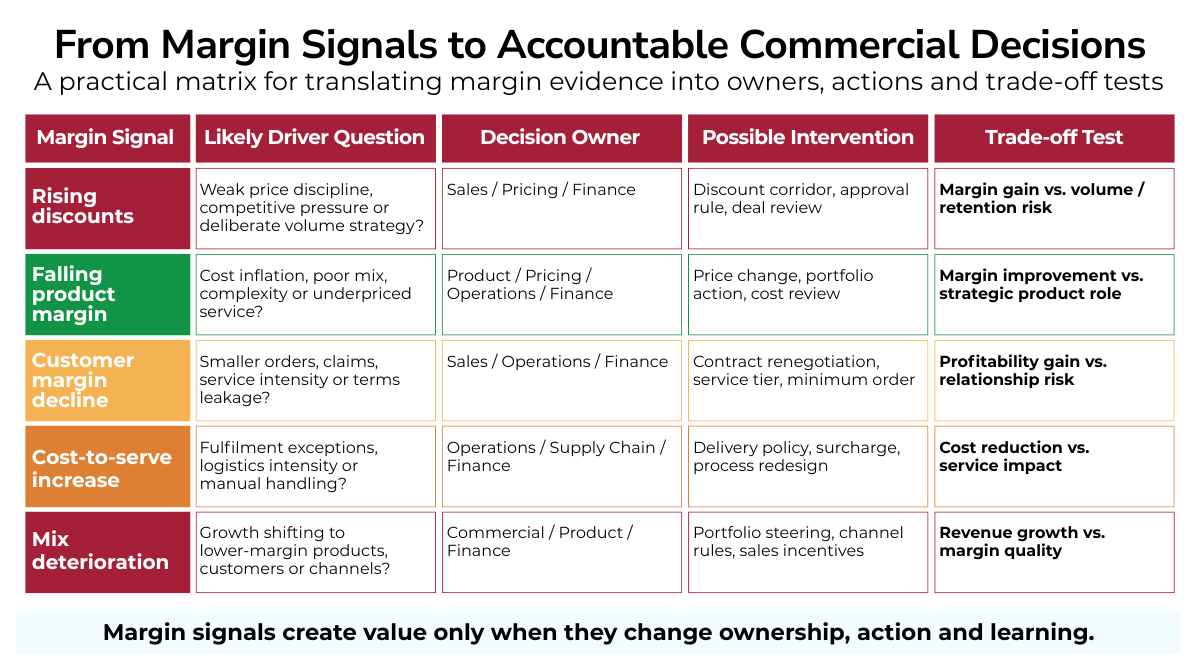
Figure 2
In a monthly margin review, FP&A would not only report that the customer margin declined. It would ask whether the decline came from discount drift, smaller order sizes, freight concessions, claims, service intensity or mix. The review would then assign ownership, define the intervention range and agree on how the effect will be tested in the next cycle.
The figure does not prescribe automatic responses. Its purpose is to ensure that every material margin signal enters the management process with an explicit hypothesis on cause, ownership and action.
This mapping is not meant to mechanise management judgment. It structures it. A discount signal may require a different response depending on whether it reflects weak price discipline, competitive pressure or a deliberate volume strategy. A customer-margin signal may point to pricing, order behaviour, claims, logistics intensity or service expectations. The useful FP&A question is therefore not only what changed. It is the decision that must now be made: who owns it, and which trade-off the business is willing to accept.
FP&A’s role is therefore more specific than ownership of every margin lever. Sales, Pricing, Product, Operations and Supply Chain remain accountable for their decisions. FP&A governs the cross-functional logic: which signal matters, which driver explains it, which trade-off is acceptable, which owner must act and how the result will be reviewed.
That role has four practical responsibilities. FP&A connects margin signals to business drivers; makes trade-offs explicit; secures ownership and escalation for repeated or material exceptions; and closes the learning loop by testing whether realised profitability improved or whether the intervention created unintended consequences elsewhere.
The management test is whether AI changed the decision process: did it explain the driver, clarify the trade-off, assign ownership, support action and test the economic effect? In weaker systems, AI produces more dashboards, alerts, and explanations of variance. In stronger systems, it improves decision quality by clarifying where margin is leaking, why it is happening, who must act, and what the outcome is.
The future of margin management is therefore not just more detailed margin visibility. It is the discipline to turn margin evidence into accountable commercial decisions before erosion becomes accepted performance.
This also points to the next FP&A challenge: scenario planning. Margin, cash and forecast signals do not move independently. A price increase may protect unit margin but reduce demand. A service-level decision may improve cost-to-serve but affect retention. A product rationalisation may improve profitability while changing working-capital needs and operational constraints. The next FP&A capability is therefore not only to detect margin leakage, but to compare alternative futures when margin, cash, demand and capacity interact.
FP&A’s role is not only to make margin leakage visible. It is to ensure that material signals are linked to a plausible driver, a clear owner, an intervention path and a test of whether profitability actually improved.
Continue to Part 5: AI in Scenario Planning: From Forecasting to Decision Preparedness, which explores how AI-enabled scenarios can prepare management for decisions under uncertainty.
References
Bertsimas, D. and Kallus, N. (2020). From predictive to prescriptive analytics. Management Science, 66(3), 1025–1044. https://doi.org/10.1287/mnsc.2018.3253
Cooper, R. and Kaplan, R.S. (1988). Measure costs right: Make the right decisions. Harvard Business Review, 66(5), 96–103.
Cyert, R.M. and March, J.G. (1963). A Behavioral Theory of the Firm. Prentice-Hall.
den Boer, A.V. (2015). Dynamic pricing and learning: Historical origins, current research, and new directions. Surveys in Operations Research and Management Science, 20(1), 1–18. https://doi.org/10.1016/j.sorms.2015.03.001
Fernández-Loría, C. and Provost, F. (2022). Causal decision making and causal effect estimation are not the same... and why it matters. INFORMS Journal on Data Science, 1(1), 4–16. https://doi.org/10.1287/ijds.2021.0006
Ferreira, K.J., Lee, B.H.A. and Simchi-Levi, D. (2016). Analytics for an online retailer: Demand forecasting and price optimisation. Manufacturing & Service Operations Management, 18(1), 69–88. https://doi.org/10.1287/msom.2015.0561
Guerreiro, R., Bio, S.R. and Merschmann, E.V.V. (2008). Cost-to-serve measurement and customer profitability analysis. The International Journal of Logistics Management, 19(3), 389–407. https://doi.org/10.1108/09574090810919215
Hinterhuber, A. (2004). Towards value-based pricing — An integrative framework for decision making. Industrial Marketing Management, 33(8), 765–778. https://doi.org/10.1016/j.indmarman.2003.10.006
Ittner, C.D. and Larcker, D.F. (2003). Coming up short on nonfinancial performance measurement. Harvard Business Review, 81(11), 88–95.
Kaplan, R.S. and Anderson, S.R. (2004). Time-driven activity-based costing. Harvard Business Review, 82(11), 131–138.
Kaplan, R.S. and Narayanan, V.G. (2001). Measuring and managing customer profitability. Cost Management, 15(5), 5–15.
Marn, M.V., Roegner, E.V. and Zawada, C.C. (2003). The power of pricing. The McKinsey Quarterly, 2003(1), 26–39.
Nagle, T.T., Hogan, J.E. and Zale, J. (2016). The Strategy and Tactics of Pricing: New International Edition. 5th edn. Routledge.
National Institute of Standards and Technology (NIST). (2023). Artificial Intelligence Risk Management Framework (AI RMF 1.0). NIST AI 100-1. https://doi.org/10.6028/NIST.AI.100-1
Shmueli, G. (2010). To explain or to predict? Statistical Science, 25(3), 289–310. https://doi.org/10.1214/10-STS330
Simon, H.A. (1955). A behavioral model of rational choice. The Quarterly Journal of Economics, 69(1), 99–118. https://doi.org/10.2307/1884852
Simons, R. (1995). Levers of Control: How Managers Use Innovative Control Systems to Drive Strategic Renewal. Harvard Business School Press.
The full text is available for registered users. Please register to view the rest of the article.
Related articles

In this article, learn how FP&A teams can turn marginal revenue and cost data into actionable...

In this article, learn how FP&A leaders can use the Growth and Profitability Matrix to balance...

In this article, you’ll discover how FP&A leaders can drive sustainable margin expansion by turning forecasting...

In this article, Campari Argentina’s FP&A team shares how they built FP&A revenue growth capabilities through...

In this article, you’ll explore why AI will transform, but not replace FP&A, and why human...
+
Subscribe to
FP&A Trends Digest

We will regularly update you on the latest trends and developments in FP&A. Take the opportunity to have articles written by finance thought leaders delivered directly to your inbox; watch compelling webinars; connect with like-minded professionals; and become a part of our global community.