

AI in FP&A creates value when earlier analytical signals are connected to governance, ownership, escalation, and...

AI in Working Capital: From Visibility to Intervention — Part 3 of 7
July 28, 2026

Part 2: AI Will Not Solve Weak Forecasting. It Will Reveal It examined how AI can expose weaknesses in forecasting logic, KPIs and management routines. This third article applies the same lens to working capital.
Why cash performance depends less on dashboards than on governed action across customers, suppliers and operations.
The Visibility Trap in Working Capital
Many organisations can see cash being trapped before they manage to release it.
Receivables, inventory, supplier exposure, payment timing, overdue balances, stock movements, disputes and liquidity forecasts are often available in greater detail than in the past. ERP, BI, treasury and dashboard tools have made cash positions more transparent. But transparency is not the same as cash performance.
A dashboard can show ageing receivables, rising inventory or a future liquidity shortfall. It cannot decide whether Sales, Credit, Collections, Operations, or Treasury should intervene, nor can it resolve the trade-off between cash release, service level, and resilience.
This is the visibility trap: organisations often improve measurement faster than intervention. The cash-conversion-cycle literature shows that working capital connects liquidity, operations and profitability, while the cash-to-cash view links suppliers, operations and customers (Richards and Laughlin, 1980; Farris and Hutchison, 2002; Deloof, 2003). A headline cash-conversion-cycle movement can therefore hide very different management realities: receivables discipline, inventory policy, supplier-payment timing or a temporary shift of risk across the value chain. The useful question is narrower and more demanding: which lever changed, who changed it and can the effect be sustained?
Better analytics can expose the trap earlier. Patterns in customer payment behaviour, dispute frequency, inventory build-up, demand volatility, supplier exposure or operating exceptions become easier to see. That matters, but it is not enough. Earlier signals improve working-capital performance only when they change management behaviour.
For CFOs and FP&A leaders, the harder question is whether the organisation has the decision system to act when the signal arrives. Working capital should be treated not only as a set of metrics, but also as a management intervention system.
Why Working Capital Is a Decision System
Working capital is often discussed through metrics such as DSO, DIO, DPO, ageing, inventory days, payables days, and the cash conversion cycle. These measures give finance a common language for monitoring cash tied up in customers, stock and suppliers. The cash conversion cycle is usually expressed as DIO plus DSO minus DPO; the formula is simple, but the management reality behind it is not (Richards and Laughlin, 1980; Farris and Hutchison, 2002).
Cash is shaped by decisions: payment terms, disputes, credit limits, collection priorities, fulfilment choices, inventory buffers, supplier terms, payment timing, demand assumptions and service-level commitments. These decisions sit across functions: Sales protects revenue, Operations protects availability, Procurement protects supply continuity, Treasury protects liquidity and Finance protects cash discipline.
Working capital, therefore, behaves less like a reporting topic and more like a decision-making system. In management-control terms, measures matter because they focus attention, test assumptions and shape action; they do not create performance by describing outcomes after the fact (Simons, 1995; Kaplan and Norton, 1992; Ittner and Larcker, 2003).
AI strengthens the signal layer of that decision system. Modern analytics can scan more transactions, detect exceptions and identify patterns that manual review routines often miss (Chen, Chiang and Storey, 2012). But predictive accuracy should not be confused with managerial action. Explanation, prediction and decision-making are related but distinct tasks: a model can predict risk without explaining the business driver, and it can explain a pattern without deciding the appropriate intervention (Shmueli, 2010; Fernandez-Loria and Provost, 2022). Prescriptive analytics can connect data to decision options, but the organisation must still define objectives, constraints, risk appetite and accountability (Bertsimas and Kallus, 2020).
A practical working-capital decision system connects six questions: What signal changed? Which driver explains it? Is the cash impact material and influenceable? Who owns the intervention? Which action should follow? Did the action improve cash performance or only move the metric? Figure 1 translates these questions into a practical FP&A cash intervention system, showing where AI strengthens detection and analysis, and where human accountability remains essential.
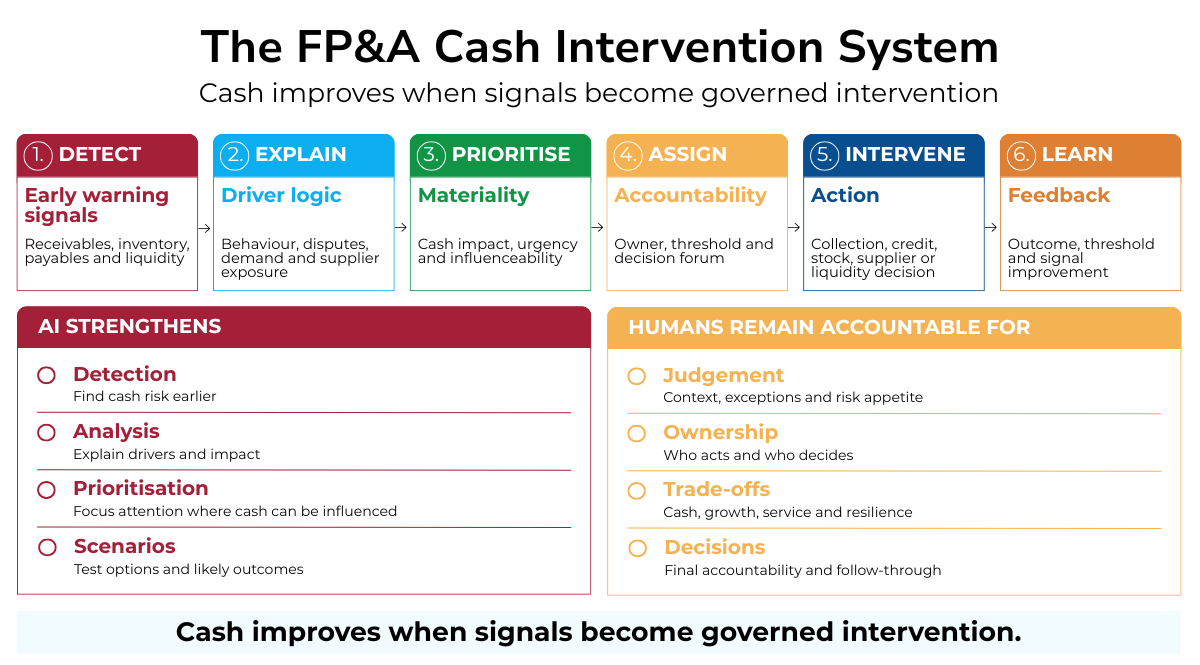
Figure 1
If these questions cannot be answered, the organisation has visibility, but not control.
Receivables: Earlier Signals, Unclear Ownership
Receivables are often the most visible working-capital problem and hard to improve sustainably.
Most organisations can see overdue invoices, ageing buckets, disputed balances and collection status. More advanced teams monitor payment behaviour, customer promises, dispute patterns, credit exposure and sales concentration. AI can improve this signal layer by identifying payment deterioration before it becomes obvious in standard ageing reports. Machine Learning approaches have shown practical relevance for accounts receivable prediction and broader credit risk assessment because they can detect patterns that simple rules may miss (Appel et al., 2020; Barboza, Kimura, and Altman, 2017).
But earlier detection does not automatically improve DSO. The management issue is often not whether finance can see the risk. It is whether the organisation knows what should happen next.
A customer may pay late due to weak collections discipline, unresolved disputes, incorrect invoices, delivery issues, commercial promises, credit limit decisions, or deliberate payment behaviour. Each cause points to a different owner: Collections, Sales, Credit, Operations or Finance.
This is where many receivables dashboards fail. They identify overdue cash and rank customers, but do not specify whether the next action is a collection call, dispute resolution, credit escalation, customer negotiation, or a commercial policy change.
FP&A's role is not to own all receivables activity. It governs the decision logic that connects receivables signals to accountable action. In practice, the decisive test is not the sophistication of the risk ranking. The question is whether earlier payment-risk signals lead to earlier, better, and more accountable intervention.
Inventory: Cash Versus Service Level
Inventory is where working-capital optimisation most visibly collides with operating reality.
Excess stock ties up cash and raises storage and obsolescence risk. Too little stock can damage service levels, production continuity and customer reliability. The question is not simply whether inventory should be reduced, but where it can be reduced without creating service, supply or revenue risk.
Inventory, therefore, has to be managed as a working-capital trade-off, not only as a finance metric. DIO may show that cash is trapped in stock, but it does not explain the root cause: weak demand planning, slow-moving products, supply volatility, minimum-order quantities, safety-stock policies, product proliferation, service-level commitments, or commercial optimism. Each driver requires a different intervention.
Analytics is useful here when it sharpens the diagnosis. It can help identify slow-moving and obsolete inventory, detect demand volatility, flag mismatches between forecast assumptions and actual consumption, and show where inventory buffers no longer reflect current risk. Advanced analytics can support better inventory decisions by systematically connecting demand, service-level targets, replenishment logic, and cost trade-offs more effectively than static reports can (Chen, Chiang and Storey, 2012; Bertsimas and Kallus, 2020). Inventory research also shows that service-level choices and inventory policies are inherently connected; reducing stock without understanding those trade-offs can move risk rather than remove it (Silver, Pyke and Thomas, 2016; Goncalves et al., 2020).
The governance challenge is ownership. Finance may see trapped cash, but Operations owns production reliability; Supply Chain owns availability; Sales owns customer commitments; and Procurement influences order quantities or supplier flexibility. Without decision rules, an AI signal about excess stock may trigger debate rather than action.
FP&A should frame inventory signals as management choices: Which inventory is truly excess? Which stock protects revenue or resilience? Which assumptions created the build-up? Who can change the planning, sourcing or commercial decision? What cash impact and service-level risk would the intervention create?
For inventory, the practical test is whether management can distinguish trapped cash from necessary resilience.
Payables and Liquidity: When Cash Optimisation Becomes a Risk Trade-Off
Payables are often treated as the most controllable working-capital lever. Extending payment terms, slowing payment runs, or improving payment discipline can quickly release cash. But payables are also where cash optimisation can turn into risk transfer.
A higher DPO may improve the cash conversion cycle, but it does not automatically mean that the business has improved. It may reflect better terms, stronger payment governance or more disciplined cash planning. It may also reflect delayed payments, supplier pressure, strained relationships or hidden supply-chain risk. The harder judgment is whether liquidity has improved without damaging supplier reliability, operational continuity or long-term commercial flexibility.
In payables and liquidity, analytics is most useful when it exposes payment pattern anomalies, supplier concentration, critical vendor exposure, and mismatches between payment timing and liquidity forecasts. Those signals help management identify emerging liquidity and dependency risks earlier. It can also scenario-model cash shortfalls and operational dependencies. But these signals matter only if the organisation has defined how cash, supplier risk and continuity should be balanced.
This is where governance matters. Treasury may optimise liquidity, Procurement may own supplier relationships, Operations may depend on critical suppliers and Finance may monitor cash flow and forecast reliability. If these perspectives are not connected, a payables action can improve one metric while weakening the system that generates cash. Research on trade credit and supplier financing shows that suppliers can effectively finance buyers, especially when external capital access differs across firms. This makes payables a financing and relationship decision, not a free cash lever (Petersen and Rajan, 1997).
FP&A's role is to make these trade-offs visible and governable. A payables signal should trigger questions such as: Is the supplier critical? Is the cash benefit material? Is the payment action contractual, negotiated or delayed? Could the supplier pass the cost back through price, service degradation or reduced flexibility?
For payables, the test is not whether the company can hold cash longer. The question is whether management can separate sustainable liquidity improvement from disguised supplier risk transfer.
The FP&A Cash Intervention System
The practical challenge is to turn working-capital visibility into a repeatable intervention loop.
A useful AI-enabled cash intervention system has six steps: detect, explain, prioritise, assign, intervene and learn. The sequence matters because many working-capital processes stop too early: they detect a problem, sometimes explain it, but fail to assign action or learn from the intervention.
Detect. AI can identify emerging cash signals earlier than standard reporting: payment risk deterioration, dispute clusters, slow-moving inventory, forecast-consumption mismatches, supplier exposure, liquidity gaps, or unusual transaction patterns. Detection improves visibility, but it is only the starting point.
Explain. The organisation must then understand the business driver. Is the receivables issue caused by customer behaviour, invoice quality, delivery performance or commercial terms? Is inventory rising because of demand error, safety-stock policy, procurement constraints or product complexity? Is the payables movement a sustainable terms improvement or a delayed-payment risk? Without explanation, prediction can create noise rather than action (Shmueli, 2010; Fernandez-Loria and Provost, 2022).
Prioritise. Not every signal deserves executive attention. FP&A should help rank issues by cash materiality, time sensitivity, controllability, risk and strategic relevance. A small overdue balance with no influenceable action may matter less than a growing dispute pattern in a strategic customer segment. A large inventory balance may be necessary if it protects a critical service level.
Assign. Every material signal needs an accountable owner. Receivables may require the attention of Sales, Credit, Collections, or Operations. Inventory may require Supply Chain, Sales, Procurement or Operations. Payables may require Treasury, Procurement or business leadership. Assignment is where many dashboards fail: they show the issue, but do not make action ownership explicit.
Intervene. The intervention should match the driver. The action may be dispute resolution, customer escalation, credit review, inventory rebalancing, demand-plan challenge, supplier negotiation, payment-timing decision or liquidity scenario review. AI can support the choice, but should not obscure management judgment.
Learn. Finally, the organisation must test whether the intervention improved cash performance or merely moved the metric. If DSO improves because disputes are resolved earlier, the system has learned. If DPO improves by transferring stress to critical suppliers, the system has only shifted risk. AI governance frameworks emphasise monitoring, accountability, and risk management because model outputs require control over their use, not only technical accuracy at design (NIST, 2023; European Union, 2024).
This is the FP&A cash intervention system: not a dashboard, not a model and not a one-off cash programme, but a governed loop that connects signals to decisions and decisions to learning. Figure 2 applies this intervention logic across receivables, inventory, payables and liquidity, showing how each early warning signal should move towards accountable management action.
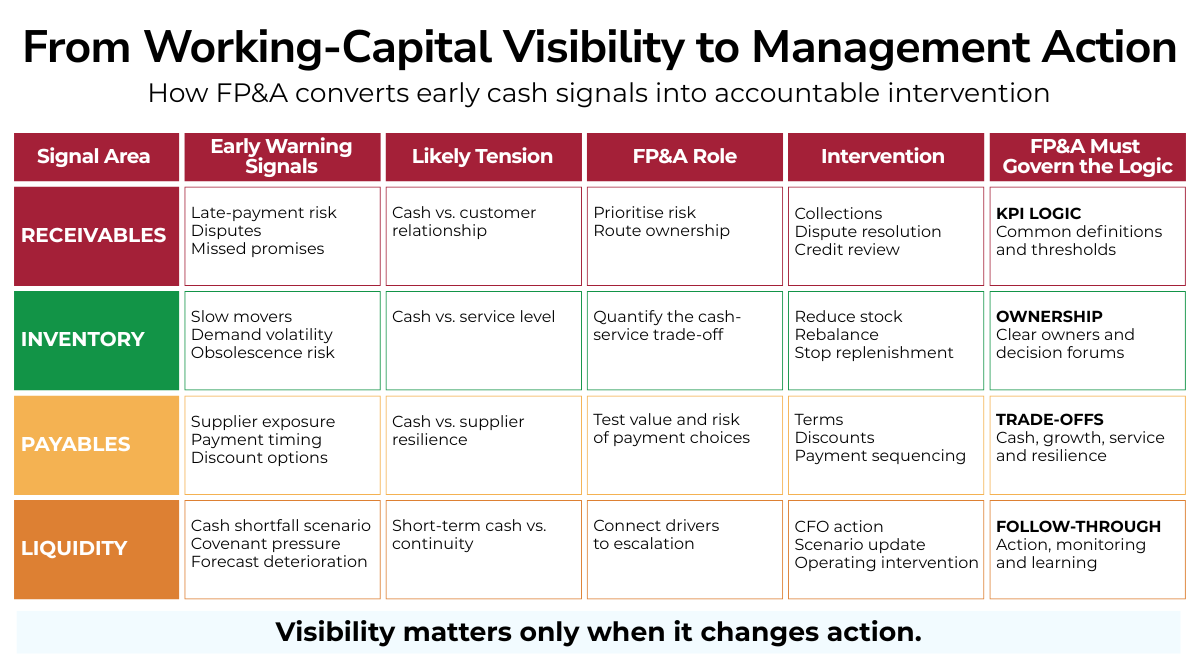
Figure 2
FP&A's Role: Governor of the Cash Decision Logic
FP&A should not be positioned as the owner of every working-capital lever. Sales, Operations, Procurement, Treasury, Credit, Collections and Supply Chain all influence cash performance through decisions they legitimately own.
The distinctive role of FP&A is different: to govern the cash decision logic across those functions.
That role has four practical elements. First, FP&A should connect working-capital signals to business drivers. A movement in DSO, DIO or DPO should be linked to customer behaviour, disputes, service levels, demand assumptions, supplier constraints, payment terms or liquidity choices.
Second, FP&A should make trade-offs explicit. Releasing cash may affect revenue, customer relationships, service reliability, supplier resilience or operational flexibility. The finance question is not only "How much cash can be released?" but "What risk, constraint or behaviour changes when we release it?"
Third, FP&A should ensure ownership. A working-capital signal should not remain a finance observation. It should become an accountable management action: who acts, by when, under which escalation rule and with which expected cash effect.
Fourth, FP&A should close the learning loop. If an intervention improves cash sustainably, the decision logic should be reinforced. If it only moves the metric or shifts risk elsewhere, the logic should be challenged.
This role is consistent with modern performance management: finance creates value by shaping routines through which assumptions are challenged, decisions are prioritised and action is made accountable (Simons, 1995; Kaplan and Norton, 1992; Ittner and Larcker, 2003).
AI raises the importance of this role. As signals become faster and more granular, organisations need stronger governance, not weaker management discipline. The FP&A contribution is to ensure that AI-enabled working-capital insight becomes cash-relevant, risk-aware and owned.
Conclusion: From Cash Visibility to Cash Intervention
Where data quality, process discipline and governance are in place, AI can make working-capital signals faster and more granular. It can help organisations see payment risk, inventory build-up, supplier exposure and liquidity pressure earlier. But visibility is not the same as control.
The decisive question is whether those signals change management action.
Working-capital performance improves when the organisation can explain the driver, prioritise the cash impact, assign ownership, intervene in time and learn from the result. Without that logic, AI may produce better dashboards, sharper alerts, and more accurate predictions, while cash remains trapped in the same customer, inventory, supplier, and operating decisions.
For FP&A, this is the central opportunity. The function does not need to own every lever. It needs to govern the cash decision logic that connects signals to accountable action.
The next frontier is margin management, where the same pattern appears again: profitability improves not because organisations measure margins in more detail, but when margin signals change pricing, portfolio, customer and commercial decisions.
Continue to Part 4: AI in Margin Management: Why Profitability Is a Decision System, which examines how margin signals must shape pricing, customer, portfolio and commercial decisions.
References
Appel, A.P., Malfatti, G.L., Cunha, R.L.F., Lima, B. and de Paula, R. (2020) 'Predicting Account Receivables with Machine Learning'. arXiv:2008.07363.
Barboza, F., Kimura, H. and Altman, E.I. (2017) 'Machine learning models and bankruptcy prediction', Expert Systems with Applications, 83, pp. 405-417.
Bertsimas, D. and Kallus, N. (2020) 'From Predictive to Prescriptive Analytics', Management Science, 66(3), pp. 1025-1044.
Chen, H., Chiang, R.H.L. and Storey, V.C. (2012) 'Business Intelligence and Analytics: From Big Data to Big Impact', MIS Quarterly, 36(4), pp. 1165-1188.
Deloof, M. (2003) 'Does Working Capital Management Affect Profitability of Belgian Firms?', Journal of Business Finance & Accounting, 30(3-4), pp. 573-588.
European Union (2024) Regulation (EU) 2024/1689 laying down harmonised rules on artificial intelligence.
Farris, M.T. and Hutchison, P.D. (2002) 'Cash-to-Cash: The New Supply Chain Management Metric', International Journal of Physical Distribution & Logistics Management, 32(4), pp. 288-298.
Fernandez-Loria, C. and Provost, F. (2022) 'Causal Decision Making and Causal Effect Estimation Are Not the Same... and Why It Matters', INFORMS Journal on Data Science, 1(1), pp. 4-16.
Goncalves, J.N.C., Sameiro Carvalho, M. and Cortez, P. (2020) 'Operations Research Models and Methods for Safety Stock Determination: A Review', Operations Research Perspectives, 7, 100164.
Ittner, C.D. and Larcker, D.F. (2003) 'Coming Up Short on Nonfinancial Performance Measurement', Harvard Business Review, 81(11), pp. 88-95.
Kaplan, R.S. and Norton, D.P. (1992) 'The Balanced Scorecard - Measures That Drive Performance', Harvard Business Review, 70(1), pp. 71-79.
NIST (2023) Artificial Intelligence Risk Management Framework (AI RMF 1.0). National Institute of Standards and Technology.
Petersen, M.A. and Rajan, R.G. (1997) 'Trade Credit: Theories and Evidence', The Review of Financial Studies, 10(3), pp. 661-691.
Richards, V.D. and Laughlin, E.J. (1980) 'A Cash Conversion Cycle Approach to Liquidity Analysis', Financial Management, 9(1), pp. 32-38.
Shmueli, G. (2010) 'To Explain or to Predict?', Statistical Science, 25(3), pp. 289-310.
Silver, E.A., Pyke, D.F. and Thomas, D.J. (2016) Inventory and Production Management in Supply Chains. 4th edn. Boca Raton: CRC Press.
Simons, R. (1995) Levers of Control: How Managers Use Innovative Control Systems to Drive Strategic Renewal. Boston: Harvard Business School Press.
The full text is available for registered users. Please register to view the rest of the article.
Related articles

Discover how FP&A professionals can optimise working capital through actionable strategies, aligned KPIs, and a cash-focused...

How FP&A thinking transforms treasury from liquidity reporting into a driver-based, insight-led function that explains and...

In this blog, we look at what makes cash flow plans a challenge and the role...

Learn how FP&A teams can transform cash flow forecasting with driver-based models, technology and collaboration to...

In this article, we will look at why Financial Planning and Analysis (FP&A) tends not to...
+
Subscribe to
FP&A Trends Digest

We will regularly update you on the latest trends and developments in FP&A. Take the opportunity to have articles written by finance thought leaders delivered directly to your inbox; watch compelling webinars; connect with like-minded professionals; and become a part of our global community.