

How AI cost dynamics force FP&A to move from forecasting to decision-ready planning.

AI in Scenario Planning: From Forecasting to Decision Preparedness — Part 5 of 7
August 20, 2026

Part 4: AI in Margin Management: Why Profitability Is a Decision System examined how margin insight becomes valuable when it changes commercial decisions. This fifth article extends the decision-system logic to scenario planning.
Why FP&A should treat scenario planning as a decision system, not as forecasting with more cases.
1. The Scenario Planning Trap
Many organisations can produce scenarios faster than they can act on them. They can model downside cases, upside cases, inflationary pressures, demand shocks, supply constraints, margin erosion, liquidity stress, and capacity limits. Yet the management problem often remains unresolved: which scenario changes which decision, who owns the response and when should the organisation act?
This is the scenario planning trap. Scenario planning creates management value only when alternative futures change present decisions. Scenario planning was originally developed not as a forecasting technique, but as a way to improve strategic decision-making under uncertainty (Wack, 1985; Schoemaker, 1995). A downside case that does not trigger a pricing review, a liquidity action, a capacity decision, a customer intervention or a cost response remains an analytical exercise. It may improve awareness, but it does not yet improve management control.
For FP&A, this distinction matters. Forecasting improves the expected performance view. Scenario planning has a different purpose: it prepares the organisation to act when the expected view becomes unreliable. The purpose of scenarios is not to predict a single future, but to explore multiple plausible futures and their strategic implications (Schoemaker, 1995; van der Heijden, 2005). It asks which assumptions are fragile, which drivers could shift, which trade-offs would emerge, and which decisions should be prepared for before the financial impact becomes unavoidable.
The trap is visible in many planning routines. A company may model lower demand, higher input costs or delayed customer payments. It may quantify the impact on revenue, margin, cash and capacity. But if the organisation has not defined the trigger points, decision rights, and intervention options for each scenario, the analysis often stays in the planning deck. Management sees the range of outcomes, but the decision system remains unchanged.
AI can make this problem more visible. It can generate scenarios faster, detect weak signals earlier, and connect demand, pricing, cost, working capital, and capacity assumptions at a more granular level. But this does not automatically make scenario planning more effective. More scenarios can even create more noise if the organisation has no discipline for deciding which signals matter, which assumptions should be challenged and which action should follow. Research on strategy under uncertainty similarly suggests that value emerges when uncertainty is linked to strategic choices, commitments and response options rather than to analysis alone (Courtney, Kirkland and Viguerie, 1997).
The central FP&A question is therefore not how many scenarios the organisation can model. It is whether scenarios improve decision preparedness. A useful scenario planning system connects weak signals to driver assumptions, driver assumptions to plausible futures, plausible futures to trigger points, and trigger points to accountable management action.
This makes scenario planning a distinct FP&A capability. It is not only a planning technique; it is also not an analytical add-on to the forecast. It is the discipline of preparing decision logic while uncertainty is still manageable. FP&A creates value when it helps management identify fragile assumptions early enough to preserve choice, rather than documenting the effect after choices have already narrowed.
Scenario planning is therefore not primarily a modelling exercise. It is a decision system for governing uncertainty before performance risk becomes unavoidable.
2. Why Forecasting Is Not Enough
Forecasting and scenario planning are often treated as neighbouring planning activities. In practice, they answer different management questions.
A forecast asks what is likely to happen. It provides management with an expected view of revenue, margin, cash, costs, and capacity, consistent with the predictive purpose of forecasting and predictive analytics (Shmueli and Koppius, 2011). A good forecast should improve transparency, challenge assumptions and support earlier intervention. But even a strong forecast remains anchored in an expected path. It helps the organisation understand the most likely development, not the full range of plausible futures that could require different decisions.
Scenario planning asks what could happen if critical assumptions shift and how management should prepare for multiple plausible futures (Schoemaker, 1995; van der Heijden, 2005). What if demand weakens faster than expected? What if a price increase protects unit margin but reduces volume? What if inventory rises at the same time as customer payments slow down? What if capacity becomes underutilised while fixed costs remain? These questions are not only modelling questions. They are decision questions.
This distinction matters for FP&A. A forecast can show that the business is still on track. Scenario planning can show that the plan depends on assumptions that are becoming fragile. A forecast may report stable revenue. Scenario planning may reveal that revenue stability depends on a small number of customers, a narrow demand band, continued price acceptance or working-capital conditions that may not hold. The value is not only in seeing a different number. The value is in preparing the organisation for a different decision.
The weakness of many planning processes is that they move from forecast to variance explanation, but not from uncertainty to decision preparedness. Management reviews ask whether the forecast is right, but less often ask which assumptions would make it wrong, which early signals would confirm that shift and which action should follow. As a result, the organisation may recognise uncertainty without becoming better prepared for it.
AI-enabled forecasting can sharpen this problem. It can improve prediction, detect driver changes earlier and expose weak KPI logic. But prediction is not the same as preparedness, particularly when uncertainty cannot be reduced to a single expected path (Courtney, Kirkland and Viguerie, 1997). A model may improve the expected view while the organisation still lacks clear trigger points, decision rights and intervention options. In that case, AI improves the forecast without improving the response system.
For FP&A, the practical boundary is clear. Forecasting improves the expected view of performance. Scenario planning improves the organisation’s ability to act when the expected view becomes unreliable. The first question is whether the number is still credible. The second question is whether the organisation is ready; if not, what is the plan?
That is why scenario planning should not be designed as an extension of forecasting alone. It should be designed as a management-control process for uncertainty: identifying fragile assumptions, testing alternative futures and preparing accountable action before the financial impact is fully visible.
Figure 1 summarises the practical distinction between forecasting and scenario planning.
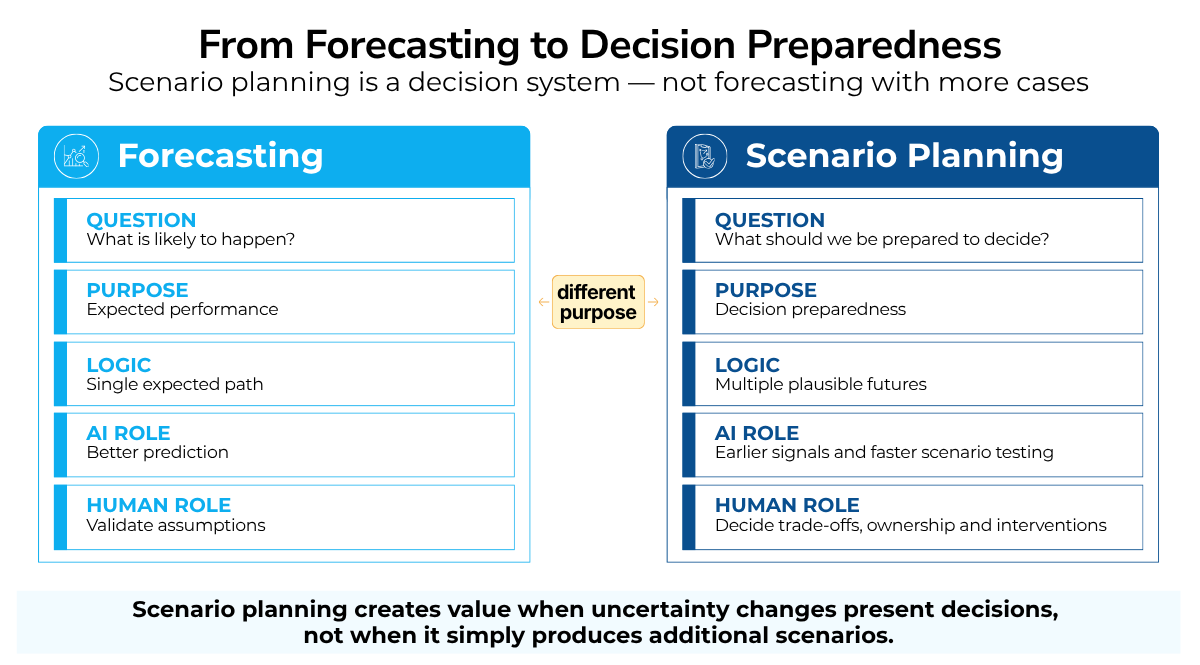
Figure 1. Forecasting vs. Scenario Planning: From Expected Performance to Decision Preparedness
3. Scenario Planning Is a Decision System
Scenario planning is often treated as a modelling layer around the forecast: base case, downside case, upside case and perhaps a stress case. That structure is useful, but incomplete. A scenario becomes management-relevant only when it changes how the organisation prepares to make decisions under uncertainty.
For FP&A, the purpose of scenario planning is not to predict the future more precisely. It is to make uncertainty governable. That requires more than alternative numbers. It requires a decision system that connects seven steps: Detect, Frame, Simulate, Trigger, Decide, Act, and Learn.
Together, these steps move scenario planning from identifying uncertainty to preparing accountable management action. The important distinction is that a scenario is not complete when alternative outcomes have been modelled. It becomes decision-ready when management knows which signals matter, when escalation should occur, who owns the response and which intervention options are available.
This changes the management question. Instead of asking whether the downside case is numerically correct, FP&A asks whether the organisation knows what it would do if the downside case starts to materialise. The test is not scenario sophistication. The test is decision readiness.
The next article applies this seven-step logic in practice, showing how FP&A can connect scenarios to signals, triggers, decision rights, actions and explicit trade-offs.
4. Where AI Helps — and Where It Does Not
AI strengthens scenario planning only where it improves the decision system. The relevant question is not whether the organisation can generate more scenarios. The relevant question is whether scenario work becomes more specific about weak signals, fragile assumptions, trigger points and management action.
The first contribution is earlier signal detection. Scenario planning often starts too late because relevant shifts first appear at lower levels than aggregate financial reporting. Demand risk may emerge in order patterns, product usage, quote conversion, service tickets or channel activity. Margin pressure may appear in discount approvals, freight concessions, mix changes or cost-to-serve patterns. Cash pressure may become visible through payment behaviour, dispute frequency, inventory build-up or supplier exposure. Predictive models can improve pattern recognition and estimation, but they do not by themselves define the management decision (Shmueli and Koppius, 2011).
The second contribution is driver connection. Many scenarios are still built around financial outcomes: lower revenue, higher cost, weaker margin or tighter liquidity. That is not wrong, but it is incomplete. A decision-relevant scenario has to show which business drivers create the outcome. A downside case should not only show lower EBIT. It should indicate whether the pressure comes from volume loss, price resistance, mix deterioration, service intensity, supplier constraints, inventory build-up or delayed collections.
The third contribution is scenario discipline under time pressure. When uncertainty changes quickly, FP&A may need to test combinations of demand, price, cost, cash, and capacity assumptions more quickly than the normal planning cycle allows. Analytical models can shorten that cycle by identifying sensitivities and pressure points. Prescriptive analytics can support the comparison of action options, but only when objectives, constraints and decision variables are explicitly defined (Bertsimas and Kallus, 2020). Speed does not create quality by itself. A faster scenario process still fails if it does not define which scenario matters, which signal confirms it and which decision follows.
The fourth contribution is trigger monitoring. Scenario planning becomes more useful when it moves from a planning document to an active management routine. A demand-risk, cash-stress, or margin-pressure scenario should have observable indicators. If those indicators move beyond agreed thresholds, the organisation should know which issue is being escalated, who owns the response and which intervention options are available. Without that link, scenario planning remains descriptive.
The boundary is equally important. AI does not decide which future the organisation should prefer. It does not decide which customer relationships are strategic, which margin risk is acceptable, which liquidity risk is tolerable, which capacity should be protected or which cost action is commercially safe. Those decisions involve risk appetite, strategic priorities, customer economics and organisational trade-offs. They remain management decisions. Decision objectives, trade-offs, risk tolerances, accountability and human oversight remain management responsibilities rather than outputs that can be delegated to a predictive system (Fernández-Loría and Provost, 2022; NIST, 2023).
There is also a causal boundary. A model may show that demand weakness, discount pressure and inventory build-up occur together. That does not prove which driver caused the pattern or which intervention will improve the outcome. Scenario planning, therefore, requires FP&A to separate correlation, explanation and decision logic. The analytical output may indicate where management should look. It does not, by itself, determine what management should do.
The useful role of AI in scenario planning is therefore bounded. It can improve detection, driver connection, scenario testing and trigger monitoring. It can prepare better evidence for management review. It can show which assumptions deserve challenge. But it does not replace the decision architecture around scenarios: trigger points, decision rights, intervention options, escalation routines and accountability.
This boundary also protects the quality of management dialogue. If AI outputs are treated as decisions, the organisation may confuse statistical confidence with managerial commitment. If AI outputs are treated as structured evidence, they can improve challenge, escalation and preparedness without displacing accountability. The practical design question is therefore not how far AI can go technically, but where human judgement must remain explicit for the scenario to become governable.
For FP&A, the practical test is not whether scenario planning becomes more sophisticated. The test is whether the organisation becomes more prepared. If a scenario does not clarify a trigger, owner, action or trade-off, it remains an analytical output. It has not yet become decision capability.
For senior FP&A leaders, this changes the role of scenario planning from producing alternative financial views to governing when uncertainty should change the management agenda.
5. Conclusion: The Shift FP&A Needs to Make
Scenario planning becomes valuable when it changes what management is prepared to do. That is the central difference between scenario modelling and scenario management. Scenario modelling compares alternative futures. Scenario management defines how the organisation will recognise, escalate, and respond when one of those futures becomes decision-relevant.
This is why scenario planning should not be treated as an extension of forecasting. Forecasting asks what is likely to happen. Scenario planning asks what the organisation should be prepared to decide if the future develops differently. The first improves expectation. The second improves preparedness.
AI can strengthen this capability by detecting weak signals earlier, connecting drivers more granularly, testing plausible futures faster and monitoring trigger conditions. But AI does not define risk appetite, decide strategic trade-offs or assign accountability. Those remain management responsibilities.
For FP&A, the practical standard is therefore clear. A scenario is not complete when the model balances. It is complete when it has a signal, a trigger, an owner, an intervention range and an explicit trade-off. Without these elements, scenario planning may create useful analysis, but it does not yet create decision capability.
The next step is operational. If scenario planning is a decision system, FP&A needs a practical way to turn scenarios into signals, triggers, owners, actions and trade-offs. That operational handover is the focus of the second article.
Continue to Part 6: Turning Scenarios into Management Action, which examines what must happen after a scenario has been developed.
References
Bertsimas, D., and Kallus, N. (2020). From predictive to prescriptive analytics. Management Science, 66(3), 1025–1044.
Courtney, H., Kirkland, J., and Viguerie, P. (1997). Strategy under uncertainty. Harvard Business Review, 75(6), 67–79.
Fernández-Loría, C., and Provost, F. (2022). Causal decision making and causal effect estimation are not the same... and why it matters. INFORMS Journal on Data Science, 1(1), 4-16.
NIST. (2023). Artificial Intelligence Risk Management Framework (AI RMF 1.0). National Institute of Standards and Technology.
Schoemaker, P. J. H. (1995). Scenario planning: A tool for strategic thinking. Sloan Management Review, 36(2), 25–40.
Shmueli, G., and Koppius, O. R. (2011). Predictive analytics in information systems research. MIS Quarterly, 35(3), 553–572.
Simons, R. (1995). Levers of Control: How Managers Use Innovative Control Systems to Drive Strategic Renewal. Harvard Business School Press.
van der Heijden, K. (2005). Scenarios: The Art of Strategic Conversation (2nd ed.). Wiley.
Wack, P. (1985). Scenarios: Uncharted waters ahead. Harvard Business Review, 63(5), 73–89.
The full text is available for registered users. Please register to view the rest of the article.
Related articles

How FP&A thinking transforms treasury from liquidity reporting into a driver-based, insight-led function that explains and...

In this article, we explore how FP&A leaders can modernise traditional budgeting through a hybrid model...

In this article, discover how Strategic Foresight enables FP&A leaders to navigate uncertainty, anticipate structural change...

In this article, discover how integrating Strategic Foresight into FP&A unlocks better scenario planning, long-term adaptability...

In this article, the author explains how AI is transforming FP&A from a reporting function into...
+
Subscribe to
FP&A Trends Digest

We will regularly update you on the latest trends and developments in FP&A. Take the opportunity to have articles written by finance thought leaders delivered directly to your inbox; watch compelling webinars; connect with like-minded professionals; and become a part of our global community.