

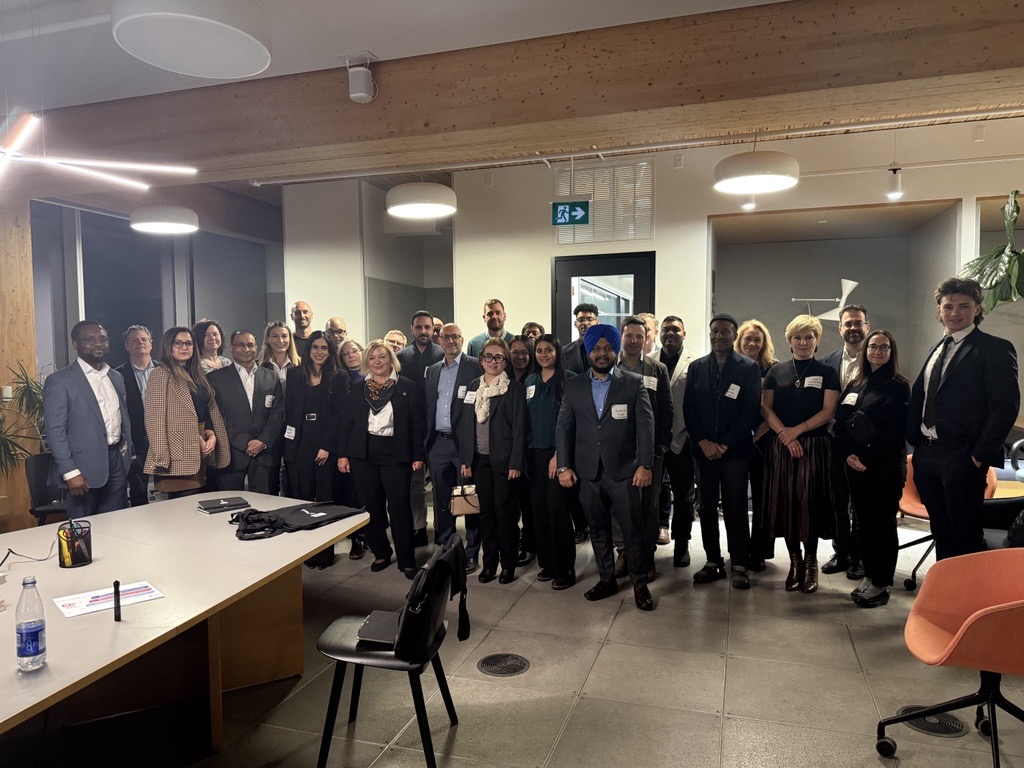
On March 5, 2026, I had the opportunity to attend the Toronto FP&A Board #10, hosted by the International FP&A Board. This meeting was sponsored by Wolters Kluwer CCH Tagetik, in partnership with isgSearch and IWG. The session brought together finance professionals to explore a question that continues to shape our roles:
How can FP&A evolve from transactional support to true strategic business partnering?
At its core, this question is not about improving analysis but about redefining the role of FP&A from reporting the past to actively shaping business decisions and driving impact.
The discussion combined global research, a real-life case study, and interactive group work, leading to a very practical and insightful exchange.
The Shift: From Reporting to Insight-Driven Decision Making
One of the strongest themes throughout the session was the evolution of FP&A’s role.
Historically, FP&A has been:
- Budget-focused
- Time-consuming
- Reactive
Today, expectations are shifting toward:
- Faster insights
- More business questioning
- Proactive decision support
FP&A is no longer just about explaining what happened. It is about understanding why it happened and what actions should follow. Some organizations remain focused on reporting and control, while others are progressing toward a more strategic role — actively influencing decisions and helping the business navigate uncertainty.
What Does Best-in-Class FP&A Business Partnering Look Like?
As highlighted during the session, FP&A business partnering is about going beyond reporting numbers to tell the story behind them, enabling better decisions and driving real change within the organization.
Best-in-class FP&A business partners combine both soft and technical capabilities, including collaboration, the ability to challenge the business, strong analytical thinking, and the ability to educate and influence stakeholders.
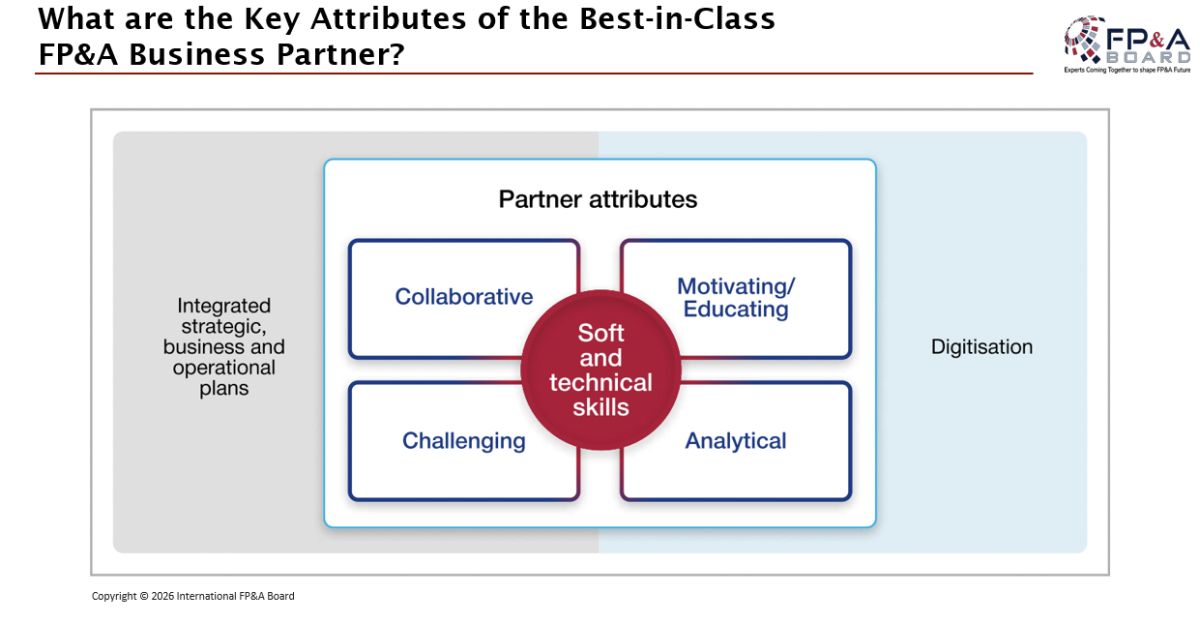
Figure 1
This is supported by a broader framework that includes business knowledge, leadership and influence, communication skills, advanced analytics, and effective use of technology.
As organizations evolve, FP&A roles typically progress through maturity stages — from transactional processing and analytical reporting to more advanced roles such as strategic controller, influential advisor, and ultimately predictive leader, where finance actively shapes business outcomes.
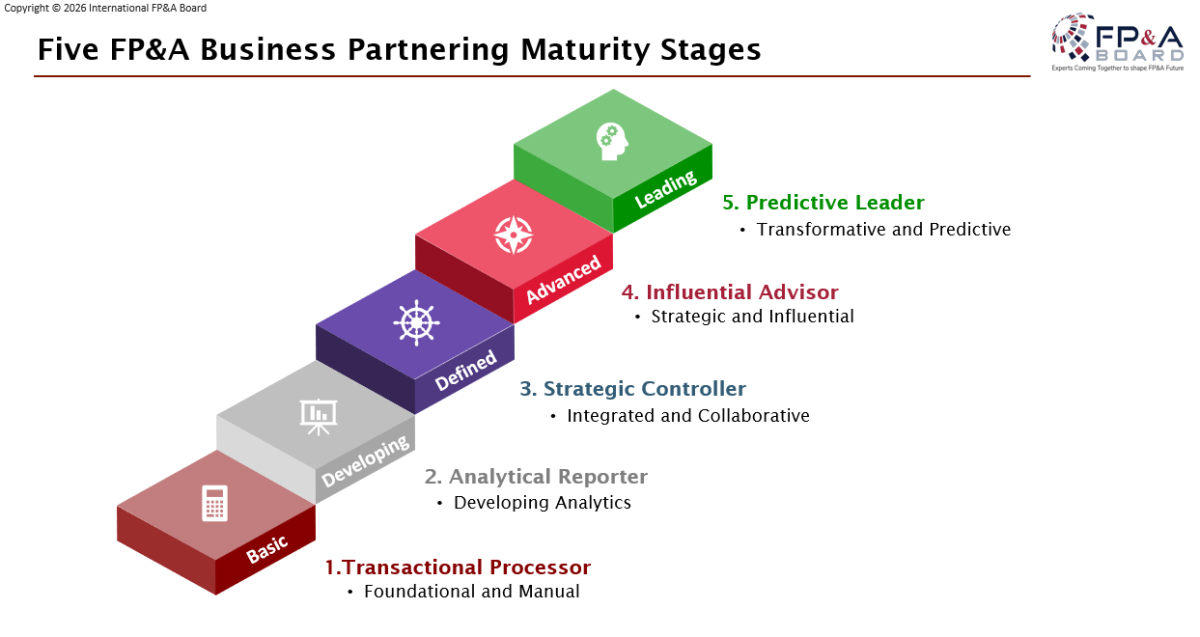
Figure 2
Breaking the Barriers to True Business Partnering
During the group discussion, participants were asked:
What is the biggest barrier preventing FP&A from being a true business partner?
A key takeaway from my group was:
Fear remains a major barrier
In Canada, hesitation often comes from:
- Cost concerns
- Risk of failure
In more mature environments, such as the US, the focus shifts toward:
- Speed of adoption
This connects closely with broader challenges highlighted in the session:
- Data accuracy and visibility
- Trust and relationships
- Culture and mindset
Moving forward is not just about tools. It requires a shift in mindset and a willingness to act.

From Data to Insight: The Role of Technology and AI
A major theme was how FP&A teams can move away from manual data work and focus more on analysis.
Key enablers include:
- Business Intelligence teams
- Helping take ownership of data processes so finance can focus on insights.
- AI and automation
Supporting:
- Data cleanup
- Data transformation
- Note-taking and summarization
- Scenario modeling and forecasting
Agentic AI
The next step in the evolution is where systems initiate analysis and FP&A focuses on decision-making. As highlighted during the session:
The system starts the analysis, and FP&A makes the decisions.
The Rise of Predictive and Real-Time FP&A
A clear gap exists between where organizations are today and where they aim to be. Many finance teams are still focused on historical reporting and reactive analysis, while leading organizations are moving toward more predictive and forward-looking capabilities. This shift is enabled by advanced analytics and integrated technology, allowing FP&A to move beyond reporting toward anticipating outcomes and supporting faster, more informed business decisions.
As organizations progress along the FP&A maturity journey, predictive and real-time capabilities become increasingly important in enabling finance to act as a true business partner.
This presents a strong opportunity to move toward:
- Predictive forecasting
- Driver-based planning
- Real-time scenario analysis
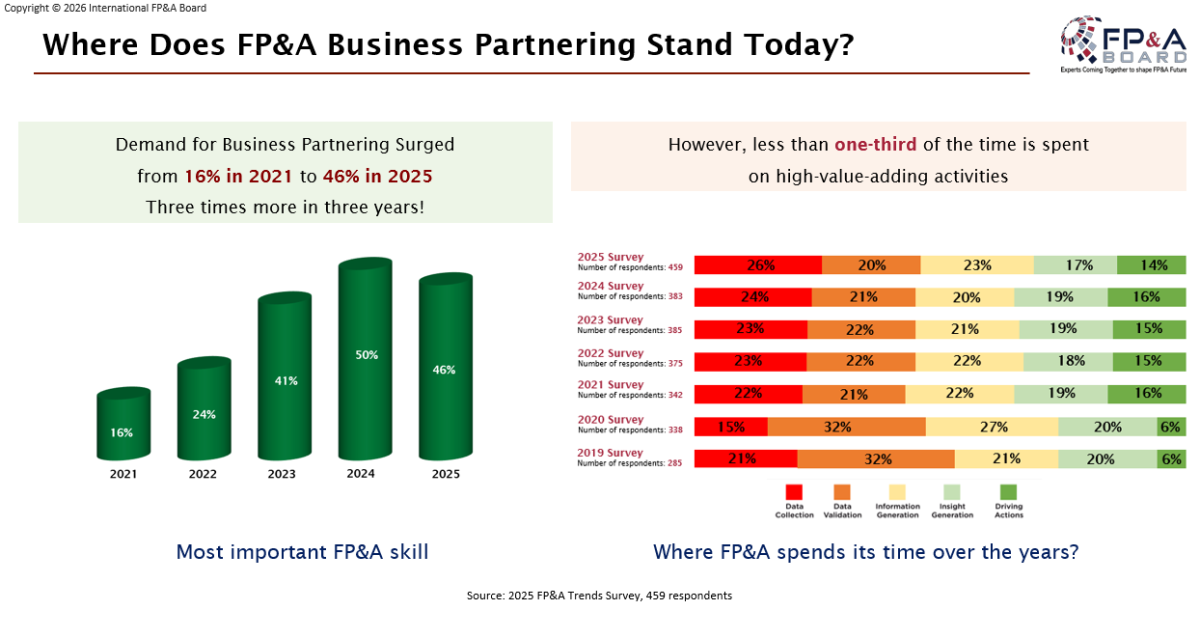
Figure 3
Case Study Insight: From Fragmentation to Integration
The session featured a case study from Right Time Group of Companies, presented by Salil Aggarwal, Director of Finance at Right Time (“RT”).
Challenges:
- Fragmented systems
- Lack of real-time data
- Inefficient processes
- Delayed insights
Solution:
- Centralized and integrated data
- Driver-based models
- Modern technology and automation
Outcome:
- Improved agility
- Faster decision-making
- Stronger collaboration
The key takeaway was clear:
Technology alone is not enough. Integration and change management are critical.
Bringing Agentic AI to Finance
Following the case study, Jonathan Gurnham, Technology Sales Support Manager at Wolters Kluwer CCH Tagetik, introduced the concept of Agentic AI in FP&A, highlighting a shift from reactive tools to systems that actively drive analysis.
Traditionally, FP&A workflows are human-initiated. With Agentic AI, systems can:
- Detect patterns and anomalies
- Initiate analysis
- Support real-time insights
This shifts FP&A’s role from executing analysis to guiding and governing decisions. AI agents, as discussed, are goal-oriented systems capable of automating tasks such as:
- Predictive forecasting and variance analysis
- Scenario modeling
- Narrative reporting
Key takeaway:
Agentic AI is not about replacing FP&A; it's about enabling teams to spend less time on data and more time driving strategic impact.
Group Work Outputs:
Participants split into three groups to discuss key questions on how FP&A in Canada can evolve into a more strategic business partner, focusing on operating models, capabilities, and the role of technology.
The three groups explored:
- Group 1: How organizations can implement a best-in-class FP&A business partnering model to move from transactional to strategic
- Group 2: How FP&A teams can develop the skills and capabilities needed for effective business partnering
- Group 3: How FP&A can leverage AI, automation, and technology to focus less on data gathering and more on insights

Group 1: Foundations for Transformation
- Curated and clean data is essential
- Strong business acumen is critical
- Technology enables but does not replace thinking
- Continuous upskilling is required
Group 2: Skills and Capabilities That Matter
- Curiosity and open-mindedness
- Adaptability and willingness to challenge the status quo
- Strong collaboration
- Forward-looking mindset
- Speed and agility
- Tech-savviness
The key theme was the need to bridge finance and technology.

Group 3: Leveraging AI for Value Creation
- Predictive forecasting
- Driver-based modeling
- Automated data gathering and mapping
- AI-powered note-taking and summarisation
- Idea generation and storytelling
- Using AI as a central support tool
AI should reduce manual work and allow FP&A to focus on higher-value activities.
Across all groups, a common theme emerged: becoming a stronger business partner requires both capability development and a shift in mindset from reporting to influencing decisions.
The Human and AI Equation in FP&A
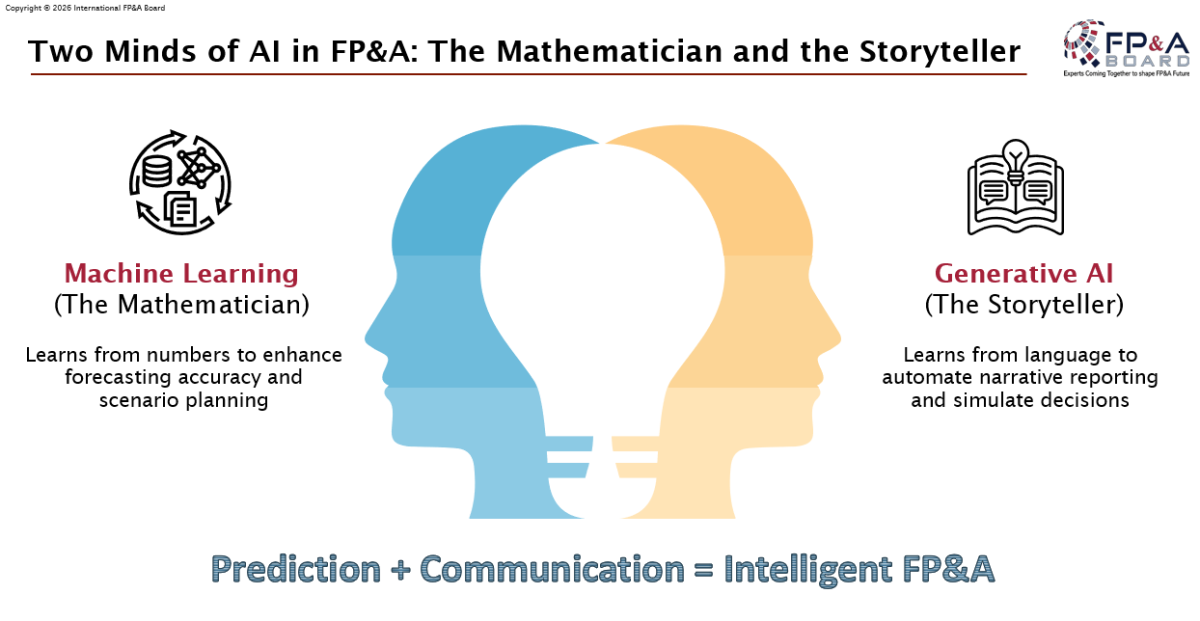
Figure 4
One of the most interesting concepts discussed was the idea of two roles of AI:
- Machine Learning as a mathematician, focused on prediction
- Generative AI as the storyteller, focused on communication
Together, they enable a more complete FP&A function, strengthening both insights and narratives.
Final Reflections
This session reinforced that FP&A transformation is not just about adopting tools. It is about redefining how we operate.
To move from transactional to strategic, FP&A teams need to:
- Build trust with stakeholders
- Invest in data quality and governance
- Leverage technology and AI effectively
- Strengthen both technical and business skills
- Focus on storytelling and influence
And most importantly, overcome the fear of change.
Closing Thought
The question is no longer whether FP&A can become a true business partner. The real question is:
How quickly can we get there, and how much value can we unlock along the way?
The real shift is not from data to insight, but from insight to impact, where FP&A plays a central role in shaping decisions and driving business performance.