

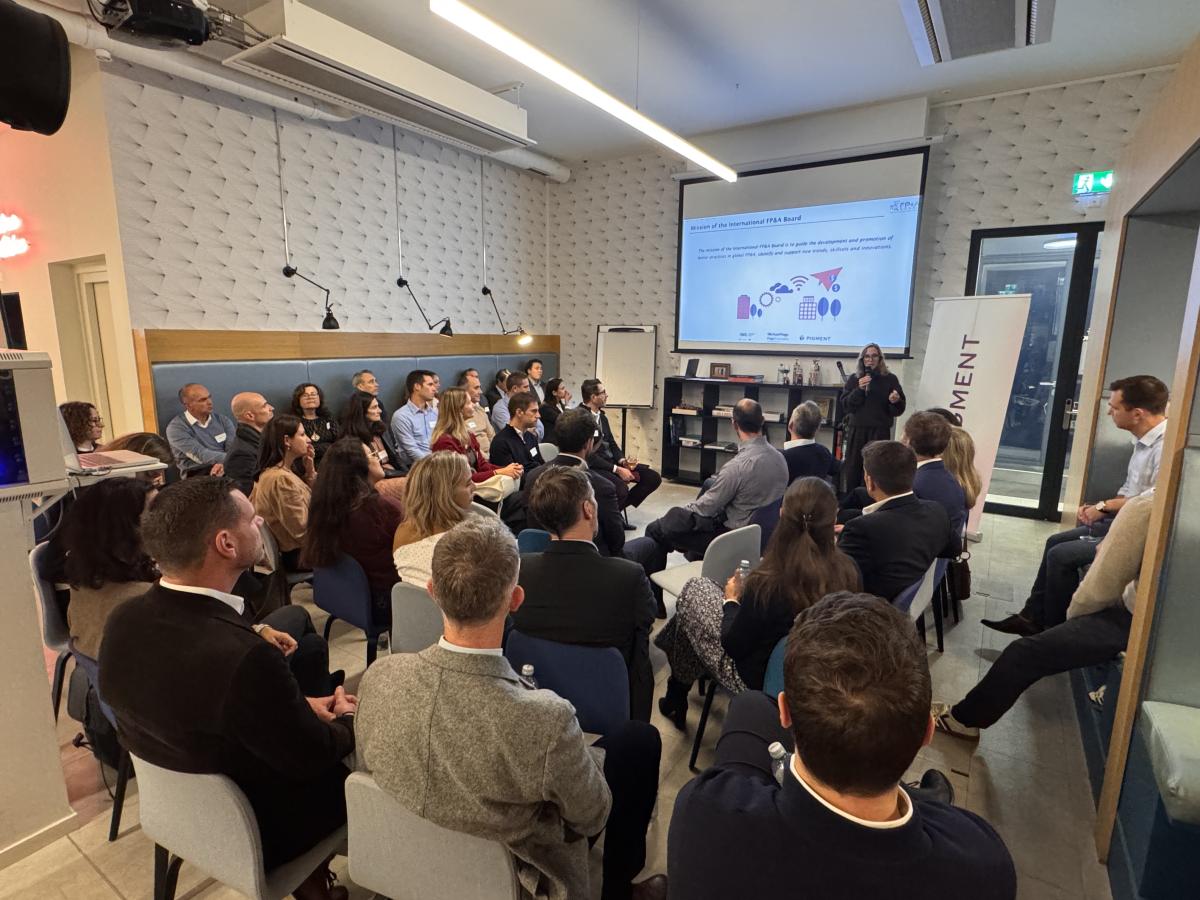
Most FP&A transformations do not fail because of technology. They stall because people keep working the old way after the new platform goes live. That was the central message of the 20th Geneva FP&A Board, the 309th meeting globally, which took place on 5 November 2026. The discussion addressed a question facing finance leaders today: how do we lead change in FP&A when AI is reshaping the function faster than our teams can adapt?
Since its launch in June 2016, the Geneva chapter has become a regular meeting point for finance practitioners across industries. Marking ten years of the Geneva Board, this session, Leading FP&A Change in the AI Era, combined fresh research, a live product demonstration and hands-on group work. It was organised by the International FP&A Board, sponsored by Pigment, in partnership with Michael Page, Page Executive and IWG, and, as always, the Board stayed vendor-agnostic in its discussions.
The Adoption Gap: Implementation Is Not Adoption
The evening opened with a quick warm-up. In small groups, we had to agree on one word that most often stops change from sticking. The answers echoed those from the Munich, Frankfurt and San Francisco chapters: discomfort, uncertainty, buy-in, leadership, persistence.
The data that followed explained why. According to the 2026 FP&A Trends Survey (475 respondents), FP&A teams still spend 47% of their time collecting and validating data, exactly the same share as in 2020. Six years of new tools have barely moved the needle. The survey also found that 58% of FP&A transformation priorities focus on technology, data and systems, compared with 24% on business partnering and team capabilities.
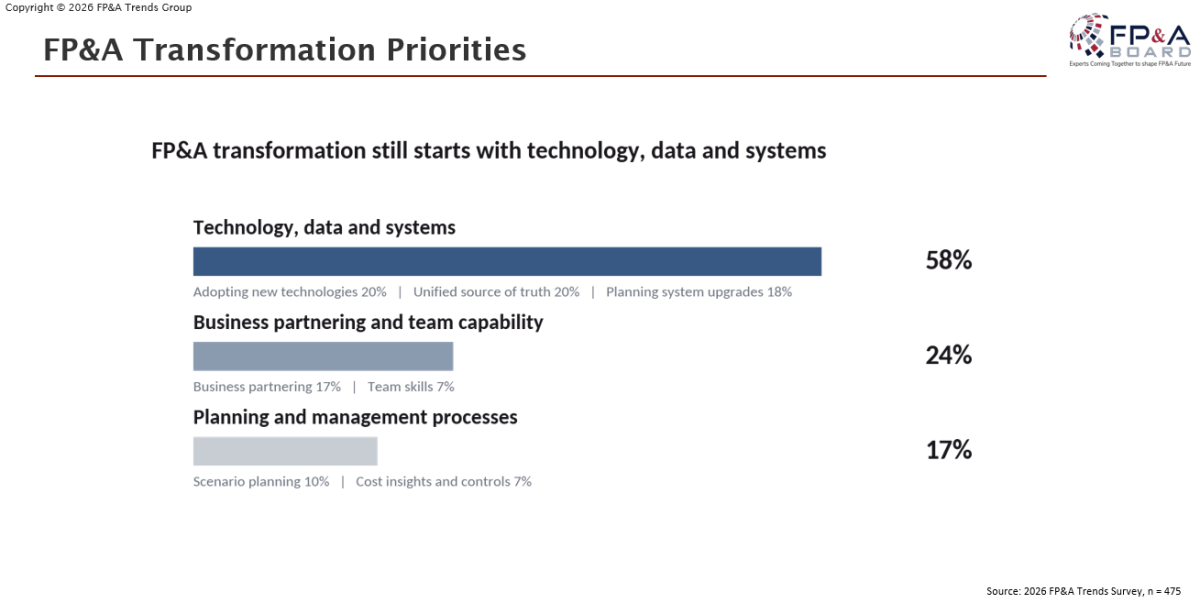
Figure 1
A June 2025 FP&A Trends webinar poll pointed to the root cause: 62% of the barriers identified were people-related, led by skill gaps (30%), resistance to change (23%) and unclear accountability (9%).
In short, technology may be implemented while behaviour remains unchanged. A platform can be live while nothing about the work has changed.
The FP&A Change Leadership Framework
The core of the session drew on the new FP&A Trends Insights Paper Managing Change in FP&A. Its starting point is the "Lag Tax": the commercial cost paid every day between a business event and the organisation's response to it. The paper gives a telling example: a pricing committee took eleven days to react to a competitor's price cut because the new platform was not yet trusted. The platform could have answered in an afternoon.
The paper also explains why FP&A change is harder than it looks. Communication and training sit visibly above the waterline. Below it lie the forces specific to finance: professional identity built on Excel, the instinct for control, asymmetric career risk, and a legacy tool that still "works".
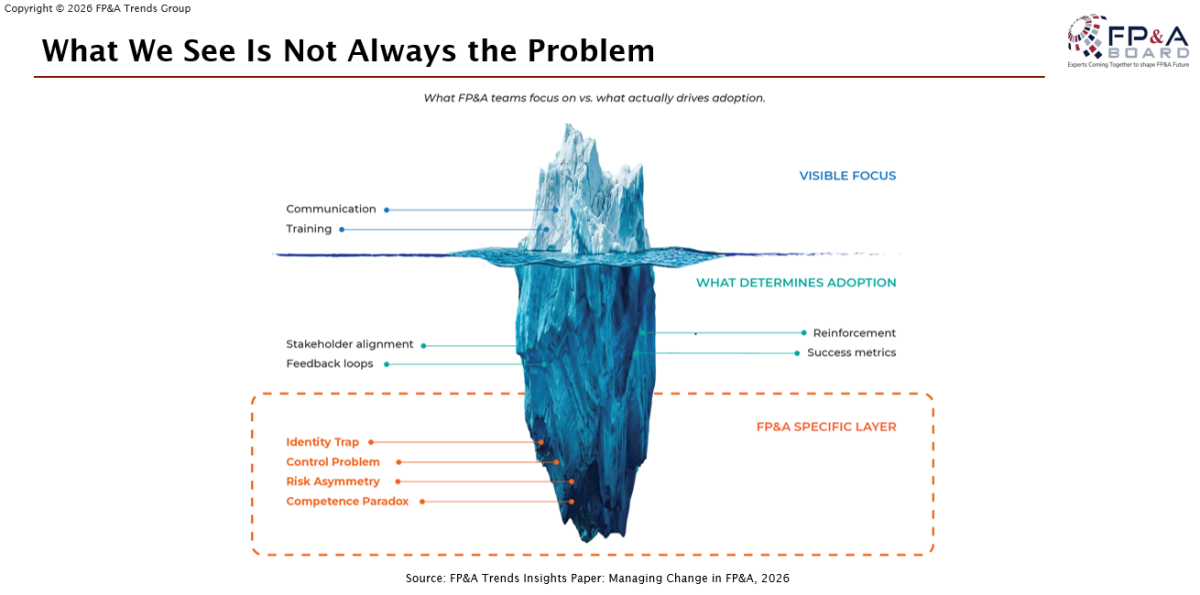
Figure 2
Also, the research shows that organisations placing people at the centre of a transformation are 2.6 times more likely to succeed.
The framework sets out five leadership responsibilities:
- Lead the case for change
- Prepare the organisation
- Enable people and capabilities
- Execute the change
- Reinforce the new way of working
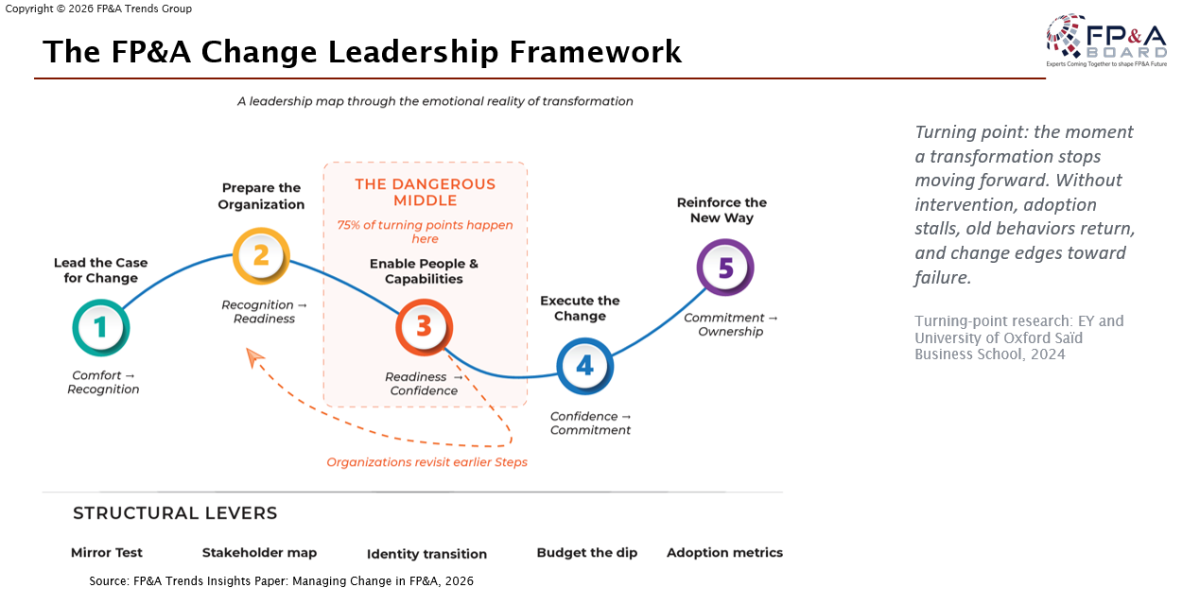
Figure 3
The most sobering point concerned the "dangerous middle". Transformations rarely fail at the start; they fail when turning points are missed. 96% of transformations hit at least one turning point, and 75% of those happen during planning or early implementation. Organisations whose leaders act early and systematically are 12 times more likely to come through stronger. One line stayed with many of us: running the old process alongside the new platform is the most expensive form of organisational distrust.
AI in Practice: From Assistants to Agents
AI adoption in finance is moving incredibly fast. A poll across the Seattle, Frankfurt, and Zurich FP&A Boards (March–Nov 2026, 76 respondents) found that 53% of finance teams use generative AI, 49% already use AI agents, 22% use machine learning, and 20% do not use AI at all. Yet, as the Board noted, AI magnifies the adoption problem rather than solving it: an agent acting on data nobody trusts simply spreads the distrust faster. The other danger comes from managers using their own set of AI skills to build their prompts and agents, and, as a result, getting analytics and reports that do not reconcile.
The discussion then turned to the practical application of AI in FP&A. Adrien Lambert, Pre-Sales at Pigment, demonstrated how AI agents could support the annual budgeting process, from model adjustments and scenario planning to variance analysis and reporting.
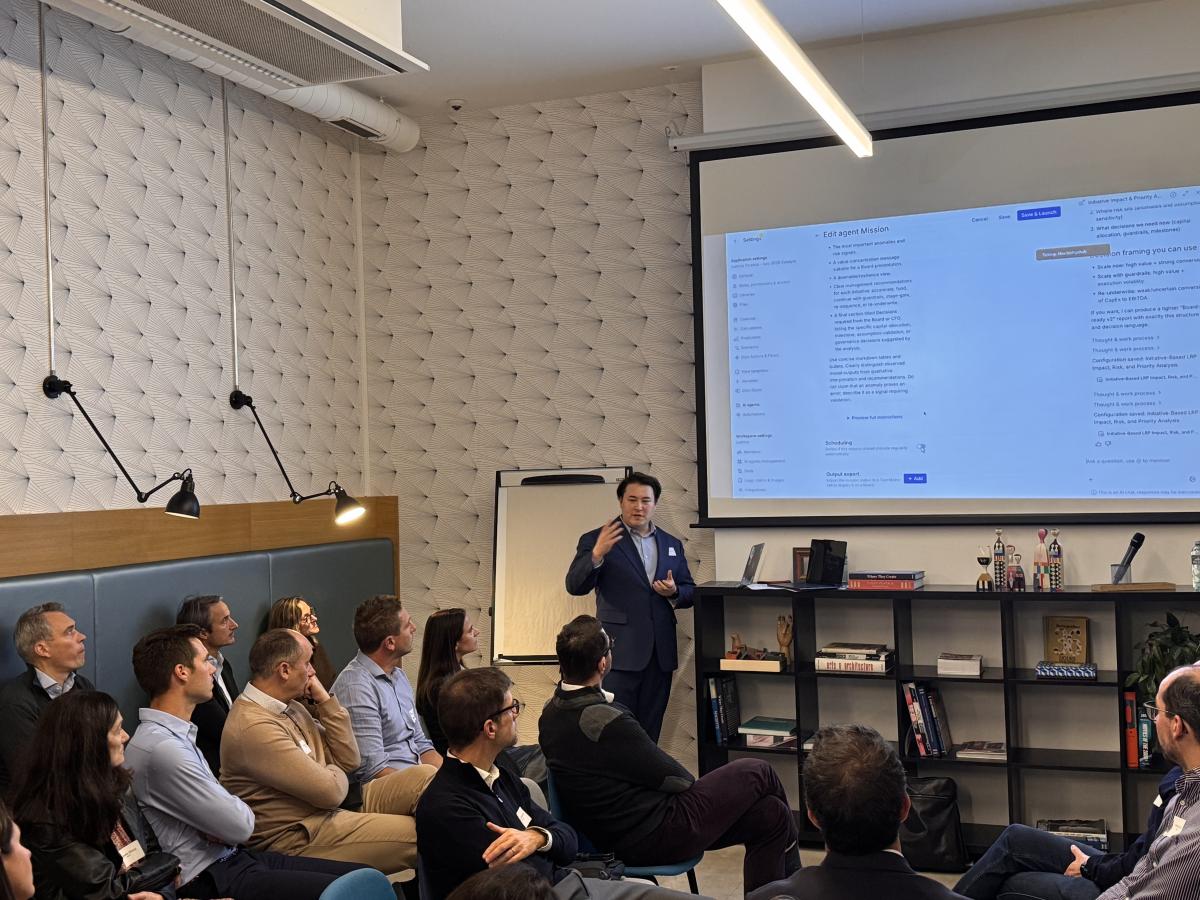
The demonstration focused on three AI agents:
Instant model architecture changes. The Modeller Agent builds and alters the budgeting architecture itself. Finance teams can modify dimensions and structures, or add entire business lines, using plain-language commands.
Dynamic recommendations and continuous projections. The Planner Agent evaluates operational performance against current market variables and recommends courses of action, enabling faster scenario building and more accurate rolling forecasts.
Automated variance analysis and reporting. The Analyst Agent monitors budget data in the background, flags anomalies, isolates root causes of deviations (such as vendor-level transaction spikes or regional churn) and drafts narrative executive summaries with charts and KPIs.
The AI experimentation should run on shared, governed data and ready-made tools, with the AI ambassadors (finance and other functions) making sure local ideas reconcile with the officially reported numbers.
Making Change Stick: Enable, Execute, Reinforce
In the group work, each table took one part of the implementation method and agreed on practical actions:
Enable: build capability, identity, confidence and capacity. Understand the politics before designing the solution, address professional identity alongside skills, and make enterprise data literacy a project deliverable. Sell the commercial relief, not the platform.
Execute: make the new way the only way. Kill the shadow spreadsheets, realign incentives before go-live rather than after, and move from "precisely wrong" to "nearly right". Do have a buffer for the worst-case scenario and a budget plan for the "valley of despair" that follows every launch. Grow and support early adopters and incorporate feedback sessions to check the “pulse” on execution and adoption phases.
Reinforce: make adoption visible and sustained. Measure return on adoption, not just go-live. Leaders should be role models to regularly use the new outputs in leadership meetings. The new KPIs should be followed; the old & unnecessary ones should be killed.

Conclusion: What We Learned
Implementation is not adoption. A platform can be live while nothing about the work has changed.
AI magnifies the adoption problem. Trusted data and clear ownership must come before agents.
Resistance is rational and carries information. It usually signals untrusted data, unclear decision rights, or no capacity to learn the new way.
Trust is earned by proof, not instruction. Show where the system was right and where it was wrong, then expand.
Every change needs a named thing that ends. If nothing stops, transformation simply becomes additional work.
My Recommendations for AI Implementation
The discussion confirmed a few basics: give the finance team access to AI, rethink whole workflows rather than single reports, keep humans accountable for judgment, and measure results rather than AI adoption itself. To these, I would add two recommendations of my own:
Don't reinvent the wheel. Check first what can be outsourced to AI-specialised companies. Many offer ready-made, Lego-type building blocks that are easy to set up and implement, and are far quicker than a costly, time-consuming in-house build.
Grow an in-house team of AI Finance experts and ambassadors. They make the right adjustments to the solutions you adopt, generate new, smaller-range ideas, and carry adoption across the function.
A Window for the Next Generation of Finance Leaders
This matters for careers, too. Crist Kolder projects CFO turnover at Fortune 500 and S&P 500 companies to reach 18.3% in 2026, the highest since 2019 and well above the ten-year average of 16%. Newly appointed CFOs are also getting younger: their average age fell to about 48, from 52 in 2025. According to Russell Reynolds, first-time CFOs made up 64% of new appointments in the first half of 2026. Boards are betting on people who have not yet held the title, and those who combine solid FP&A foundations with hands-on AI experience are best placed to step up.
What I appreciated most was the openness of the exchange and the real-life challenges participants were willing to share. A special thank you to Christine Fromont, who stepped into the big shoes of the Board's founder, Larysa Melnychuk, and guided us through the evening.
A big thank you also to the International FP&A Board for organising the session, to Pigment for sponsoring it, to Adrien Lambert for the live demonstration, and to Michael Page, Page Executive, and IWG for supporting the event.