

If there is one thing today’s FP&A leaders agree on, it is this: uncertainty is no longer a temporary disturbance; it is the operating environment itself. Yet most organisations still struggle to plan for it. Finance leaders need to adapt — not only to “keep up” with an increasingly dynamic environment, but also to elevate their role as effective co-pilots to the business.
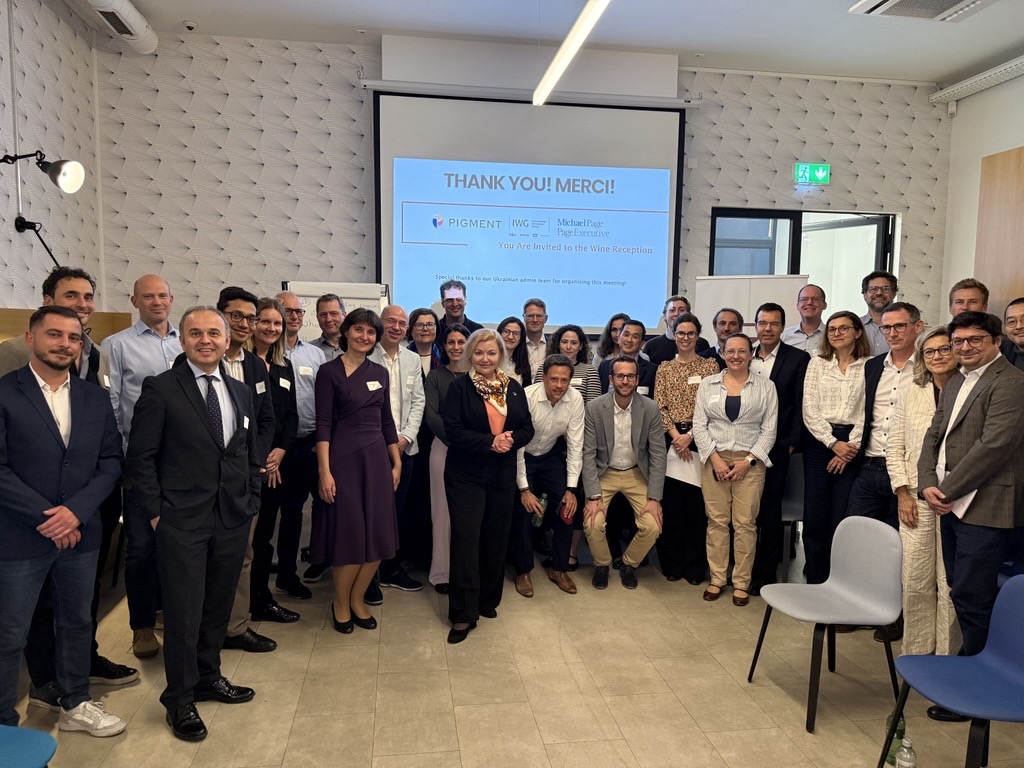
The 19th Geneva FP&A Board convened on May 12, to tackle a pressing question: What does Agile FP&A really mean, why is it needed, and how do we move from aspiration to practice? The meeting brought together practitioners from across industries for candid discussion, practical examples, and hands-on group work.
The event was organised by the International FP&A Board, sponsored by Pigment, in partnership with Michael Page, Page Executive and IWG, and, to say it right away, it was quite an inspiring, open exchange, full of examples.
Introduction: The Challenge of Planning in an Uncertain World
The session opened with a simple but powerful framing:
“If there’s one thing that’s certain in business, it’s uncertainty.”
That observation led to the Uncertainty Cone concept: the predictability span is shrinking, and beyond that span organisations must manage multiple plausible futures rather than a single “most accurate” forecast. Hence, the need for agile and focused scenario planning is evident.
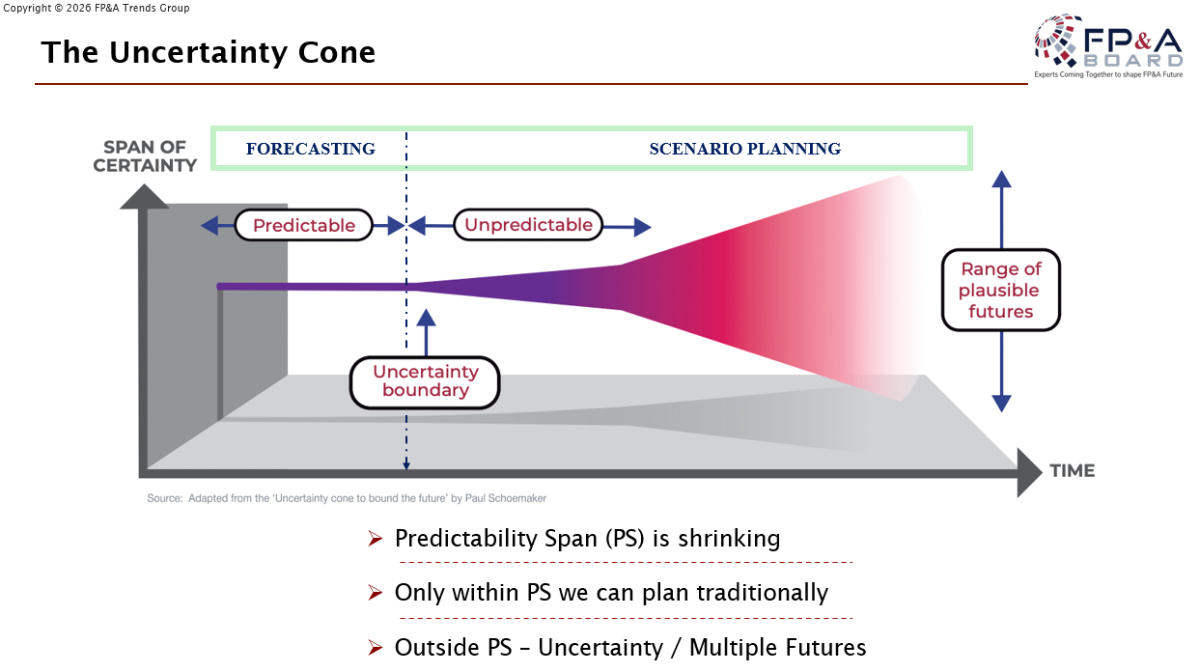
Figure 1
What is Agile FP&A
After a quick warm-up exercise, we turned to a practical definition. In essence:
Agile FP&A empowers organisations to quickly adapt to market shifts while maintaining financial stability and shareholder value. It relies on three interlocking pillars:
Integrated Processes & People
Technology & Analytics
Rather than chasing a single perfect forecast, Agile FP&A emphasises anticipation and adaptability. It is focused on scenario management, monitoring continuous signals, and rapid decision cycles. The integration of planning processes & people across the organisation moves centre-stage.
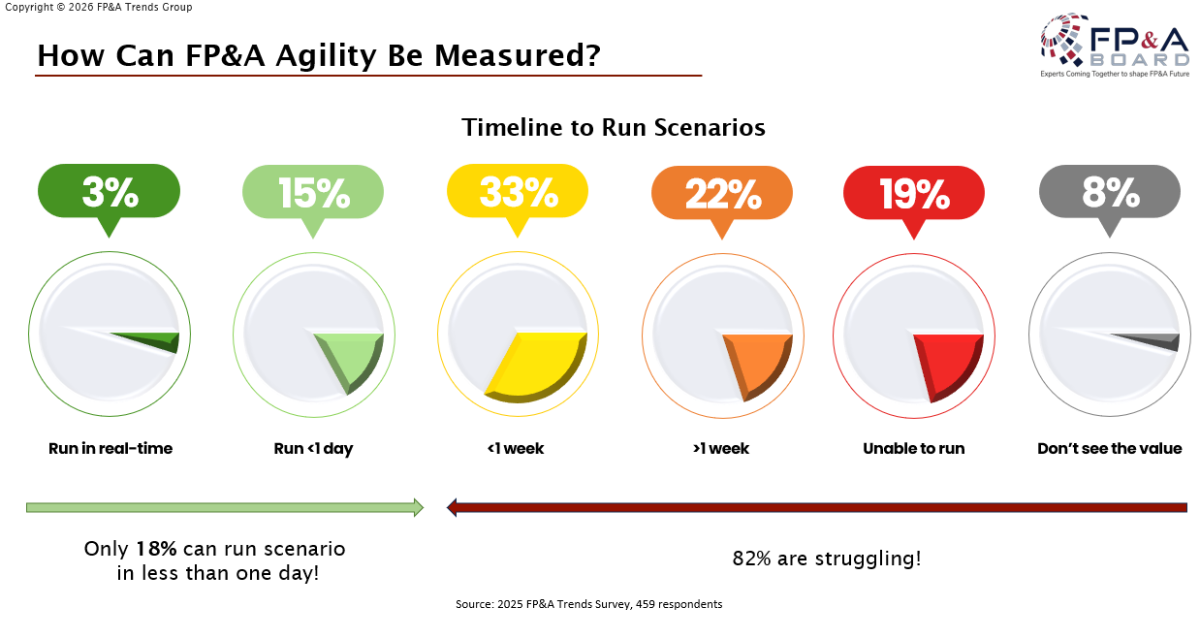
Figure 2
A Reality Check: Why Many Organisations Struggle
This is a great aspiration. But in reality, many organisations find it difficult to advance on practical solutions, as evidenced by numerous surveys the FP&A board has conducted:
Only 18% of respondents can run scenarios in under 1 day; the majority take about 1 week or more.
FP&A teams still spend nearly half their time on data collection and validation.
Only 17% of organisations use fully driver-based models.
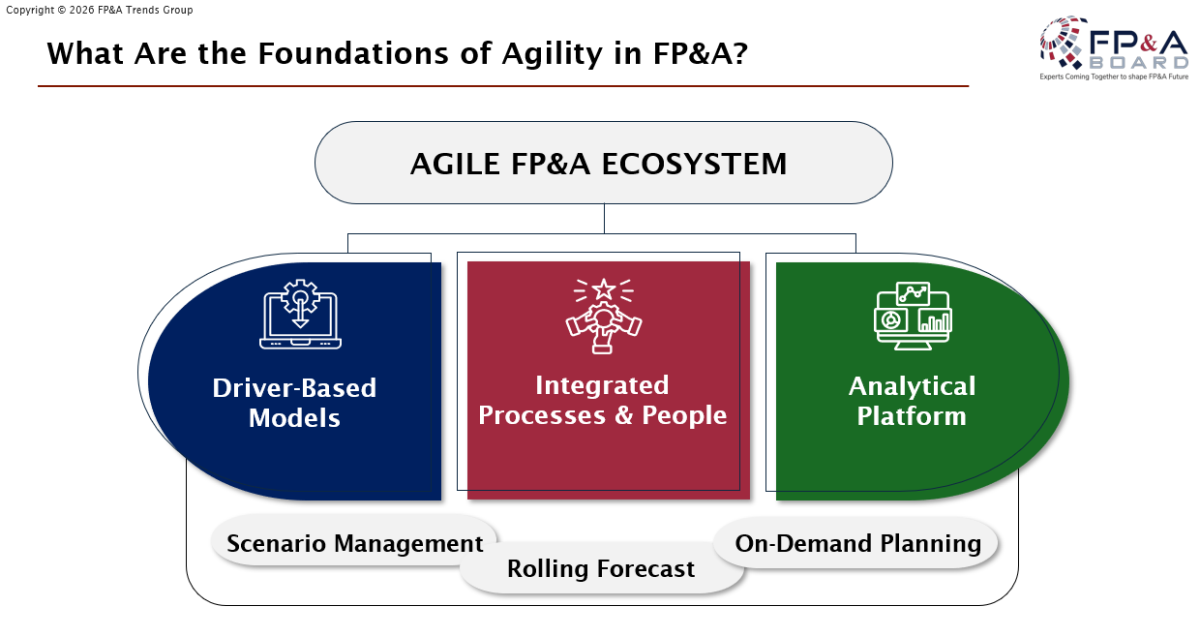
Figure 3
Agile FP&A depends on driver-based models, integrated processes and people, and analytical platforms that enable scenario management, rolling forecasts, and on-demand planning.
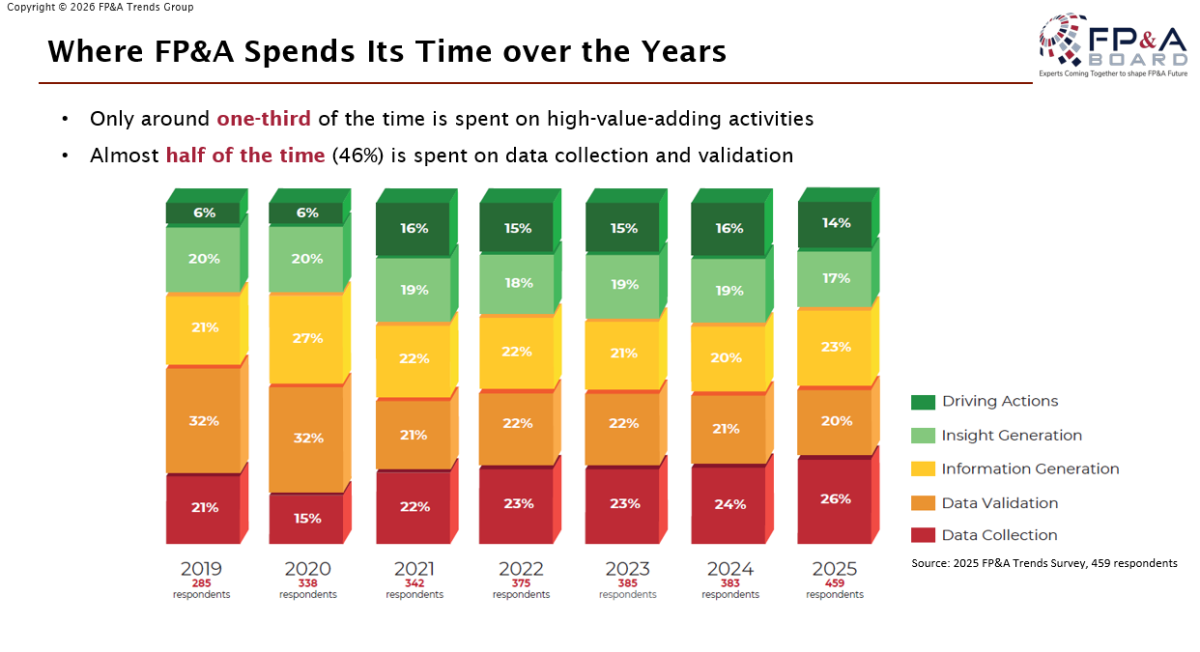
Figure 4
Together, these findings reveal a clear agility gap. Many organisations want faster scenario planning, but their FP&A teams are still constrained by manual data work, limited driver-based modelling, and fragmented decision processes. The issue is not only the speed of calculation; it is whether finance can convert changing assumptions into timely, trusted decisions.
Pillar 1: Driver-Based Planning — Keep It Material and Dynamic
Financial outcomes result from business drivers, whether internal or external. Embedding these drivers in the heart of the planning exercise is crucial to maintain a consistent plan, to anticipate changes and their financial impact. The Board stressed that agility starts with a focused set of material drivers — the 20% that explain 80% of outcomes. Practical guidance included:
Identify and validate drivers from business input rather than guessing.
Prioritise simplicity: avoid over-engineering; validate added complexity against incremental insight.
Make drivers dynamic and multidimensional, with simple governance and control to keep models reliable.
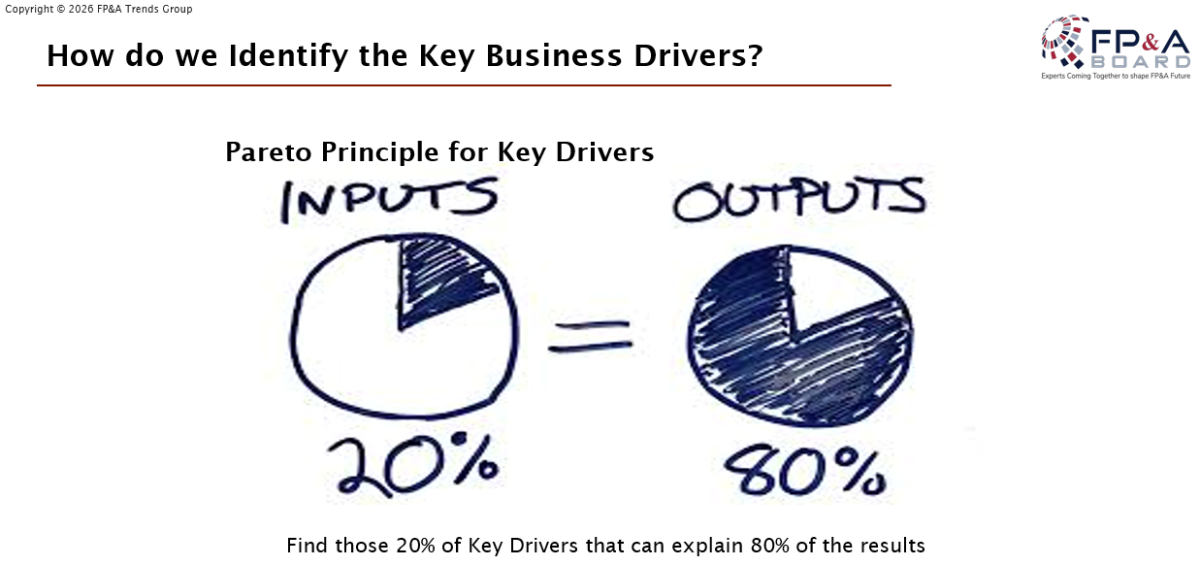
Figure 5
The group discussion also highlighted that FP&A teams need to truly understand the business drivers and their meanings, and be ready to adjust them when required.
Pillar 2: Integrated Processes & People — Design for Decision-Making
Integration is organisational, not just technical. There is a clear need to connect strategic, financial, and operational planning through shared drivers, with a three-way model (P&L, cash flow, balance sheet). But equally important is collaboration across the many stakeholders, and that requires integrated processes and clear ownership. All of this is supported by a system platform that connects models, processes & people.
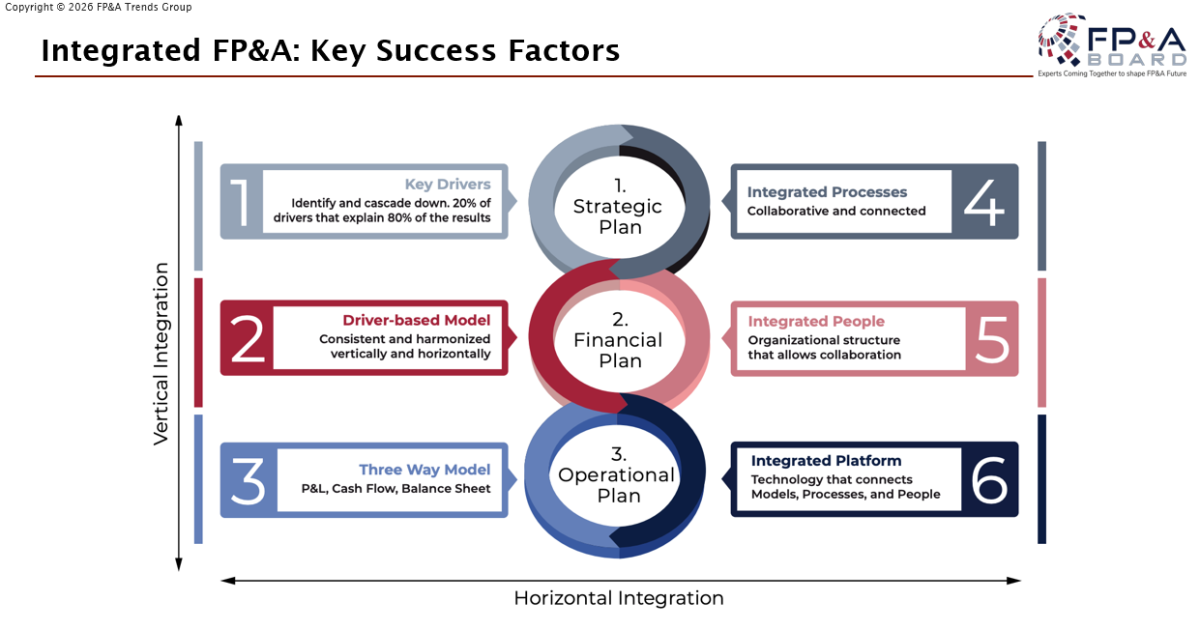
Figure 6
In “Designing Value-Adding Processes”, the group discussion highlighted further practical advice:
The importance of engaging stakeholders across leadership, business functions (commercial, operations), tech, HR, and FP&A.
Be intentional about the cadence of the process and level of detail:
Review frequency depending on volatility.
Level of details adjusted to the audience
Select KPIs that directly link to value drivers and decision needs. Co-design, leadership sponsorship, and clear ownership are essential. Processes should inform decisions rather than just produce reports!
Practical Examples: From Annual Cycles to Continuous Decisions
A special Thank You to Anna Fastishevskaya, Finance Director at Eaton, who shared compelling insights on how FP&A can lead the change towards agility: business dynamics mandated a shift from a legacy FP&A model to one that continuously monitors signals, drives decisions, and ultimately protects margins. Anna explained to us how FP&A took the lead in connecting drivers at the product & customer levels, which offered more conclusive perspectives on commercial impact and enabled differentiated & dynamic pricing strategies. They also shifted their process from an annual cycle to continuous decision-making. The result: faster executive decisions, stronger margin protection, and a repositioned FP&A function that helps the business to create value.
To note, the cultural shift was seen as the hardest part. That resonated in both the practical case study and our group discussions. Overcoming resistance requires clear decision guardrails, shared ownership at the right level, and prioritising speed over perfection.
Pillar 3: Technology & Analytics as Enablers
Technology can accelerate agility, but is not a cure-all. My thanks also to Augustin Wittig, ECS - Enterprise|DACH at Pigment, and Jacques Frey, Regional Sales Lead Switzerland & Austria at Pigment, for sharing insights on how Agentic AI is beginning to enhance FP&A agility and support more adaptive decision-making.
Facilitated by Pigment, the Board discussed the shift from legacy financial planning applications towards modern cloud platforms and the use of AI-based solutions.
According to the 2025 FP&A Trends Survey, the use of spreadsheets, legacy systems, and accounting modules remains predominant in planning. However, the use of Machine Learning, Generative and Agentic AI is clearly on the rise. Self-learning systems that can interpret goals, plan steps, and execute actions within guardrails offer huge potential. It augments planning agility and refocuses the human role to judgment and governance.
But technology alone cannot drive value – it has to be complemented with the other components: the driver-based model, integrated processes, and data quality.

Conclusion
Agile FP&A is achievable but requires coordinated change in setting up a driver-based model. The integration of processes, people, and mindset is as important as the analytical part. Technology is an important enabler and productivity driver, allowing human work to be refocused on judgment and decision-making.
Start focused, learn and adjust: focus on the few drivers that move the needle. Prepare for dynamism and continuous adaptation.
Design processes for decisions, not for reporting.
Invest in change management: stakeholder engagement and sponsorship are essential.
Use AI and analytics thoughtfully: augment prediction and narrative while preserving human judgment.
What I liked most were the really open and practical discussions and the exchange on real-life challenges. A big Thank You to the International FP&A Board for organising this session, Pigment for sponsoring, and Michael Page, Page Executive, IWG, for supporting the event.