
Introduction: The Shift Toward Autonomous FP&A
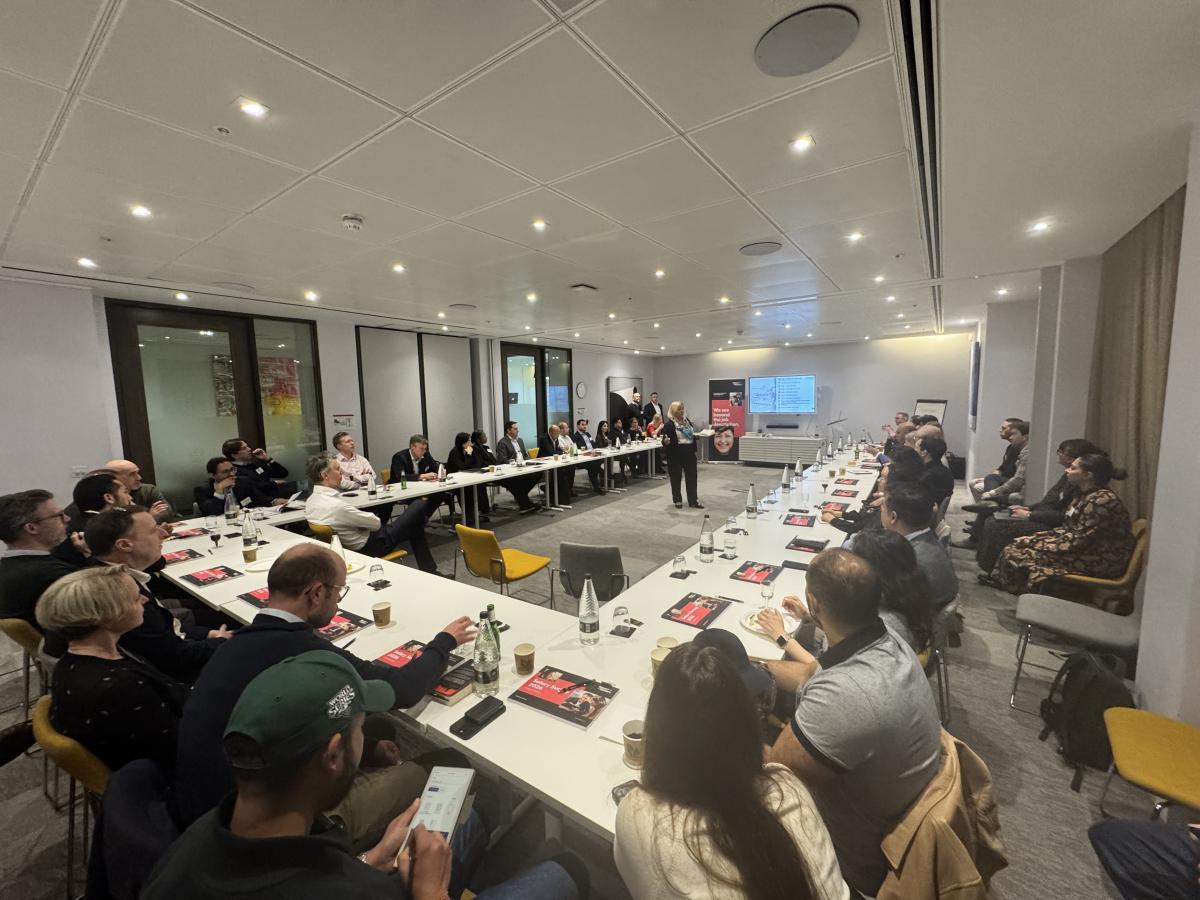
On 25 February 2026, senior finance leaders gathered in London for the 37th London FP&A Board meeting (the 296th global session), organised by the International FP&A Board. The session, hosted by Larysa Melnychuk, explored the theme “Beyond the Horizon: Top FP&A Trends of Tomorrow” and focused on how Artificial Intelligence is reshaping the future operating model of Financial Planning & Analysis. The event was proudly sponsored by EY and held in partnership with IWG and Robert Walters.
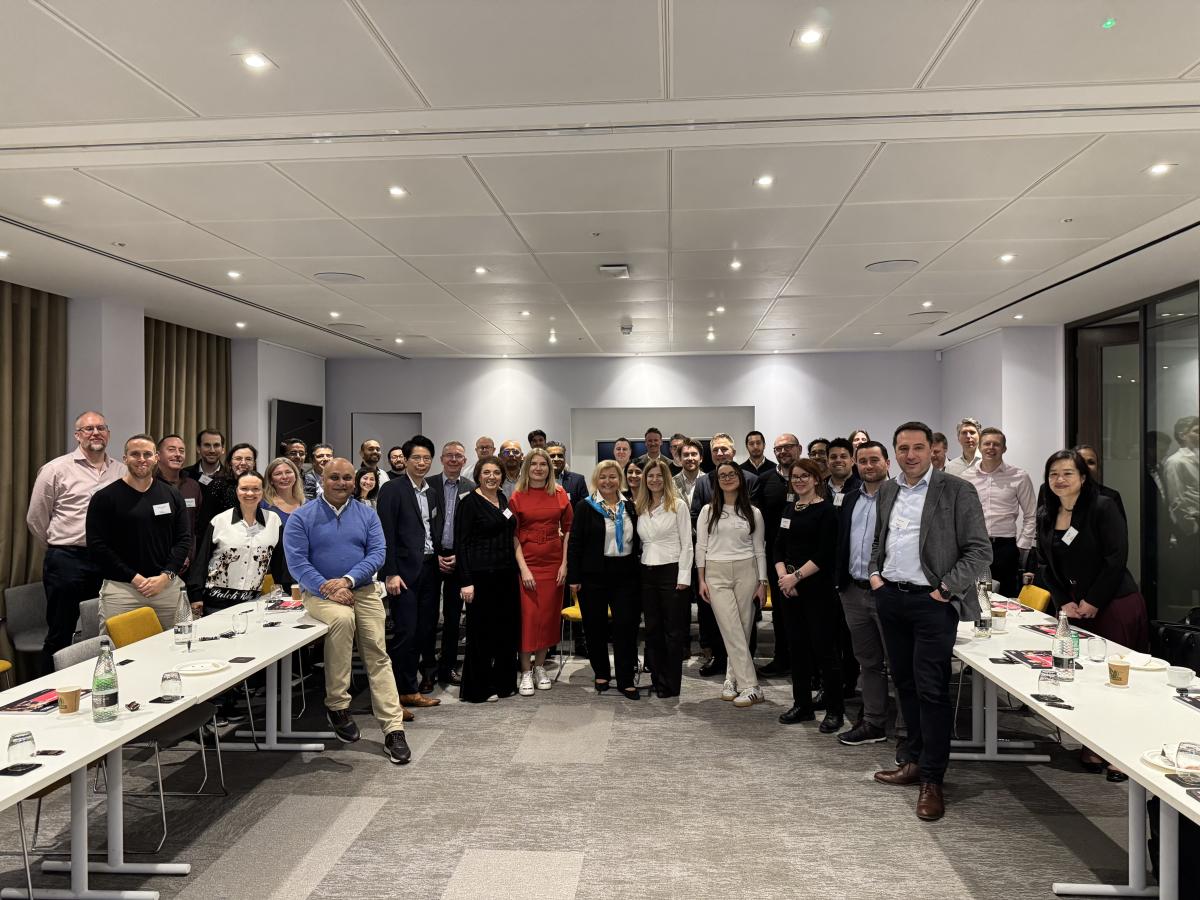
Participants discussed how emerging technologies, particularly AI agents, may change the way finance teams operate, and how organisations may ultimately move towards autonomous FP&A. The discussion also explored how the FP&A operating model may evolve as systems become capable of initiating analytical work, as well as the opportunities presented by agentic AI and the challenges organisations may face as autonomous systems play a greater role in finance processes.
What Would You Ask an AI Agent to Do?
The discussion began with a short warm-up exercise. Participants were asked to work in small groups and identify one task they would assign to an AI agent if such an agent joined their FP&A team tomorrow.
Several recurring themes emerged from the responses. Data-related activities were mentioned most frequently, highlighting the continued challenge many organisations face in managing and preparing data for analysis. Participants suggested a range of tasks that AI agents could perform, including data preparation and cleaning, reconciliations, forecasting and analysis, reporting and visualisation, as well as process automation.
The exercise highlighted how quickly digital workers could become integrated into the daily workflow of FP&A teams, particularly in areas where manual effort still absorbs significant time.
The Modernisation Paradox in FP&A
Following the exercise, the discussion moved to a broader observation described as the “modernisation paradox.”
Finance functions today have access to modern technologies such as cloud platforms, real-time data access, automated reporting tools and AI pilots. Despite these advances, many FP&A teams continue to operate largely with traditional processes, including annual budgeting, variance analysis, and calendar-driven reporting cycles. When asked about the continued use of Excel, almost everyone in the room raised their hand, confirming that spreadsheets remain central to FP&A processes.
Statistics shared during the session revealed the gap between the capabilities offered by modern technology and the way FP&A processes are currently structured.
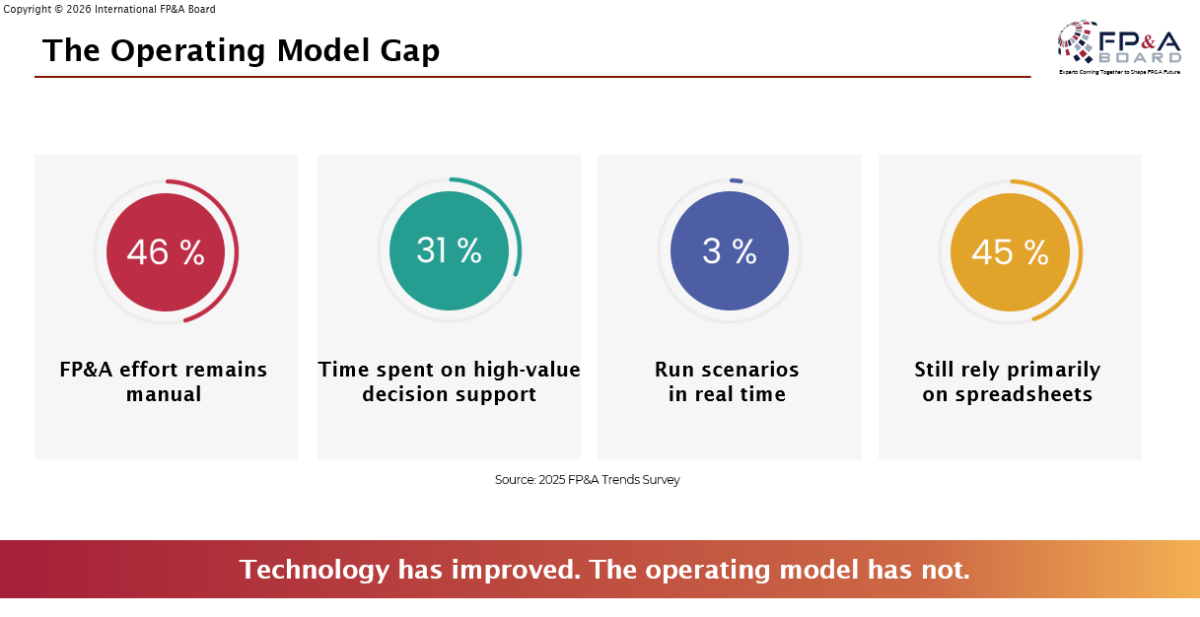
Figure 1
This gap between technological capability and operating model design set the stage for the central theme of the meeting: the shift from human-initiated to system-initiated finance. In other words, while finance has modernised its tools, the underlying operating model has often remained largely unchanged.
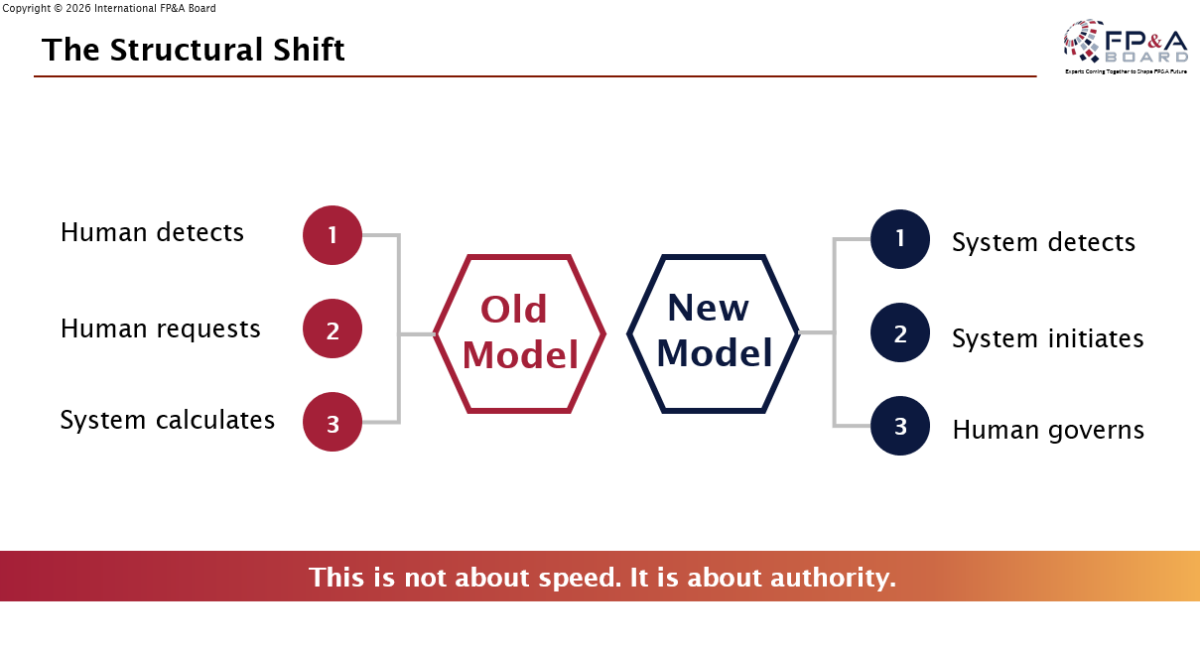
Figure 2
The Emergence of AI Agents in Finance
The concept of AI agents became a central theme of the meeting.
AI agents were described as systems capable of performing tasks with a degree of autonomy and returning insights or recommendations. One participant defined an agent simply as “someone you can send to perform a task and come back with an opinion.”
Participants discussed what types of work organisations may be willing to delegate to digital workers, from operational tasks such as reconciliations and data preparation to potentially more complex analytical outputs.
Preliminary survey results referenced during the session suggested that almost 50% of organisations are already using AI in some form within FP&A processes, compared with around 6% in a similar survey a year earlier. This rapid increase in adoption suggests that finance teams may need to adapt their operating models sooner than many organisations currently expect.
The discussion therefore moved beyond the question of whether AI would be used in finance and instead focused on how the role of FP&A may evolve as analytical work is increasingly initiated by systems.
Structural Trends Redefining FP&A
The discussion then explored several trends that may shape the evolution of FP&A.
At the beginning of this transformation is Agentic AI, referring to systems capable of autonomously initiating tasks and analytical processes. At the other end of the spectrum lies Autonomous FP&A, a potential future state in which finance processes become highly automated and analytical workflows are largely managed by intelligent systems.
Between these two stages, several developments were discussed.
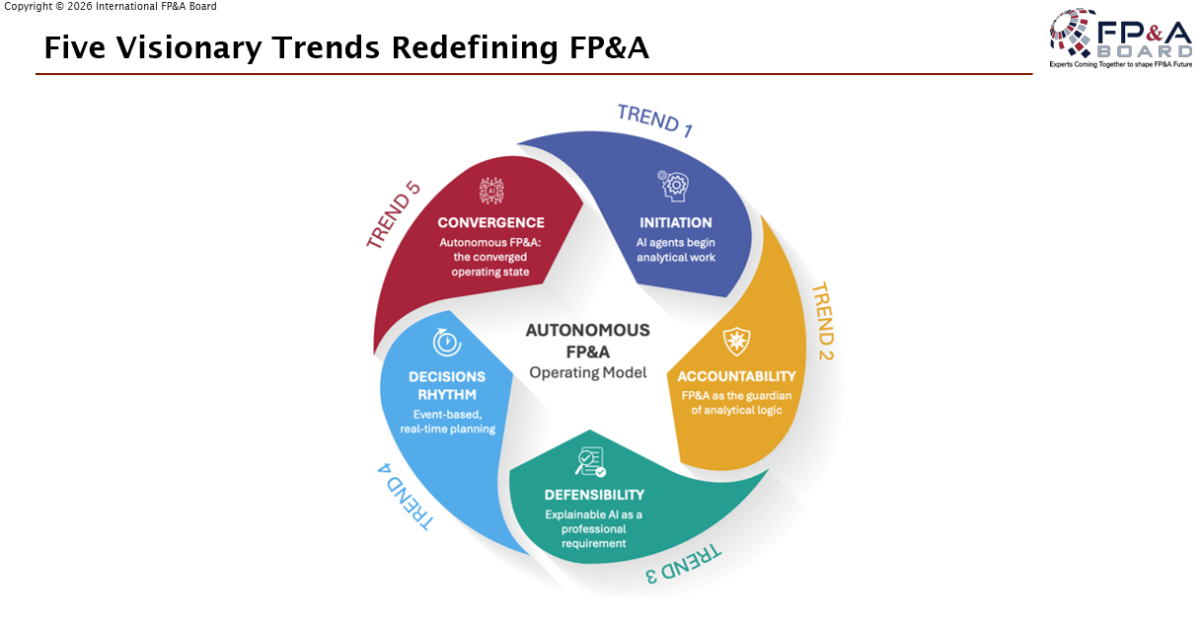
Figure 3
Accountability and Governance
Participants emphasised the importance of governance as AI becomes more integrated into finance processes. Finance teams may play an important role in defining guardrails and ensuring that AI tools are used responsibly.
FP&A professionals may increasingly act as architects of AI-enabled finance processes, designing systems that operate within clearly defined governance frameworks and ensuring that automated insights remain transparent and trustworthy.
In this context, autonomy does not remove accountability. Instead, it increases the importance of clearly defined ownership of models, assumptions and analytical logic.
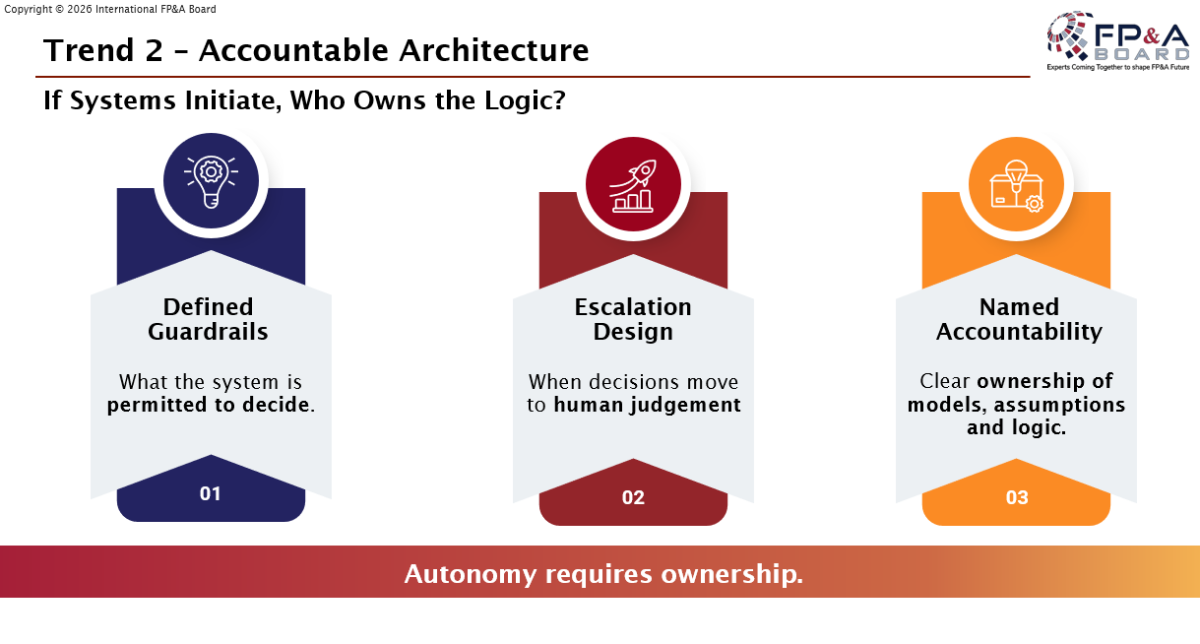
Figure 4
Defensibility and Explainable AI
Another theme discussed was the need for defensible and explainable insights. As AI systems begin generating analytical outputs, finance professionals must understand how those outputs are produced and verify the results.
Participants emphasised that understanding business drivers remains critical. AI may generate analysis, but finance professionals still need to evaluate whether conclusions are supported by the underlying data and whether they reflect the realities of the business.
One participant raised an interesting question during the discussion:
What is the difference between trusting an AI agent and trusting a first-year graduate?
The comment reflected the broader issue of building confidence in automated analytical processes.
For finance functions, analytical outputs must remain explainable and auditable, particularly when insights may be presented to senior leadership or boards.
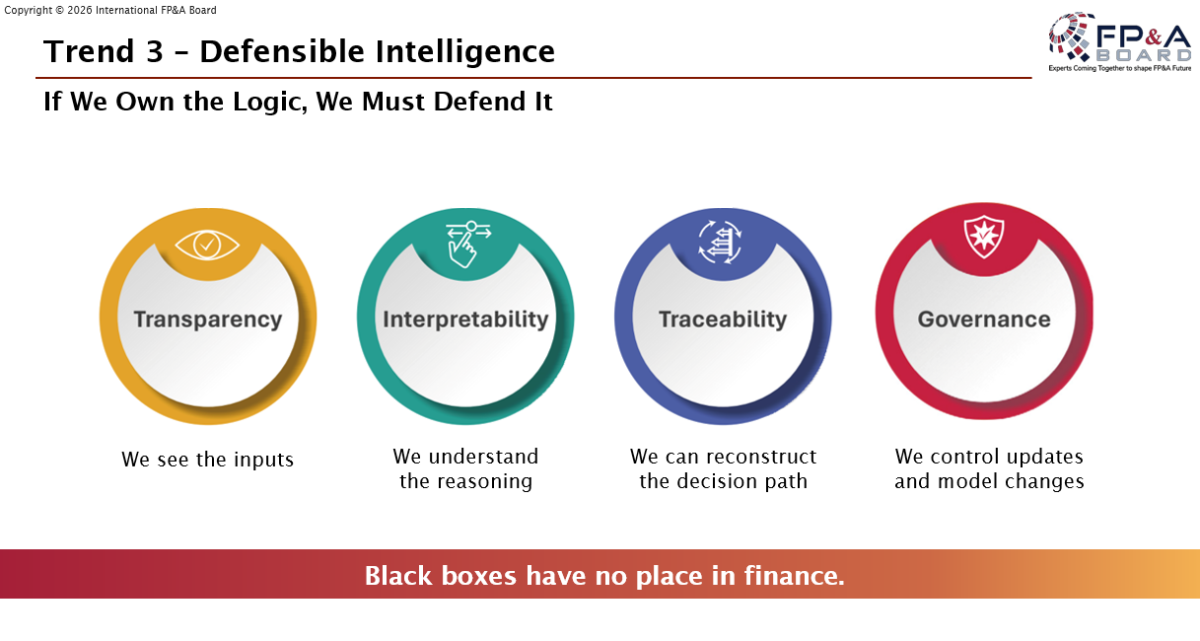
Figure 5
Decision Rhythm: From Calendar-Based to Event-Driven
Another theme discussed was the changing rhythm of decision-making. Many finance teams still operate on calendar-based reporting cycles, producing analysis monthly or quarterly. However, business environments increasingly change in real time.
A polling question was asked: “If a major market shift occurs today, how long until a fully analysed ‘Insight & Action’ plan reaches the Board?”
The results revealed that for nearly 70% of participants, it would take seven days or more.
This observation highlighted a structural challenge: markets move continuously, while finance processes in many organisations still move in periodic cycles.
One participant noted that real-time planning could sometimes become “a nuclear weapon” for management, potentially encouraging overly reactive decisions. Another participant observed that while AI can generate projections based on historical data, human judgement remains essential when making decisions under uncertainty.
Emirates Airline's proactive approach was highlighted, using technology to forecast and anticipate market changes.
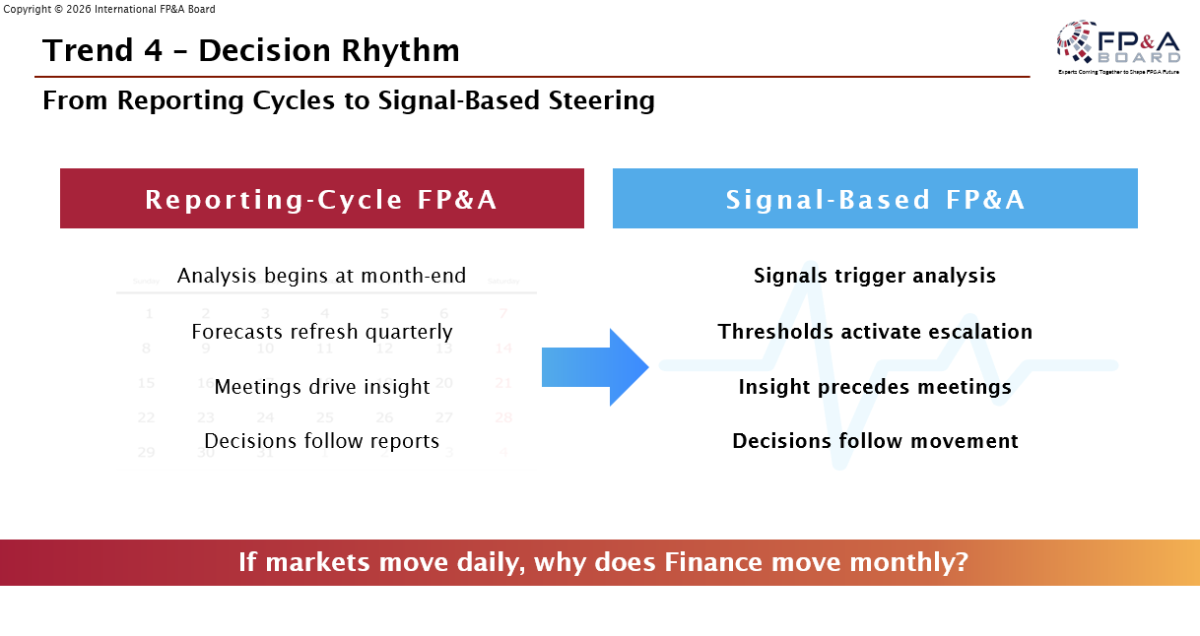
Figure 6
Skills and the Future of the Finance Profession
A significant part of the discussion focused on how AI may change the skills required within FP&A teams.
Participants noted that as analytical work becomes more automated, finance professionals may spend less time producing analysis and more time interpreting results, communicating insights, business partnering and supporting business decisions.
Soft skills such as communication, storytelling and influencing may therefore become increasingly important. Automation may also change how junior professionals gain experience, as traditional entry-level tasks become increasingly automated.
At the same time, understanding the business and identifying its performance drivers will remain essential. Even in highly automated environments, finance professionals must still interpret insights and translate them into business decisions.
Demonstration of AI Agents in FP&A
The discussion was followed by a short demonstration from EY showing how AI agents can support FP&A analysis. Instead of navigating dashboards, users interact with the system through natural language questions. The system built by EY analysed financial data, explained a sales variance by identifying key drivers, and allowed users to review the underlying calculations, illustrating how AI-generated insights can remain transparent and explainable.
Insights from the Group Discussions
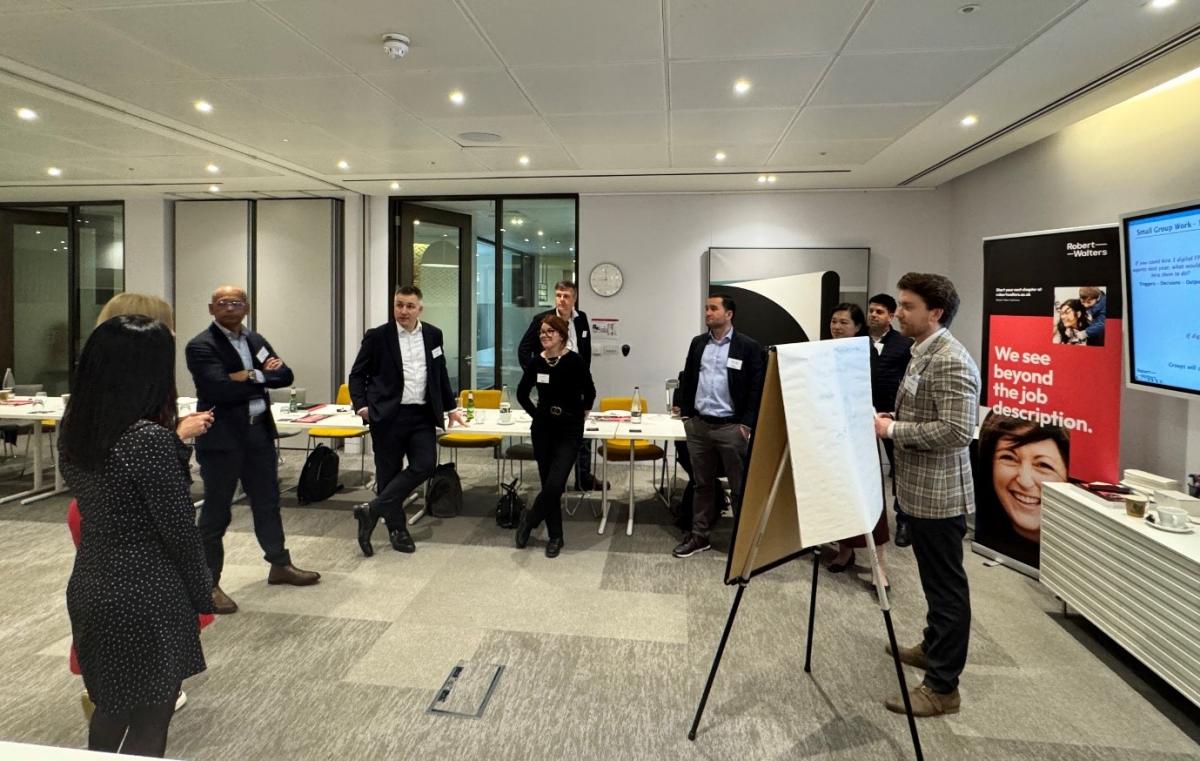
In the final part of the meeting, participants were divided into smaller groups to explore the practical implications of introducing AI agents into FP&A functions.

Group 1 identified three main areas for digital FP&A agents:
- data quality and accuracy
- storytelling and visualisation
- decision support.
Group 2 named 3 guardrails that should be in place before those agents can act:
- technology itself (vendor’s own security posture
- internal data access controls, internal governance processes
- clear guidelines for the responsible use of AI tools
Finally, Groups 3 and 4 concluded that if digital agents join the team, FP&A roles should evolve to:
- Do less manual production, more business partnering and decision impact
- Master storytelling and influence, not just technical finance
- Interpret, audit, and challenge AI, reasoning backwards from its outputs
- Operate in hybrid, cross-functional structures, with data and AI skills embedded in FP&A
Conclusion
The London FP&A Board discussion highlighted how AI may reshape the finance operating model in the coming years. Rather than simply automating existing tasks, the emerging shift may redefine how analytical work begins, how insights are generated, and how finance teams govern the systems that produce them.
As organisations experiment with AI agents and autonomous analytical systems, the role of FP&A professionals may increasingly focus on interpreting insights, guiding decisions and designing the governance structures under which intelligent systems operate.
In this emerging model, the role of FP&A shifts from producing analysis to architecting the systems that generate it, ensuring that speed, governance and accountability evolve together.