

In this article, discover how FP&A strategic business partnering helps finance professionals challenge assumptions, expand decision...

Lean Finance: From Complexity to Business Value
October 15, 2026
An FP&A Framework for Reallocating Finance Capacity.

Why Lean Finance Matters For FP&A
Expectations towards FP&A and the wider Finance organisation are moving in two directions. The function should become leaner, more standardised and more digital, while moving closer to the business, looking further ahead and contributing more strongly to decisions. This combination appears repeatedly in discussions among finance executives and in the profiles companies seek from their future finance leaders.
Delivering one side is relatively easy. A CFO can reduce costs or add resources for business partnering and analytics. The real leadership challenge is to achieve both: a more efficient operating model and a Finance function with greater business impact.
For FP&A professionals, this tension is especially important. FP&A is expected to optimise group performance through sharper forecasts, better resource allocation, pricing and investment support, and earlier visibility of risk. Yet it rarely applies the same discipline to its own processes. Forecast cycles, reporting routines and recurring analyses accumulate even when their impact on the decision is unclear.
This is the paradox: FP&A owns many of the Finance processes with the highest potential business-value impact, but does not always optimise their value-complexity relationship. Because these processes can directly influence margin, cash, growth, risk and capital allocation, FP&A plays a central role in moving Finance work towards higher business value.
The Lean Finance Value-Complexity Matrix assesses the complexity of Finance work in relation to the business value it creates. Cost pressure, benchmarks and technology may trigger Lean Finance. However, they do not provide a sufficient transformation logic.
A Finance function can become smaller and still become weaker. It can automate reports that should have been stopped, centralise work while shifting complexity into subsidiaries, or reduce business-partnering capacity while preserving historical routines. Faster information production alone does not improve management decisions.
Lean Finance, therefore, needs a more precise definition: the disciplined management of finance complexity in relation to the business value it creates.
Start With the Operating Model, Not the Cost Ratio
Cost benchmarks can make inefficiency visible. However, they tell the CFO and FP&A leadership how much Finance costs. They do not explain which capabilities should be removed, protected or strengthened.
That distinction matters because Finance is not a homogeneous service. Transaction processing, statutory reporting, controls, forecasting, pricing support, cash management and capital allocation serve very different purposes. Cutting the same percentage across all of them may improve the cost ratio and reduce the value of the function at the same time.
Classical Lean thinking distinguishes between value-added and non-value-added activity. This is helpful, but too binary for Finance. A control, a tax process or a liquidity reserve may not create commercial upside. Nevertheless, it can protect enterprise value by reducing material risk, preserving cash or maintaining trust in the numbers. In Finance, the protection of value is part of business value.
The relevant question is therefore not simply whether an activity adds value, but whether the business value it creates justifies the complexity involved.
Business value can mean better decisions, stronger margins or cash flow, lower risk, faster reaction, greater scalability or stronger strategic control. Complexity includes manual effort, data requirements, interfaces, governance, specialist skills and management attention. It must also include the work pushed into other functions. A process is not lean if headquarters saves two hours and ten subsidiaries each lose one.
This creates two independent questions. Can complexity be reduced? Can business value be increased? The strongest Lean Finance initiatives address both.
The Matrix Is a Movement Model
The Lean Finance Value-Complexity Matrix translates these questions into four management responses. Its purpose is movement towards higher business value and, wherever possible, lower complexity. The upper half is the target corridor for FP&A and Finance work that can materially influence business outcomes.
Not every retained activity will become strategic. A statutory filing or master-data check will never have the same decision impact as pricing or capital allocation. Where value cannot be increased, complexity must be reduced. High-complexity, low-value work must be eliminated or fundamentally redesigned.
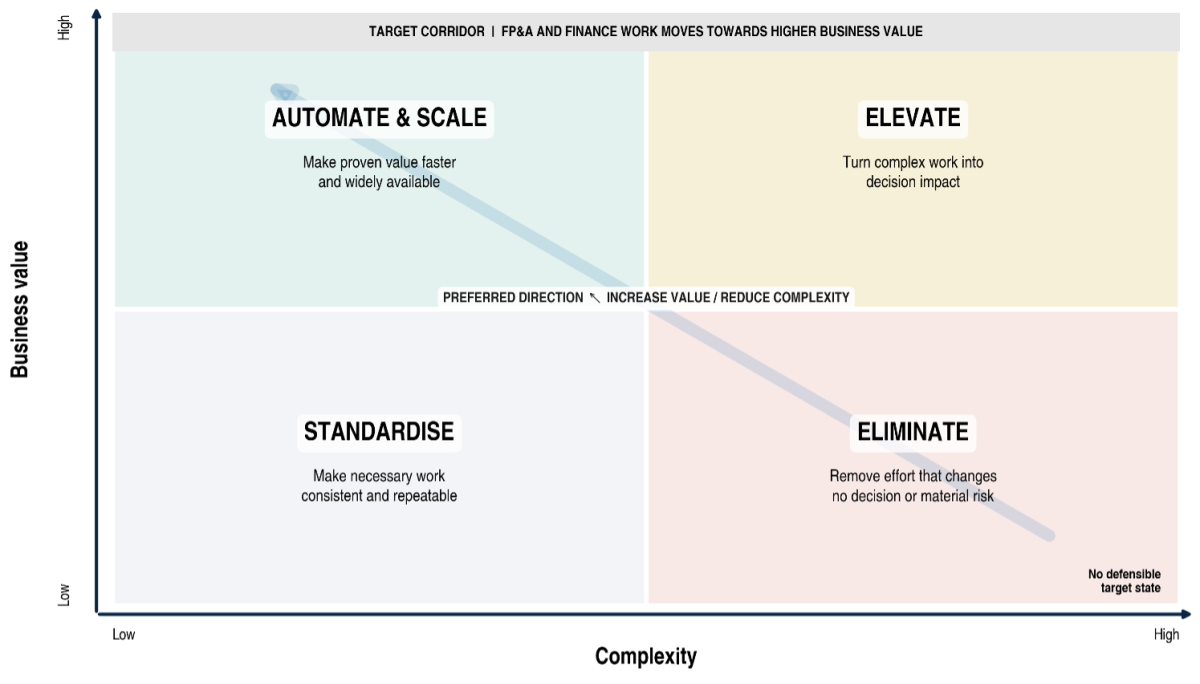
Figure 1. The Lean Finance Value-Complexity Matrix and its preferred direction of movement
Eliminate: Stop Low-Value Complexity
Legacy reports, duplicated checks, excessive budget detail and approval loops that reduce no material risk belong here. Elimination rarely means removing an entire Finance process. It means stopping the elements within it that consume effort without improving an action, decision or risk outcome.
The most revealing question for a report is often: what would become worse if it disappeared? If nobody can name a decision, action or material risk, the report is a candidate for elimination. The same principle applies to recurring analyses, meetings and approval steps.
Standardise: Make Necessary Work Uneventful
Some work remains necessary but offers limited differentiation. Reconciliations, master data checks, intercompany routines, common definitions, and recurring compliance documentation should be reliable and deliberately uneventful.
Common logic, clear ownership, consistent data structures, and fewer local variants characterise the management response. This is also the foundation for automation. Standardise before automating. Otherwise, technology merely makes inconsistency faster and hides it behind a more modern interface.
Once the production logic is stable, Finance should ask whether the output can become more useful. A consistent data model, for example, can improve margin transparency or support faster scenario analysis. This moves low-complexity work upward in value.
Automate and Scale: Expand Useful Output Without Expanding Effort
Low-complexity, high-value activities are particularly suitable for automation and wider use. A working-capital dashboard, exception-based control, or a first draft of management commentary can be produced faster and made more widely available without increasing manual effort.
Automation adds value when it improves speed, consistency or decision quality. Producing more reports at a lower cost achieves little unless they lead to better decisions or actions.
Elevate: Turn Necessary Complexity Into Decision Impact
Elevate is a strategically important field. Forecasting, business partnering, scenario planning, pricing support, and capital allocation can be complex because the decisions themselves are. Cutting these capabilities may make Finance cheaper and the company weaker.
Elevation means moving from information production to decision impact. A forecast is elevated when it challenges assumptions, identifies risks early, creates scenarios and triggers decisions on pricing, capacity, inventory, cost or cash. Reporting is elevated when Finance explains the implications rather than repeating variances. Business partnering is elevated when Finance helps shape the choice.
FP&A, therefore, has a special position in this field. It owns the processes most capable of moving upward: forecasting, business partnering, scenario planning, pricing support, performance steering and capital allocation. Ultimately, these processes create value by helping the business make better and faster decisions.
This connects directly to the challenger role I described in my earlier FP&A Trends article. FP&A creates value when it expands the decision space, challenges both the proposed path and the underlying objective, and makes alternatives visible before a decision is locked in. Elevate brings that same logic into the Lean Finance operating model.
Assess Process Elements, Not Whole Processes
A common mistake is to place “reporting”, “budgeting” or “forecasting” into one field. These categories are too broad. Reporting may contain a board pack, margin bridge, cash dashboard, local sales reports and outputs that continue only because they have always existed. Their value and complexity differ materially.
The review must therefore go one level deeper. FP&A is accustomed to optimising business performance; it should apply the same analytical discipline to its own portfolio of reports, forecasts, analyses, meetings and decision outputs. For every process element, Finance should ask who uses it, which decision it improves, which action it triggers, which material risk it reduces and where the complexity sits. It should then ask whether the same value can be delivered with less effort and whether greater value can be created from the same information.
Budgeting provides a practical example. The annual process may remain necessary, but planning sales at the part-number level requires substantial effort and creates a false sense of precision without improving resource allocation. A leaner approach would retain the budget while removing low-value details, standardising the underlying drivers, and focusing management's attention on the assumptions and decisions that matter.
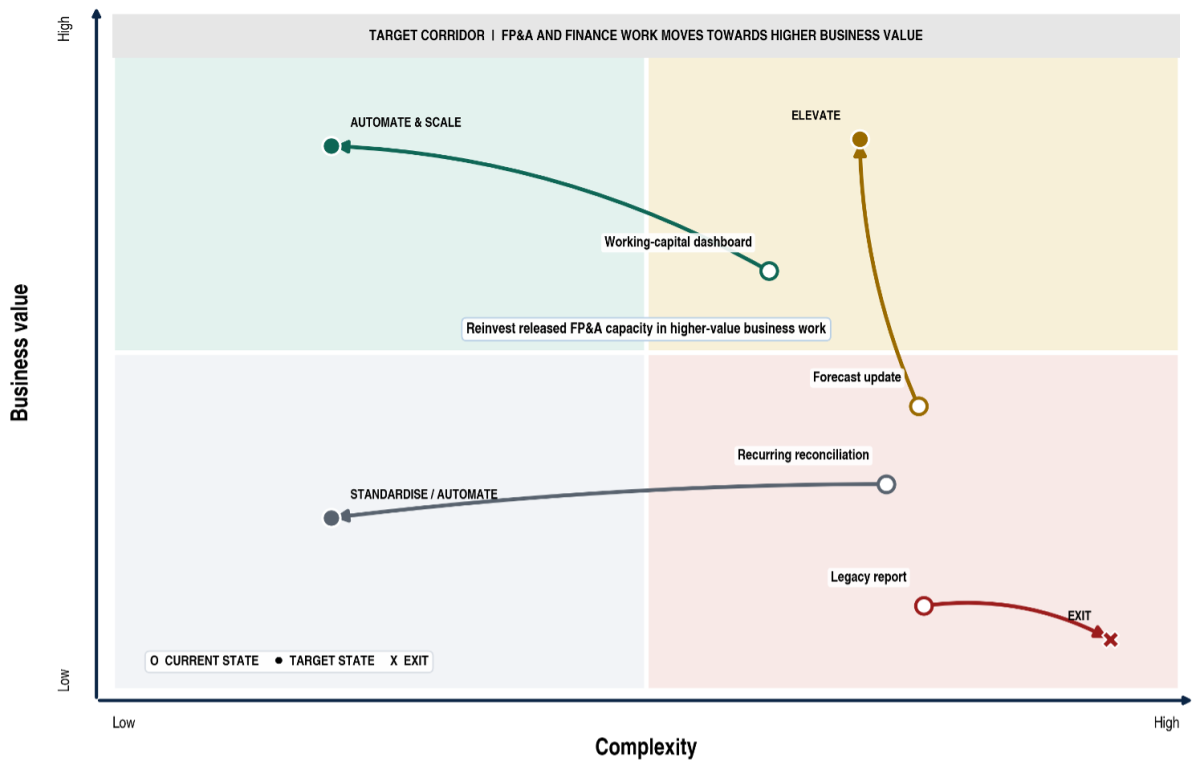
Figure 2. Illustrative movement paths for Finance process elements. Actual placement depends on the decisions supported and risks reduced.
Where AI Belongs
AI is a permanent part of Finance, and its capabilities will continue to improve. It is already a major enabler that can reduce the time required for many activities and make advanced analysis possible with less effort. Examples include drafting commentary, detecting anomalies, comparing assumptions and preparing scenarios.
Within the matrix, AI can move work to the left by reducing complexity and upward by increasing business value. As access to broadly similar AI tools becomes standard, the way Finance uses them to improve decisions and business outcomes will become the main differentiator.
AI also introduces requirements for data governance, access rights, validation, auditability, ownership, skills, and model risk. These costs should be included in the assessment. A technically impressive application can still have a poor value-complexity relationship if it does not improve a relevant decision or outcome.
AI should therefore be used where it reduces complexity, increases business value or, ideally, achieves both. It can strengthen Finance judgement and accelerate the work behind it, while accountability remains with Finance.
The CFO Remains in the Driver's Seat
Lean Finance is ultimately a capital-allocation decision applied to the Finance function itself. The CFO remains accountable and therefore stays in the driver’s seat. FP&A has a particularly important role because it owns many of the processes with the greatest potential to improve business performance. Capacity released from low-value complexity should be selectively reinvested in higher-value FP&A work, such as business partnering, performance steering, cash forecasting, pricing support, scenario planning, risk assessment and capital allocation.
The assessment works best when Finance involves both process owners and recipients. Process owners understand the effort involved, while recipients know whether an output changes a decision or action. Their views will often differ. This helps identify reports whose assumed value is not recognised by users and controls whose risk relevance is underestimated. The CFO then needs to resolve these tensions based on materiality rather than hierarchy.
Creating a shared-service centre or implementing an AI tool does not by itself make a transformation successful. Success depends on whether the operating model directs more attention towards the decisions that matter and less capacity towards internal friction. Technology and organisational changes support the transformation, but its strategic impact depends on how Finance capacity is allocated.
The target state is clear: retained work should move towards higher business value, while complexity is reduced without weakening control. This means eliminating activities that cannot justify the effort, standardising work that must remain reliable, automating stable, useful processes, and elevating activities that can materially improve business outcomes. FP&A should lead this movement by applying the same performance discipline it brings to the group to its own processes.
The objective is a more effective FP&A function and a Finance organisation with greater business impact.
Submission Details
1. Stoller, A. (2025), “FP&A as a Challenger, not Just a Mirror: Expanding the Decision Space”, FP&A Trends
The full text is available for registered users. Please register to view the rest of the article.
Related articles

Finance needs a new operating model that connects data, product thinking, and AI to reduce manual...

Why FP&A teams need Minimum Effective Models to reduce forecasting complexity and support faster, better decisions.

A practical guide to automating FP&A processes to reduce manual work, improve reporting accuracy, and enable...

In this article, discover how a finance team accelerated decisions by automating commentary, simplifying reports, and...

AI in FP&A creates real value only when finance redesigns its operating model around governed data...
+
Subscribe to
FP&A Trends Digest

We will regularly update you on the latest trends and developments in FP&A. Take the opportunity to have articles written by finance thought leaders delivered directly to your inbox; watch compelling webinars; connect with like-minded professionals; and become a part of our global community.