

In this article, the author shares a practical, insider-led framework for running an FP&A/EPM software selection...

FP&A Process Automation: The What, The How and The Why
May 7, 2026

The Subjects of Automation
As technology drives more and more areas of corporate finance, few disagree with business partnering being the direction FP&A should move towards. Recent advancements and the explosion of the mass of business data make this transformation both easier and inevitable. But old habits die hard, and as the 2025 FP&A Trends Survey continues to highlight, manual tasks, like data collection & validation or reports creation, still take the majority of these teams' time.
Automating these routine, recurring processes can bring several tangible advances to FP&A operations. Processes with clear objectives and deliverables (e.g., month-end closes), where the requirements are well defined, and the underlying data is relatively easy to access and gather (e.g., performance analysis, variance reports), and where the data preparation (cleaning) can easily be made part of the automation process (e.g., budgets and forecasts) are the most typical subjects.
Defining The Scope (What We Automate)
In my experience as a consultant and project manager, financial management usually has a clear view on what the most time-consuming, error-prone, and business-critical processes are, i.e., the best subject candidates for automation.
The process of choice can define the scope, and when it comes to the scope, there are two directions the project can go:
- Automate the process with the existing scope/objectives
- Extend the scope at the same time, and in line with the automation
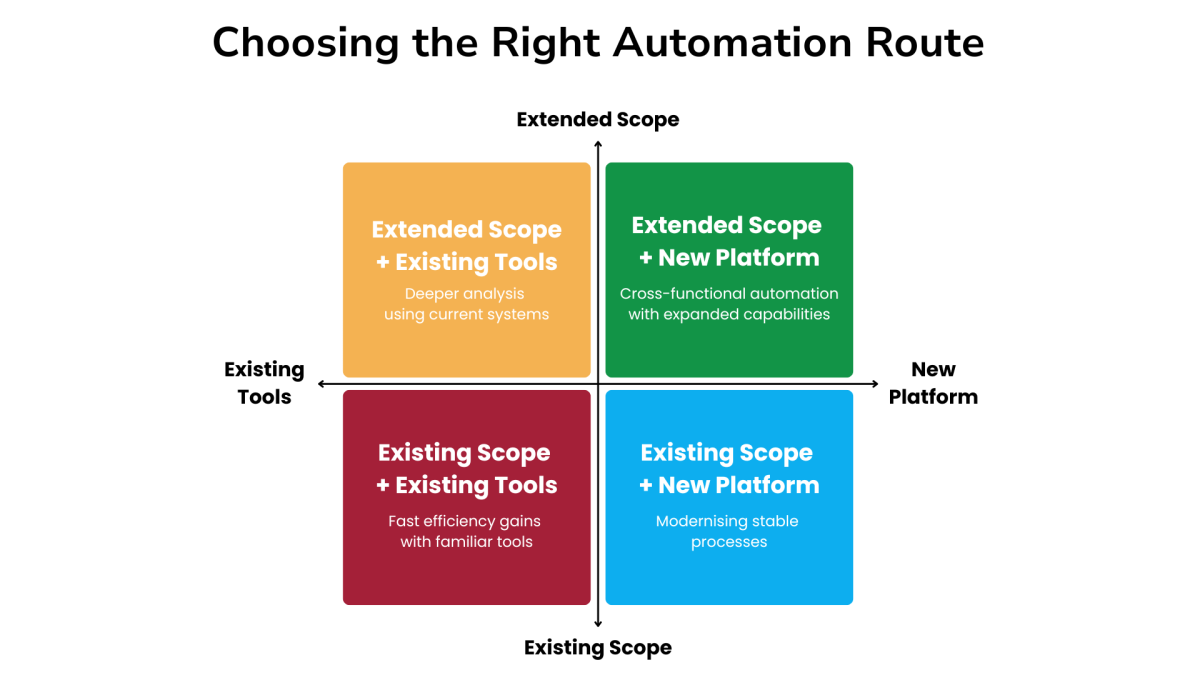
Figure 1
Periodic reporting (e.g. month-ends), budgeting and forecasting are typical examples of the 1st. While these procedures can have very different mechanisms when it comes to data collection and presentation, they all share some attributes that make them the low-hanging fruits of automation, the most frequent subjects:
They are recurring and time-bound, making preparations a routine exercise
They generally have clear, centrally defined deliverables that don't change too rapidly over time
Like-for-like comparison to previous periods and planning is crucial in these, making their data requirements relatively stable and calculable
For teams that mostly use manual processes for reporting and analysis, I usually advise these exercises as starting points, as they are relatively easy to map and reward with fast, visible efficiency gains.
Performance analysis, variance reporting and KPI development are good examples of the 2nd direction. We talk about an extension of scope when we:
- Add new features or extend the depth of analysis using the existing data
- Add new functionality by adding new data source(s)
Extending the scope of automation usually results in a more complex project, where more resources are needed, and, due to the nature of broadening the audience by adding features and functionality, greater cross-functional cooperation is required.
In one of my recent projects, we have developed a sales analysis model for a consumer electronics giant. In this exercise, the original scope of a comparative, regional, and channel performance analysis was extended to include a product (category) performance element. This scope extension didn't require additional data, still enabled a deeper variance root-cause analysis, providing much more direct management decision support.
In another project, for a cash-flow analysis model at a major player in FMCG, we have added vendor categories to the cash-out monitoring analysis. This new functionality required adding a new data source (vendor category master data), but the extra effort paid off by enabling the team to build a stronger business case for strategic benefits (deeper analysis of purchasing behaviour).
Excel, or Not? (How We Automate)
There are several factors that drive the decision on what technology we use for automation. Data volume and complexity, the available budget as well as the overall strategy of data governance, all have their effect on the execution, but at the end of the day, the exercise typically comes down to these choices:
- Automating with existing tools and platforms (Excel and the running MIS)
- Implementing a new platform
They often say Excel is the "Swiss army knife" of corporate finance, and for good reasons. It's versatility and its powerful features introduced in recent years (especially the Power Suite) make it an industry standard. It's installed on most computers and used on a daily basis in most FP&A Teams. It can collaborate with many data platforms and requires only limited user training.
Excel is so powerful that, in many cases, I've seen finance teams use sophisticated planning and visualisation tools simply as data warehouses to download the numbers into Excel for their analysis.
In my experience, simple automation techniques utilising existing tools like Excel, which FP&A is already using for its daily operations, are perfectly sufficient in many cases. A "good enough" solution can significantly increase efficiency. Becoming data-driven is a journey that can have many stops. As long as the data is accessible and can be sourced and sorted easily, Excel and common data visualisation tools can be "enhanced", using cloud-based data warehouse solutions and data flows.
Implementing a new platform is a viable solution when processes involve several independent systems, the volume of data is too high, or the security level of existing systems is insufficient. These projects are typically much more time-consuming, require more preparation, and involve more business areas. They can further increase complexity, surely need more user training and definitely cost more. But with the use of recent technological advancements like AI and ML, there is a growing consensus that larger, cross-functional organisations should transition to robust systems for critical, repeatable, and collaborative processes.
The Business Impact Pitch (Why We Automate)
But choosing the right subject and selecting the right tools for automation is often not enough. Even a well-prepared, well-prioritised project roadmap will fail to get the green light if it doesn't get management support.
When pitching an automation project to decision-makers, it's important that the project delivers clear, measurable benefits that secure stakeholder buy-in. I usually emphasise three major strategic gains that automation brings to FP&A.
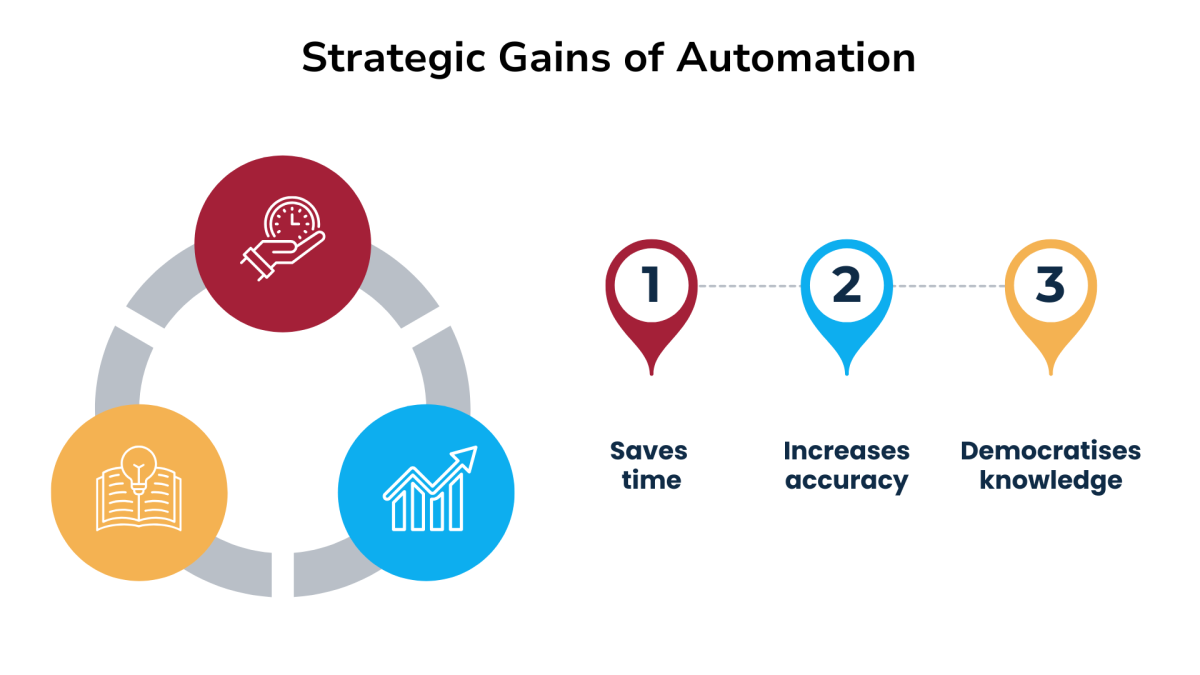
Figure 2
The time saved by automation is relatively easy to measure and has a large impact on FP&A's daily operations. It reduces the time spent on data gathering and validation, preparing and adjusting management reporting decks and presentations. It also frees up time for analysis, shifting the balance of the Pareto principle. It shortens forecasting and reporting cycles, reducing team stress during periods when time is most expensive.
Accuracy is a more difficult KPI to get a grip on. In one of the projects I've worked on, monthly P&L data was gathered from twelve subsidiaries, all reporting their monthly figures in their local currency. Mapping these data and updating the corresponding FX rates was a regular exercise for FP&A, and the model the team used required all file links to be up to date for consolidation to work. This resulted in constant corrections and error fixing, that unified inputs, and automated consolidation was eliminated. The reduction in frustration and team stress is not easy to measure, but one way to gauge accuracy is to demonstrate the decrease in the number of "revisions" and "updates" sent to decision makers. Another one is the number of manual adjustment GL entries post-automation.
Lastly, automation makes teamwork more efficient. Manual processes are often linked to specific people in the team, who own the process, know where the right files are stored, and can navigate the maze of interlinked inputs to assemble the required end result. Manual procedures are rarely well documented, making them difficult to replicate once the process owner is on vacation or has left the company. Automation usually democratises this knowledge. It requires the source information to be accessible, preferably in real time, and with secure data flows that cannot be traced exclusively to a single person. This makes automated cycles more robust and independent of personal preferences and work methods.
Closing Thoughts
Tedious, time-consuming manual processes can sap the appetite of any FP&A professional and erode team efficiency and morale. Modern FP&A needs to become a partner to the business, an advisor, a compass, if you will. For this to happen, we have to let the machine do the monkey work, so that the team can concentrate on what matters the most: supporting management strategy with knowledge and initiatives that can only be found in FP&A. There is more than one way to skin a cat, and when it comes to process automation, there are several factors that play a role in deciding the right path for the team and the organisation.
One of my former CEOs, Daniel Grieder, used to tell us at town hall meetings:
"Complicating things is simple, simplifying things is complicated."
I hope these thoughts from my own experience will help FP&A teams find solutions that gradually simplify things, even if it's sometimes a bit complicated.
The full text is available for registered users. Please register to view the rest of the article.
Related articles

In this article, the author explains how a self-service, button-press integration model enables FP&A teams to...

In this article, discover how a finance team accelerated decisions by automating commentary, simplifying reports, and...

In this article, the author explains how CFOs can build “AI-ready FP&A” teams through disciplined governance...

In this article, Ashok Manthena reflects on what 2025 really delivered for AI in FP&A —...

In this article, you’ll learn how FP&A teams can adopt AI step-by-step by using small, practical...
+
Subscribe to
FP&A Trends Digest

We will regularly update you on the latest trends and developments in FP&A. Take the opportunity to have articles written by finance thought leaders delivered directly to your inbox; watch compelling webinars; connect with like-minded professionals; and become a part of our global community.