

Agentic Planning helps CFOs move beyond Excel-based driver models by combining AI-enabled speed with stronger FP&A...

Decision Governance After AI — Part 7 of 7
September 10, 2026

Part 6: Turning Scenarios into Management Action examined how prepared scenarios become management action. This final article brings the series together by defining the governance required when AI participates more directly in FP&A decision processes.
Why does governing AI-enabled decisions matter more than governing AI alone?
Core thesis: Management Control defines the objective. Decision Governance provides the organisational mechanism. Governed Decision Capability is the organisational outcome.
1. The New Governance Problem
The purpose of management control has long been to support rational, coordinated and accountable management decisions. Artificial Intelligence does not change that objective. It changes the nature of the decision work through which the objective is achieved. (Merchant and Van der Stede, 2017; Simons, 1995).
Many organisations have invested significantly in AI Governance. They define policies, assess model risks and introduce controls for transparency, fairness, human oversight, autonomy limits and compliance. These capabilities become more important as AI systems support forecasting, planning, pricing, risk assessment and operational decisions, and as AI agents participate in workflows with greater autonomy. (NIST, 2023).
Yet a different governance problem is emerging. The question is no longer only whether an AI model is reliable or an AI system is responsibly governed. It is increasingly the case that organisations govern the decision-making work in which humans, AI systems, and hybrid human-AI configurations participate.
An AI system may identify an emerging cash risk, recommend a pricing action, prioritise forecast exceptions, prepare a scenario comparison or trigger an escalation. Each activity can shape how managers interpret information, prioritise issues and allocate attention. The governance challenge, therefore, extends beyond models and systems to the management decision processes in which AI participates.
This distinction matters because organisations rarely fail simply because information is unavailable. They more often struggle to translate information into timely, accountable and coordinated management action. Business Intelligence has improved visibility through governed data, KPI definitions, reporting processes and dashboards. These foundations remain essential, but governed information alone does not create governed decision capability. (Kaplan and Norton, 1992; Ittner and Larcker, 2003; Seufert, 2026a).
For FP&A, this shift is particularly significant. The function already operates at the intersection of planning, performance management and management control. Forecasts, working-capital reviews, margin analyses and scenario discussions are not valuable because they generate information. They create value when they improve management decisions. (Malmi and Brown, 2008).
This article uses Decision Governance as a conceptual extension of management control and AI Governance. The argument is that governing AI alone is no longer sufficient: organisations increasingly need an organisational mechanism that governs how decision work is prepared, challenged, authorised, monitored, and reviewed, while preserving accountability, transparency, and learning. It complements AI Governance by governing the decision work in which AI operates. (Merchant and Van der Stede, 2017; Simons, 1995; NIST, 2023).
Figure 1 summarises this conceptual architecture. It shows how environmental dynamism and AI participation change management decision work, how Decision Governance extends existing governance disciplines, and how Governed Decision Capability supports the enduring objective of Management Control.
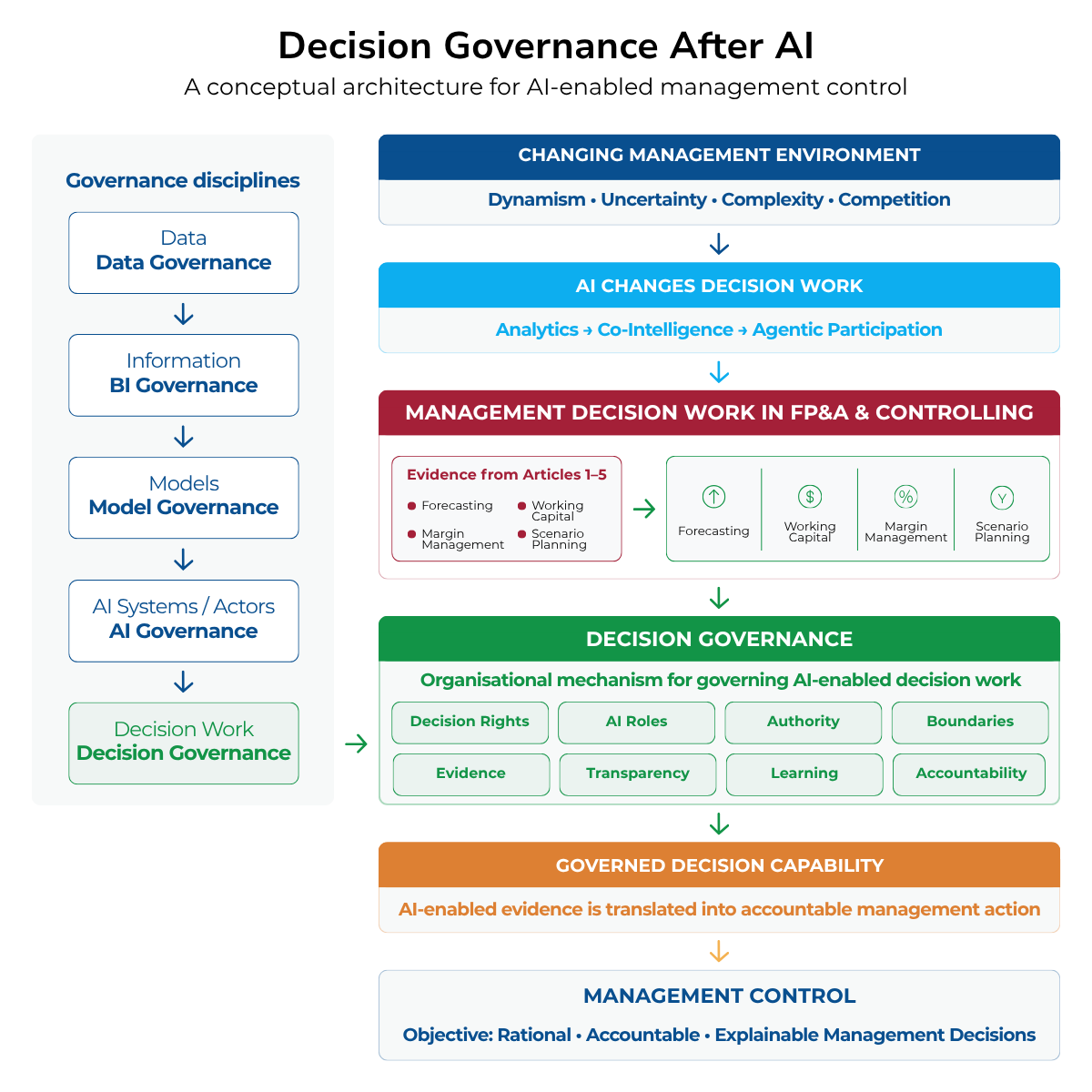
Figure 1. Decision Governance After AI - Conceptual Architecture. Decision Governance complements AI Governance by governing the decision work in which AI participates and by linking AI-enabled evidence to Governed Decision Capability and Management Control.
2. What Decision Governance Is, and Is Not
Decision Governance should not be confused with AI Governance, Data Governance, Model Governance, BI Governance or IT Governance. Each remains necessary because each governs a different organisational object.
Data Governance ensures that the underlying data can be trusted. But trusted data do not automatically create trusted management information. Revenue, margin, DSO, forecast accuracy or cash conversion may still be defined, calculated or presented differently across functions.
This is the role of BI Governance. It governs the semantic layer of management information: KPI definitions, calculation logic, report structures, dashboard design and the management story created from them. Its purpose is to ensure that managers not only see data but also consistent, comparable information. (Kaplan and Norton, 1992; Ittner and Larcker, 2003).
Model Governance helps ensure that analytical models are valid, documented and monitored. AI Governance provides broader rules for responsible AI use, system-level risk controls, human oversight, autonomy limits, monitoring and compliance, especially where AI systems act with greater autonomy or participate, and compliance, especially when AI systems operate with greater autonomy or act as agents. (NIST, 2023; Seufert, 2026b).
Decision Governance begins at the next boundary. Even trusted management information, valid models and responsibly governed AI systems do not automatically create accountable decisions. A forecast signal, margin alert, cash warning or scenario trigger still has to be interpreted, prioritised, escalated and translated into action.
Decision work comprises the organisational activities through which management decisions are prepared, interpreted, prioritised, authorised, executed, reviewed and improved. These activities may be performed by humans, AI systems, AI agents or hybrid configurations. From a Decision Governance perspective, the primary object of governance is not the actor but the decision work. The actor changes the governance design; it does not remove the need for governance. (Merchant and Van der Stede, 2017; Malmi and Brown, 2008).
Decision Governance is therefore proposed here as the organisational mechanism that governs decision rights, AI role, autonomy boundaries, escalation routines, accountability, reviewable evidence, monitoring and learning. It connects AI Governance to the management decision context in which AI-supported evidence becomes action. (Merchant and Van der Stede, 2017; NIST, 2023; Seufert, 2026b).
A forecast model may be governed, but the decision to revise capacity, pricing or liquidity assumptions may still be weakly governed. A margin signal may be accurate, but the commercial trade-off may remain unresolved. A scenario may be analytically plausible, but no trigger, owner or action may be defined. Decision Governance focuses exactly on this missing layer.
Decision Governance is the mechanism. Governed Decision Capability is the organisational outcome.
3. The Decision Governance Framework
Decision Governance does not begin with AI. It begins with the management decision that AI is intended to support.
A general AI policy is not enough. Building on AI risk management, management-control logic and the governance challenges of AI agents, every AI-supported management decision should answer six governance questions. Together, these questions govern the decision before, during and after action. (Merchant and Van der Stede, 2017; NIST, 2023; Seufert, 2026b).
Purpose: Which management decision is being supported? The decision must be named before the AI use case is defined. "Improve the forecast" is too vague. "Decide whether production capacity should be adjusted" is a governable decision.
Role: What may AI actually do? AI may observe signals, classify exceptions, prioritise issues, prepare analysis, recommend options or trigger escalation. These roles should be explicit. An AI system that only prepares evidence requires different governance from one that routes a case, updates a workflow or proposes an intervention.
Authority: Who remains accountable? AI can support decision work, but accountability remains organisational. A manager may use AI-generated evidence, but the decision still needs a named owner who can challenge the output, accept the trade-off and explain the action taken.
Boundaries: Where must AI stop? Decision Governance defines boundaries. AI may support routine prioritisation, but not approve a strategic customer concession. It may flag a margin risk, but it does not decide whether volume should be sacrificed for profitability. It may prepare a cash-risk escalation, but not change payment terms without authority.
Evidence: What must be reviewable? A governed decision should be reconstructable. The organisation should be able to see which data, assumptions, model outputs, explanations, recommendations, escalations and human overrides shaped the decision. Auditability is not only a compliance requirement. It is how organisations learn from AI-supported decisions.
Learning: How will the decision improve over time? Governance does not end with approval. It includes monitoring whether the decision logic worked: whether the signal was useful, whether the escalation was timely, whether the accountable owner acted and whether the intervention improved performance or shifted risk elsewhere.
These six questions turn Decision Governance from an abstract principle into a management discipline. They connect AI participation to decision rights, boundaries, accountability, evidence and learning. In FP&A terms, they define how AI-supported forecasts, cash signals, margin alerts, and scenarios become accountable actions rather than additional analytical outputs.
4. Why Model Governance Is Necessary but Not Enough
Model Governance remains essential. Organisations need reliable data, validated models, access controls, documentation, monitoring and human oversight. Without these foundations, AI-supported management decisions become fragile. (NIST, 2023).
But each governance layer reduces a different source of management risk. The management-control literature supports the broader point that controls operate as interdependent packages rather than isolated mechanisms, and AI risk management likewise requires system-level governance. None eliminates the need for the next layer. (Malmi and Brown, 2008; NIST, 2023).
Data Governance asks whether the data is reliable. BI Governance asks whether management information is consistent and comparable. Model Governance asks whether the analytical model is valid. AI Governance asks whether the AI system is used responsibly. Decision Governance asks whether decision work becomes accountable action. (Kaplan and Norton, 1992; Ittner and Larcker, 2003; NIST, 2023).
The distinction is practical. In working capital, AI may detect a payment-risk pattern earlier than the monthly review. That does not release cash unless the organisation knows whether Sales, Credit, Collections, Treasury or Operations should act. In margin management, AI may flag discount leakage, but profitability improves only when decision rights, intervention options and trade-offs are clear.
A model can be technically sound and still fail to improve a decision. A forecast signal may be statistically useful, but no one may own the response. A cash-risk alert may be accurate, but escalation may be unclear. A margin recommendation may be plausible, but the trade-off between volume, price and customer relationship may remain unresolved.
A governed model can still produce a weak decision if the organisation lacks ownership, escalation and learning. Conversely, a modest model can improve management control when embedded in a clear decision process. This is the practical implication of the BI Gap: the critical gap is not only between data and information, but between information and governed decision capability. (Seufert, 2026a).
A model may be technically valid, an AI system may be responsibly governed, and management information may be responsibly governed and consistent. Yet organisations can still make poor decisions if the process through which AI-supported evidence becomes management action is not itself governed. (Kaplan and Norton, 1992; Ittner and Larcker, 2003; NIST, 2023; Seufert, 2026a).
A governed model does not automatically create a governed decision.
5. The Dynamic Problem: Boundary Instability
Decision Governance is not static. Management decisions are embedded in routines, technologies, roles and control systems. As AI capabilities, business contexts and human reliance on AI outputs evolve, the boundary between analytical support and management action may shift. (Simons, 1995; Malmi and Brown, 2008; Seufert, 2026c).
A useful lens for this dynamic problem is boundary instability. AI may expand control capacity while making it less clear who should interpret, escalate, override or act. A system may correctly flag a risk, but the organisation may still be unsure whether the issue falls under Sales, FP&A, Treasury, Operations, or senior management. (Seufert, 2026c).
This matters because management control depends on sufficiently stable boundaries. Managers need to know who owns a decision, when escalation is required, where AI support ends and when human judgment must take over. If these boundaries are unclear, AI can generate more signals without increasing control.
Boundary instability is especially relevant when decisions are ambiguous, material, cross-functional or difficult to reverse. A margin signal may require commercial judgement. A working-capital alert may involve customer relationships and liquidity. A scenario trigger may affect capacity, cost, cash and service levels at the same time, and service levels simultaneously.
The answer is not to remove AI from these processes. The answer is to make boundaries explicit and reviewable. FP&A should help define stop points, escalation rules, accountable owners, evidence requirements and learning routines.
In practice, Decision Governance must therefore be continuous. The six governance questions should not be treated as a one-time design exercise. They require periodic review as AI capabilities, business conditions and organisational routines evolve. Governance is not only the design of decision rules; it is the discipline of keeping decision boundaries stable enough for accountable management action.
6. FP&A as Decision Governance Integrator
Decision Governance does not belong to a single function. AI Governance requires contributions from IT, data and analytics, risk, compliance, internal audit, legal and the business. Each function governs a different part of the AI-enabled management system. (NIST, 2023).
FP&A's contribution is more specific. It operates where AI-supported analysis becomes management action.
From a management-control perspective, FP&A extends beyond reporting or forecasting. A long-standing objective of controlling is to support the rationality of management decisions by connecting information, analysis, dialogue and accountability. As AI participates in management decision work, Decision Governance becomes an extension of making, Decision Governance extends rationality assurance into AI-supported decision processes. (Weber and Schäffer, 2022; Burns and Baldvinsdottir, 2005; Järvenpää, 2007).
This does not make FP&A the owner of AI Governance. It makes FP&A a natural integrator of Decision Governance where AI-supported decisions influence planning, performance, resource allocation and management control. That role follows from FP&A's position within the management-control system, but it is conditional rather than automatic. Governance legitimacy depends on competence. (Burns and Baldvinsdottir, 2005; Järvenpää, 2007).
FP&A cannot credibly govern AI-supported decisions if it cannot explain how signals are generated, which assumptions influence them, where model limitations exist, which business drivers matter and how trade-offs should be evaluated. Governance requires more than consuming analytical outputs. It requires sufficient understanding to challenge evidence, define escalation, preserve accountability and review outcomes. This competence requirement is consistent with the broader shift of controlling and management accounting towards business partnering and decision support. (Burns and Baldvinsdottir, 2005; Järvenpää, 2007; Weber and Schäffer, 2022).
This competence extends beyond financial expertise. FP&A does not need to become a data-science function, but it needs sufficient literacy in data, models, uncertainty, AI capabilities, and governance to fulfill its role within AI-enabled management control. Equally important is the ability to translate analytical evidence into management dialogue, connect financial and operational drivers, and coordinate decisions across organisational boundaries. (Burns and Baldvinsdottir, 2005; Järvenpää, 2007; NIST, 2023).
Across forecasting, working capital, margin management and scenario planning, the same pattern emerged in this series. AI can improve the quality of analytical signals. Management performance depends on how those signals become accountable decisions. Decision Governance provides the governance mechanism that connects these individual decision systems into a coherent management capability.
The contribution of FP&A is not ownership of every AI system or business decision. Its distinctive role is to integrate decision logic across functions. FP&A helps ensure that AI-supported signals are connected to accountable owners, explicit trade-offs, escalation routines, review processes and organisational learning.
Governed Decision Capability emerges when Decision Governance is consistently embedded in management-control processes. FP&A can help build that capability, but only when governance is supported by competence, accountability and cross-functional coordination.
7. Decision Governance in Practice
The principles of Decision Governance become most visible in everyday management processes. Across forecasting, working capital, margin management and scenario planning, the analytical question differs. The governance question is the same: how should AI-supported evidence become accountable management action? (Seufert, 2026a; Seufert, 2026b; Seufert, 2026c).
In forecasting, Decision Governance asks who decides when a forecast signal requires intervention. AI may identify weakening demand, changing customer behaviour or emerging margin pressure earlier than traditional planning cycles. Governance determines who reviews the signal, which assumptions are challenged, when escalation is required and who is accountable for changing the forecast or business response.
In working capital, Decision Governance asks who decides which cash signal triggers action. AI may detect deteriorating payment behaviour, inventory imbalances or supplier-related liquidity risks before they become visible in standard reports. The governance challenge is whether the organisation has defined ownership, intervention authority and decision rules that translate earlier visibility into sustainable cash improvement.
In margin management, Decision Governance asks who decides which trade-off between price, volume and profitability is acceptable. AI may reveal pricing anomalies, discount leakage, shifts in customer profitability, or increasing cost-to-serve. These insights become valuable only when commercial trade-offs are explicitly governed and pricing, sales, operations, and finance coordinate their responses.
In scenario planning, Decision Governance asks who decides when a scenario trigger moves from monitoring to intervention. AI can support weak-signal detection, scenario generation and trigger monitoring. Yet scenarios create value only when predefined thresholds, accountable owners and prepared intervention options exist before uncertainty materialises.
Across all four domains, AI can strengthen prediction, explanation and recommendation. Decision Governance determines how these capabilities are translated into accountable management decisions.
This explains the common thread running through the series. Forecasts, cash analyses, margin reviews and scenarios are not valuable because they generate more information. They create value by improving how organisations interpret evidence, allocate responsibility, manage trade-offs, and act under uncertainty. AI expands analytical capability. Decision Governance ensures that this capability strengthens management control rather than organisational complexity.
The practical implication for FP&A is consistent across all use cases. Before introducing another AI model, dashboard or agent, organisations should ask a simpler question: How will this AI capability improve the way management decisions are governed? If that question cannot be answered clearly, the organisation is likely to be improving its analytical capability faster than its decision-making capability.
8. Conclusion: From Governing AI to Governing AI-Enabled Decisions
Artificial Intelligence is changing management control, not mainly because organisations can generate more forecasts, explanations or recommendations, but because AI increasingly participates in the work that precedes decisions: identifying signals, interpreting evidence, prioritising issues, preparing alternatives and supporting escalation.
The objective of management control remains rational, accountable and coordinated management decisions. What changes is the decision work through which this objective is achieved.
Reliable models, governed data, consistent management information and responsible AI remain essential foundations. But they do not, by themselves, ensure better decisions. As AI becomes embedded in management processes, governance must extend beyond systems and models to the decision work in which AI participates. (Kaplan and Norton, 1992; Ittner and Larcker, 2003; NIST, 2023).
This is the role of Decision Governance as developed in this article. It connects AI-supported decision-making to accountability, transparency, review, and organisational learning. Rather than replacing AI Governance, it complements it by focusing on how AI-enabled analysis becomes responsible management action. (Merchant and Van der Stede, 2017; NIST, 2023).
For FP&A, this is a natural evolution. The competitive advantage of AI will depend less on generating more analytical insight and more on strengthening management decisions. Forecasts, working-capital reviews, margin analyses and scenario planning create value only when they improve how organisations interpret evidence, navigate trade-offs and act with accountability.
Across this series, the pattern is consistent: better visibility does not automatically improve performance; better prediction does not automatically improve decisions; better analysis does not automatically improve management control. Value is created when information becomes accountable action.
Management Control defines the objective. Decision Governance provides the organisational mechanism for governing AI-supported decision work. Governed Decision Capability emerges when this mechanism is embedded consistently across management processes. (Merchant and Van der Stede, 2017; Simons, 1995; Weber and Schäffer, 2022).
Business Intelligence governs information. AI Governance governs AI systems. Decision Governance governs AI-enabled decision work. Governed Decision Capability is the organisational capability that emerges when that decision work is governed consistently, transparently and accountably. This final distinction is a conceptual synthesis of the article, grounded in the management-control, BI/performance-measurement and AI-governance foundations cited above.
This article concludes the seven-part series. Return to Part 1: AI in FP&A: From Analytical Signals to Management Decisions to revisit the decision-system framework on which the series is built.
References
Burns, J. and Baldvinsdottir, G. (2005) 'An institutional perspective of accountants' new roles - the interplay of contradictions and praxis', European Accounting Review, 14(4), pp. 725-757.
Ittner, C.D. and Larcker, D.F. (2003) 'Coming Up Short on Nonfinancial Performance Measurement', Harvard Business Review, 81(11), pp. 88-95.
Järvenpää, M. (2007) 'Making Business Partners: A Case Study on how Management Accounting Culture was Changed', European Accounting Review, 16(1), pp. 99-142.
Kaplan, R.S. and Norton, D.P. (1992) 'The Balanced Scorecard - Measures That Drive Performance', Harvard Business Review, 70(1), pp. 71-79.
Malmi, T. and Brown, D.A. (2008) 'Management control systems as a package - Opportunities, challenges and research directions', Management Accounting Research, 19(4), pp. 287-300.
Merchant, K.A. and Van der Stede, W.A. (2017) Management Control Systems: Performance Measurement, Evaluation and Incentives. 4th edn. Harlow: Pearson.
NIST (2023) Artificial Intelligence Risk Management Framework (AI RMF 1.0). National Institute of Standards and Technology.
Simons, R. (1995) Levers of Control: How Managers Use Innovative Control Systems to Drive Strategic Renewal. Boston: Harvard Business School Press.
Weber, J. and Schäffer, U. (2022) Einführung in das Controlling. 17th edn. Stuttgart: Schäffer-Poeschel.
Seufert, A. (2026a) The BI Gap: From Business Intelligence to Governed AI-enabled Decision Capability. SSRN Working Paper No. 6804199.Seufert, A. (2026b) Agentic AI in Management Control Systems: A Decision Architecture for Governing AI Agents. SSRN Working Paper No. 6716098.
Seufert, A. (2026c) The Jagged Frontier of AI-Enabled Control. Manuscript under review.
The full text is available for registered users. Please register to view the rest of the article.
Related articles

Agentic AI can transform finance workflows, but FP&A leaders must build governance, auditability, and human-in-the-loop controls...

Agentic AI is reshaping FP&A by automating repeatable finance workflows while raising new questions about governance...

AI in FP&A creates value when earlier analytical signals are connected to governance, ownership, escalation, and...

Finance needs a new operating model that connects data, product thinking, and AI to reduce manual...

The article is not only about AI cost. It argues that FP&A gatekeeping, business-case approval, cost...
+
Subscribe to
FP&A Trends Digest

We will regularly update you on the latest trends and developments in FP&A. Take the opportunity to have articles written by finance thought leaders delivered directly to your inbox; watch compelling webinars; connect with like-minded professionals; and become a part of our global community.