

Agentic AI may remove Finance from the decision chain. Explore how FP&A can shift from insight...

From Analysis to Orchestration: How FP&A Is Evolving in the AI Era
July 24, 2026
Artificial Intelligence has become the finance profession’s favourite topic, but for many FP&A teams, the reality still lags behind the hype. While organisations are investing heavily in AI, finance leaders continue to wrestle with fragmented data, disconnected planning processes and the challenge of turning insights into action.
That tension formed the backdrop to the latest FP&A Trends Circle webinar, “From Analysis to Orchestration: How FP&A Is Evolving in the AI Era”, where three experienced finance leaders explored what it will really take for AI to transform FP&A, rather than simply automate it.
Beyond the Hype: Making FP&A Ready for AI
Gaby Makstman, Director of Financial Planning and Analysis at SquareTrade, began by acknowledging how much has changed over the past year. AI is no longer a future possibility; it is becoming part of everyday finance work. Many finance professionals now have access to tools capable of producing instant analysis, dynamic forecasts and automated commentary. At the same time, executive expectations have increased just as quickly.
Business leaders increasingly expect finance teams to provide immediate answers, evaluate multiple scenarios and deliver decision-ready insights almost in real time. However, according to Gaby, many organisations are discovering that having access to AI tools does not necessarily mean they are ready to use them effectively.
The biggest obstacle is not the technology itself, but the underlying data. Many organisations continue to rely on multiple disconnected systems, inconsistent data definitions and manual processes. ERP systems, CRM platforms and spreadsheets often contain conflicting information, making it difficult for AI tools to generate reliable outputs. Finance teams therefore spend significant time validating data before they can trust the results.
Another challenge is organisational priorities. While many businesses are investing heavily in AI across customer service, operations and marketing, finance does not always receive the same level of attention or investment. As a result, FP&A teams are expected to deliver faster insights without having the foundations required to do so effectively.
Organisations must close four important capability gaps if they want AI to become a genuine competitive advantage:
Data readiness: Clean, consistent and integrated data remains the foundation of any successful AI initiative. Without trusted information, even the most advanced AI models will produce unreliable results.
Process integration: Planning still tends to happen in functional silos, with finance, sales and operations working independently. AI works best when these processes are connected and information flows seamlessly across the organisation.
Role evolution: FP&A needs to continue evolving into a genuine strategic partner. Rather than simply reporting historical performance, finance professionals should increasingly help shape future decisions through predictive analysis, scenario modelling and business collaboration.
Speed and agility: While monthly closes will remain essential, leading organisations are moving towards continuous forecasting and real-time scenario planning, allowing them to respond much faster to changing business conditions.
Gaby ended her presentation by examining what leading FP&A teams are doing differently, as summarised in the slide below.
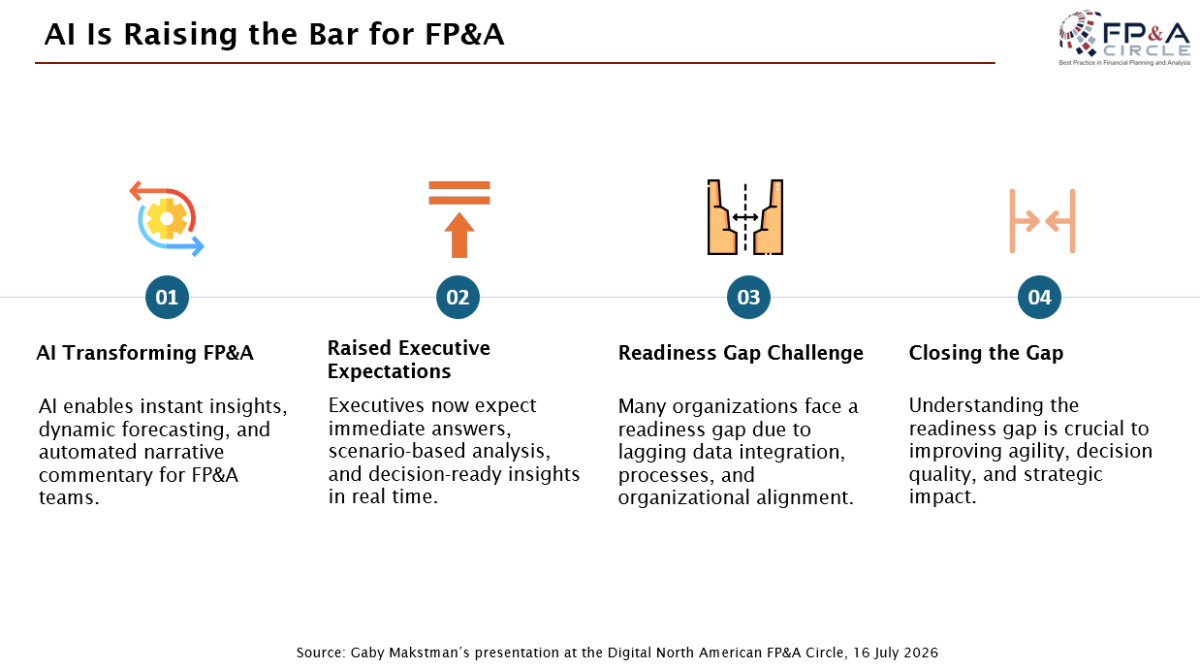
Figure 1
From Analysis to Orchestration
Ankit Chopra, Director of FP&A & Cloud at Neo4j, challenged the audience to think differently about AI. While much of the conversation around AI focuses on automation, he argued that the bigger opportunity lies in orchestration.
To illustrate the point, Ankit compared FP&A to a symphony orchestra.
He then described FP&A’s evolution as progressing through three stages.
The first is Control, where planning is largely reactive. Organisations focus on accuracy and reporting, supported by basic data integration, but have a limited ability to adapt quickly.
The second stage is Agility. At this level, organisations can incorporate real-time business drivers, run multiple scenarios and respond faster to change. Many FP&A teams have reached this stage, but they still rely heavily on human intervention to interpret results and coordinate actions.
The final stage is Orchestration. At this level, systems continuously learn, AI helps coordinate activities across functions, and finance moves beyond producing forecasts to actively enabling better decisions. Rather than simply highlighting what has happened, FP&A becomes responsible for helping the business decide what to do next.
According to Ankit, three major barriers prevent organisations from reaching this final stage, as demonstrated in the slide below.
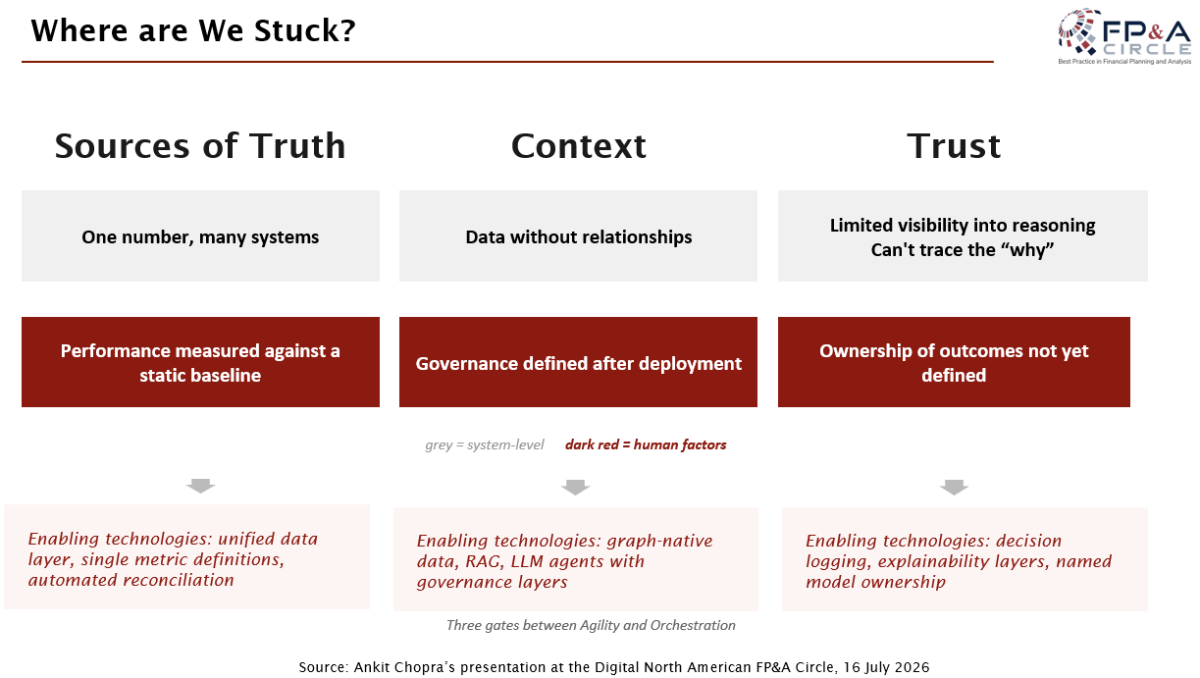
Figure 2
To address these challenges, Ankit presented a practical four-layer framework:
Data foundation layer: Bringing together actuals, operational signals and planning information while preserving business context.
Forecasting layer: Using predictive models and anomaly detection to identify emerging issues much earlier than traditional month-end reporting.
LLM reasoning layer: Enabling AI to interpret results, explain variances and draft management commentary.
Agentic action layer: Routing approved recommendations automatically to the right people or systems so that action can begin immediately.
In conclusion, Ankit encouraged organisations not to wait for a perfect solution before getting started. Instead, they should begin with one business signal, one forecasting model and one alert. Demonstrating value on a small scale can create momentum for wider transformation.
Orchestration is about reducing the time between identifying a business signal and taking meaningful action, allowing FP&A to improve both the speed and quality of decision-making.
A New Operating Model for Finance
The final presentation came from Rowan Tonkin, Chief Marketing Officer at Planful, who shifted the discussion from technology to business outcomes.
Despite enormous investment in AI, many organisations are still struggling to demonstrate measurable returns.
Rowan cited recent research showing that, although AI experimentation is widespread, relatively few initiatives are delivering meaningful business value. The problem, he suggested, is that organisations often treat AI as a technology project rather than redesigning the way finance operates.
Rather than simply layering AI onto existing processes, finance leaders need to rethink how work flows across the organisation. AI can generate analysis in seconds, but if approvals remain slow, data is fragmented and decisions continue to be made in silos, the technology will deliver only marginal improvements.
The real opportunity lies in creating an operating model in which people, processes and AI work together. Routine analysis becomes increasingly automated, allowing finance professionals to spend more time interpreting business implications, challenging assumptions and supporting strategic decisions.
The slide below demonstrates what this operating model looks like, together with two examples of how it works in practice across finance and marketing.
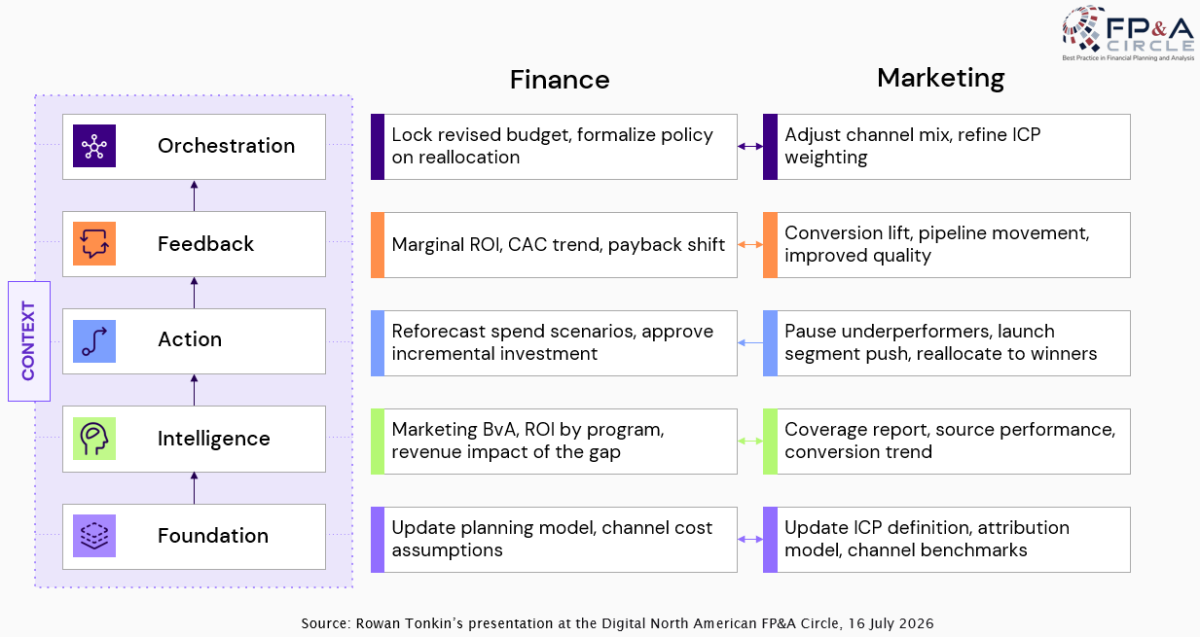
Figure 3
Rowan also shared two customer case studies. In one case, adopting this model reduced the global consolidation process across 120 countries and 140 legal entities from Day 20 to Day 7. In another, the model had been used for four years, helping the Board and private equity sponsor build greater trust in the numbers.
Conclusion
AI has enormous potential for FP&A, but success depends on much more than adopting the latest technology.
Strong data foundations, connected planning processes and trust in information remain essential. At the same time, the role of finance continues to evolve.
As AI takes on more routine work, FP&A professionals have an opportunity to focus on what adds the greatest value: asking better questions, interpreting business performance and helping organisations make better decisions.
The future of FP&A is not about replacing people with AI. It is about giving finance teams the time, information and tools they need to become even more effective business partners.
A special thank you to Planful for sponsoring the Digital FP&A Circle and supporting this important discussion on the evolution of FP&A in the AI era.
The full text is available for registered users. Please register to view the rest of the article.
Related articles

In this article, the author examines how FP&A teams can implement trustworthy agentic AI by matching...

In this article, Ashok Manthena reflects on what 2025 really delivered for AI in FP&A —...

In this article, you’ll explore why AI will transform, but not replace FP&A, and why human...

In this article, the author explains how FP&A teams can use the FAIR data management framework...

In this article, the author explores how the evolution of dashboards and AI-powered business intelligence mirrors...
+
Subscribe to
FP&A Trends Digest

We will regularly update you on the latest trends and developments in FP&A. Take the opportunity to have articles written by finance thought leaders delivered directly to your inbox; watch compelling webinars; connect with like-minded professionals; and become a part of our global community.