

A Deloitte survey of 600 global finance leaders, as highlighted in CFO.COM, found that: "companies spent...

Why ERP Transformations Fail to Improve Decision-Making
May 19, 2026

ERP implementations often begin with big ambitions. They promise cleaner processes, better controls, and a system that finally brings order to chaos. But once the dust settles, many organisations quietly admit that the transformation didn’t deliver what they hoped. The system works, yes. Invoices go out, suppliers get paid and the books close, but the business doesn’t steer better. And that is exactly where most ERP programs fall short.
The usual explanations are familiar: timelines were unrealistic from day one, change management lagged, scope kept shifting, data wasn’t ready, testing was rushed, and leadership support faded once the project became difficult. These issues matter, but they don’t explain the deeper pattern.
The real reason so many ERP implementations fail is that they are designed as transactional transformations, not decision-making transformations. And nowhere is this more visible than in the Financial Planning & Analysis (FP&A) domain.
The Transactional Comfort Zone
From a finance perspective, most ERP programs start with the same three areas: Purchase-to-Pay (PtP), Order-to-Cash (OtC), and Record-to-Report (RtR). These processes form the basis and are therefore essential. They keep the company running. They reduce manual work. They improve compliance. They are also predictable, measurable, and relatively easy to justify.
But they don’t help the business make better decisions.
Still, they dominate the agenda. FP&A, the part of Finance that helps the organisation understand what is happening, why it’s happening, and what to do next, is almost always pushed to the end. It becomes “phase 2”, the “reporting layer”, or “we’ll get to it once the basics work”.
By the time the project reaches that stage, budgets are tight, teams are exhausted, and the business has moved on. What should have been the strategic heart of the ERP becomes a thin layer of reports built on top of a system that was never designed to support real decision-making.
Why FP&A Gets Marginalised
The root cause is simple: transactional processes deliver efficiency, while FP&A delivers effectiveness. Efficiency is easy to measure. Effectiveness, or better and faster decision-making, is difficult to measure.
It’s straightforward to calculate the ROI of automating invoices or reducing manual journal entries. But how do you quantify the value of better decision-making? The impact is real, but it’s spread across functions, timelines, and markets. It doesn’t fit perfectly into a business case.
Yet these decisions shape the company’s future. However, the systems that should support them are often an afterthought. Here are a few examples of decisions where value is created or lost.
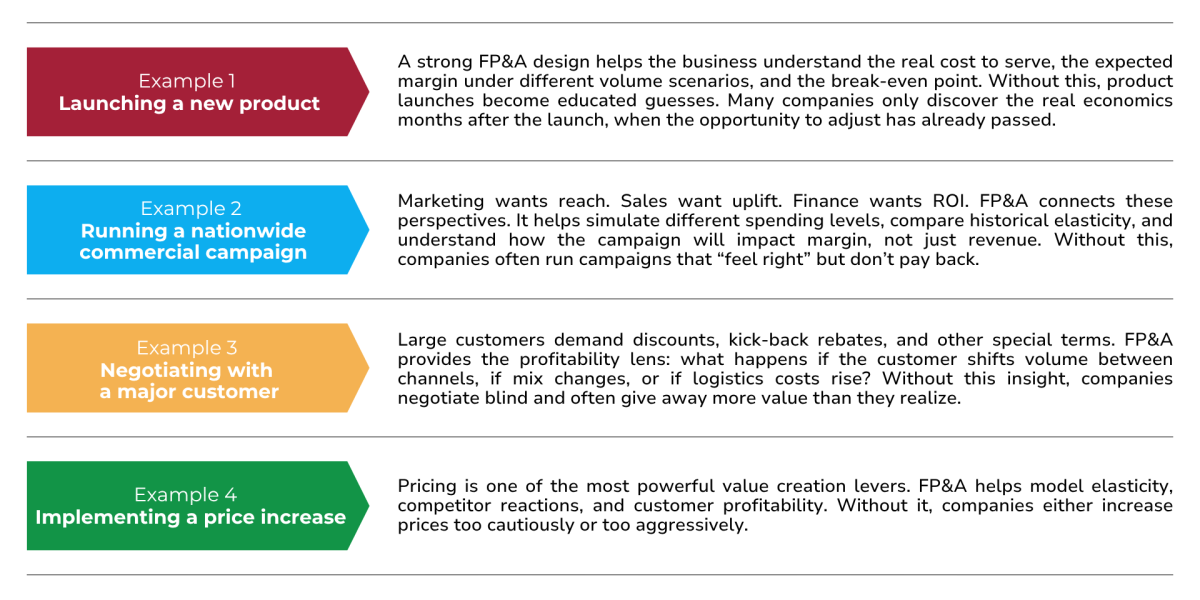
Figure 1
The Silent Failure: The ERP System Works, but the Business Doesn’t Steer Better
When FP&A is brought in too late, the consequences are predictable. Reports don’t answer the questions the business asks. Data structures don’t support forecasting or scenario modelling. Finance teams rebuild everything in Excel because the system can’t keep up. And the business continues to make decisions with incomplete or inconsistent information.
The ERP works but the company doesn’t steer better. That is the real failure.
AI Is Changing the Game and Raising the Stakes
The rise of agentic AI is only accelerating this shift. Many transactional activities that once justified ERP investments, such as invoice processing, reconciliations, journal entries, and standard reporting, are becoming automated. As the transactional workload shrinks, the value of Finance moves toward forward-looking insights, scenario modelling, and cross-functional influence.
In this volatile world, FP&A becomes the core value engine of Finance. If ERP systems are not designed with FP&A at the centre, companies will fall behind. Not because their transactions are slow, but because their decisions are slow.
ERP Providers and Consultants Must Evolve, Too
This shift forces ERP vendors and consultants to rethink their business model. Their traditional value proposition of mapping processes, configuring modules, and reducing manual work is no longer enough. They need to help companies design decision-ready data models, embed FP&A logic into the ERP core, and integrate AI native planning and forecasting capabilities.
In other words, they must move from ‘process implementers’ to ‘value creation partners’.
The Human Factor Becomes the Differentiator
Even with AI native ERP systems, the real impact of FP&A depends on people: their judgment, their ability to interpret context, their skill in storytelling, and their influence in the meeting room where decisions are made. Technology accelerates insight, people turn insight into action, and action is what finally creates value.
The Bottom Line
ERP implementations often fail because they primarily focus on optimising transactions rather than decisions. They treat FP&A as a reporting layer instead of a strategic capability. In an AI-driven world, this approach is no longer sustainable. To stay competitive, companies must elevate FP&A to a strategic pillar in the ERP design, equal to the transactional Finance processes (PtP, OtC, and RtR), and build systems that support the way the business makes decisions.
Key Takeaways
Start with ‘the end in mind’. Define what the FP&A vision is for the total company and make sure there is the right sponsorship from the business, not only from Finance and Technology.
Steering committees must rethink program governance and put ‘better & faster decision making’ on the same level as transactional excellence. In this way, the ERP is treated as a real value-creation engine.
Ensure all FP&A pillars (Data & Accounting, Performance Evaluation, Forecasting & Scenarios, Planning & Targeting, Resource Allocation) and enablers (People, Process & Technology) are included in the design from day one. If this is pushed to the end, companies end up with an ERP that runs the business instead of steering it.
The full text is available for registered users. Please register to view the rest of the article.
Related articles

In this article, you’ll learn how FP&A teams can adopt AI step-by-step by using small, practical...

Discover how FP&A professionals can lead digital transformation by integrating AI, Power BI, automation and continuous...

Learn why most Integrated FP&A efforts fail and how to align data, drivers, and decisions to...

Integrated FP&A thrives on effective data management — ensuring accuracy, consistency and automation to drive better...

In this article, the author shares a seven-step roadmap to help finance leaders cut through sprawl...
+
Subscribe to
FP&A Trends Digest

We will regularly update you on the latest trends and developments in FP&A. Take the opportunity to have articles written by finance thought leaders delivered directly to your inbox; watch compelling webinars; connect with like-minded professionals; and become a part of our global community.