

In this article, the author explores how Integrated FP&A transforms traditional business partnering into a proactive...

Integrated FP&A: Building the Analytical Backbone That Works
April 15, 2026
Integrated FP&A is widely talked about, but in reality, very few organisations have successfully implemented it. Recent insights from the FP&A Trends Survey 2025 highlight that only around 11% of companies have fully aligned their strategic, financial, and operational planning. At the same time, 42% cite fragmented processes and a lack of cross-functional alignment as the key reasons integration efforts fall short.
The FP&A Trends webinar on the 31st of March 2026 focused on how organisations can practically enable Integrated FP&A at scale — bringing together data, drivers, assumptions, models, and technology into a single, connected planning ecosystem.
Below is the write-up of what was discussed.
From Data to Decisions: Enabling Integrated FP&A at Scale
Our first speaker, Abhi (Abhishek) Chandna, director at Visa, started by looking at the current state, the backwards-looking trap where finance still spends a disproportionate amount of time explaining variances rather than predicted future outcomes. This is driven by fragmented data, spreadsheet-heavy processes, and what he described as a “spreadsheet tax,” in which highly skilled professionals effectively act as data plumbers.
He introduced the shift in mindset required to move to integrated FP&A and classified them into 5 distinct categories:
- From tasks to decisions
- From hard-coded assumptions to driver-based models
- From siloed data to a single source of truth
- From annual budgets to rolling forecasts
- From static consolidation to dynamic, multi-variable scenario planning
The three-pillar operating model, which brings together Data, Platform and Talent, is not a stand-alone element but operates as a multiplier effect in a powerful equation:
Clean Data x Driver Models x Business Partnership = Predictive Agility. If one of these is missing, then the whole model fails to deliver value.
He then moved into a practical transformation playbook, outlining a structured approach to scaling integrated FP&A:
- Audit legacy models and technical debt
- Establish strong data foundations and governance
- Focus on a small number of critical business drivers
- Implement a connected platform (but not as the starting point)
- Build dynamic scenario modelling capabilities
- Strengthen cross-functional collaboration
- Transition to rolling forecasts
Finally, he closed with several key takeaways, which can be seen in the slide below
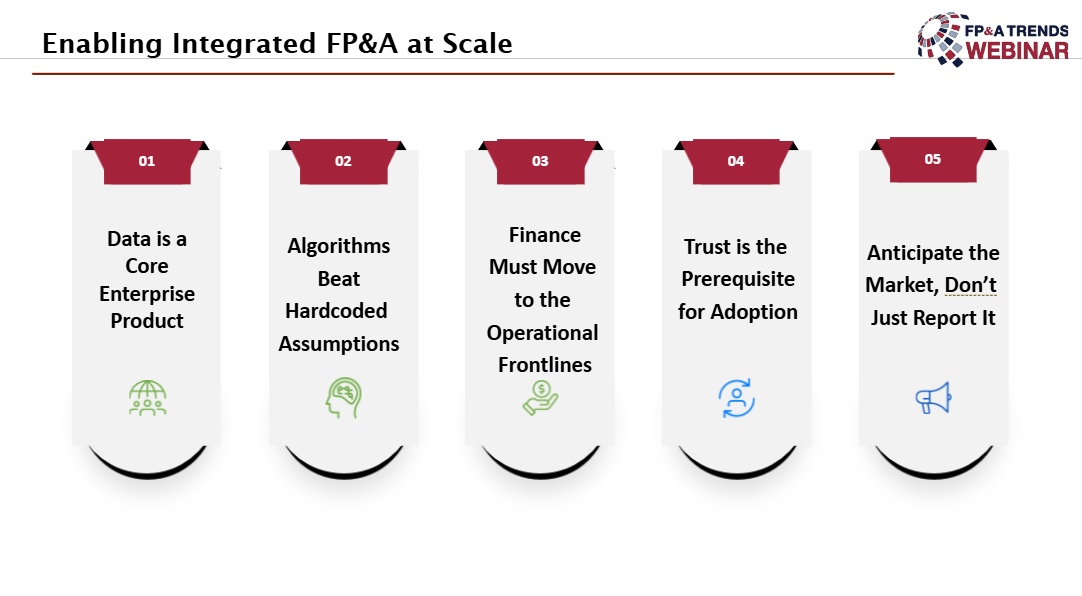
Figure 1
Elevating Integrated FP&A through People, Process, & Data
Anthony Rossano, Senior Director at Indeed, focused on Integrated FP&A and how it comes to life through people, process and data.
His four-part framework for integrated FP&A is shared below:
- People – finance must act as true business partners, understanding operational drivers and building trust
- Data – FP&A must use the same operational data as the business to translate activity into financial outcomes
- Process – planning and forecasting must align with how the business actually operates, not just finance cycles
- AI – an emerging accelerator that enhances speed, insight generation, and scalability
The key message is that AI only delivers value when the first three elements are already integrated and working effectively.
The two examples shared, which aligned with the business cadence and Co-creating models, brought this to life. Whether it’s joining weekly sales discussions or co-building models with marketing, the goal is the same: work in the same rhythm, with the same data, to drive decisions in real time.
He then shared with us the concept of an “Integrated Decision Engine”, where operational signals feed directly into driver-based models and continuous forecasts, helping leaders act faster and with more confidence, as shared below:
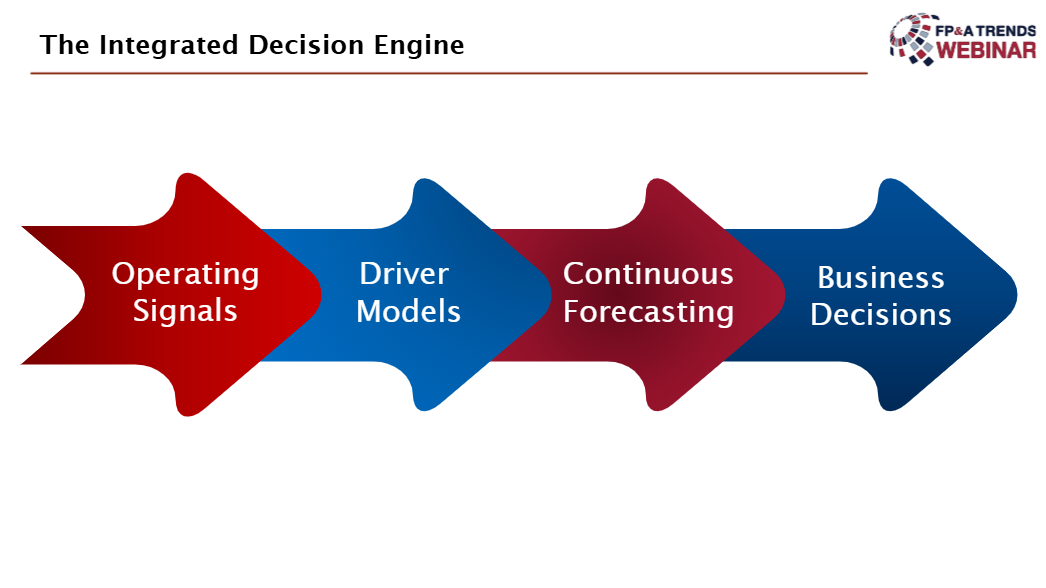
Figure 2
Finally, he highlighted the role of AI as an accelerator of this model, amplifying the impact of finance teams who already understand the business, rather than replacing them.
Technology in Action – Modern Systems with Embedded AI
Neil Thomas, Senior Vice President of Applications at Anaplan, our final speaker, focused on what it really takes to enable Integrated FP&A from a technology and AI perspective.
His key message was: to make Integrated FP&A work, you need a connected, scalable platform that serves the entire organisation, not just corporate finance. That means supporting:
- Corporate (consolidation and reporting)
- Business units (flexible, local planning)
- Functions like HR, supply chain, and sales
All while keeping everything aligned through a single source of truth.
He then brought this to life through the idea of connected planning, where finance is fully integrated with operations, workforce, and commercial teams, all working from the same data and feeding into a single planning model.
AI was positioned as a major enabler:
- Helping users interact with data more easily (e.g. natural language queries)
- Automating model building and system management
- Accelerating forecasting and scenario analysis
But again, echoing earlier speakers, AI only delivers value when the data and foundations are right.
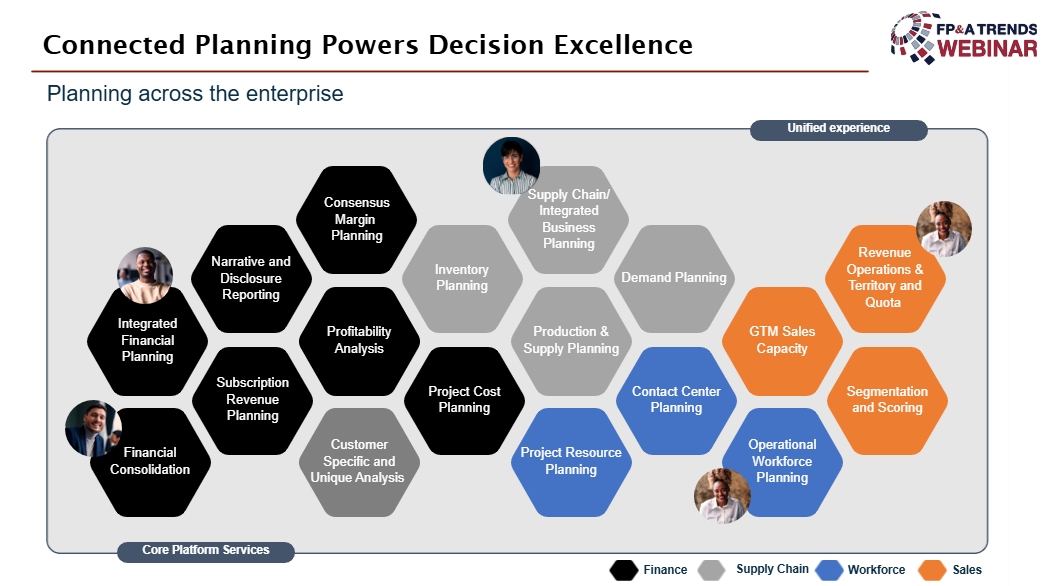
Figure 3
The real-world examples reinforced the benefits — faster scenario modelling, instant insight into financial impacts, and better alignment between plans and actions.
He closed with three clear takeaways:
- You need the right platform to scale and connect everything
- You need tailored applications for different parts of the business
- You need to leverage AI thoughtfully to enhance decision-making
Key Takeaways:
In conclusion, the speakers left us with three clear messages:
Abhi Chandna emphasised the fundamentals — people, process, and data — with one standout point: get the data right. A strong data foundation is the starting point for everything in Integrated FP&A.
Anthony Rossano focused on the role of FP&A — having a true seat at the table, influencing decisions and driving outcomes. AI will help, but only as an accelerator, not a replacement for strong foundations.
Neil Thomas reinforced the importance of embracing AI now. It’s moving fast and will reshape finance, but success depends on combining it with human insight, business context, and strong systems.
We would like to take this opportunity to thank our technology sponsor, Anaplan, for bringing this webinar to our FP&A community.
The full text is available for registered users. Please register to view the rest of the article.
Related articles
In this video, Michael Coveney, Analytics Thought Leader and Author and Head of Research at FP&A...

In this article, discover how FP&A principles can transform liquidity planning from a reactive task into...

In this article, we explore the complexities, advantages, risks, and models of FP&A centralisation, offering a...

In this article, the author explains how integrated modelling enables FP&A leaders to balance speed and...

In this article, the author shares a seven-step roadmap to help finance leaders cut through sprawl...
+
Subscribe to
FP&A Trends Digest

We will regularly update you on the latest trends and developments in FP&A. Take the opportunity to have articles written by finance thought leaders delivered directly to your inbox; watch compelling webinars; connect with like-minded professionals; and become a part of our global community.