

AI in FP&A creates value when earlier analytical signals are connected to governance, ownership, escalation, and...

Driving Decision Intelligence in FP&A with AI
September 24, 2026
AI is moving quickly into finance, but the real prize is not a faster forecast or a smarter dashboard. It is the ability to make better decisions while there is still time to act. That was the central theme of the FP&A Trends webinar Driving Decision Intelligence in the Age of AI, held on 16 September 2026.
The starting point is a familiar one. The 2026 FP&A Trends Survey showed that performance has barely shifted in five years:
47% of FP&A teams are still involved in low-value-added activities
Only 22% of FP&A teams perform well, while 32% say they struggle.
Just 41% describe FP&A as an embedded or trusted business partner.
Only 19% can run scenarios in real time or in less than a day.
Finance wants to spend more time generating insights and driving action, yet too much capacity is still consumed by collecting, checking, and reconciling data.
SAP's Lukas Deutsch and Nick Verhoeven explored the issue from inside the finance function and from a technology perspective. Their message was encouraging but grounded: AI can transform the speed and reach of FP&A, provided organisations first create the data, processes, and culture that enable people to trust it.
From Static Plans to Connected Decisions
Lukas Deutsch, Chief Controlling Officer at SAP, described how SAP has moved beyond a stand-alone financial plan towards extended planning and analysis. Strategy, finance, marketing, sales, workforce, services and cloud infrastructure are connected through common dimensions and a central data foundation. This matters because a change in one part of the business rarely stays there.
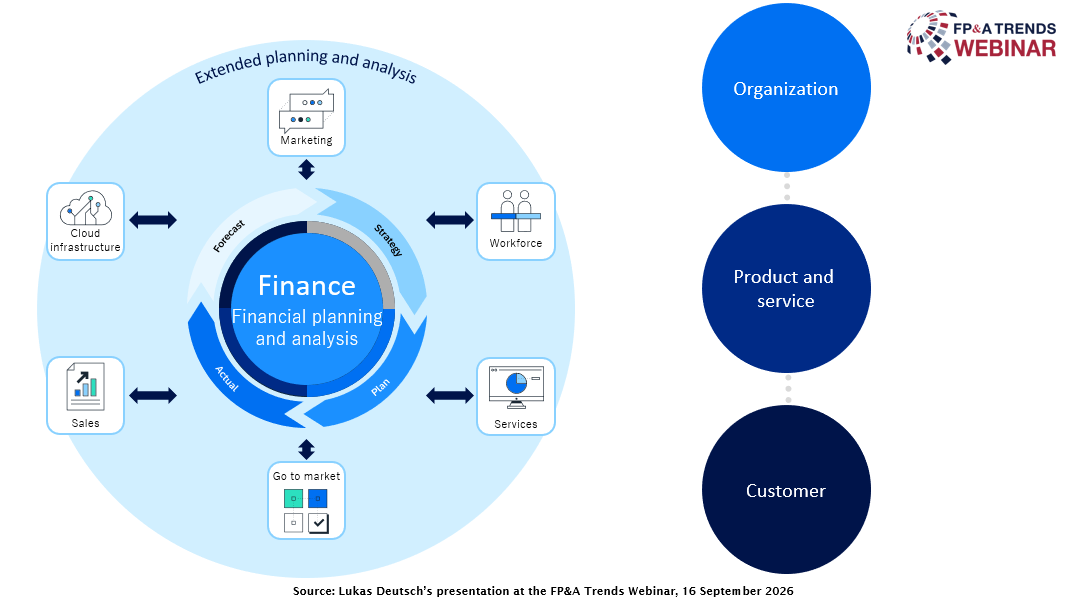
Figure 1
He illustrated the point with the rising demand for SAP's AI agents. Higher revenue expectations also affect cloud infrastructure and token costs, the number and mix of sales and customer-success roles, and marketing investment across regions. In an integrated model, those implications can be reflected in the forecast together, rather than being worked through in separate files by different teams. Finance can then tell the CFO not only that demand has changed, but what it means for operating profit and what the organisation needs to do next.
The lesson was not that planning has become easy. It was that a plan is already ageing the moment it is approved. Decision intelligence depends on a continuous loop between strategy, plan, actuals and forecast, with finance able to update assumptions as reality changes.
AI as a Co-worker
SAP is already applying AI across reporting, forecasting and planning. According to Lukas, the results include:
Time savings of up to 50% in parts of financial reporting.
A five-person team managing SAP's headcount and personnel-expense forecast through predictive workforce forecasting.
40% of the wider controlling organisation's time is saved in each forecast cycle.
AI-enabled reporting use cases are already delivering up to 50% time savings, while broader AI tools are being applied across forecasting, planning and controller productivity.
Yet neither speaker argued for handing finance decisions to a machine. Lukas was clear that a controller cannot defend a choice by saying that AI made it. The tool can scope a problem, challenge an assumption, detect a pattern or generate alternatives; accountability remains with the person making the recommendation.
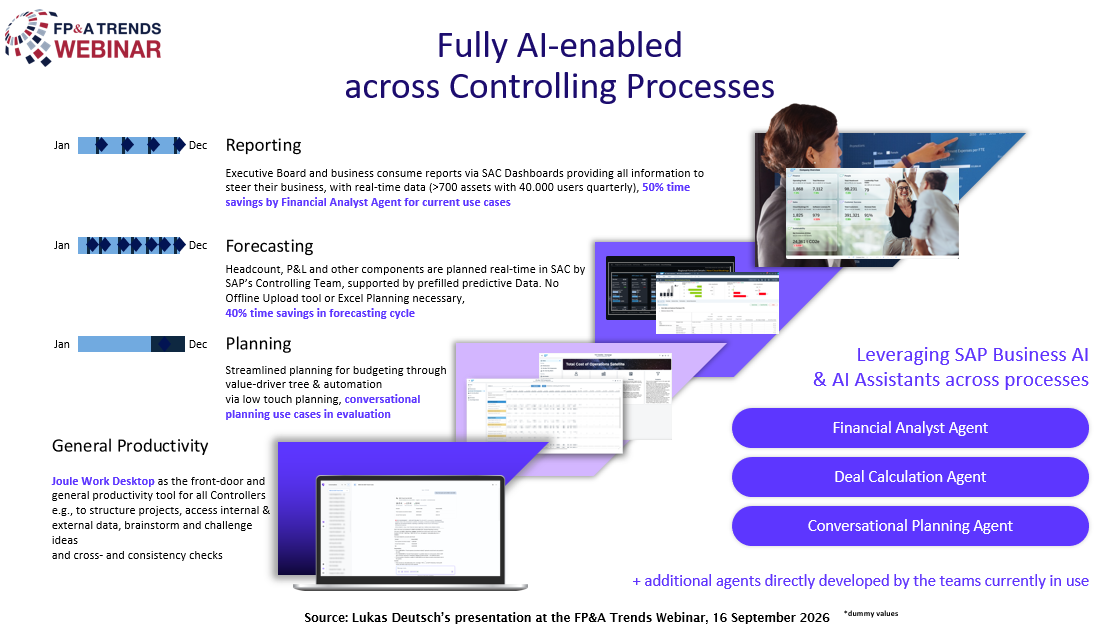
Figure 2
Nick Verhoeven, Global Product Marketer for SAP Enterprise Performance Management, reinforced this with SAP's experience of predictive forecasting. The automated forecast proved more accurate than the decentralised forecast, but adoption still took time. Confidence grew when users could see accuracy measures and understand the drivers behind the output. The shift from forecasting tool to decision support happened through evidence and familiarity, not through a mandate alone.
The audience also highlighted where they see the most immediate opportunity for AI in planning. Baseline forecasting emerged as the clear first priority, while risk detection and real-time scenario planning formed a second tier. Only a small minority felt their organisations were not yet ready. The result suggests that, for many FP&A teams, the first practical step is not autonomous decision-making, but strengthening and accelerating an established forecasting process.
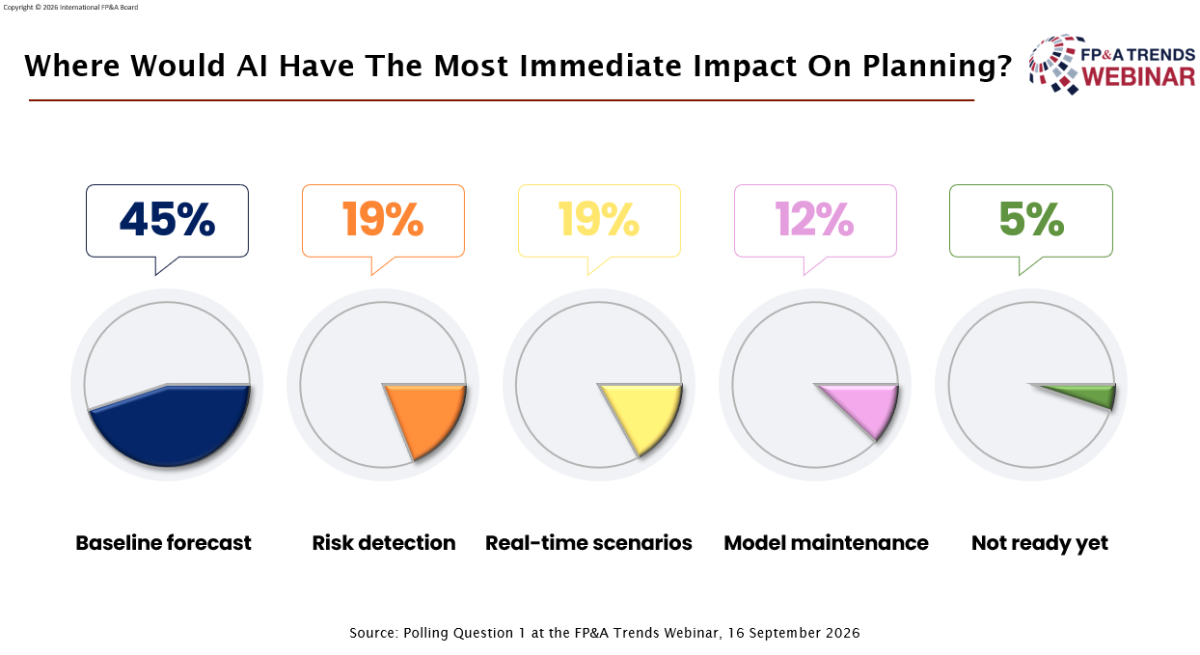
Figure 3
From Plan-Do-Check-Act to Sense-Reason-Act
Nick then looked at where the technology is heading. Traditional planning follows a plan-do-check-act cycle. AI adds a more immediate layer: sense, reason and act. An agent can monitor trusted sources for signals, assess whether they threaten a KPI, propose plausible responses and route the decision to the right person or operational system.
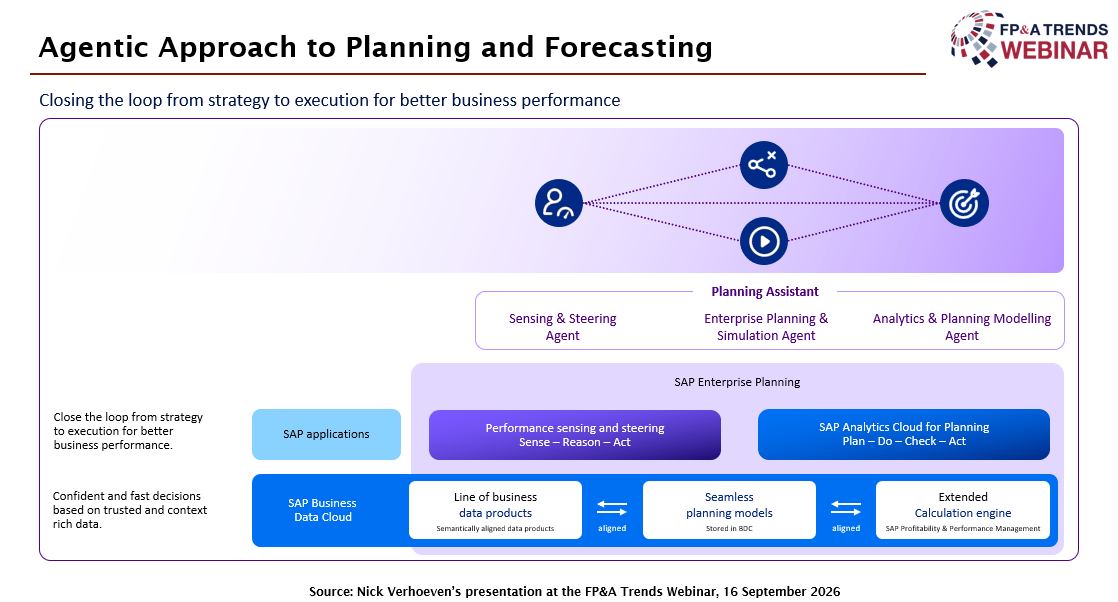
Figure 4
His demonstration used a US company with significant operations in Mexico. A sensing agent identified that exchange-rate movements, not included in the original OPEX planning assumptions, could create a material exposure. It surfaced the relevant drivers and sources, developed scenarios and prepared the context for a treasury decision. In the future, an operational agent could automatically execute a hedging response within agreed limits, escalating only when a threshold is exceeded.
This is a meaningful change. Instead of waiting for the next planning cycle, finance can spot an external signal and begin shaping a response immediately.
The Hard Part Is Still Human and Manual Work
The audience poll provided a practical reality check. Manual work emerged as the biggest barrier to timely, decision-ready insight, ahead of data trust and the lack of real-time scenario capability. Capacity, by contrast, ranked far lower. This suggests that the constraint is not simply having too few people. It is how work, data and planning processes are organised.
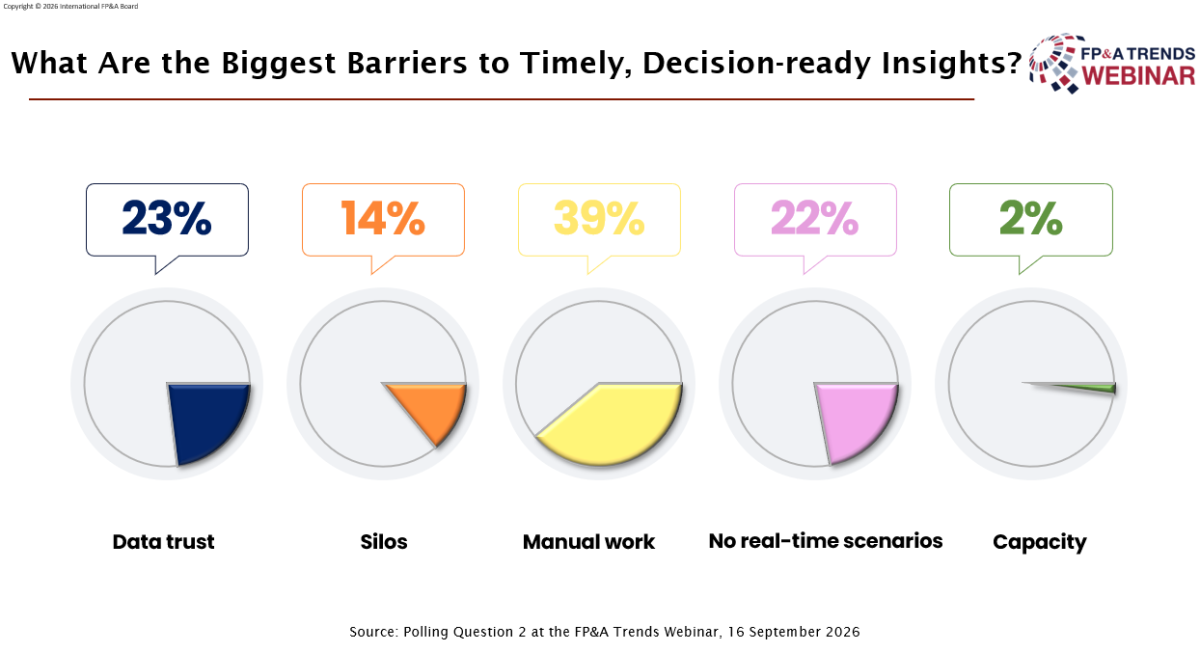
Figure 5
Both speakers identified change management as the harder challenge, ahead of technology. Nick referred to the 70-20-10 rule used in AI transformation: 70% of the effort concerns people, 20% concerns models, and 10% concerns technology. Teams must be willing to retire familiar processes, build confidence through smaller use cases and learn new skills. Controllers, in turn, need broader commercial and operational understanding so the time released by automation becomes better business partnering, not simply more analysis.
Data readiness remains non-negotiable. AI needs governed information, clear authorisations and trusted business logic. Without those foundations, it can make a weak analysis faster and more convincing. As Nick put it, being AI-ready is, in practical terms, being data-ready.
Conclusion
The discussion pointed to five practical priorities for FP&A:
Begin with a connected planning foundation. Link financial and operational drivers so that changes can be understood across the business.
Automate work that consumes time without adding judgment. Reporting, data checks and established forecasting processes are sensible places to start.
Build trust before increasing autonomy. Show the drivers, accuracy and source of an AI recommendation, and keep a person accountable for the decision.
Develop the ability to sense and respond. Use AI not only to refresh plans, but to identify emerging risks and trigger timely action.
Invest in people as deliberately as in technology. Experiment, upskill controllers, and use the capacity freed by AI to deepen the business partnership.
Decision intelligence is not a destination that arrives with a new tool. It is a way of connecting reliable data, intelligent technology and experienced people around the decisions that matter. AI can shorten the journey from signal to action, but finance still has to choose the direction.
We would like to take this opportunity to thank SAP for sponsoring the event.
The full text is available for registered users. Please register to view the rest of the article.
Related articles

AI-enabled scenario planning helps FP&A move beyond forecasting by turning uncertainty into signals, triggers, owners, and...

AI-enabled scenario management helps FP&A turn uncertainty into trigger-based action by connecting signals, owners, interventions, and...

Learn why most Integrated FP&A efforts fail and how to align data, drivers, and decisions to...

AI in FP&A creates real value only when finance redesigns its operating model around governed data...

Finance has a strange job. We are not the ones making most of the business decisions...
+
Subscribe to
FP&A Trends Digest

We will regularly update you on the latest trends and developments in FP&A. Take the opportunity to have articles written by finance thought leaders delivered directly to your inbox; watch compelling webinars; connect with like-minded professionals; and become a part of our global community.