

In this article, explore how Digital Twin FP&A unlocks smarter budgeting, real-time forecasting, and collaborative financial...

From Spreadsheets to AI-Powered Data Products: Why Finance Needs a Platform Strategy
February 26, 2026

Introduction
Better data equals better decisions. This is something no Finance leader will disagree with. Nevertheless, in most companies, data is still scattered across SharePoint spreadsheets, siloed data warehouses/lakes, or stored on someone’s computer. The result? Endless hours spent doing reconciliations, arguing about who has the right version of the truth, and bending over backwards to decide which numbers to trust instead of analysing them.
What’s different now is that AI magnifies both the opportunity and the risk. A single inconsistent definition used to delay a forecast; now, with AI, that inconsistency can cascade into hundreds of models, forecasts, and investment decisions in minutes. AI without the right foundation is useless.
AI without a solid foundation is like a car without roads. You might have horsepower, but you’re going nowhere fast. What finance teams need first is a way to solve for the foundation: data. A way that enables collaboration, ownership, and speed within a robust set of guardrails. Once that foundation is in place, AI can amplify the value of every dataset and every decision.
Introducing AI-Powered Data Product Platforms
What Is a Data Product?
A data product is a dataset (sometimes connected to one or many dashboards) that’s ready to use, with definitions and quality checks built in. For FP&A, that might mean:
- A revenue product that calculates net sales the same way every time.
- An expense allocation product that applies the correct rules across regions.
- A forecast product that consolidates all scenarios built by business units.
Instead of each analyst building these from scratch, they are created once by the right team and shared across the company. Think of it like Netflix but for data: pick the product you need from the catalogue and start analysing.
Why Platforms?
Everyone plays their part: Today, too many teams build the same reports over and over. Sales defines revenue one way, Supply Chain defines inventory another way, Finance fixes numbers in spreadsheets. A platform changes this by letting the right people own the right definitions. Once those numbers are published, everyone else can use them. No more guessing whose version is right.
Shared guardrails, not roadblocks: Some people worry platforms mean bureaucracy. Done right, it’s the opposite. A platform sets guardrails (such as standard definitions, quality checks, and security) so that anyone in the company can build new reports or analyses safely. Instead of slowing people down, guardrails give teams the freedom to move faster with confidence.
Built-in internal controls: For Finance, speed and access aren’t enough: controls matter just as much. Too often, companies operate with numbers that work fine internally but crack under scrutiny when prepared for external disclosure. A platform strategy solves this by embedding controls into the data products themselves: lineage and traceability, continuous validation, and audit-readiness by design.
The result: the same numbers used for planning are trusted in quarterly filings.
Scale without chaos: Enterprise-level data can flow in terabytes per hour. No single team can manage that volume. A platform distributes the work, where each team takes responsibility for its piece, while keeping everything consistent in one place. A single central team doing all the vetting quickly becomes a bottleneck. With shared ownership, FP&A isn’t buried in reconciliations; they’re free to focus on planning and insights.
Connect the builders and the users: The real magic of a platform is how it connects the people who create data (like Sales or HR) with the people who use it (like FP&A). Think of it as a company-wide catalogue of ready-to-use numbers. Finance can open the catalogue, grab the certified “Revenue by Region” dataset owned by Sales, combine it with “Operating Expenses” from Finance, and get straight to analysis.
Where Does AI Fit In?
Automation of the grunt work: AI Agents can help alleviate repetitive work. They can build and maintain data pipelines, perform validations, and do reconciliations, reducing the manual effort that eats up analysts’ time.
Quality at scale: We can leverage AI to continuously review numbers without the need for complex coding skills. Simple language rules help teams check for anomalies, errors, or inconsistent definitions, ensuring numbers can be trusted.
Personalised access: AI helps associates find the right data product instantly, without waiting in line for IT or a central reporting team.
What Are the Benefits for FP&A?
Speed: With pre-built, AI-assisted data products, finance teams get answers in hours instead of weeks. That means scenario modelling, driver-based forecasts, and board packs are ready faster.
Accuracy: Because ownership is delegated to the teams that know the data best (e.g., Sales owns bookings, Supply Chain owns inventory), FP&A works from a single trusted version of the truth. No more debating whose spreadsheet is right.
Consistency: When data is accurate and easy to find, business partners actually use it. Store managers, merchandisers, and executives can all pull the same numbers, driving alignment across the enterprise.
Cost savings: Eliminating duplicate reports and redundant pipelines can save millions annually. More importantly, FP&A talent spends less time on reconciliations and more time on insights.
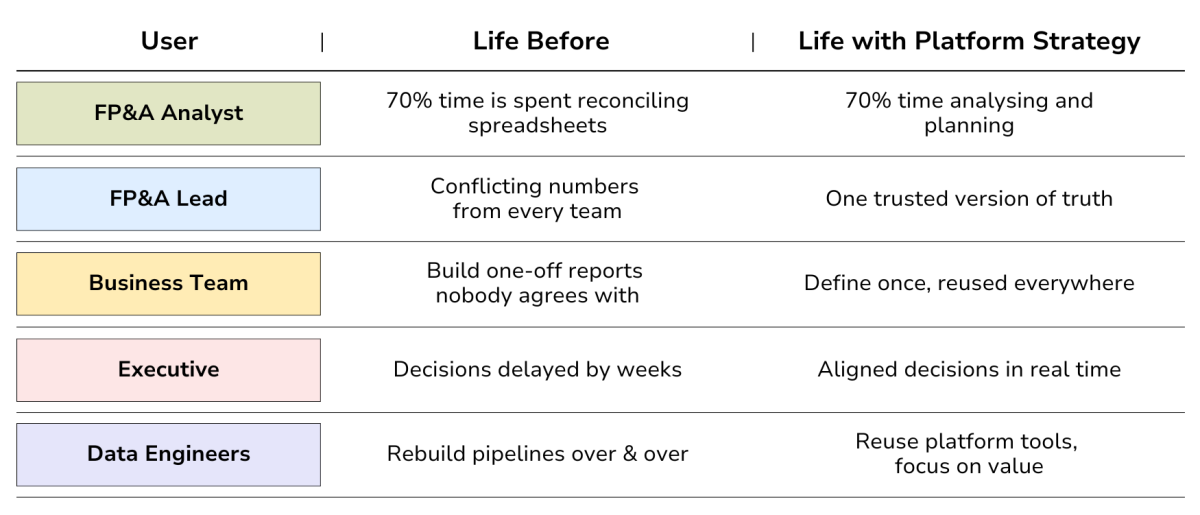
Table 1: Benefits by User
A Simple Example
Imagine preparing a quarterly forecast. Today, analysts may spend 70% of their time chasing down numbers from different systems, adjusting definitions, and reconciling discrepancies. With an AI-powered platform strategy, they can simply:
- Pull the certified “Revenue by Channel” product.
- Combine it with the certified “Operating Expenses by Channel” product.
- Run scenario models directly in their planning tool.
- The grunt work disappears. What’s left is value-added analysis, the work FP&A was hired to do.
Why Does This Matter Now?
Data volumes are exploding, but finance teams can’t keep throwing headcount at manual tasks. CFOs need speed, accuracy, and confidence to guide their organisations through volatility. An AI-powered data product strategy turns finance from a reporting factory into a strategic partner.
As one FP&A leader put it:
“I don’t want my analysts spending nights fixing spreadsheets. I want them advising the business on where to invest next.”
Where Do I Start?
Platforms are not one-size-fits-all. The goal isn’t to “build a platform” for its own sake; it’s to reduce the cost of trust, speed up decision-making, and keep controls intact as complexity grows.
The best starting move is a maturity check. The right first step depends on your current challenges and constraints. Here are a few questions to ask:
Quality: Can we trust the numbers? Do they show up on time? When something looks wrong, do we assume the business changed, or do we worry the data is broken?
Speed: How long does it take to get a new report or dataset (days, weeks, or months)? Are we still living in spreadsheets because getting a real table takes too long?
Adoption: Are teams building their own numbers outside Finance? Are we duplicating work? Do we spend more time reconciling than talking about what the numbers mean?
Fix Quality first. Solve your specific trust and timeliness issues. Identify the root causes (missing checks, unclear ownership, unmanaged manual inputs, limited transparency) and address them in a reusable way.
Then improve Speed. Make it easy for teams to build and publish data safely through self-service tools that are integrated with your quality guardrails.
Finally, drive Adoption. Enable teams across the enterprise to find, understand, and share your datasets so they can reuse certified data instead of rebuilding it.
After that, when a new use case shows up, the right team can solve it in the right way. Why? Because the guardrails are already built into the platform.
Conclusion
At the end of the day, the winners in finance won’t be the ones with the most spreadsheets, the biggest central data team, or the fanciest AI tool. They’ll be the ones who can make faster, smarter, trusted decisions at scale. This means:
Trust in the numbers: Everyone is working from the same definitions.
Speed to insight: No delays, no endless reconciliations.
Platforms are the best way to get there. They give every team the tools and guardrails to play their part while ensuring the organisation works from a single trusted source of truth.
AI is the accelerator. But platforms are the road.
The full text is available for registered users. Please register to view the rest of the article.
Related articles

In this article, the author shares a seven-step roadmap to help finance leaders cut through sprawl...

In this article, discover how strategic data harvesting transforms FP&A by improving forecasting accuracy, decision-making, and...

The AI/ML FP&A Committee Meeting #26 on March 5th, 2025, will feature a presentation by Peter...

Discover how AI/ML in FP&A is transforming forecasting, automation, and decision-making through quality data and advanced...

The article explores how data-driven FP&A transforms organisations by integrating financial and non-financial metrics to drive...
+
Subscribe to
FP&A Trends Digest

We will regularly update you on the latest trends and developments in FP&A. Take the opportunity to have articles written by finance thought leaders delivered directly to your inbox; watch compelling webinars; connect with like-minded professionals; and become a part of our global community.