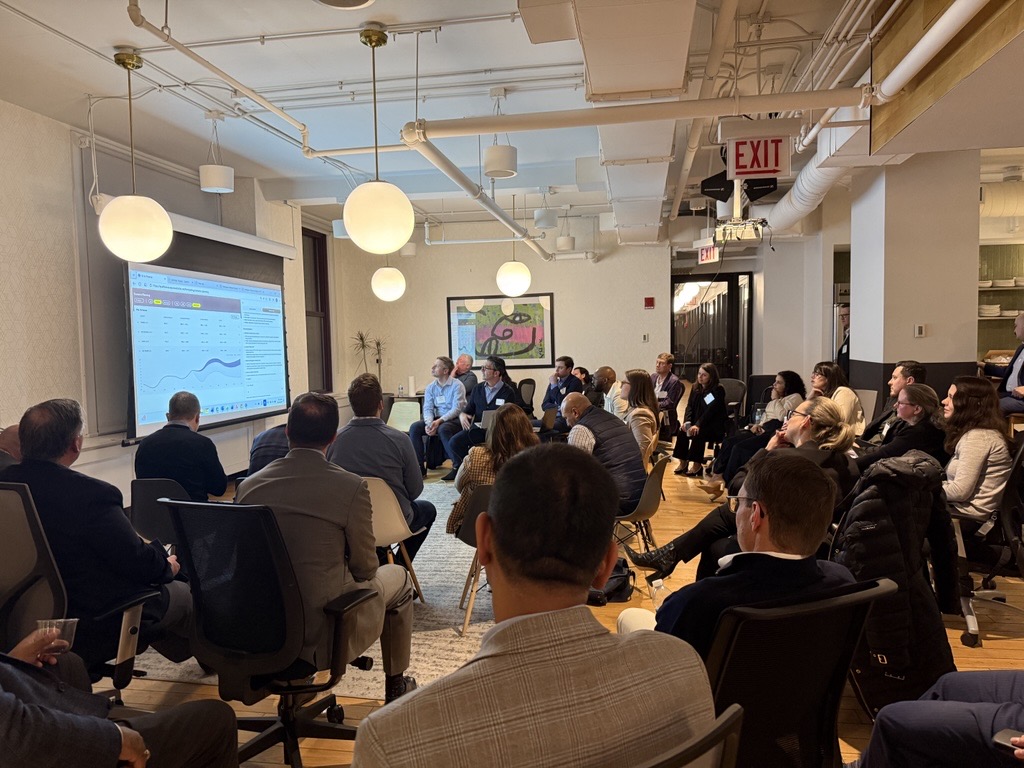

The Chicago FP&A Board gathered for its 11th face-to-face meeting, bringing together senior finance professionals to explore how FP&A is evolving beyond traditional models toward a more autonomous and insight-driven function.
The session was facilitated by Larysa Melnychuk, Founder and CEO of the International FP&A Board and FP&A Trends Group, continuing the Board’s mission to shape and promote best practices in modern FP&A.
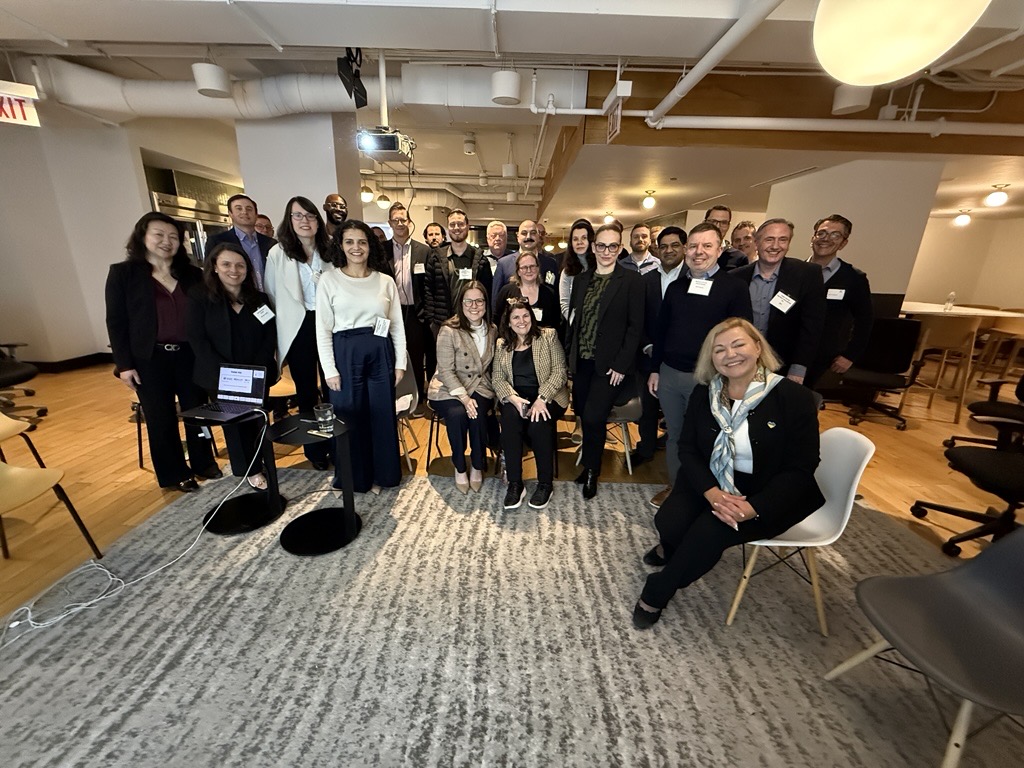
We would like to extend our sincere thanks to Ernst & Young, the event sponsor, as well as Robert Half, the global recruitment partner, and IWG, the workspace partner, for their continued support and contribution to making this session possible.
Opening the Discussion: What Changes First?
The session began with a simple but powerful question:
“If AI agents became part of your FP&A team, what would change first?”
Participants highlighted that the first impact of AI agents would be on core activities such as note-taking, research, and data analysis. At the same time, roles would evolve toward more value-added responsibilities, including analysis review, data synthesis, and communication of insights. This reflects a shift from executing tasks to reviewing, refining, and translating outputs into business-relevant insights.
The discussion made it clear that the real change lies not only in automation, but in how FP&A professionals redefine their contribution.
The Modernisation Paradox
A central theme of the session was what can be described as the modernisation paradox. FP&A has already made significant progress. Cloud platforms are in place, real-time data is increasingly accessible, reporting is more automated, and AI initiatives are emerging.
Yet, despite these advancements, the underlying operating model remains largely unchanged.
Processes continue to be:
- Calendar-driven
- Triggered by humans
- Built around reporting cycles
- Reactive rather than proactive
We upgraded the engine, but kept the same driver.
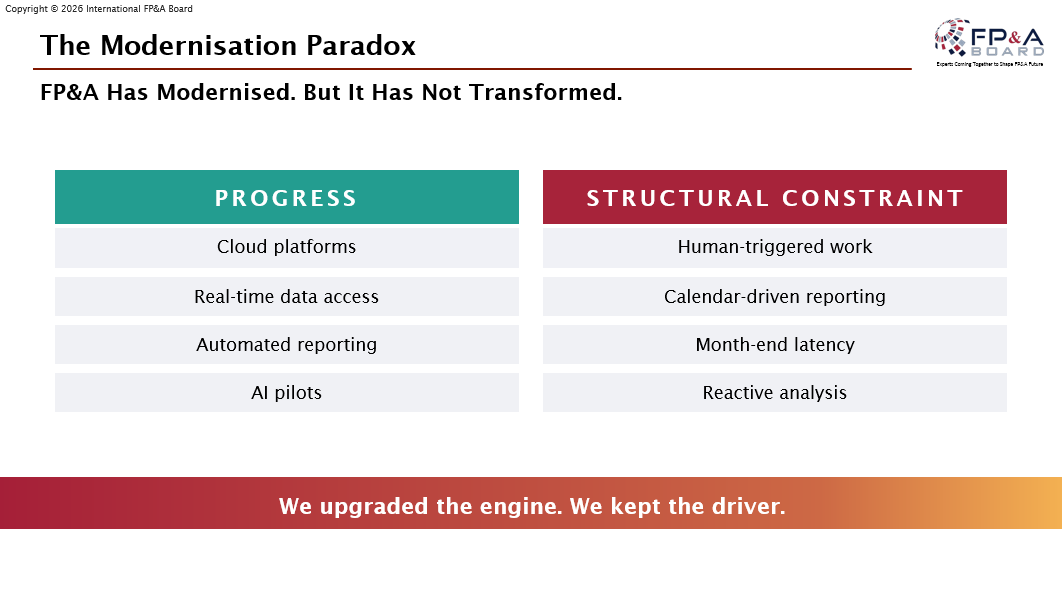
Figure 1
The Operating Model Gap
This disconnect becomes most visible when organisations need to respond to change. Most organisations still require several days, often longer, to deliver a fully analysed ‘Insight & Action’ plan after a market shift.
Only a very small proportion can respond in real time. Finance is still not operating at the speed of the business environment.
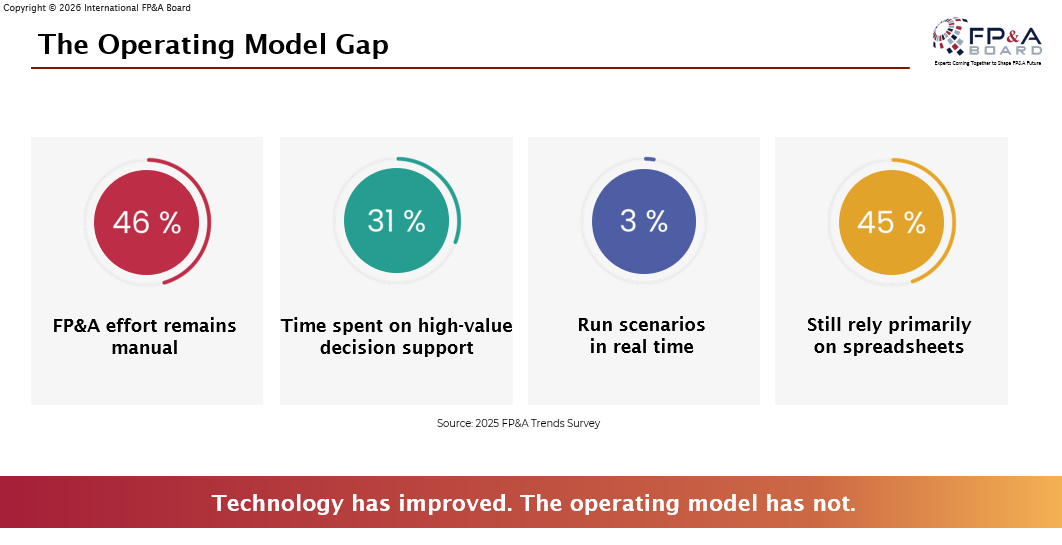
Figure 2
From Human-Initiated to System-Initiated Finance
At the core of the Chicago discussion was a fundamental shift in how FP&A operates.
Traditional model:
- Human detects
- Human requests
- System calculates
Emerging model:
- System detects
- System initiates
- Human governs
This shift redefines FP&A’s role toward governance and decision-making
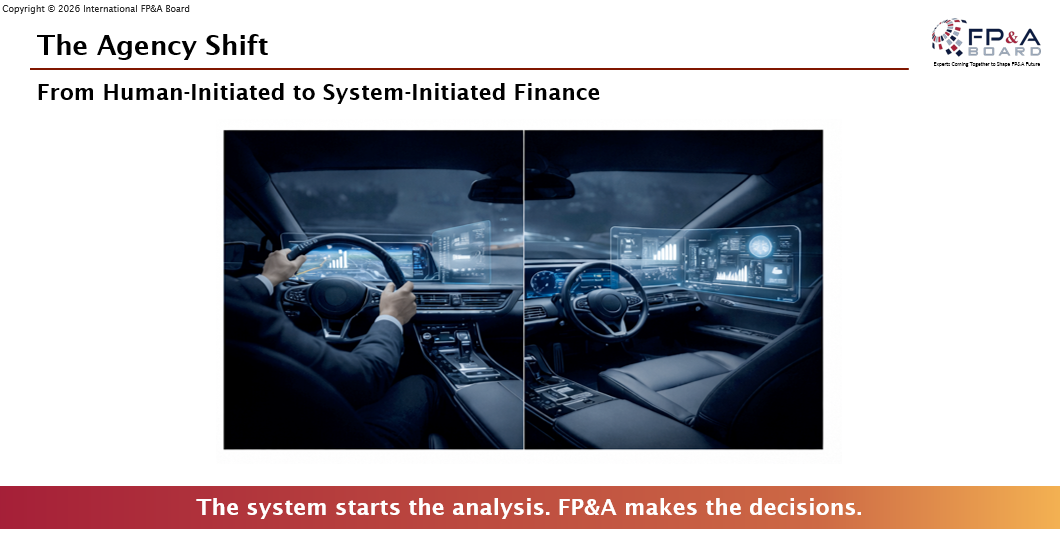
Figure 3
What Is an AI Agent?
AI agents were defined as: Goal-oriented systems that initiate, coordinate, and execute work autonomously within human-defined guardrails. This reframes AI from a tool into an active operating model component — setting the foundation for the structural shifts discussed next.
Figure 4
Five Trends Redefining the Future of FP&A
A key part of the Chicago session was the introduction of five structural trends shaping the future FP&A operating model. Together, these trends reflect a shift from incremental improvement to a fundamentally redesigned approach to finance.
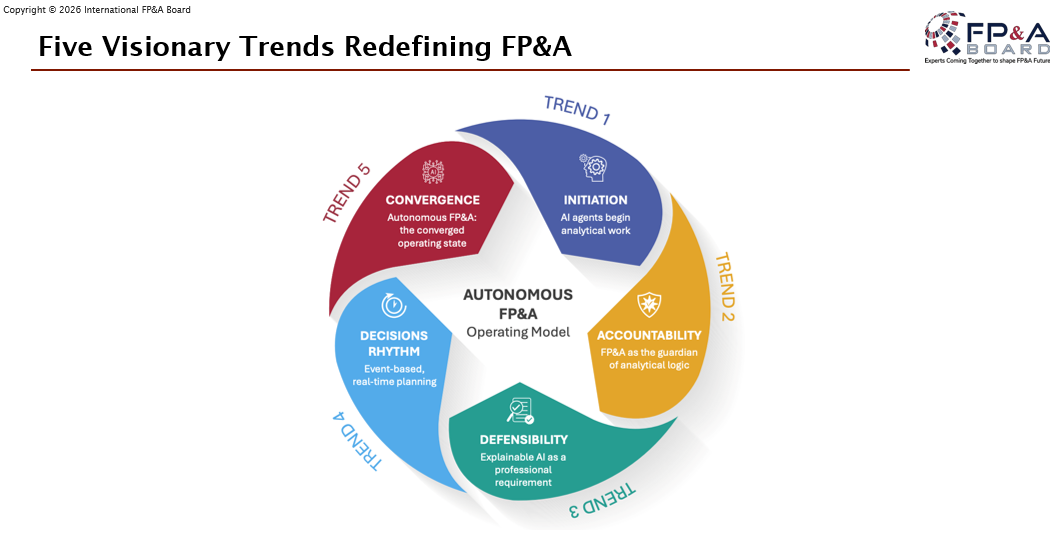
Figure 5
Trend 1 – System Initiation
FP&A is moving from human-triggered processes to systems that detect signals and initiate analysis automatically. This allows finance teams to focus less on initiating work and more on interpreting and guiding decisions.
Trend 2 – Accountable Architecture
Autonomy introduces a key requirement: accountability.
Three elements were highlighted:
- Defined guardrails
- Escalation design
- Named accountability
Autonomy requires ownership.
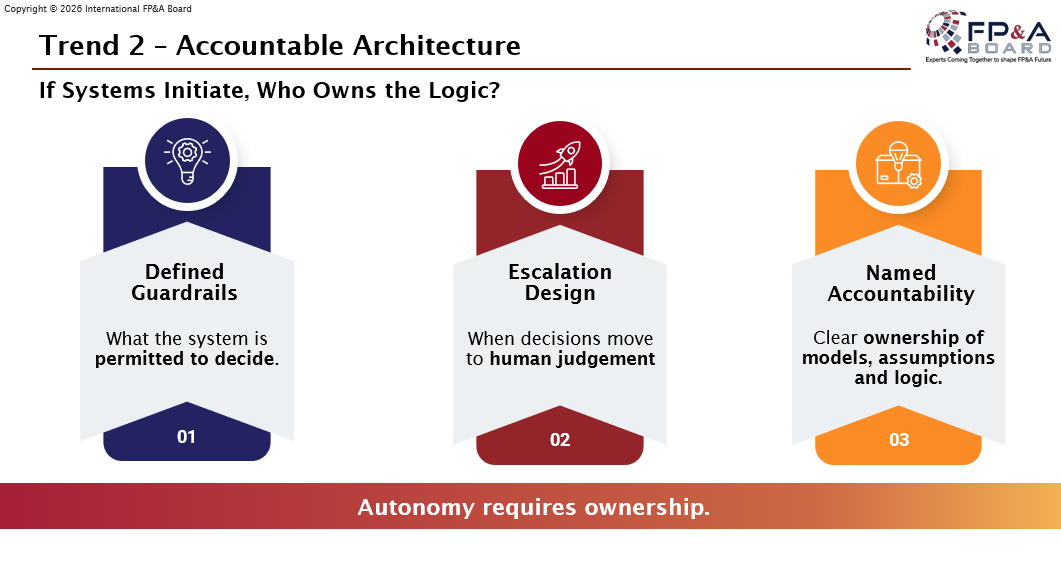
Figure 6
Trend 3 – Defensible Intelligence
AI-driven insights must be transparent and explainable.
FP&A teams need to:
- Understand how outputs are generated
- Be able to explain decisions
- Reconstruct the logic when challenged
Black-box models cannot support finance decision-making — trust depends on clarity.
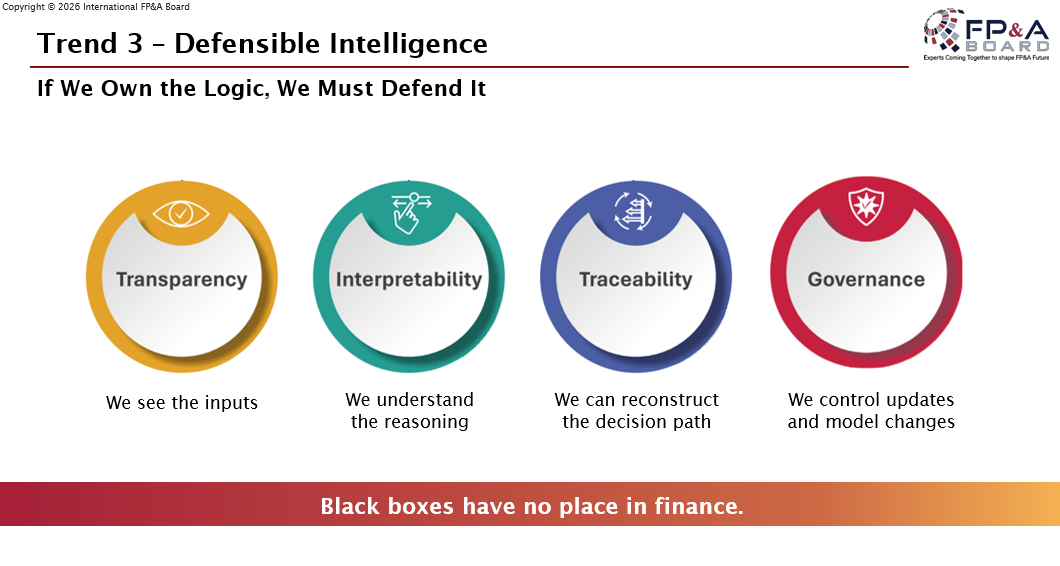
Figure 7
Trend 4 – Event-Based Steering
Traditional calendar-based planning is being replaced by signal-driven decision-making.
Instead of waiting for reporting cycles:
- Signals trigger analysis
- Forecasts update dynamically
- Decisions are made in response to events
This enables FP&A to operate in real time, aligned with business dynamics.
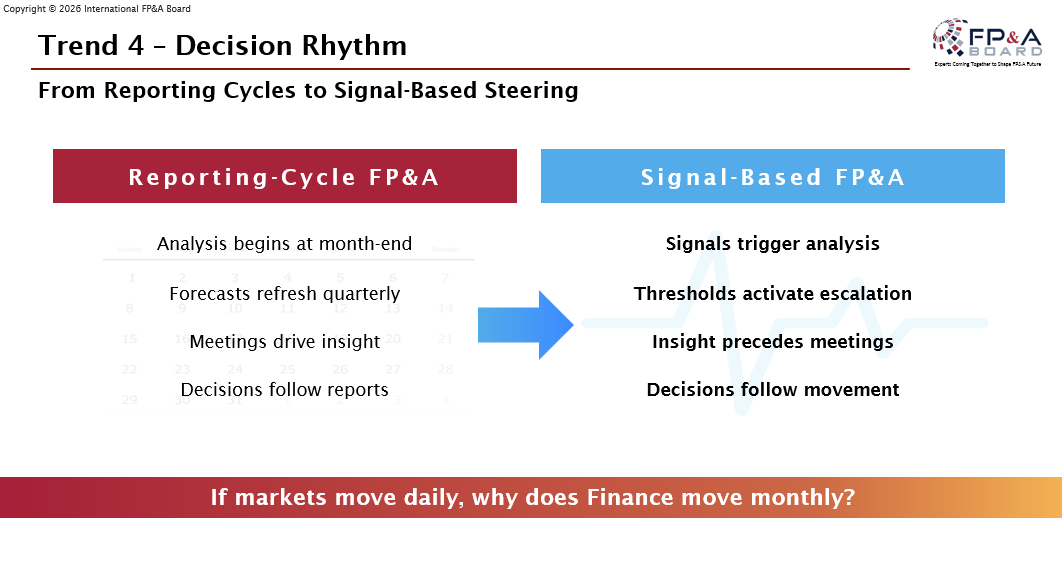
Figure 8
Trend 5 – Autonomous Convergence
The final trend brings all elements together. Autonomous FP&A is not a single tool or capability. It is the alignment of systems, processes, data, and decision-making into one integrated operating model.
In this state:
- Systems initiate and execute analysis
- FP&A governs decisions
- The organisation operates with speed, clarity, and control
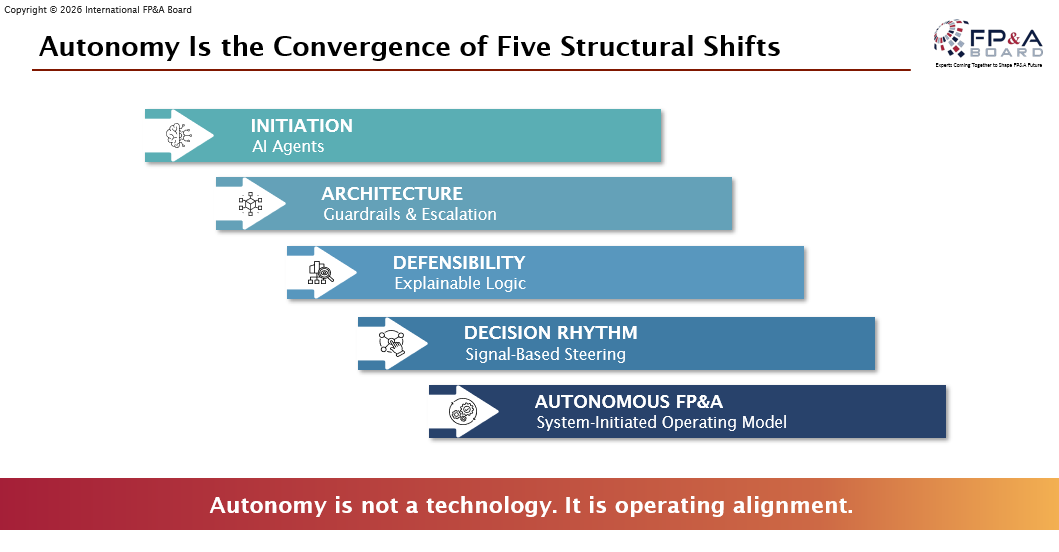
Figure 9
These five trends collectively describe a shift from incremental improvement to a fundamentally redesigned FP&A operating model — one where systems and humans work together in a structured, accountable, and proactive way.
AI in Practice: From Manual Effort to Intelligent Systems
A key part of the session focused on how AI is already transforming FP&A in practice — not as a future concept, but as a present capability.
Traditionally, many FP&A processes were well-structured but highly manual:
- Process documentation required continuous updates
- Variance analysis took several days of analyst effort
- Revenue analytics were rebuilt each cycle
- Scenario modelling was limited by time and capacity
AI is now fundamentally reshaping this dynamic.
Organisations are moving toward:
- Automated process documentation
- End-to-end variance analysis
- Driver-based revenue insights
- Rapid scenario modelling
What stands out is not just efficiency, but a shift in how FP&A capacity is deployed. From manual preparation → to insight generation and business partnering.
Speaker Insights
Marina Plavnik, Head of FP&A at Discover Card / Capital One, shared practical insights into how AI is transforming FP&A processes and enabling more efficient and scalable analytics.
Dennis Sparacino, Partner at EY, delivered an insightful presentation on Agentic AI, highlighting how autonomous systems can initiate, coordinate, and execute financial processes within defined governance frameworks.
Group Work: From Concepts to Action
To translate these concepts into practice, the session concluded with interactive discussions focused on practical implications. Participants’ discussions reflected a clear and structured view of how FP&A could evolve in an AI-enabled environment.

Group 1 – Digital Agents and Outputs
The first group focused on the role of digital agents, highlighting their potential to support data-related activities, analysis, and decision support, as well as enable faster and more consistent outputs across planning and reporting processes.
Group 2 – Guardrails and Governance
The second group emphasised that enabling AI-driven capabilities requires strong governance frameworks, including clearly defined thresholds, escalation mechanisms, and ownership structures to ensure that decisions remain controlled and accountable.
Group 3 – Roles and Skills Evolution
The third group explored how FP&A roles must evolve, with a shift toward skills, accountability, and design, where finance professionals focus more on interpretation, oversight, and structuring decision-making processes rather than executing routine tasks.

Across all groups, a consistent theme emerged: as AI takes on more execution, FP&A’s role shifts toward judgement, integration, and strategic influence, supported by clear accountability and well-defined guardrails.
Final Reflection
The Chicago FP&A Board session highlighted that the future of FP&A is not defined by technology alone. The technology is already in place.
The real transformation lies in:
- Redesigning the operating model
- Establishing clear accountability
- Building trust in systems
- Developing the right skills and mindset
The five trends discussed during the session point to a clear direction toward a more autonomous, responsive, and insight-driven FP&A function.
AI is accelerating this shift, but the transformation itself is fundamentally about how FP&A operates and creates value.