

Seven cities, seven conversations, and one question that proved more difficult than it first appeared: what does it really take to change the way FP&A works?
On 12 November 2026, the International FP&A Board met in Dubai for its 16th local meeting and 310th globally. Led by Larysa Melnychuk, the event brought together senior finance professionals to explore Leading FP&A Change in the AI Era. For the first time, we held our Dubai FP&A Board meeting at the beautiful Spaces CommerCity venue.
The meeting was sponsored by Jedox. We are also grateful to our valued partners, Alchemy Search and IWG, for their continued support.
Dubai marked the conclusion of a seven-city research series covering Munich, Frankfurt, San Francisco, Geneva, Zurich, Singapore and Dubai. Across these cities, a recurring challenge emerged: Finance teams are gaining access to increasingly sophisticated technology, but changing established behaviours, responsibilities, and decision-making processes remains difficult.

The Problem Is Not Just Technology
The evening began with a simple question: what most often stops change from sticking?
Dubai participants identified culture, fear, uncertainty, mindset, motivation, trust and comfort, alongside acceptance, adaptability and change management. Almost every response pointed to people rather than technology.
These observations echoed discussions from the previous six Boards, where resistance, established habits, leadership and buy-in had repeatedly emerged as challenges. The discussion highlighted a difficult reality for FP&A leaders: people may recognise the need for change without feeling ready or confident enough to embrace it.
The wider research reinforced this concern.
The 2026 FP&A Trends Survey, based on responses from 475 finance professionals, reveals how little has changed in the way FP&A teams spend their time. Almost half of their working hours (47%) still go towards collecting and checking data, exactly the same proportion as in 2020. Meanwhile, only 32% of their time is spent generating insights and driving action. The survey also reveals where transformation efforts are concentrated. Technology, data and systems account for 58% of the priorities identified, while business partnering and team development represent just 24%.
The difference is telling. New technology may be arriving in Finance faster than teams are being prepared to make effective use of it.
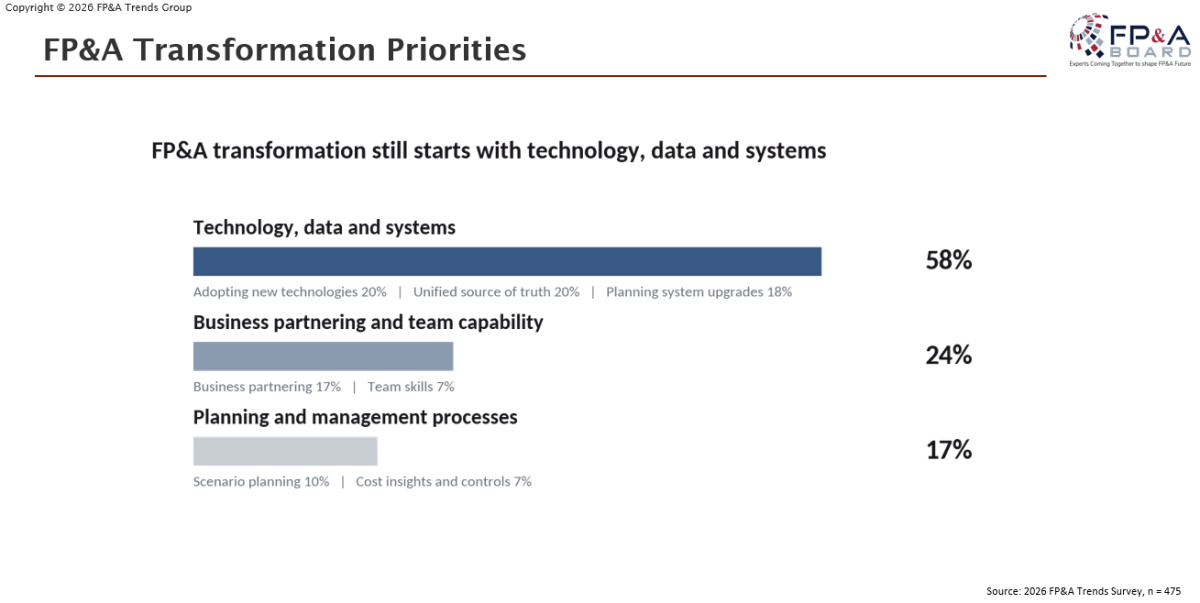
Figure 1
A separate FP&A Trends webinar poll from June 2025 found that 62% of AI adoption barriers were people-related, including skills gaps, resistance and unclear accountability.
Why Change Management Matters in FP&A
The discussion explored why resistance can be particularly difficult to overcome in Finance. Drawing on the FP&A Trends Insights Paper, Managing Change in FP&A, participants considered four underlying forces: professional identity, the need for control, unequal perceptions of risk, and the competence paradox.
For many FP&A professionals, expertise has been built around complex models, reconciling numbers and maintaining control over financial information. When AI begins performing some of these activities, the challenge is not simply learning a new tool. It is redefining where professional value comes from.
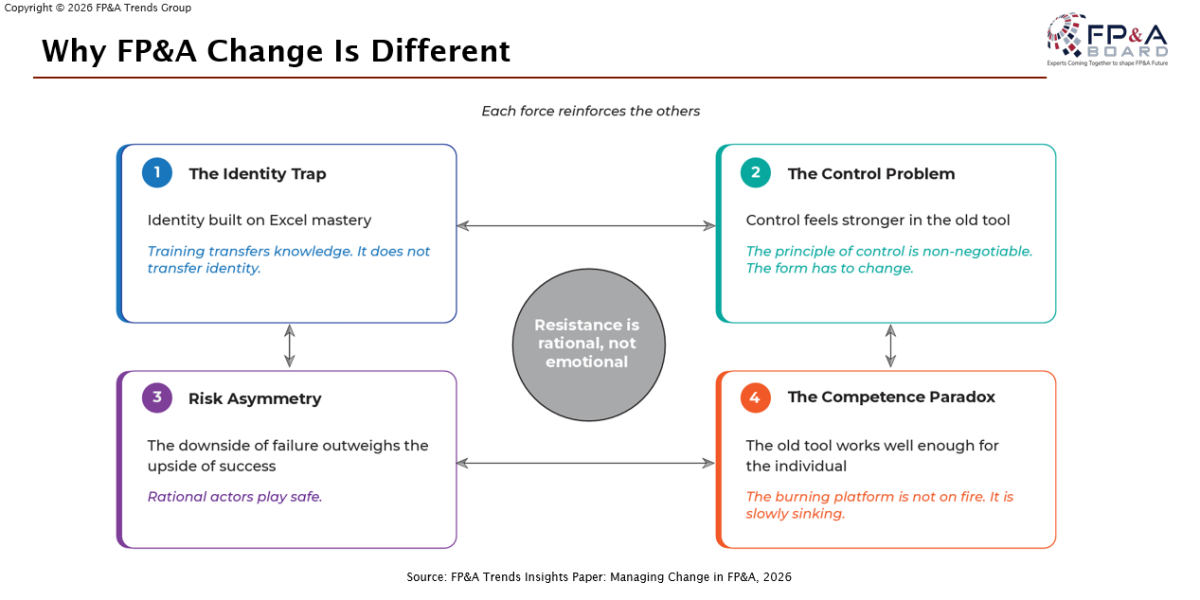
Figure 2
The FP&A Change Leadership Framework addresses this transition through five responsibilities: Lead the Case for Change, Prepare the Organisation, Enable People and Capabilities, Execute the Change and Reinforce the New Way.
A particularly difficult period is the "dangerous middle", when the new process is available but employees are not yet confident enough to abandon familiar methods. This is where leadership becomes critical. Without clear expectations, support and reinforcement, employees may return to familiar processes even after new systems go live.
Successful Change Management, therefore, requires more than communication and training. It means understanding people's concerns, creating confidence and ensuring that everyday practices support the transformation.
From AI Adoption to Trust and Ownership
The Dubai discussion also considered how far AI has entered the finance function.
Polling across five FP&A Boards, Seattle, Frankfurt, Zurich, Geneva and Singapore, involving 134 respondents, found that 59% reported using Generative AI, 49% AI agents and 26% machine learning. Meanwhile, 14% reported no AI use. Multiple answers were permitted.
These cross-city results show that AI is already being used in different forms across Finance. However, adoption figures alone cannot tell us whether it has improved decisions or changed established processes.
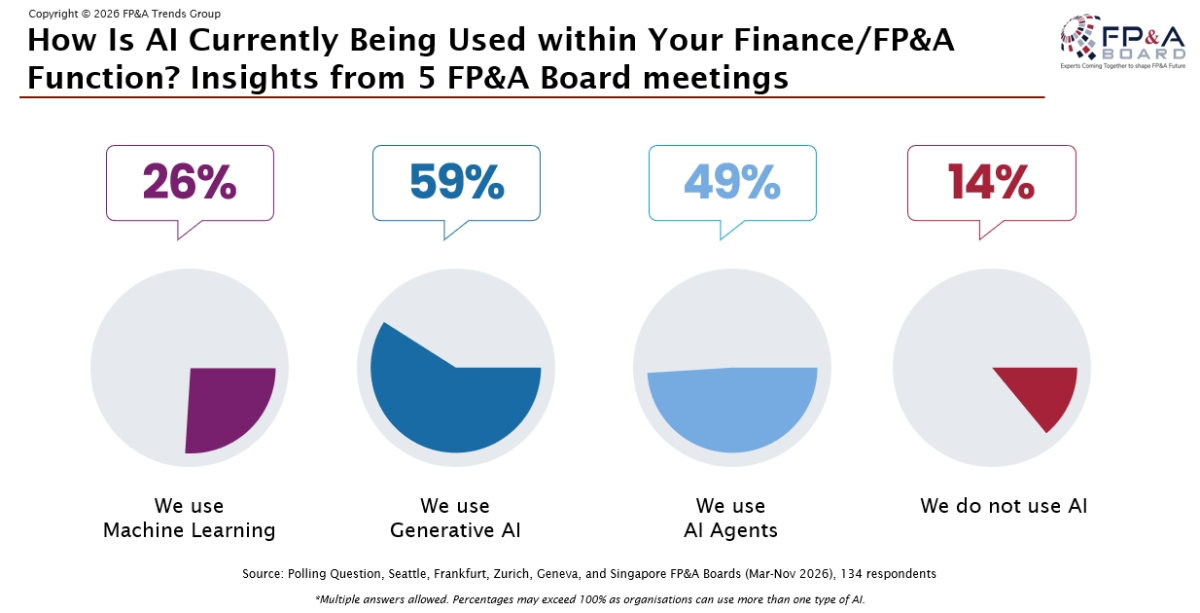
Figure 3
The discussion also emphasised that trust must be earned through proof. Finance professionals need to see where new systems work, understand their limitations and build confidence before relying on them for decisions.
From Data to Decision: AI-Powered Planning at Scale
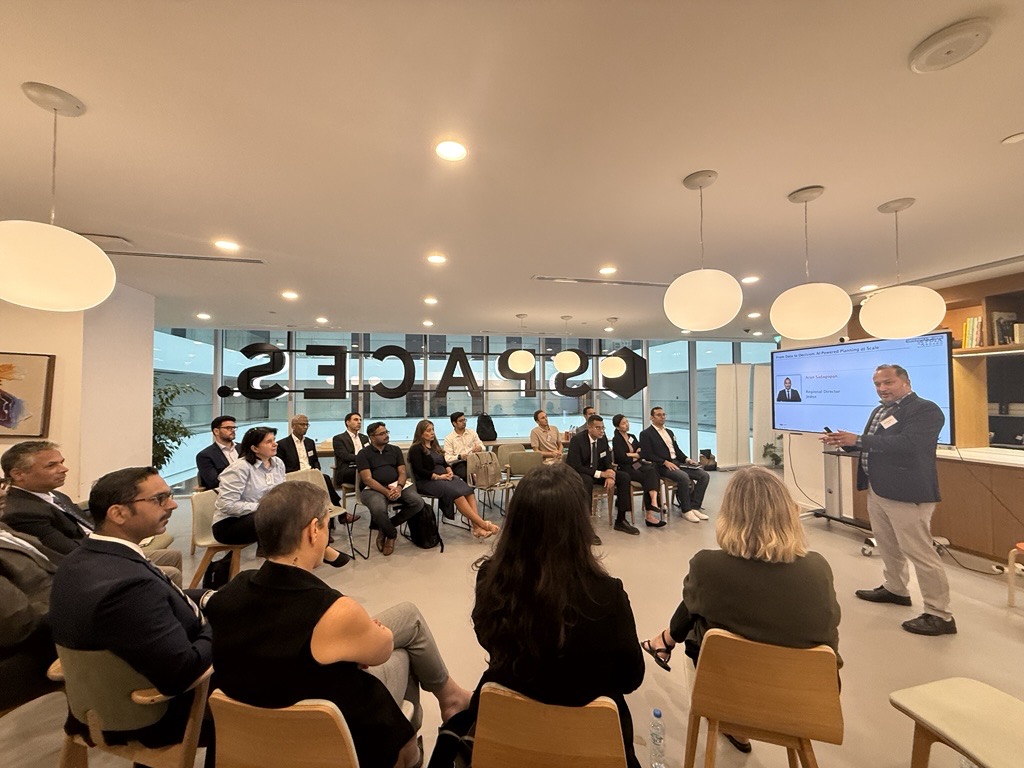
Arun Sadagopan, Regional Director at Jedox, contributed a technology perspective through his presentation, From Data to Decision: AI-Powered Planning at Scale.
His session explored the opportunities that AI-powered planning creates for Finance and how technology can support the move from data processing towards decision-making. The wider discussion raised an important question: as AI takes on more analytical work, where should finance professionals focus their attention?
Technological progress becomes valuable when FP&A can redirect its capacity towards business partnering, more responsive planning and better decisions. Technology can enable these capabilities, but it cannot create trust, accountability or business understanding on its own.
Group Work: Turning Change into Practice
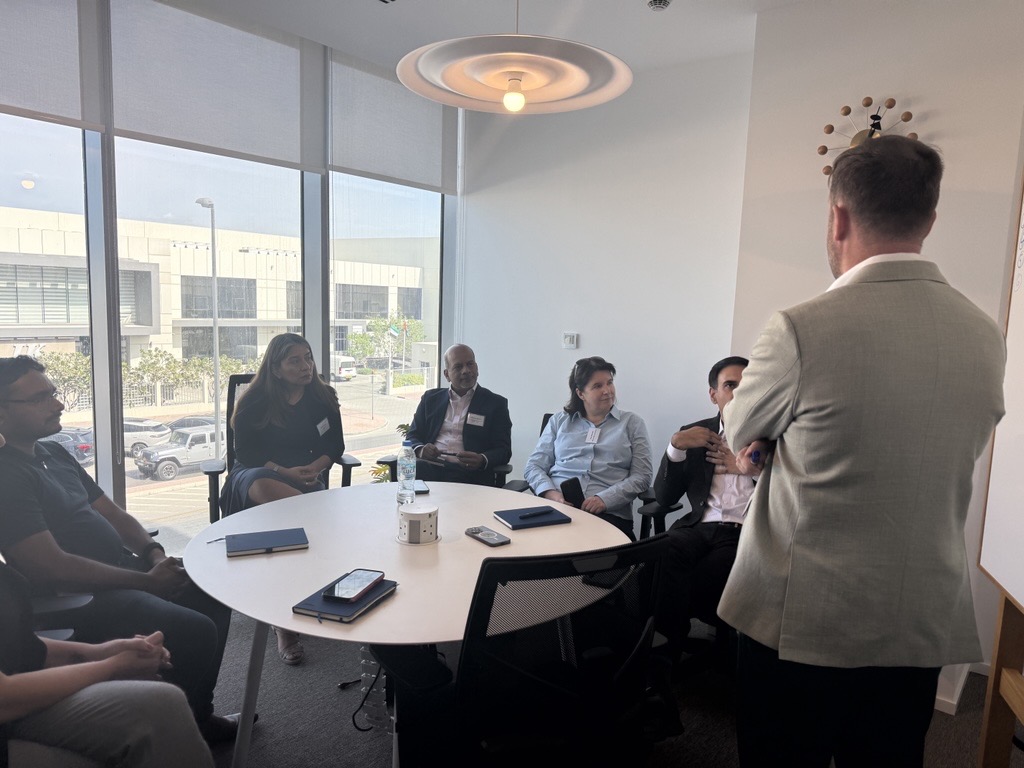
The practical part of the evening brought participants into three working groups, each examining a different stage of adoption: Enable, Execute and Reinforce.
Group 1 — Enable: Preparing People for Change
The first group focused on what must be established before expecting people to work differently.
Key outputs:
Education and competency
Clarity of purpose and expected outcomes
Trust and fear
A clear journey or roadmap
The discussion highlighted that readiness requires both practical skills and confidence. People need to understand why change is happening, where it is leading and what will be expected of them.
Group 2 — Execute: Making the New Way Work
The second group explored what helps employees move away from familiar processes.
Key outputs:
Create champions
Provide training
"Burn the bridge" and demonstrate the benefits
Lead by example
Introduce incentives
Develop soft skills
One particularly interesting contribution was the idea of "burning the bridge". Rather than allowing old and new processes to coexist indefinitely, organisations need to make deliberate decisions about what should stop. However, participants also stressed the importance of demonstrating benefits. Employees need a reason to embrace the new approach, not simply instructions to abandon the old one.

Group 3 — Reinforce: Measuring What Changes
The third group examined how organisations can determine whether adoption is delivering value.
Key outputs:
Financial KPIs: time savings, cost savings and better decisions contributing to profit
Non-financial measures: retention, decision quality and user satisfaction
Regular surveys and feedback
Scalability and ongoing training
Root-cause analysis and corrective action when adoption slips
This group moved the discussion beyond implementation milestones towards measurable results. Saving time or reducing costs matters, but participants also recognised the importance of decision quality and user satisfaction. These indicators can reveal whether new processes are becoming part of everyday work.
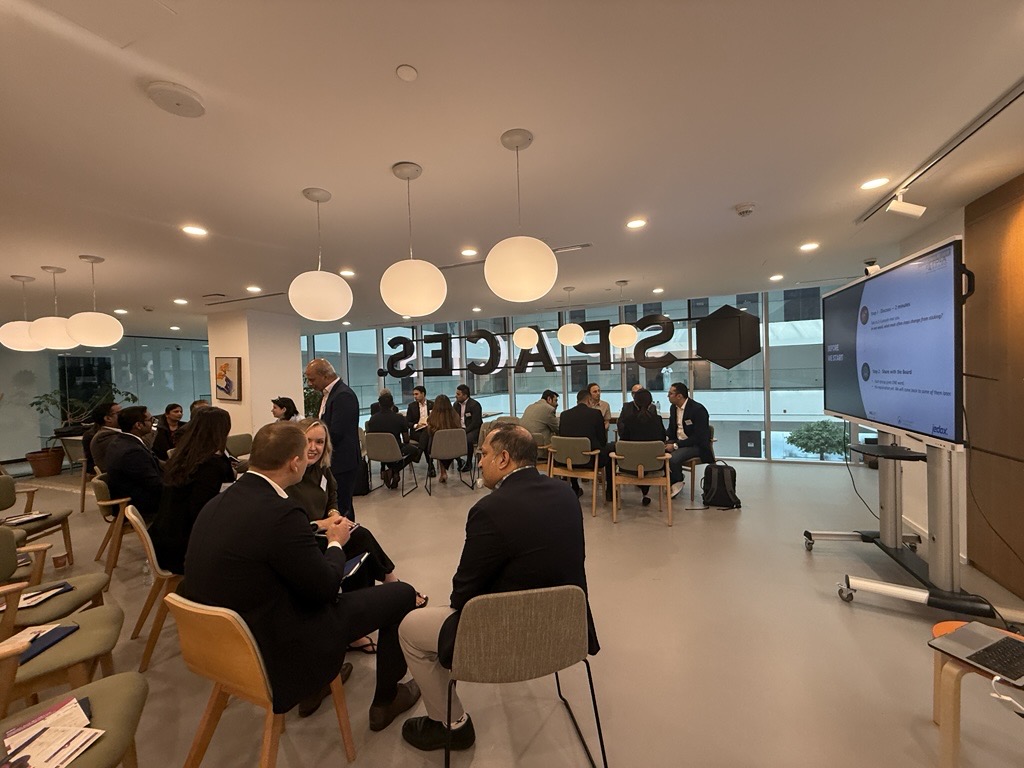
Together, the three groups described a practical sequence: build understanding and trust, embed new behaviours through leadership and incentives, and measure whether the changes are delivering value.
Conclusion: What Seven Boards Taught Us
Dubai closed a research series that began with a question about leading FP&A change in the AI era and developed into a wider discussion about the future value of Finance.
Across seven cities, the recurring challenges were not simply technological. They concerned trust, professional identity, accountability and the difficulty of leaving established practices behind.
For FP&A leaders, the next priority is to turn those findings into measurable progress: develop people's confidence, remove processes that no longer add value and reinforce new behaviours through everyday decisions. AI implementation changes what Finance can do. Successful adoption changes what Finance actually contributes and that difference must be demonstrated in practice.