

The Controllership and FP&A are two separate components of the organisation. This article will highlight a...

Standing on Solid Ground: How Controllership Supports FP&A Performance
May 21, 2026

Taking Sides
In FP&A, we tend to focus on forecasts, budgets, variances, narratives, storytelling, and, in general, on being part of the business teams that impact results. As hard as it is to believe, we may even, in some cases, be seen by the other side of finance as running somewhat fast and loose. Those on the other side may indeed marvel at our relative comfort with grey areas.
But on the other side sit the controllers and financial accountants who are focused on closing the books, publishing financial statements, preparing tax packages, ensuring compliance, and, of course, safeguarding those assets. Those on our side of finance may indeed marvel at their relative discomfort with grey areas. After all, it’s what they do.
But here’s the thing, and you can take this one all the way to the bank:
FP&A’s ability to deliver reliable insights depends directly on the strength and support of controllership. Without solid controllership, FP&A may find itself standing in quicksand, not at all on solid ground. And this will put even the best analysis and business insight at risk.
The impacts and consequences of this instability beneath our feet are very easy to spot. FP&A is usually the first to feel the tremors and shifts. They include missed forecasts, blown budgets, lumpy actuals, unexpected variances, and end-of-period surprises. And as we know, too often FP&A ends up explaining why results didn’t turn out as expected, just last week, just last month, or maybe even all year long. And this is where the series of very scary thoughts can become downright nightmarish in their realities.
But all is not lost. The solution lies in a deeper understanding of the other side of finance.
On That Other Side
Of course, I have always had my own view of that other side of finance, perhaps even held some stereotypes. I also spent some time in a combined FP&A/Controller role. In my current consulting role, while we still shouldn’t call me a controller, I have been doing many “controller-type” activities, gaining a more complete perspective on effective partnership between controllers and FP&A.
For starters, it’s important to understand the other side. Who they are, what makes them tick, and where they spend their time. It can improve FP&A performance by fortifying the ground upon which we stand.
A Controller’s mission is, at its core, about truth in numbers. In the context of sports, a Controller’s organisation is analogous to the offensive line in American football. Rather quietly toiling in the trenches, getting down and dirty under the pile, and not usually garnering much attention - unless that is, something goes wrong. But ironically, their efforts help make forward progress possible.
In soccer terms, Controllers are not the strikers. They are the defenders and midfielders, who respectively defend the back line and push the ball up the field to those who put the points on the board. Similarly, in hockey terms, they are muckers and grinders. Their work enables success, even if it’s not always visible.
Just like in sports, winning teams in finance are built atop solid fundamentals. And good controllership delivers solid fundamentals and solid ground upon which FP&A can confidently operate.
Seeing Both Sides
On the FP&A side, we know all too well the weight of our responsibilities. Some would even say that FP&A does more than its fair share, particularly given the data-wrangling necessities of its everyday work. FP&A Trends Survey results consistently show that FP&A spends about 50% of its time handling data. That is, we struggle to reach the higher levels of the FP&A pyramid (think Maslow), where, by my definition of this hierarchical pyramid, adeptly rendered narratives, effective storytelling, and impactful insights coalesce into the soundtracks and drumbeats of our businesses.
The punchline, of course, is that FP&A can benefit by seeing both sides more clearly and recognising that a better partnership with those across the finance aisle is a potential inflexion point for our own performance. What controllers do and how well they do it shapes the quality, speed, and credibility of FP&A outputs.
How Good Controllership Provides Solid Ground
From my perspective on the controllership side, I want to share a few things that strong controllership brings to the table. These points also show why FP&A should pay close attention to what happens in this part of finance, and even try to shape it. FP&A benefits when these key structures are set up and running well. But they do not always fall into place on their own, so sometimes FP&A needs to step in and help.
Basic Control Foundations
While it is highly likely that the trial balance will tie out at the end of each month, it really can become a matter of what’s hanging out in the shadowy recesses of unreconciled accounts. Apart from greed and illegality, this is a leading source of the previously mentioned unplanned, unexpected, and/or unpleasant surprises. Good controllership ensures that a general ledger account reconciliation schedule exists and that reconciliations are effective and prioritised. Verifying with the financial controlling organisation that such a schedule exists and that a purposeful risk-prioritisation approach is in place helps ensure a stronger foundation for downstream FP&A functions. Having this in place greatly reduces the chances of an unplanned reconciliation entry causing a forecast miss.
Flashes & Soft Closes
Weekly flashes or even soft closes for sales and operating income have a way of being very effective cleansing mechanisms. Not necessarily the most popular tasks, but I have found that when FP&A needs to do this type of reporting and forecasting, it brings process issues and gaps to the surface. While these mid-month events are unlikely to be as accurate as a full monthly close, they do shine a spotlight on the major result drivers, enabling reverse-engineering and troubleshooting. Doing this also helps FP&A build and revise narratives as well as generate valuable input for future forecasts. These stable and effective processes form the base layers upon which other improvements, including enhanced timeliness, can be built.
Faster Close Cycles
Speaking of timing, who in FP&A doesn’t like getting access to their monthly results sooner rather than later? A quick close is FP&A gold because it enables us to be off and running with reasonably vetted results sooner.
I am very familiar with a situation in which an accounting team consistently closes by the end of day 2. Fundamental to this close cycle is that net sales and most of COGS are closed by noon on the first workday. Closing subledgers (e.g. AP) on day minus one can also speed the pace of play. This, in turn, enables the controlling team to move quickly to ensure proper reconciliations occur on a timely basis.
Speed should not be confused with recklessness. When based on solid controls, closing the books faster is very likely to be a winner for FP&A, providing us with more time for analysis, narratives, and insights.
Strategic Journal Entries
By what stretch of the imagination can journal entries ever be strategic? Well, journal entries become strategic when they facilitate faster closing cycle times. Utilising a combination of pre-close and standard monthly entries, as well as simplified accrual methods, an accounting team can get and keep a leg up on its close cycle. These are simple tools that most organisations can put in place if they have the awareness and information to do so. FP&A should know enough about these to advocate their use when speaking with controller friends. For example, encourage setting up prepaids and amortising them monthly to smooth expense flow. Although just one small piece of the puzzle, this is a simple means of achieving greater predictability in results.
Charts of Accounts
How a chart of accounts is laid out and structured is another basic blocking-and-tackling element that can help or hinder FP&A. This is basically just a matter of aligning the structuring of inputs with the desired output needs. For example, if FP&A needs to report by customer groups or product lines, it’s much easier if the GL account structure is aligned to facilitate it. While most ERPs are set up with strong detail, in my experience, it’s not uncommon for GL accounts to aggregate that detail. A good example is with gross-to-net sales deduction items such as volume-incentive rebates. As we know, there’s the price, and then there’s the real net price a customer pays, which often has a major impact on relative customer and product profitability. Aligning natural accounts with analysis needs is good for FP&A and, to the extent possible, promotes efficiency. Being able to get to meaningful analysis with less detailed data work has obvious FP&A productivity benefits.
FP&A Leader Takeaways
These are just a few examples from my experience on the other side, and the reality is that no one-size-fits-all. Different businesses have different needs, constraints, cultures, and capabilities.
In summary, this approach is largely about making it easier for Controllers to help FP&A. More discussion along these lines is likely to yield some low-hanging fruit that benefits both sides.
For FP&A leaders, the implication is simple:
Reach across the aisle. Get to know your accounting team - not just the Controller, but accounting team members. Build Rapport. Be dependable with your deliverables to the controlling team. They like that. And it builds trust.
Understand the basics of what happens on the other side. Show an Interest. Ask questions. Just like engineers, most will be happy that you asked and start telling you all about what they do. Getting them to stop may be the hardest part.
In practical terms, this means working together across four key areas:
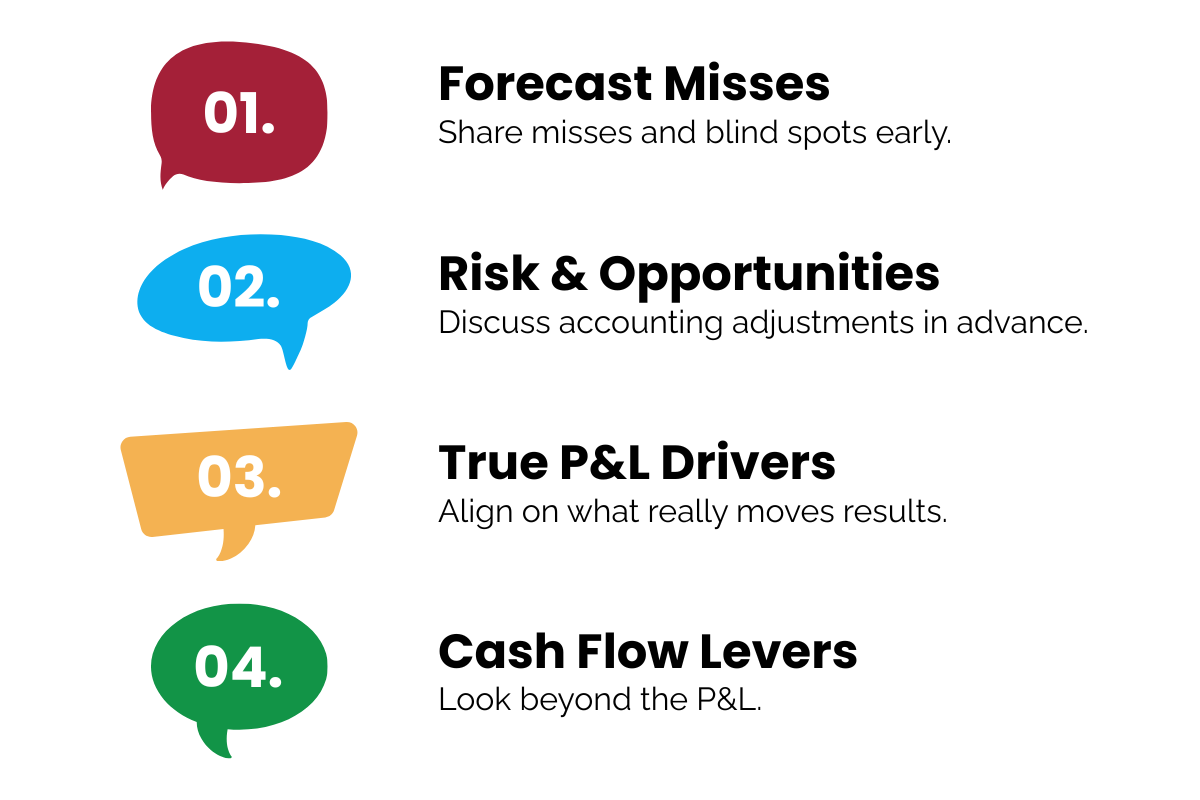
Share FP&A forecasts and reporting, and provide timely examples of the misses and FP&A blind spots. Seek input from the controller team on root cause identification and improvements to prevent the same thing from happening next month.
Get your Controller's input on your Risk & Opportunities grid. Discuss potential accounting adjustments with your Controller and team in advance. Not after the fact when it’s too late. Know what’s “out there” on both sides of the ledger, good and bad.
Forge a shared understanding as to what the true P&L drivers really are for your business. What gets measured tends to be what gets managed, so aligning Controller and FP&A resources and attention along these lines is just plain good business.
Ensure visibility of balance sheet relationships and cash flow levers. It’s not all about the P&L, but even when it looks like it is, a controller having your back when turning balance sheet and cash flow levers is potentially a valuable asset for FP&A to have.
Do some things that help them. Involve your Controller and team in the business. Share business perspective, information, and insights. Partner in core areas. Be a control advocate for them with your business team.
All of this has a multiplicative effect and creates synergistic energy. And as a result of doing some of these relatively easy things and helping to bring others on both sides along this same path, you’ll probably start getting information you wouldn’t otherwise get. Perhaps even a few timely heads-ups, all of which can significantly increase the likelihood that you and your FP&A team are still standing on solid ground.
The full text is available for registered users. Please register to view the rest of the article.
Related articles

In this article, you’ll discover how the CACTUS Data Quality Framework helps FP&A teams build trust...

In this article, the author reveals the essence of a true FP&A Partnership Model. He also...

In this article, the author explains how deliberately building a differentiated FP&A skillset, combining commercial finance...

In this article, discover how FP&A strategic business partnering helps finance professionals challenge assumptions, expand decision...

Discover how modern FP&A drives business impact through data democratisation, performance storytelling and scalable digital solutions.
+
Subscribe to
FP&A Trends Digest

We will regularly update you on the latest trends and developments in FP&A. Take the opportunity to have articles written by finance thought leaders delivered directly to your inbox; watch compelling webinars; connect with like-minded professionals; and become a part of our global community.