

AI adoption in FP&A is stalling due to data, change, and governance gaps. Learn how to...

Keep the North Star, Change the Route: FP&A Transformation in the Age of AI
August 27, 2026
How do we make FP&A transformation truly stick? Why do well-designed programmes, backed by strong business cases and modern technology, still struggle to change the way finance teams work? And as AI enters more FP&A processes, are traditional change management approaches still sufficient?
These questions were at the heart of the recent FP&A Trends webinar, “FP&A Change Management in the Age of AI”, which attracted more than 320 registrations from almost 50 countries. The discussion explored why resistance to change can be particularly strong in finance, how organisations can build genuine buy-in, what can be learned from a global rolling forecast transformation, and how AI adoption requires a more practical and human-centred approach.
Creating Buy-In for FP&A Transformation
Ronald Forster, Head Corporate FP&A at MS PHARMA, focused on the gap between how transformation is presented in a business case and how people actually experience it. On paper, transformation normally has a clear rationale, defined milestones and an attractive future state. In reality, employees encounter uncertainty, fear, disruption, and questions about what the change will mean for them personally.
He illustrated this with an earlier transformation involving the relocation of hundreds of employees across national borders. From an organisational perspective, the move made sense: there were strategic, operational and financial advantages. Yet employees did not experience the transformation through the business case. They experienced leaving their communities, relocating with their families, and helping children adjust to new schools.
The lesson was simple: change in execution is personal.
Ronald also highlighted one of the most common leadership mistakes. Organisations tend to be good at explaining what will change and how it will happen, but less effective at explaining why the change matters. In another transformation, responsibilities were moved from countries into a global structure to concentrate resources and create efficiencies. Yet local employees were left questioning the future value of their roles because the purpose and personal implications had not been explained clearly enough.
For Ronald, genuine buy-in comes from involving people in the design, creating momentum through early adopters and ambassadors, encouraging open debate, demonstrating visible new behaviours and generating quick wins. A transformation may promise significant value in two years, but teams also need evidence in the next 30, 60 or 90 days that the new approach can work.
His experience also showed why transformation plans need flexibility. Using the analogy of building a house, Ronald described how an ambitious initial design may eventually need to lose some of its “landscaping” and decorative features when reality intervenes. What matters is preserving the foundations, walls and roof: the elements essential to the original objective.
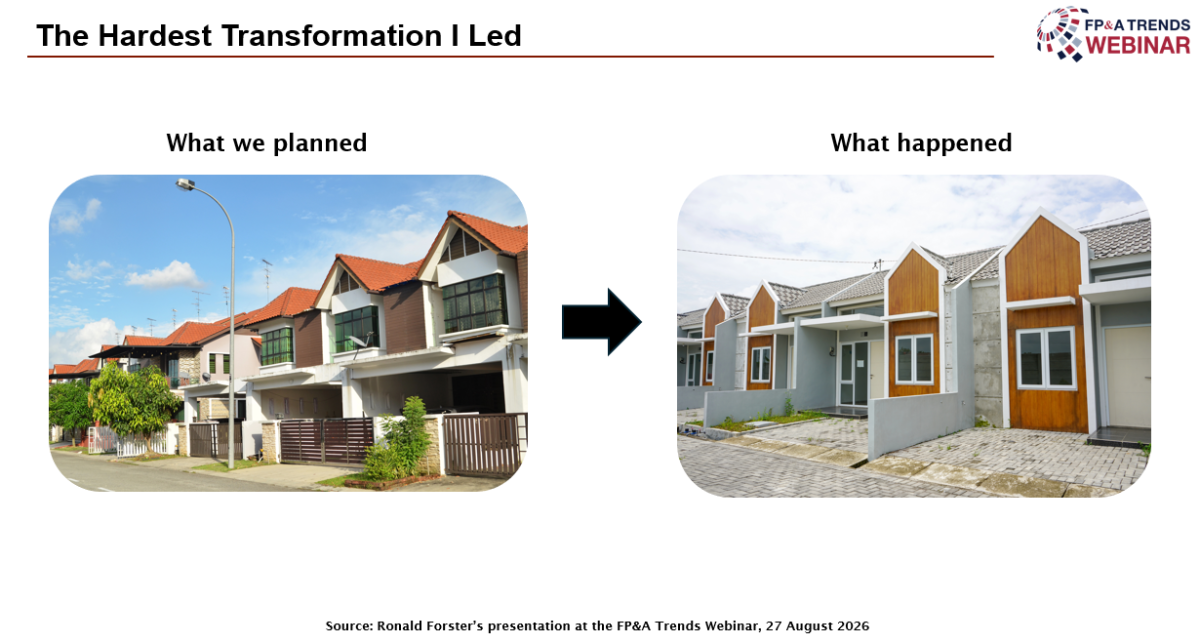
Figure 1
This becomes particularly important with AI, where technology and available capabilities can change extremely quickly. The destination may remain stable, while the route towards it needs continual adjustment. Above all, people are more likely to support transformation when they see themselves as participants in building a better future rather than as recipients of change imposed upon them.
What Prevents Transformation Benefits from Materialising?
The first audience poll asked what most often prevents transformation benefits from materialising. Legacy processes and incentives received the highest share of responses at 36%, closely followed by an unclear reason for change at 32% and inconsistent leadership behaviour at 28%. Only 4% selected insufficient employee capability.
The results are revealing. They suggest that organisations may overestimate the role of skills gaps and underestimate the environment in which people are being asked to change. Employees can often develop the necessary capabilities, but transformation will still struggle if incentives point towards the old process, leaders behave inconsistently, or people do not understand why change is necessary. Ronald noted that he rarely sees transformation fail simply because people are incapable of learning the new way of working.
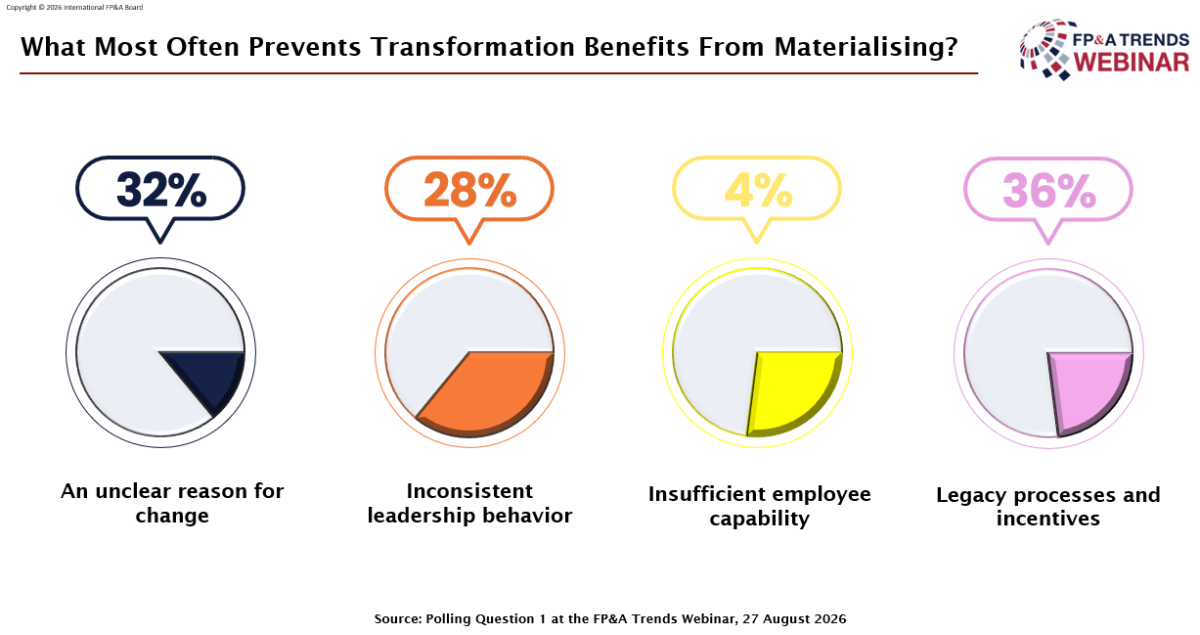
Figure 2
Driving Rolling Forecast Adoption: Lessons from Global Change
Jana Kottasova, VP Finance Global Shared Services, IT at Mondelēz International, brought these themes to life through Mondelēz International’s global planning transformation. With operations across 86 markets, more than 90,000 employees and over 130 plants, introducing a common planning approach required change across a highly complex organisation.
The original transformation plan envisaged a three-year journey. The CFO challenged the team to deliver it in one year. Within that period, Mondelēz implemented a global planning tool, although Jana reflected that the technology itself proved to be one of the easier elements of the transformation. The greater challenge was changing established behaviours and processes across markets.
Initially, the finance team believed that formal change management might not be particularly important. Forecast submissions were mandatory, CFO sponsorship was strong, and finance professionals could ultimately be relied upon to complete the process. Experience showed that this was not enough.
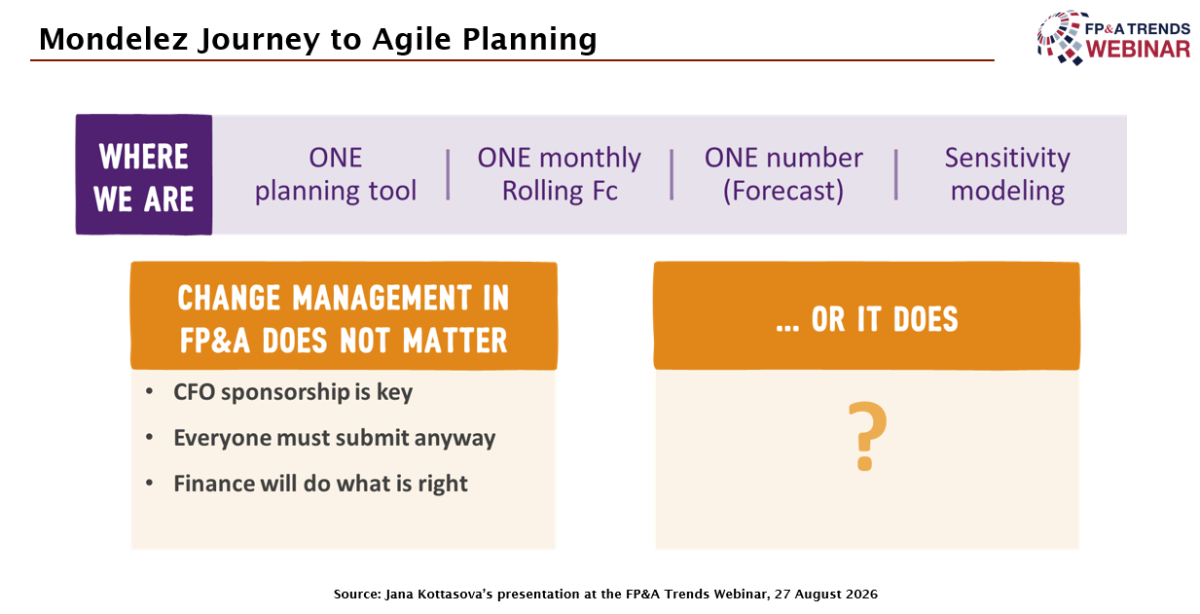
Figure 3
The turning point came through practical, hands-on change management. Regular questionnaires were used to understand whether users saw how the planning tools supported their work, whether they understood the benefits and whether implementation timelines felt realistic. The team introduced open office hours where users could raise seemingly small but important questions, provided additional testing opportunities, and extended parallel runs as needed until users were confident that the new tool could deliver results at least as reliable as their existing Excel processes.
Standardising the process also created new visibility. The team could begin measuring manual workloads, including the number of spreadsheets still being uploaded into the planning tool each month. The ultimate objective was zero, but rather than simply demanding that spreadsheets disappear, the team sought to understand why people were still using them and what would need to change before those files could genuinely be retired.
A network of key users and change champions became particularly important. Mondelēz was moving towards one global process and rolling forecast calendar, while many local processes had developed over the years. Adoption, therefore, had to extend beyond finance into demand planning, sales, and marketing. In some regions, demand planning teams were brought directly into the transformation effort.
The destination remained global, but communication had to reflect different local starting points, levels of maturity and pain points. Jana described the journey as planning excellence rather than a finished project: feedback continues to expose new opportunities and sometimes identifies issues in areas the team previously believed were working well.
Who Has the Greatest Influence on Day-to-Day Adoption?
The second poll shifted attention from sponsorship to everyday behaviour. Direct line managers were considered the greatest influence on day-to-day adoption by 36% of participants. Peer users followed at 28%, while FP&A change champions received 21%. Only 15% selected executive sponsors.
This does not mean executive sponsorship is unimportant. As Jana explained, senior sponsors are essential for keeping transformation moving and signalling organisational commitment. However, everyday adoption happens much closer to the work itself. Managers, peers and change champions create the examples that other users observe and follow.
The finding reinforces a critical distinction: senior leadership may authorise change, but communities turn it into normal behaviour.
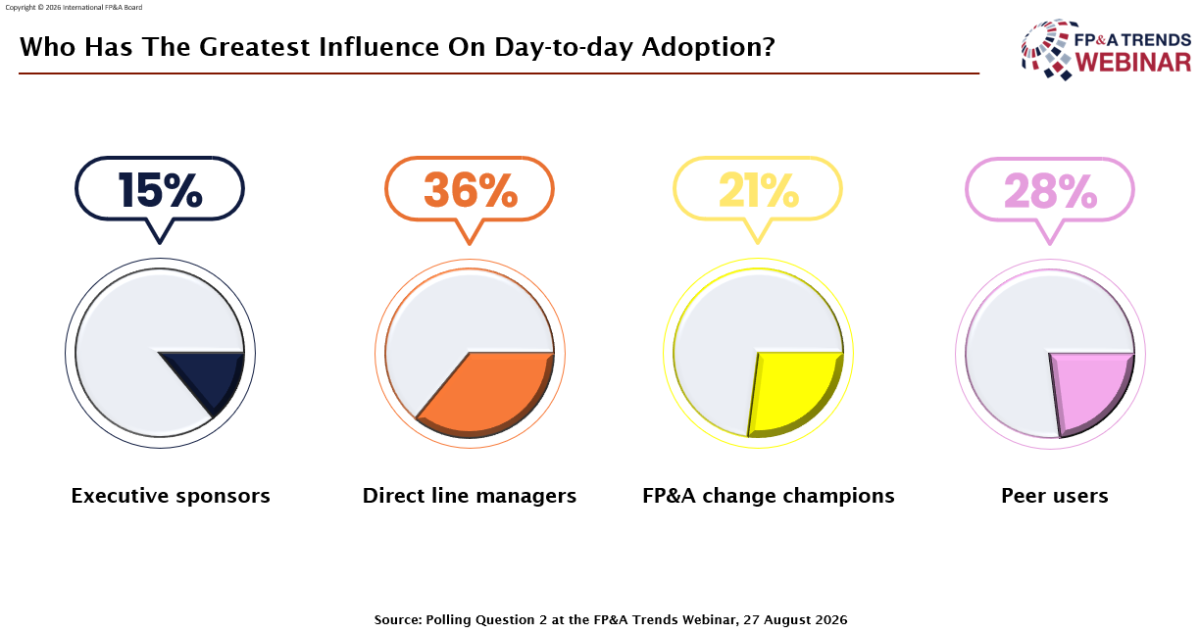
Figure 4
Enabling Sustainable FP&A Transformation with AI
Graham Hunter, AI/ML Solution Architect at Wolters Kluwer CCH Tagetik, underlined that sustainable AI adoption begins by moving away from jargon. Business users do not need to become experts in AI terminology; they need to understand what a capability does, how it helps their work and where its limitations lie.
This matters because every AI implementation is also a transformation. Leaders have to balance genuine risks with opportunities for innovation and productivity, while employees may simultaneously feel excitement, hesitation, or fear. Graham highlighted an enablement gap that emerges when organisations provide access to technology without enough practical support — or, alternatively, restrict access because those responsible for governance are themselves still becoming familiar with the technology.
To make these dynamics more manageable, Graham described four recurring user personas: educated, confused, scared and exuberant.
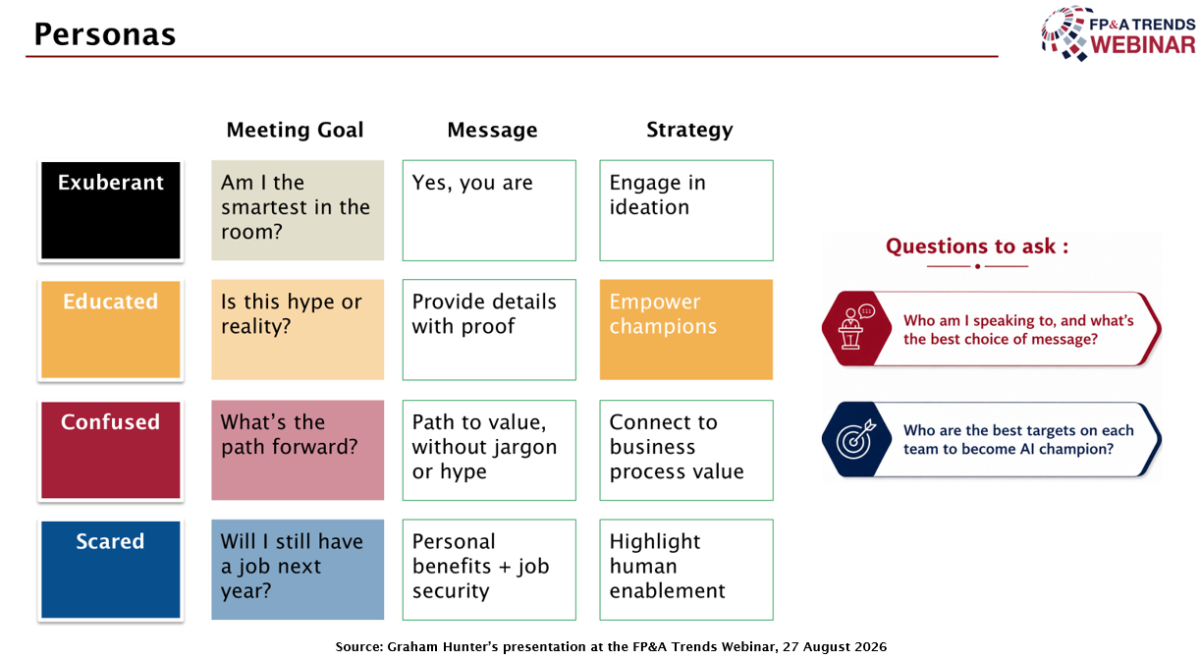
Figure 5
Educated pragmatists can often become effective champions. Confused users need a clear path towards business value without unnecessary hype. Scared users may need reassurance that AI will support them rather than simply remove parts of their role. Meanwhile, highly exuberant users must also be managed carefully; excessive enthusiasm can dominate discussions and make more cautious colleagues reluctant to raise legitimate concerns.
The implication is that a single AI adoption message will not work for everyone. Communication and enablement should reflect what different groups need to hear and understand.
Graham also positioned AI champions as a force multiplier. Champions are close to everyday problems and can often help colleagues faster than a central project team can. Their role should be explicit: help others move faster, share ideas, maintain close contact with the central team and escalate issues when needed. Organisations can strengthen the network by giving champions early exposure to technology roadmaps, involving them in new ideas and providing responsive support when problems arise.
Finally, Graham outlined three practical recipes for AI transformation:
First, start with a minimum viable product that already delivers measurable value and creates an opportunity to gather feedback. Large first releases that try to solve everything at once have a much higher risk of stalling.
Second, build prompt-authoring skills early. General AI tools and AI embedded within familiar workplace applications can provide a relatively accessible starting point and help users develop confidence before moving to more advanced use cases.
Third, follow a crawl–walk–run approach. The long-term destination should remain clear, but most management attention should focus on what the organisation can achieve over the next 30, 60 and 90 days. AI chat can be an entry point, followed by AI embedded within applications and, once the foundations are in place, more advanced agents, analytics, and machine learning. Importantly, those later stages depend heavily on data quality and organisational readiness.
Conclusions
FP&A transformation succeeds when organisations treat adoption as a business outcome rather than a project milestone. Technology can be implemented on schedule while old behaviours, spreadsheets and assumptions remain firmly in place.
The webinar highlighted that sustainable change requires organisations to understand why resistance occurs, make the purpose of transformation personally meaningful, involve users in shaping the journey and create visible evidence that the new way works. Line managers, peers and champions then become critical in converting formal transformation into everyday behaviour.
AI increases the urgency of these lessons. Its capabilities are evolving too quickly for rigid transformation plans, while its impact on roles can intensify concerns around competence, control and identity. FP&A leaders, therefore, need a clear north star combined with flexibility in execution: start small, demonstrate value, listen continuously and build capability as the technology develops. Ultimately, transformation has succeeded when ownership moves from the project team into the business itself.
To watch the full webinar recording, please check here.
We would like to take this opportunity to thank CCH Tagetik for sponsoring the event.
The full text is available for registered users. Please register to view the rest of the article.
Related articles

In this article, the author explains why agentic AI adoption in FP&A depends less on technology...

In this article, the author demonstrates how AI can become a governed strategic collaborator in FP&A...

In this article, you’ll learn how FP&A teams can adopt AI step-by-step by using small, practical...

Agentic AI may remove Finance from the decision chain. Explore how FP&A can shift from insight...

In this article, the author examines how FP&A teams can implement trustworthy agentic AI by matching...
+
Subscribe to
FP&A Trends Digest

We will regularly update you on the latest trends and developments in FP&A. Take the opportunity to have articles written by finance thought leaders delivered directly to your inbox; watch compelling webinars; connect with like-minded professionals; and become a part of our global community.