

In this article, the author explores how Integrated FP&A transforms traditional business partnering into a proactive...

Integrated FP&A as an Operating Model for Better Decisions
May 1, 2026
Introduction
What does it really take to make Integrated FP&A work in practice — not just as a planning concept, but as a way of connecting people, roles, technology, and decisions across the organisation?
This was the central idea behind the FP&A Trends webinar “Integrated FP&A in Action: Connecting People, Roles, and Decisions”, held on April 22nd, 2026. The session explored Integrated FP&A not only as a planning methodology, but as a practical operating model that connects strategy, finance, operations, people, technology, and decision-making. It featured insights from Mariya Guttoh, Julian Scutari, and Oliver Sullivin, who examined the topic from three connected angles: AI-enabled finance, the human factor, and the technology architecture needed to remove friction across the enterprise.
Integrated Finance in the AI Era
Mariya Guttoh, Director of FP&A & Treasury at PayJoy, opened the speaker insights with a powerful reflection on the changing role of FP&A. In the past, finance often sat at the end of the process. Business teams made decisions, models produced outputs, and finance was expected to explain the results. In the AI era, this model becomes risky. When logic is distributed across data, systems, algorithms, and operational processes, the traditional “walk me through the numbers” moment becomes far more difficult.
Mariya described this as an accountability gap: finance is still held responsible for explaining outputs it did not build. Her example of a headcount forecasting model made the point clearly. A data science team built a model using HR definitions and included only full-time employees. Finance, however, had historically included contractors for CFO and board reporting purposes. The model was not technically wrong, but the definition was not aligned. Two weeks of work could have been avoided if finance had been involved at the point where the assumptions were being defined.
The solution, according to Mariya, is not simply a better review process. It is an earlier financial involvement. FP&A needs to be involved when metrics are selected, models are designed, and financial assumptions are embedded into operational logic. This means finance must move from explaining decisions to shaping them. It also means that the FP&A skill set has to evolve. AI literacy, practical statistics, predictive analytics, data fluency, automation awareness, and basic cybersecurity sense are becoming important technical capabilities.
At the same time, soft skills — or rather power skills — are needed earlier in the finance career path. Storytelling, business acumen, collaboration, adaptability, and ethical judgment are no longer only leadership-level qualities. They are becoming core FP&A skills from day one.
A key theme from her presentation was that AI does not reduce the need for financial judgment. Instead, it raises the bar. Models can detect patterns, but they cannot always understand what leadership will not accept, what the board has been concerned about, or what incentives may create unwanted behaviour in the next twelve months. This is where FP&A can bring real value.
Poll Results: What Will Advance FP&A Integration?
During the webinar, participants were asked: “What is the most important factor to further advance your FP&A Integration?” The results were almost evenly distributed, which shows how multi-dimensional Integrated FP&A really is. The leading answer was harmonising organisational processes, selected by 35% of respondents. Leadership support followed closely with 31%, while skills and competencies in finance received 20%. Only 15% selected technology as the most important factor.
These results are important because they show that organisations no longer see integration as a pure systems issue. Technology matters, but the audience clearly recognised that processes, leadership, and people capabilities are the bigger constraints.
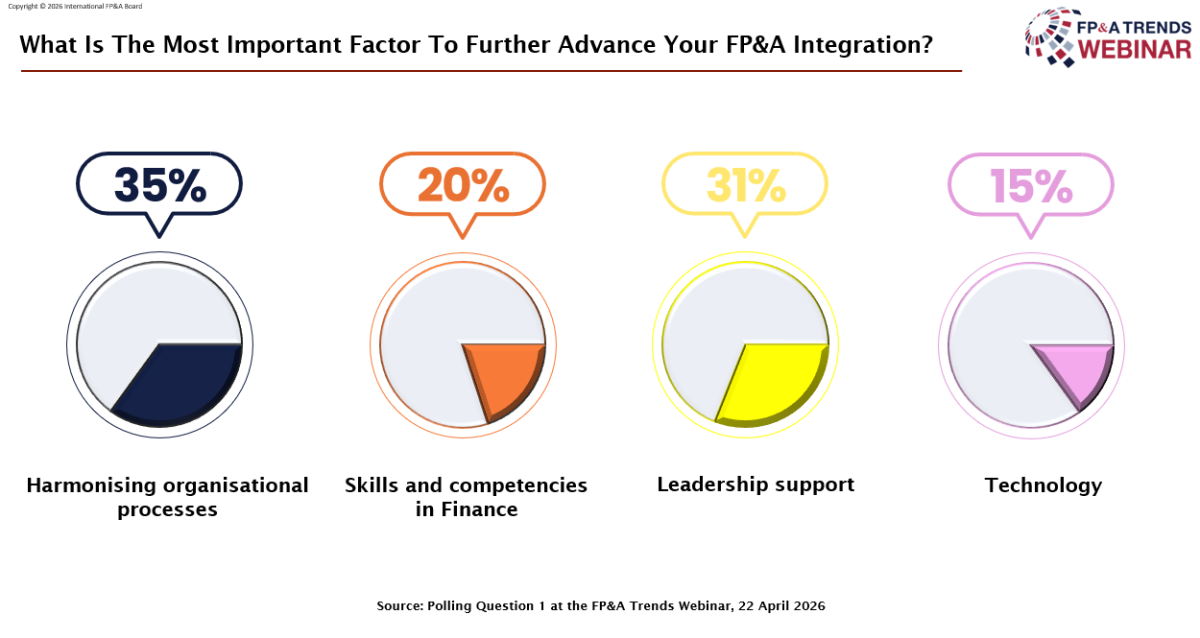
Figure 1
The Human Factor in FP&A Integration
Julian Scutari, ex CFO and FP&A at ITT / Kimberly Clark / SC Johnson, brought the discussion back to people. His main message was direct: Integrated FP&A is not a software installation. It is a management system and an operating model. Technology can enable integration, but it cannot create ownership, trust, role clarity, or adoption by itself.
Julian supported this view with several transformation data points. According to the webinar materials, only 11% of respondents in the FP&A Trends Survey 2025 reported fully integrated FP&A. At the same time, broader transformation research shows high failure rates, while organisations putting humans at the centre are much more likely to improve transformation performance. His point was not that technology is unimportant, but that transformation fails when the human system underneath it is weak.
He identified five adoption drivers that appear repeatedly across countries, industries, and company sizes: trust, role clarity, translation, incentives, and leadership behaviour. Trust means confidence in the data, assumptions, and escalation path. Role clarity means knowing who owns a driver, who can challenge it, and who decides. Translation means creating one common business language. Incentives matter because if KPIs are not aligned, people will protect their own function instead of the enterprise outcome. Finally, leadership behaviour is essential because teams look for signals from leaders to understand whether integration is real or just another initiative.
Julian also gave a practical starting point for organisations that want to begin without overcomplicating the journey. Pick one cross-functional decision, such as inventory level. Clarify who provides the input, who can challenge the assumption, and who makes the final decision. Define three to five shared drivers, run a monthly decision forum, and measure adoption through fewer reconciliations, faster decisions, and clearer follow-through.
Poll Results: Culture Readiness for Integrated FP&A
The second polling question asked: “How ready is your organisation culture-wise for successful Integrated FP&A?” The largest group, 42%, said they are getting ready. Another 36% described themselves as moderately ready. 16% said they were not at all ready, while only 6% considered their organisations highly ready.
These results suggest that more than half of the audience did not feel fully ready for integrated FP&A.
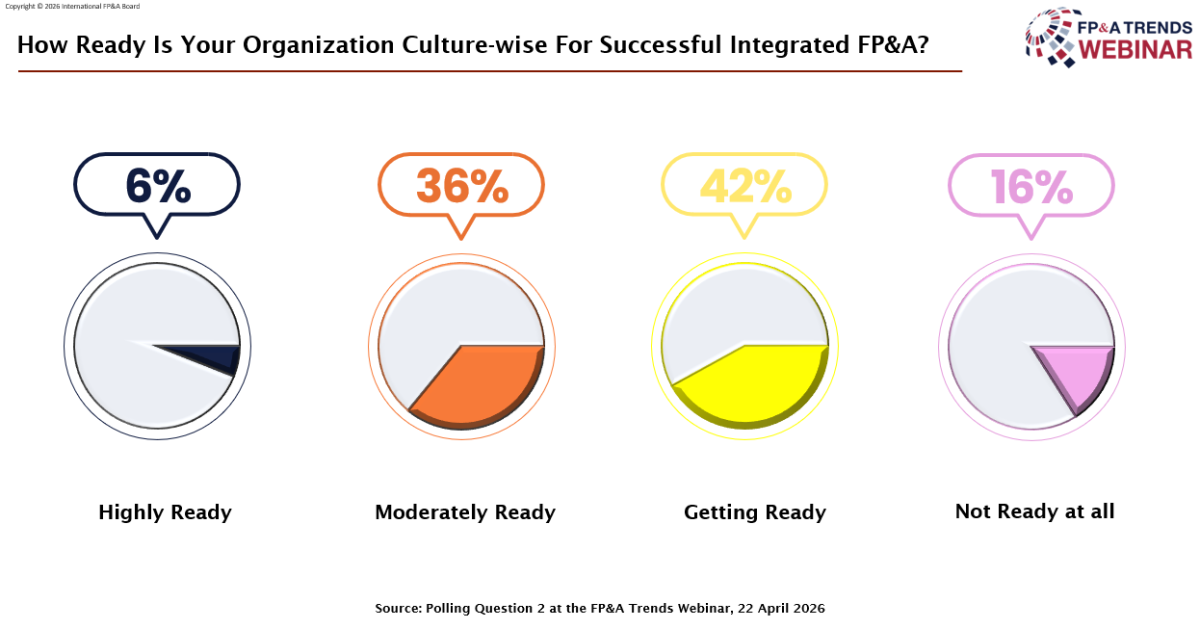
Figure 2
The Hidden Architecture Behind Better Decisions
Oliver Sullivin, Global Head of FP&A at Unit4, focused on the architecture that makes Integrated FP&A possible in practice. His central argument was that even capable people with strong intent will struggle if the operating model and technology are not designed to support collaboration. In many organisations, FP&A still operates manually: data is extracted from core systems, spreadsheets are circulated, and teams spend too much time reconciling rather than interpreting.
This matters even more in an AI-enabled future. As Oliver put it, AI cannot fix a weak foundation; it will amplify the architecture that already exists. Fragmented planning creates multiple versions of the truth, heavy handovers, stale data, and delayed decisions. The result is not just inefficiency. It is friction in the way people work and make decisions.
Oliver made an important distinction between technical connectivity and real integration. Integration is not just about connectors, interfaces, or tools passing files around. True integration means that planning data, logic, workflows, and roles exist in one coherent environment, ideally close to or embedded in the ERP. This creates a shared data structure, a consistent calculation engine, coordinated workflows, and a governed version of the truth.
The human benefit is also clear. When complexity is reduced, cognitive load falls. Analysts spend more time thinking and less time reconciling. In one example, Oliver described a public-sector customer in which workforce planning, service demand, and financial planning were brought into a single FP&A environment. HR could adjust workforce plans, service teams could update demand assumptions, operational leaders could change delivery constraints, and the financial impact became visible through shared logic. The discussion moved from “whose numbers are right?” to “what should we do?”
For Oliver, good FP&A architecture removes dependence on spreadsheets and manual extracts. It provides a single planning environment, unified models, shared views, governance, and security. Most importantly, it shortens the distance between insight and decision-making, making better decisions repeatable rather than accidental.
Conclusion
The central takeaway from the webinar was clear: Integrated FP&A is not a software installation or a one-off project. It is a management system and an operating model that changes how an organisation connects strategy, finance, operations, technology, and people around decisions.
Technology is an important enabler, especially as AI becomes more embedded in planning and analysis. However, technology alone cannot create integration. It cannot build trust, clarify ownership, align incentives, or make leaders use one shared view of the business. These are human and organisational disciplines.
For FP&A professionals, the opportunity is to move beyond reporting and become active participants in decision design. This means shaping assumptions earlier, connecting financial logic with operational drivers, and helping the business make faster, clearer, and more joined-up decisions. Integrated FP&A works when it becomes part of how the organisation is managed every day.
To watch the full webinar recording, please check out this link: https://info.unit4.com/global-exb-fpa-20260422-wb-integrated-fpa-action-connecting-people-roles-and-decisions_Registration-On-Demand.html
The full text is available for registered users. Please register to view the rest of the article.
Related articles

In this article, discover how FP&A principles can transform liquidity planning from a reactive task into...

In this article, we explore the complexities, advantages, risks, and models of FP&A centralisation, offering a...

In this article, the author explains how integrated modelling enables FP&A leaders to balance speed and...

In this article, the author shares a seven-step roadmap to help finance leaders cut through sprawl...

Explore how Integrated FP&A empowers organizations to achieve analytical excellence through synchronised planning, driver-based models and...
+
Subscribe to
FP&A Trends Digest

We will regularly update you on the latest trends and developments in FP&A. Take the opportunity to have articles written by finance thought leaders delivered directly to your inbox; watch compelling webinars; connect with like-minded professionals; and become a part of our global community.