

In this article, discover how FP&A storytelling turns numbers into compelling business stories using waterfall charts...

FP&A Storytelling in the Age of AI Turning Data into Clearer, Faster Business Decisions
May 5, 2026

Can you tell your business performance story in one sentence and end it with a clear decision ask?
If you can, you are not just reporting. You are guiding the business.
Most FP&A reports explain performance well. Very few, however, truly help leaders decide what to do next. And when executives look at a performance update, their underlying questions are usually simple: What changed? Why does it matter? And what should we do now?
The challenge is not a lack of data. Organisations today are surrounded by dashboards, variance packs, and KPI reports. Leaders no longer struggle with a lack of information. They struggle with making sense of it. This is where FP&A storytelling becomes essential.
FP&A storytelling is not about making reports more engaging or adding narrative for its own sake. It is the discipline of turning numbers into clear business stories that leads to decisions. Because the real goal of FP&A is not better reports; it is better business outcomes.
Just as importantly, effective FP&A storytelling is not about inventing a new narrative every month. It is about continuity. At its core, strong storytelling connects actuals to budget, links results to prior periods, and shows how monthly performance rolls into quarterly and annual momentum. It ties plan to performance, performance to strategy, and strategy back into the plan, while linking financial outcomes to the operational drivers behind them.
When this works well, leaders always know two things: where the business stands today, and what is likely to happen next. That is the difference between reporting numbers and telling the story of the business.
Introducing the CCC FP&A Storytelling Model
The most effective finance stories follow a simple structure:
Context → Content → Conclusion
Context helps leaders understand where the business stands. Content explains what changed and why it matters. Conclusion leads to a clear decision or action. When you use this structure regularly, financial updates become decision-focused conversations instead of just looking back.
As shown in Figure 1, this structure is simple but powerful when applied consistently.
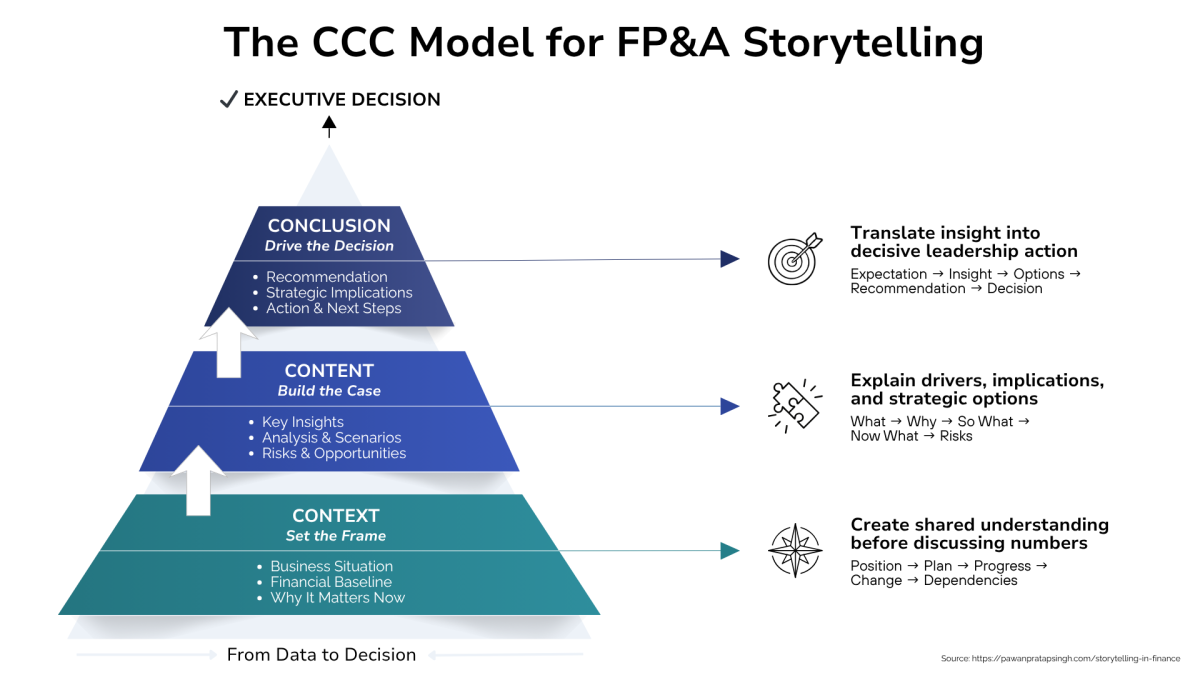
Figure 1
1. CONTEXT — Start with the Bigger Picture
Before diving into variances or metrics, leadership needs some orientation. They need to understand the broader setting, understand the background, the direction of travel, and where the business sits in its current cycle. This bird’s eye view turns numbers into meaning and prevents reactive discussions.
At its simplest, context answers one question: Where are we in the story, and why are we discussing this now?
Doing context well does not require adding more slides; it requires better framing. In practice, this means clarifying the current position, what was expected at this point, what was discussed in previous reviews, what has changed since then, and which assumptions or dependencies are now being confirmed or challenged.
Without context, numbers float. With context, numbers guide decisions.
Strong context is important because it prevents three common problems in business reviews: late surprises, repeated explanations, and decision fatigue. This is how FP&A keeps things consistent and avoids changing the story every month.
Once the context is clear, the focus shifts to explaining what has changed and why it matters.
2. CONTENT — Connect the Dots
Once the context is set, analysis should follow a structure that leaders easily understand:
What changed? Why did it change? So what? Now what? How would we execute? And what are the risks?
This order takes the conversation from facts to drivers, implications, choices, execution, and risk.
Effective content focuses on the few changes that really matter rather than every metric. Strong explanations concentrate on two or three real drivers, distinguish between ongoing and one-time issues, and highlight what management can control.
The “so what” is where FP&A moves from reporting to insight. One month’s result can be misleading, but momentum tells the real story. Month over month shows movement, quarter to date shows the trajectory, and year to date shows if the plan is still credible.
Insight, however, only creates value when it leads to choice. FP&A’s role is to frame realistic options, including the option of doing nothing, and make the trade-offs explicit. Decisions like growth versus margin, investment versus cost, short-term versus long-term results, and risk versus speed are for leaders, but FP&A should ensure those choices are informed ones.
Execution is important too. Leaders do not need full project plans, but they do need to know that actions are realistic with clear ownership, practical timelines, and known dependencies. Finally, acknowledging risks strengthens credibility. A recommendation without risks seems naive, but a balanced story makes FP&A a trusted advisor.
With the analysis in place, the final step is to turn insight into a clear decision.
3. CONCLUSION — The Decision Moment
The conclusion is not just a summary. It is the point where insight becomes action.
A practical way to close the loop is to restate the original expectation, explain what the analysis now shows, outline viable options, recommend a course of action, and end with a clear decision ask. Leadership may be asked to approve funding, align on priorities, choose between options, escalate constraints, or confirm ownership and timelines.
If a meeting ends without a decision or confirmed action, the story is not complete. The purpose of FP&A storytelling is simple: turn insight into action.
Real World Application: Turning Any FP&A Update into a Decision Story
The CCC model is strong because it’s flexible. You can use it for a monthly variance review, a cost deep dive, or an annual plan discussion. The scale changes, but the structure remains the same.
Financial Performance Review
During a performance review, FP&A starts by setting the context: the business is entering the final quarter with growth slightly behind plan and cost pressure building in two key functions.
The content shows that revenue is £4m below forecast, mainly because of lower conversion in one segment. Cost overruns are concentrated in contractor and discretionary spend. If nothing changes, the full-year margin will fall short of the target by 8%.
The conclusion is clear. FP&A presents two options: speed up commercial efforts to recover volume or cut back on discretionary spending. They recommend doing both in a targeted way and ask leadership to approve the actions, assign owners, and set timelines.
Travel & Subsistence Discretionary Spend Analysis
In a cost review, FP&A sets the context by showing current T&S spend versus plan, highlighting an upward trend driven by higher travel volumes in specific units and emerging behavioural patterns.
The content reveals that cost increases are concentrated in a small number of categories and teams, with outliers in late bookings and non preferred hotels driving most of the variance and increasing forecast risk.
The conclusion frames the impact on the quarter, presents options such as virtual first meetings, advance booking, and preferred hotel usage, and asks leadership to confirm the selected approach, ownership, and enforcement timeline.
Annual Plan Review
At the annual plan review, FP&A begins with context: where the business stands today versus plan, what progress has been made, what has changed since the last cycle, and which key assumptions are now under pressure.
The content lays out the facts and the real drivers behind the movement — explaining how changes in demand, productivity timing, or cost inflation affect the quarter, the year, and the overall plan — while outlining realistic response options, execution considerations, and key risks.
The conclusion reviews the business goals, summarises the analysis, recommends a path forward, and ends with a clear leadership ask for direction, trade-offs, and required decisions.
Whether you are explaining a revenue variance, looking at travel and subsistence costs, or reviewing the annual plan, the same pattern holds: set the context, explain what changed and why, outline what it means and the options, and end with a clear leadership ask. Across all scenarios, keeping things consistent is more important than making the presentation perfect.
Together, these examples show how the same CCC structure can guide different FP&A conversations.
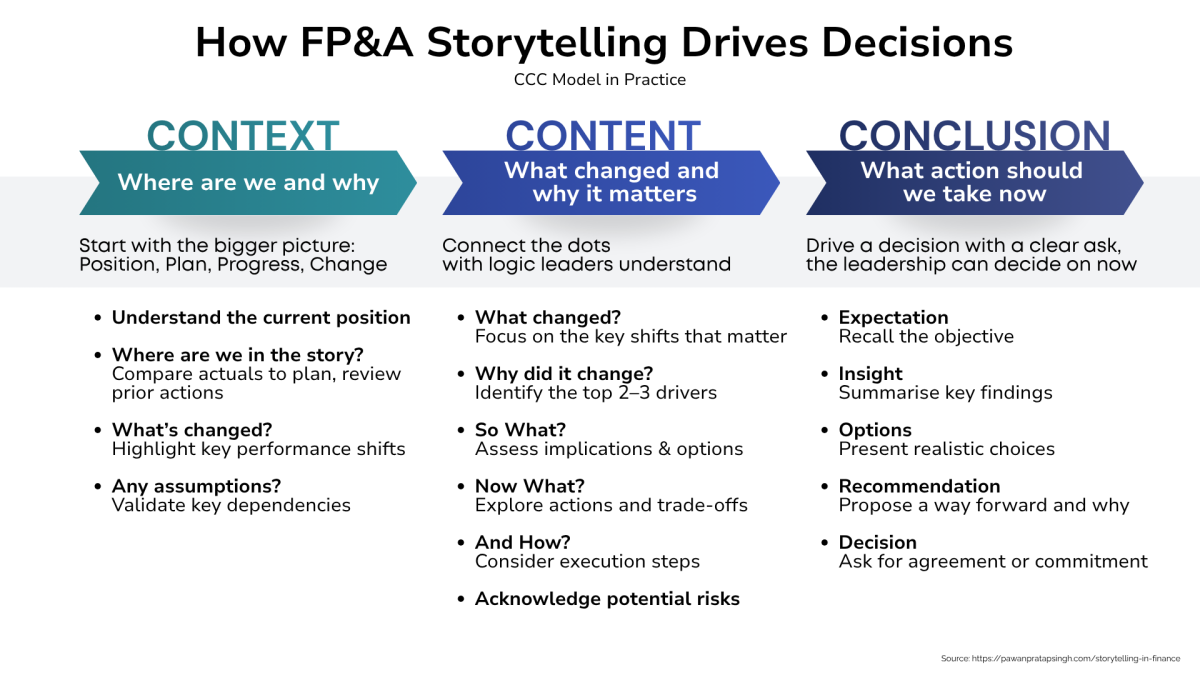
Figure 2
AI Is Changing FP&A Storytelling
Artificial Intelligence (AI) is accelerating how FP&A moves from numbers to narrative. Tools such as Microsoft 365 Copilot, Power BI, SAP Joule, SAP Business AI, and SAP Analytics Cloud are already doing much of the heavy lifting — analysing data, detecting patterns, identifying performance drivers, and drafting executive-ready commentary.
Agentic AI can go further by handling repetitive, manual tasks. Finance teams can use different agents to analyse performance, prepare management commentary, or build dashboards, all quickly and consistently.
In the CCC model, AI helps support the story from start to finish. It can set context by summarising what has changed and highlighting past decisions. It can improve content by highlighting anomalies and pointing out unusual results and likely causes or scenarios. And it can assist in the conclusion by drafting recommendations, decision asks, and next steps.
This shift can be visualised as shown in Figure 3:
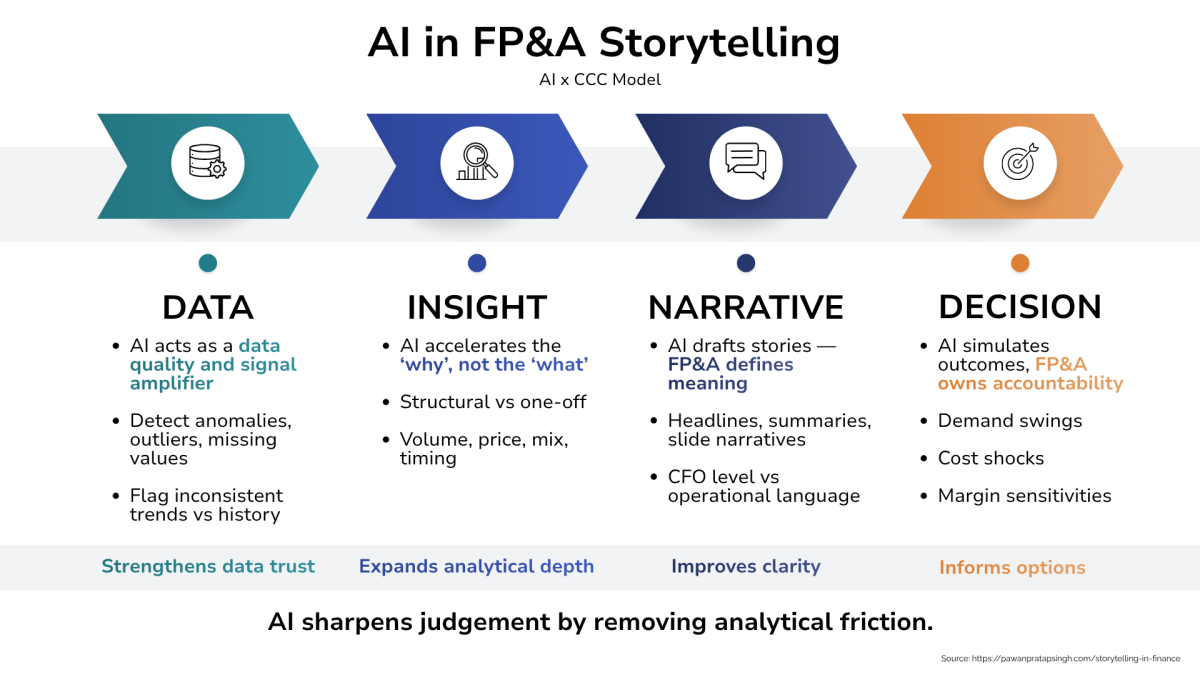
Figure 3
The principle is simple: AI speeds up the work, but FP&A still makes the final judgment.
Final Thought
Ultimately, data isn’t hard to find anymore. Insight is rare, and clear decisions are even harder to come by.
The real value of FP&A is not producing better reports, but bringing clarity to complexity and helping leadership move from numbers to decisions. AI will speed up analysis, and dashboards will keep improving. But the best organisations will be those where FP&A can consistently connect context, insight, and action into one clear story.
When that happens, finance stops explaining the business.
It starts shaping it instead.
The future of FP&A is not reporting faster — it is deciding smarter.
The full text is available for registered users. Please register to view the rest of the article.
Related articles

In this article, FP&A professionals discover how soundtracking — the art of blending data, storytelling, and...

This article aims to explore the role of FP&A in facilitating decision-making processes, overcoming communication obstacles...

The article explores how data-driven FP&A transforms organisations by integrating financial and non-financial metrics to drive...
Communication & Decision-Making Framework for FP&A
In this article, the author outlines the specifics of the Situation, Complication, Question, and Answer (SCQA)...

In this article, the author considers why data alone could not speak for itself and tell...
+
Subscribe to
FP&A Trends Digest

We will regularly update you on the latest trends and developments in FP&A. Take the opportunity to have articles written by finance thought leaders delivered directly to your inbox; watch compelling webinars; connect with like-minded professionals; and become a part of our global community.