

Artificial Intelligence has moved quickly from a side conversation to a live question for finance leaders: what should it actually do, who remains accountable, and how do you turn a promising pilot into something people use every day? We ran through those questions in the FP&A Trends webinar, "Augmenting the Finance Function with AI," held on 24 June 2026. The session drew more than 1,050 registrations from over 60 countries, which says something about both the level of interest and the uncertainty still surrounding the subject.
The webinar brought together Gopi Singh of PwC US, Christopher Wittman of Microsoft and Antonio Rosa of CCH Tagetik. Their presentations came from different angles, but the message was remarkably consistent: the technology is moving fast; the harder work is redesigning the way finance operates around it.
From Pilots to a Human + AI Operating Model
Gopi Singh, EPM Director and FP&A AI Leader at PwC US, focused on the point at which many organisations are currently stuck. AI use cases are proving their value in small pockets, but the benefits remain trapped within individual teams or users. The real challenge is to take what works and redesign the whole workflow around it.
He described four predictable problems when the relationship between people and AI is left to chance:
Pilot sprawl
Unclear accountability
Controls added after the event
Value that never compounds beyond the original experiment
A successful pilot may save one person time, but that is not the same as changing the end-to-end performance of a financial process.
Gopi's solution is as follows:
First, design the partnership one workflow at a time. Humans are strongest at judgment, exception handling and narrative; agents are strongest at volume, pattern recognition and signals. Each activity should therefore be defined as human-led, agent-assisted or agent-driven before a tool is selected.
Second, anchor the work on the planning platform, where forecasts, assumptions, agent outputs and human overrides can meet in one decision record.
Third, govern the partnership itself by setting decision rights, escalation points and evidence trails for both people and agents.
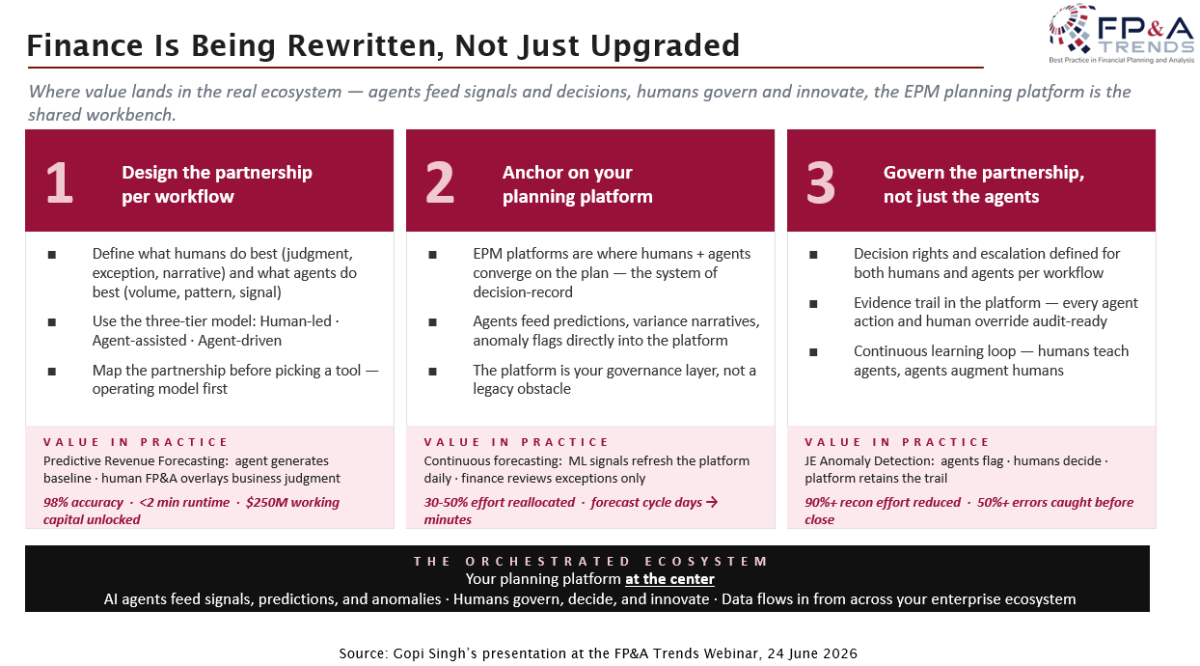
Figure 1
The examples he shared showed why that design matters. In predictive revenue forecasting, an agent can generate a baseline in minutes while FP&A applies business judgment. In continuous forecasting, machine-learning signals can refresh the platform daily, so finance reviews exceptions rather than rebuilding the forecast. In anomaly detection, agents can flag unusual journal entries while risk-based thresholds determine when a manager, director or control owner must intervene.
AI-powered Innovation at Microsoft
Christopher Wittman, Director of Finance at Microsoft, shifted the discussion from design principles to live production. Agentic AI is already delivering measurable results across core finance operations.
The examples were not demonstrations waiting for a business case; they were working processes.
In treasury and data ingestion, agents read PDF emails, extract structured data and consolidate it into reporting, replacing manual copying and pasting.
In credit risk and collections, they assemble customer information, apply credit logic and recommend next steps.
Christopher said this reduced preparation from about 45 minutes to one minute per case and returned roughly 41,000 hours across the broader collections rollout. Smart cash application was running 60% faster and saving around 70,000 hours a year, while validation and reconciliation work that once took weeks had been reduced to roughly two days.
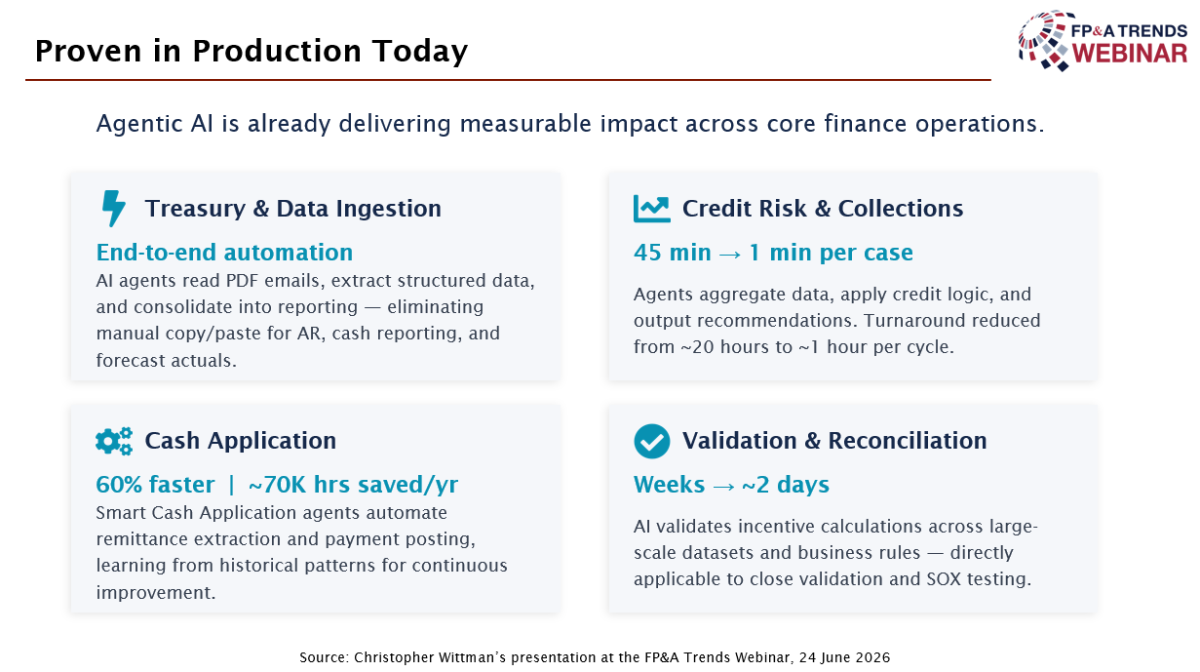
Figure 2
The figures were striking, but Christopher was careful about the lesson behind them. The hard part was rarely the calculation. It was the unstructured information, fragmented systems and repeated preparation surrounding the calculation. Once agents handled that work, teams could move from collecting and assembling information to reviewing it and deciding what to do.
None of it worked without a clean, common data layer. Microsoft used Fabric to consolidate legacy cubes and fragmented datasets into a single platform capable of handling billions of rows each month. Christopher described the governing idea as a 'disciplined core with a flexible edge': strict standards for data, taxonomy, security and controls, combined with room for the people closest to the process to experiment and build.
From there, the next capabilities become more plausible: conversational FP&A analytics, continuous forecasting, proactive anomaly detection and end-to-end budgeting workflows. Christopher organised them as a layered agentic stack, moving from data ingestion to decision support, validation and control, narrative insight, and finally orchestration. Each layer depends on the one below it. That is why Microsoft's journey began with small, repeatable wins rather than a single large transformation programme.
Boosting Performance with AI and Agents
Antonio Rosa, Product Management Associate Director for Extended Planning and FP&A at CCH Tagetik, began with a useful distinction: finance does not lack data, but having data is not the same as being AI-ready. Numbers do not explain relationships, dependencies or business meaning on their own. AI needs that context, and so does finance.
The pressure on the CFO's office makes this more than a technical detail. Boards expect continuous insight rather than quarterly updates. Regulators want traceability across every output. Business leaders want scenario answers in hours, not weeks. A general-purpose model layered over disconnected data may produce a fast answer, but if the CFO cannot explain it, the controller cannot defend it, and the planning team cannot trace it back to its source, it creates a new risk rather than solving an old one.
Antonio described three stages of applied AI in finance.
Machine Learning identifies business drivers, anomalies and relationships across financial and operational data.
Generative AI simplifies interaction with systems by allowing users to ask questions, retrieve information and execute tasks in natural language.
Agentic AI goes further by monitoring performance, detecting what matters, explaining causes and proposing actions - always with human oversight.
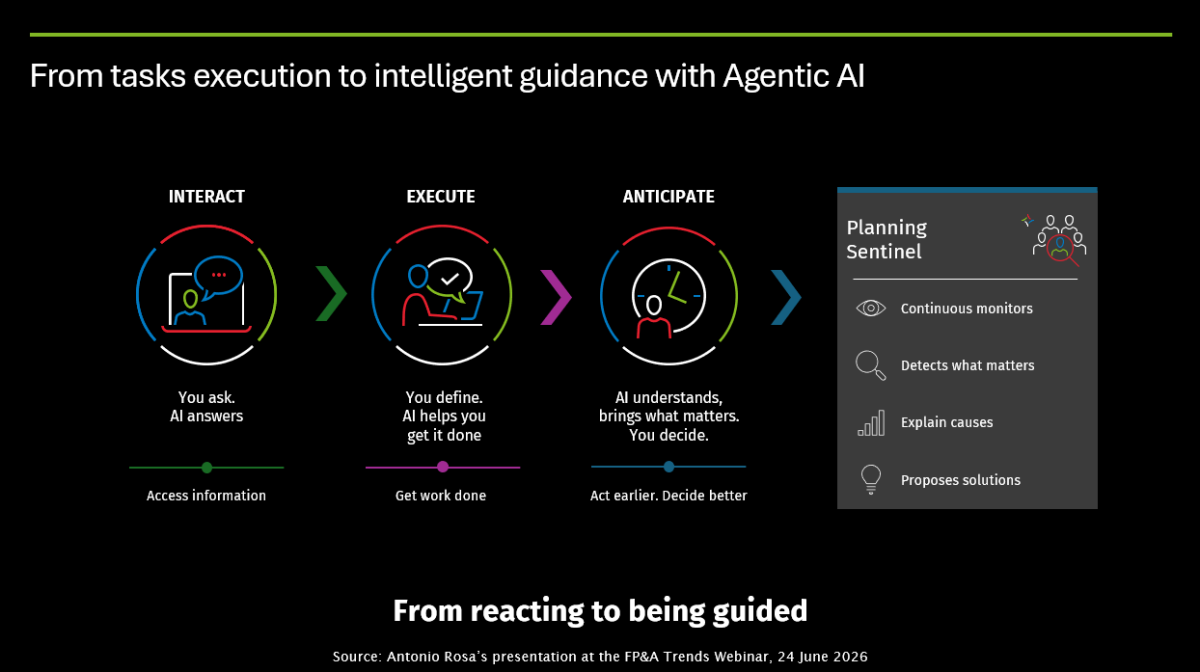
Figure 3
His Planning Sentinel demonstration made the sequence concrete. A controller could ask about revenue for a product family and receive an immediate explanation of the main drivers. Days later, the same agent could detect a significant variance between actuals and the sales forecast, alert the user, suggest several actions and show the simulated impact of each. The agent did the monitoring and prepared the options; the controller selected the response.
Antonio's closing advice was therefore to start with data and governance, not with AI in the abstract. Choose high-impact use cases such as forecasting and scenarios, build AI literacy in the finance team, and make explainability a condition of automation rather than an afterthought.
Conclusion
The key conclusion from the session was:
Start with a real finance workflow, not a general ambition to 'use AI'.
Define the partnership before selecting the tool. Be clear about what the agent does, where human judgement enters and who owns the outcome.
Build on trusted data and a governed platform. Speed has little value if the answer cannot be explained, traced or defended.
Measure a small outcome and then repeat it. Production scale grows from useful patterns, not from an ever-expanding collection of pilots.
Invest in finance capability as well as technology. AI literacy, curiosity and a willingness to redesign work are now part of the operating model.
We would like to take this opportunity to thank CCH Tagetik for sponsoring the event.
Subscribe to
FP&A Trends Digest

We will regularly update you on the latest trends and developments in FP&A. Take the opportunity to have articles written by finance thought leaders delivered directly to your inbox; watch compelling webinars; connect with like-minded professionals; and become a part of our global community.