

In this article, discover how FP&A storytelling turns numbers into compelling business stories using waterfall charts...

Audience-First Storytelling for Modern FP&A
February 12, 2026
The old wisdom “more is less” holds true for FP&A. Better data understanding and decision-making don’t come from more data, more dashboards, or more comments; they come from audience understanding and crafting a relevant message. “The Power of FP&A Storytelling” webinar demonstrated exactly that.
Three different perspectives were shared at the webinar: a practitioner’s view from a global professional services firm, a proven executive-communication technique from a listed tech leader, and a platform lens on how AI can make storytelling repeatable and consistent. At this session, we spoke about storytelling not as a presentation skill but as an FP&A technique to pass the data message across and ensure it lends. Most teams already know what good looks like; the real question is how to deliver good, consistent results under time pressure.
This report summarises the key messages and takeaways from the webinar.
Catering the FP&A Story to the Audience
Fernando Schreiner, FP&A Director at Gensler, started with a refreshingly pragmatic message: “The data doesn’t change. The framing does.” Every stakeholder looks at numbers through a different lens. The same numbers must answer different questions, depending on the audience. For regional updates, a high-level narrative is helpful; for a board, the storyline must connect to external risk and strategic trajectory; for business unit leaders, it must translate into operational levers such as backlog, staffing, and delivery risk.
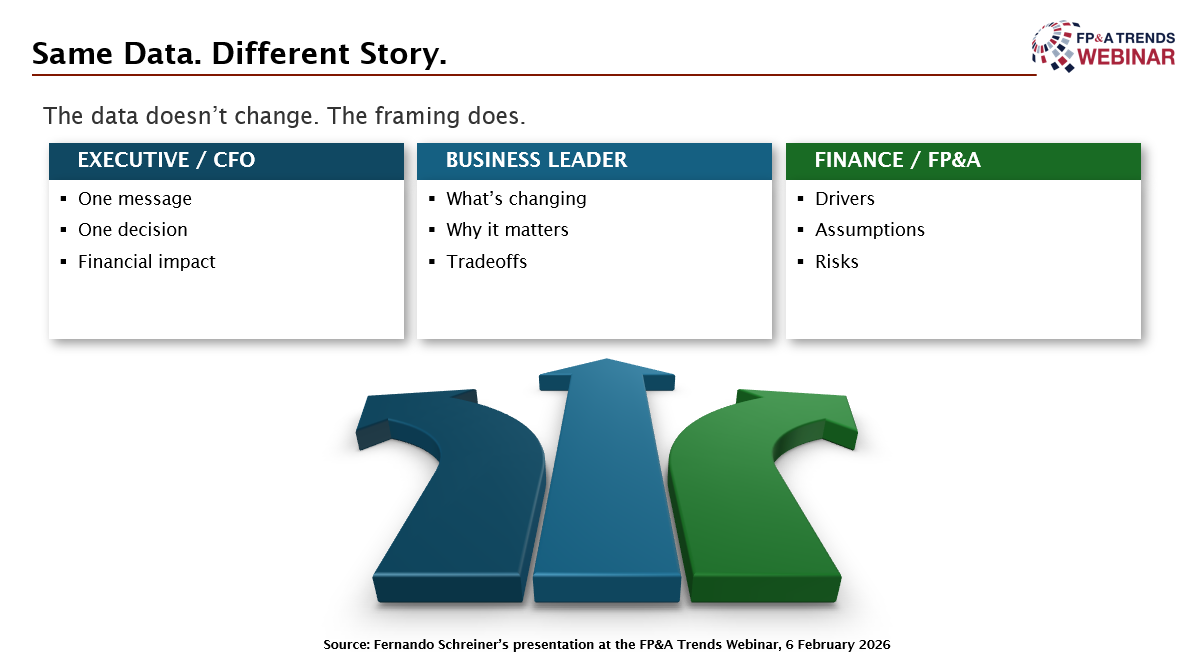
Figure 1
He showed us a relatable scenario: for instance, utilization rate drops below 60% while overhead rises and revenue stays flat. The analytical explanation of “what moved” is obviously needed. Fernando explained to us the narrative arc and how FP&A teams can use it:
- Exposition: what we see on the dashboard?
- Conflict: what warning light is flashing?
- Resolution: what decision needs to happen next?
- Recommendation: what we will do next?
He also used a quite memorable metaphor: an “oil pressure light”, a signal for action, not just a datapoint.
Poll Insight: How Often Does FP&A Tailor Messages By Audience (CEO Vs BU Vs Ops)?
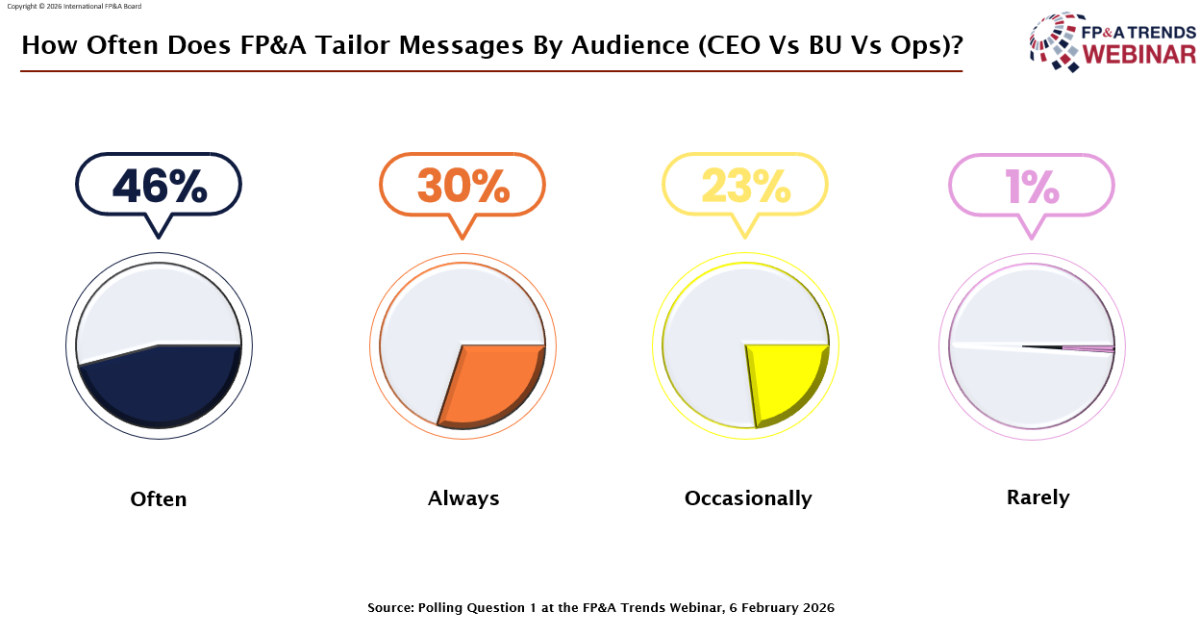
Figure 2
This result can be interpreted as follows: FP&A teams can tailor messages, but time pressure and “one-size-fits-all decks” still dominate.
Action Titles, Storylining, and your AI Sparring Partner for FP&A Storytelling
Steve Legg, FP&A Director at Arm, was very blunt about modern business reality: senior leaders rarely “read” a deck the way analysts expect. They skim, often on a phone, in transit, between meetings, so the message should still be clear for such a type of reading.
His solution is simple and powerful:
- Action titles (message titles): every slide headline states the key takeaway, not the topic.
- Storylining: when read top-to-bottom, slide headlines form a coherent narrative — often developed before building the slides (“so what first”).
Steve contrasted a generic title (“FY25 Revenue by Region”) with an executive-ready one that already contains the meaning (“EMEA growth offsets APAC softness, keeping revenue on plan”). This is not just naming what is on the slide but saying what it means for the business.
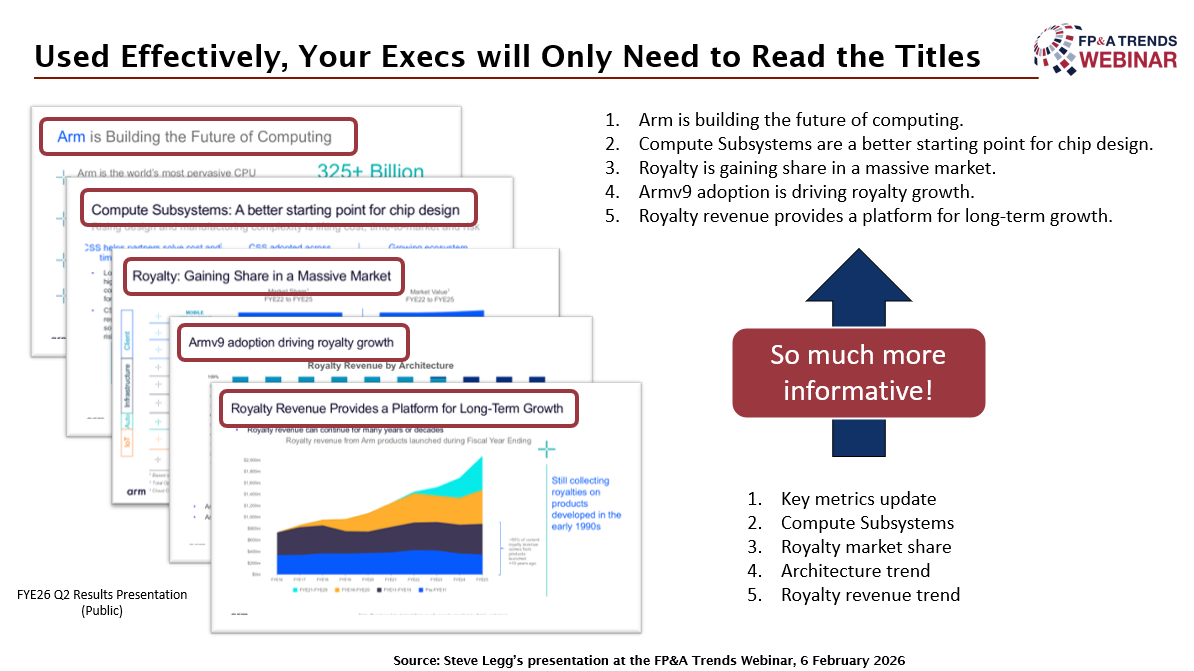
Figure 3
Steve also shared a practical tip on how to use AI as an “FP&A storyline sparring partner”. AI workflow: provide draft slide headlines only and ask AI to (a) describe the story it hears, (b) identify unclear or repetitive parts, (c) propose revised action titles, with a critical guardrail: do not invent data.
Poll Insight: One Week From Now, What Will Most Improve Your FP&A Storytelling?
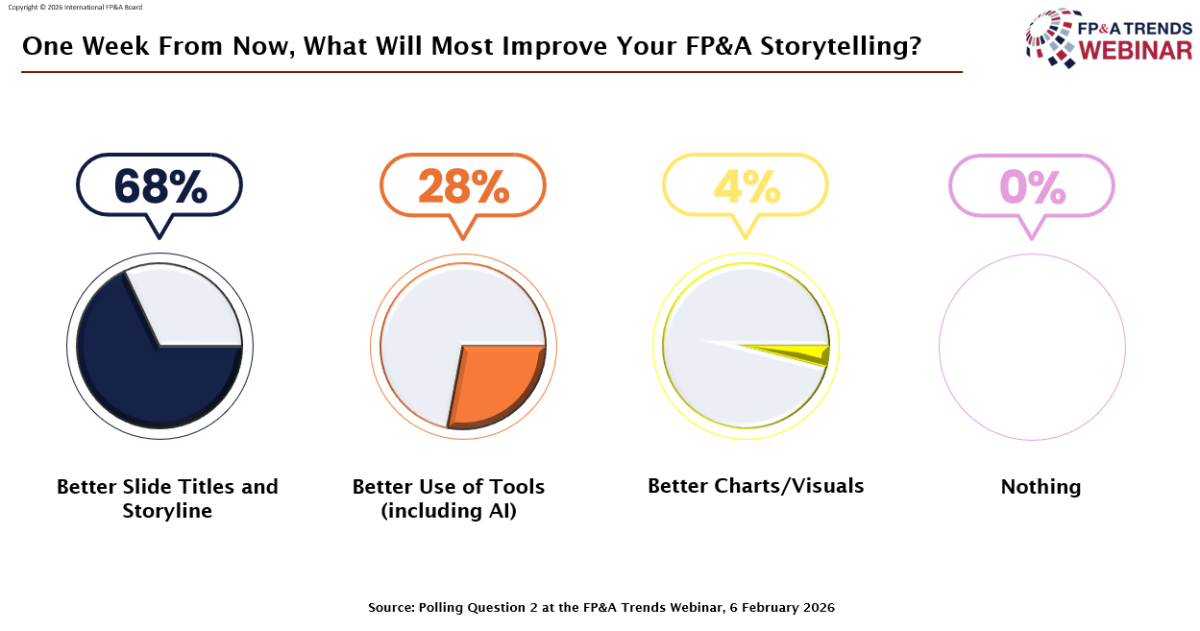
Figure 4
Most practitioners, at least after hearing Steve’s presentation, see storytelling leverage in structure and narrative. It also suggests that people are interested in using AI to improve their data communication.
Using AI Functionality for Storytelling within a Modern FP&A Platform
Matt Sledge, Product Marketing Leader at Planful, summarized what was said before him: FP&A knows what good storytelling looks like, but it is hard for them to use storytelling regularly and consistently due to time pressure, because storytelling is prepared at the very end, right before the report is sent or the deck is presented.
AI can help the FP&A team change processes and make storytelling a part of every data communication.
Matt shared with us “embedded capability” concepts:
- Contextual planning: Plans and forecasts start with historical context, not a blank slate
- Anomaly detection: FP&A is guided to what changed, not buried in what didn’t
- Narrative assistance: Explanations are created in context, as questions arise
- Repeatable execution: Storytelling becomes part of the process, not a last-mile task
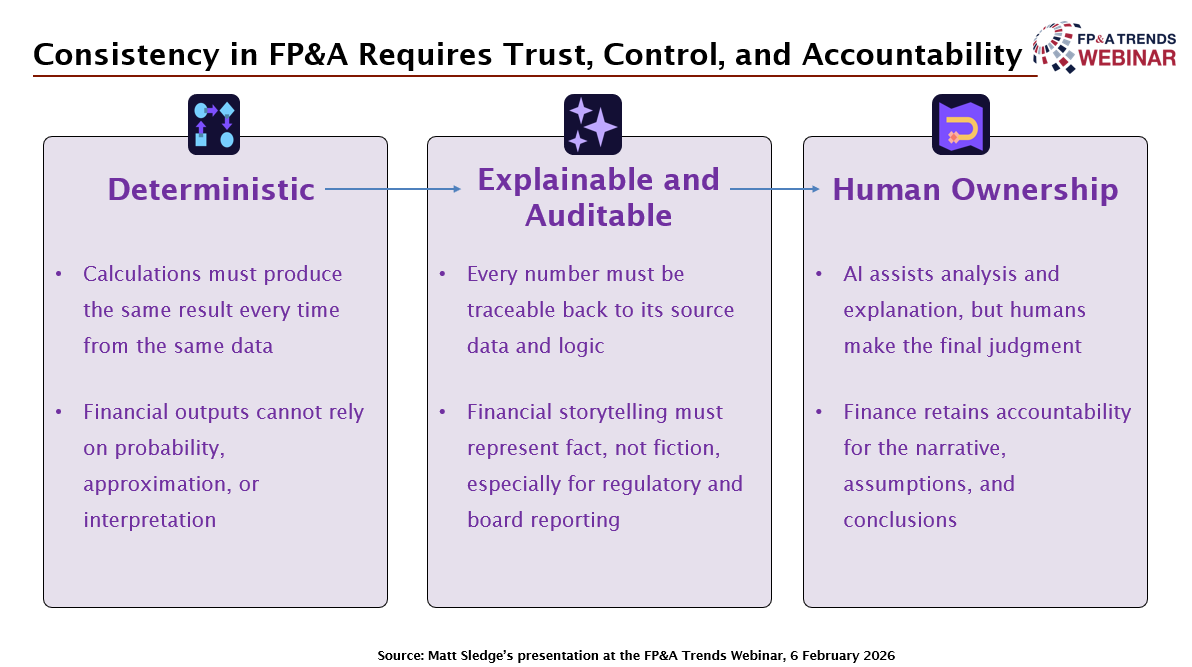
Figure 5
AI use requires trust, human control, accountability, and clear human ownership of conclusions and decisions.
Conclusion
The webinar made it clear to all participants that FP&A storytelling involves finding the right message for the right audience, linked to the right decision. Quick ways to achieve it might include action titles, storylining, and relevant context.
Discussions between webinar panellists showed that finance teams and finance leaders recognize that storytelling is necessary for effective data communication; nevertheless, time pressure due to reporting cycles makes it very hard to devote enough time to storytelling. That is why it is inconsistent so far and should become part of the process. That is why we need to embed it into a modern AI-supported platform.
To watch the full webinar recording, please check out this link.
The full text is available for registered users. Please register to view the rest of the article.
Related articles

In this article, FP&A professionals discover how soundtracking — the art of blending data, storytelling, and...

In this article, discover how AI is transforming FP&A roles, skills, and storytelling — and what...

Discover how appropriate humour can reduce workplace stress, foster better communication and make corporate presentations more...

As the FP&A function continues to evolve, soft skills will remain crucial. In this article, the...

In this article, the author explores how Integrated FP&A transforms traditional business partnering into a proactive...
+
Subscribe to
FP&A Trends Digest

We will regularly update you on the latest trends and developments in FP&A. Take the opportunity to have articles written by finance thought leaders delivered directly to your inbox; watch compelling webinars; connect with like-minded professionals; and become a part of our global community.