

In this article, the author explains why FP&A career “luck” is not random but deliberately built...

Elevating FP&A Business Partnering Through AI
March 30, 2026
How FP&A works is evolving as we speak. Artificial Intelligence, in particular Agentic AI, is revolutionising FP&A. As increasingly recurring analysis and planning tasks are taken over by digital workers, the FP&A Business Partnering landscape is shifting towards interpretation, judgment, and deeper engagement in decision-making.
On the 18th of March 2026, the FP&A Trends Webinar brought three distinguished thought leaders to discuss how we can elevate FP&A Business Partnering through AI.
Breaking down the Barriers to Business Partnering in the Age of AI
The first speaker, Liping Qi, CFO, Board Member at MicroSurgical Technology, opened the session by setting a clear tone: AI is not a threat to finance professionals, but a tool that is redefining competitiveness.
She started by describing the core challenge: today, it's still data. To address this, she stressed the importance of:-
Centralising data through cloud platforms and integration tools
Ensuring data completeness and accuracy
And treating data as the Foundation of AI
Her message was clear:
“Rather than viewing AI as a large complex transformation, break the challenges into smaller manageable tasks, adopt a learn as you go mindset, begin with low hanging fruits, build confidence and capability before scaling.”
In the slide below, she went through a few practical AI use cases in finance, each of which could be a standalone project.
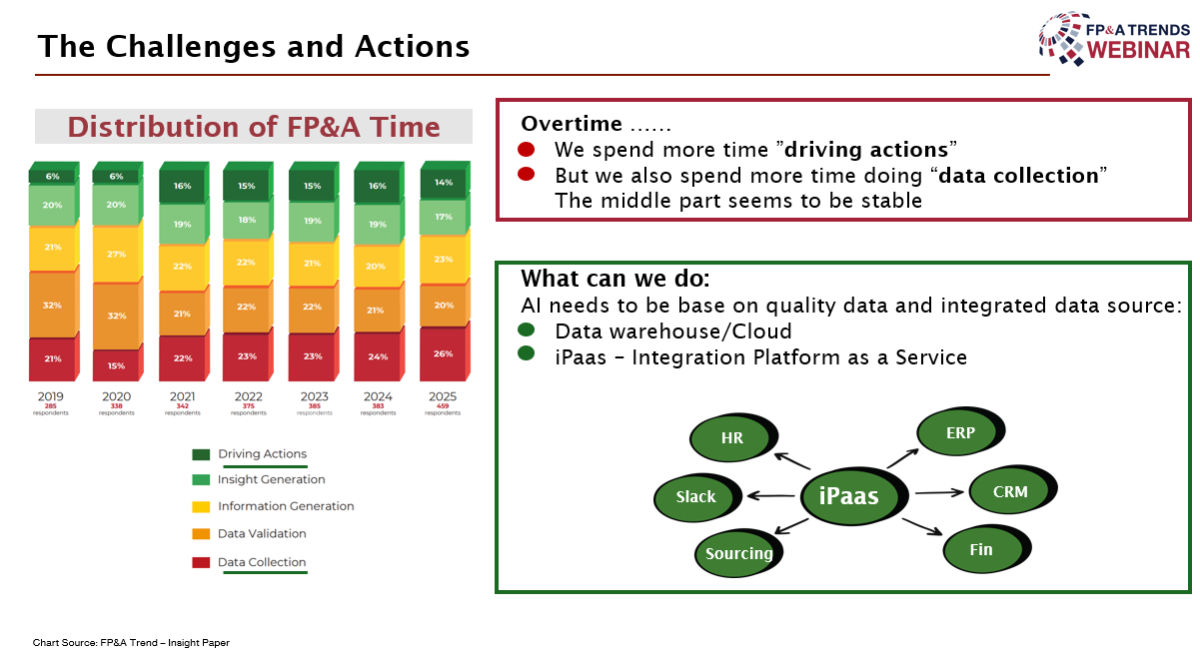
Figure 1
In conclusion, AI is shifting the workforce more towards senior roles, reflecting demand for judgement and experience, and, of course, for the use and mastery of AI.
The AI-Enabled Future of FP&A
For Sushmita Cosner, VP, FP&A and Business Intelligence at Mission, a CDW Company, the current state of FP&A remains very heavy and backwards-looking. FP&A still spends most of their time in data extraction from multiple systems, cleaning and structuring, calculating KPI’s and metrics, variance analysis and report preparation.
She then introduces her 3-stage Maturity curve for the role of AI:
Efficiency through automation: AI automates data extraction, reconciliation, cleansing & structuring and report generation through the use of AI-enabled Excel, GPT, Claude, etc.
Enhanced Forecasting and Insight: With time freed up, the team can now move to forward-looking insight, e.g., scenario modelling, sales pipelines, mapping expected close dates, translating pipelines into forecasts and building dynamic revenue waterfalls.
FP&A as a decision-making engine: Answering questions in real time through real-time scenario management, e.g., what is the impact of hiring changes, what happens to conversion rate drops and the effect of pricing changes.
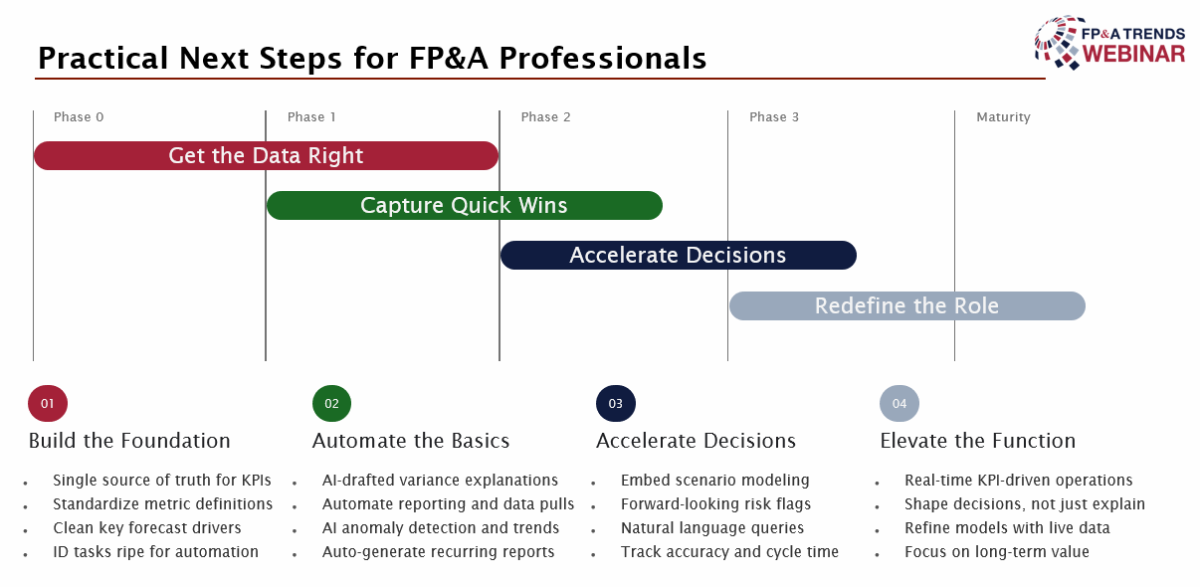
Figure 2
In her last slide, she shared with us the next steps and practical roadmap to adoption, which went as follows:
Define business drivers and metrics
Align data and establish a single source of truth
Introduce AI-driven automation (data, reporting, commentary)
Enable continuous visibility (live forecasts vs monthly cycles)
Evolve into real-time decision support
This progression allows organisations to build capability gradually while delivering value at each stage.
How Technology Is Changing FP&A Business Partnering
Our third and final speaker on the day, Kyle Trainor, Senior Technology Manager at Wolters Kluwer CCH Tagetik, built on the earlier discussions by focusing on how technology, particularly AI, is reshaping FP&A business partnering in practice.
For Kyle, fragmented data with inconsistent definitions, multiple disconnected systems, and gaps in technical capability and the right talent mix are common barriers that limit FP&A's ability to operate strategically.
Understanding AI is key and they come in two main forms:
Deterministic AI (Rules Based) – “if this, then that” logic / produces consistent repeatable outputs / ideal for structured processes, where humans define the rule and maintain control.
Probabilistic AI (pattern-based) – Works on probabilities & patterns/output may depend on data & context / used in Scenario Modelling, forecasting, predictive analysis. This is where AI becomes more powerful but also less certain
As AI cannot fully understand business strategy, interpret risk appetite and grasp market nuances, human oversight is key.
Finance professionals must provide context, refine models and challenge outputs. Accountability must always remain with humans, regardless of how advanced technology becomes.
In his conclusion, Kyle shared with us what modern technology and AI can now make possible:
Continuous reforecasting without manual effort
Greater accessibility to insights through natural language tools
Real-time analysis during discussions, rather than after
Scalable, complex modelling across multiple dimensions
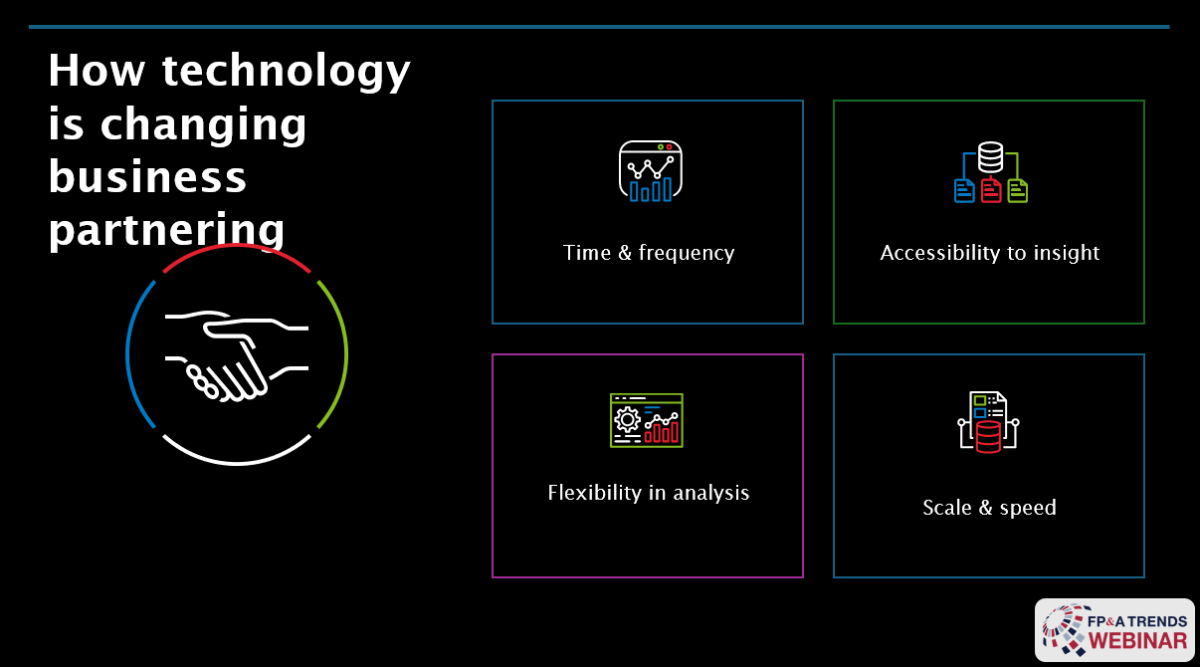
Figure 3
Key Takeaways From the Session
Liping Qi - AI should be seen as a tool to enhance capability, not a threat and those who adopt AI will deliver greater business impact.
Sushmita Cosner - The core role of FP&A hasn’t changed. Still a strategic partner, but what has changed is speed, efficiency, and execution and AI enables FP&A to deliver insights faster and more effectively
Kyle Trainor - An AI strategy equals a data strategy, whereby strong, clean, and consistent data is foundational
All three panellists agreed that AI is an enabler, not a replacement, and will change the way we do business forever. Adoption is crucial and not an option.
We would like to take this opportunity to thank our technology sponsor, Wolters Kluwer CCH Tagetik and our panellists for bringing this webinar to everyone.
The full text is available for registered users. Please register to view the rest of the article.
Related articles

In this article, the author explains why FP&A influence is determined long before the board pack...

In this article, a senior finance leader explores how FP&A teams can unlock true strategic business...

In this article, a former CFO outlines five practical pillars that help FP&A professionals evolve from...

Discover how modern FP&A drives business impact through data democratisation, performance storytelling and scalable digital solutions.
Frédéric Labey, Group CFO – France at dentsu International, shares how to turn FP&A into a...
+
Subscribe to
FP&A Trends Digest

We will regularly update you on the latest trends and developments in FP&A. Take the opportunity to have articles written by finance thought leaders delivered directly to your inbox; watch compelling webinars; connect with like-minded professionals; and become a part of our global community.