

Agentic AI is reshaping FP&A by automating repeatable finance workflows while raising new questions about governance...

From Faster Reporting to Better Decisions: Designing the FP&A Operating Model for the AI Era
July 16, 2026
What happens when finance adds increasingly capable AI to an operating model that was never designed for machines to initiate work? The result may be faster reporting, but not necessarily better decisions. This tension was at the centre of the FP&A Trends webinar “Designing the FP&A Operating Model for the AI Era”, which attracted more than 350 registrations from 61 countries.
The discussion brought together Derk-Jan van der Wal of EY, global CFO and board adviser Atif Hafeez, and Fernanda Noronha of Grainger. Together, they explored why the operating model has become FP&A’s main bottleneck, how organisations can design for the right level of AI agency, and what practical applications, such as automated reporting and finance chatbots, look like when supported by strong governance. This article highlights the central frameworks, audience perspectives and practical priorities for finance leaders.
Why the Operating Model Is the Bottleneck
Derk-Jan van der Wal, Global Lead Partner, Business Planning, Reporting & Analytics at EY, opened with a challenge: finance has spent a decade investing in platforms, data and talent, yet the improvement in decision advantage has not kept pace. The 2026 FP&A Trends Survey shows the scale of the gap. Only 2% of FP&A functions describe themselves as fully optimised, 47% of effort is still spent collecting and validating data, and only 32% of analytical effort reaches insight and action.
For Derk-Jan, the issue is not simply a lack of technology. Most organisations already have an FP&A operating model, but it has often been inherited rather than deliberately designed. New tools are then placed on top of old roles, fragmented workflows and unclear decision rights. He described the resulting burden as “manual debt”: the accumulated financial, strategic, and operational costs of keeping a process human-initiated when machine-initiation would now be more effective.
This changes the nature of the FP&A bottleneck. Historically, the hard part was producing insight. Today, the greater constraint is acting on it. Derk-Jan called the distance between the analysis FP&A produces and the decisions it actually shapes the “decision alpha gap”.
Closing that gap requires FP&A to test its contribution in three ways:
the impact test, which assesses where finance changed an outcome;
the absence test, which considers the cost of decisions made without early FP&A involvement;
the design test, which identifies the operating-model changes needed to influence more decisions, earlier and more reliably.
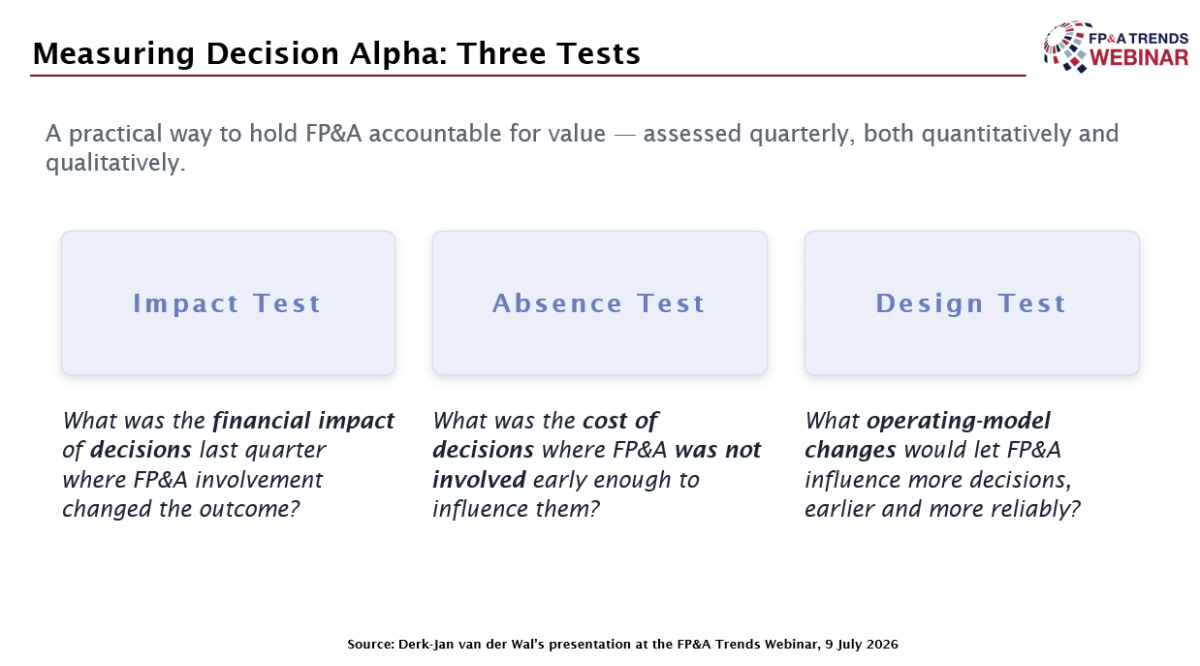
Figure 1
The implication is significant. FP&A should not measure progress primarily through faster reporting cycles or higher volumes of analysis. Its value lies in improving the quality, timing and economic impact of business decisions. Technology matters, but only when the operating model enables it to work at scale.
Where Does the FP&A Operating Model Create the Most Friction?
The first audience poll showed that friction is spread across the operating model rather than concentrated in one isolated area. Data and technology ranked first at 31%, while structure, roles, and processes each received 24%. Governance accounted for 11% and decision rights for 10%.
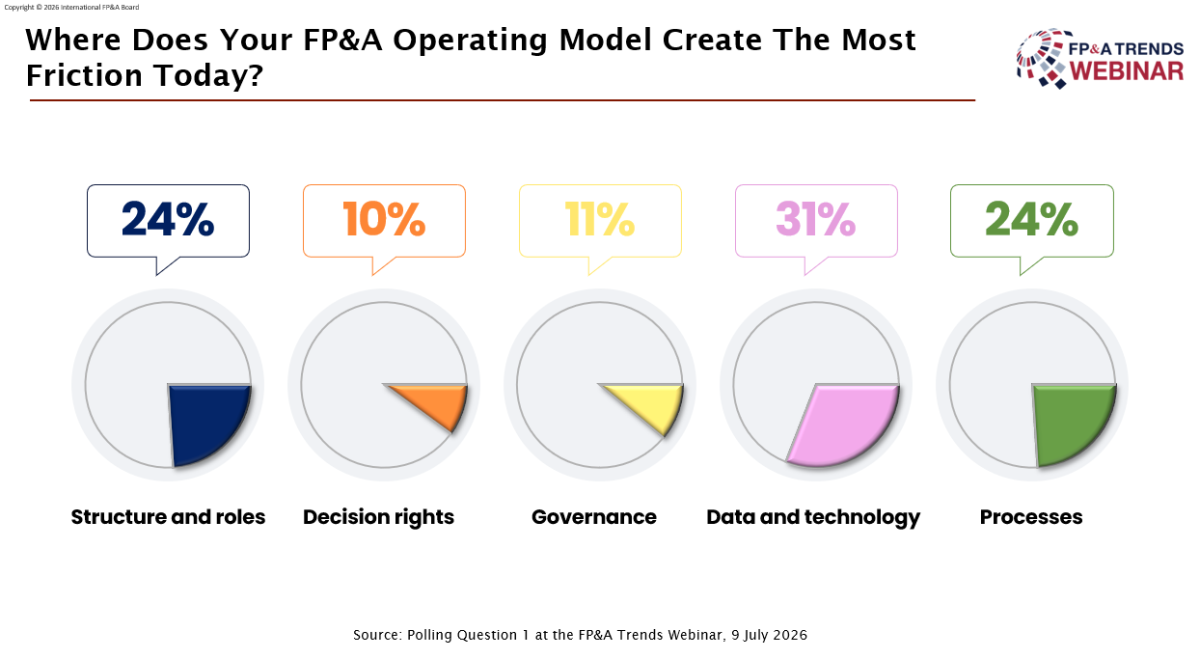
Figure 2
Although data and systems are highly visible pain points, almost half of the respondents identified structure, roles or processes as the main source of friction.
What We Learned for You: Fit, Not Maturity
Atif Hafeez, Global CFO & Board Advisor and member of the AI FP&A Committee, presented the research paper’s design framework. Its governing proposition is simple but important: there is no single correct operating model. Organisations should pursue fit, not maturity. The five archetypes described in the research are identities and structural choices, not stages on a ladder towards a universally superior end-state.
Atif highlighted three design lessons. First, not every lever is a ladder: some levers represent capability, while others are deliberate choices about where FP&A sits and what it sources. Secondly, the levers are coupled. A mandate to act as a value architect cannot be delivered if FP&A remains too distant from the decisions it is expected to influence. Thirdly, a higher AI agency is not automatically better. The right level depends on the purpose of the activity and the organisation’s ability to govern it.
The framework can be visualised as a house.
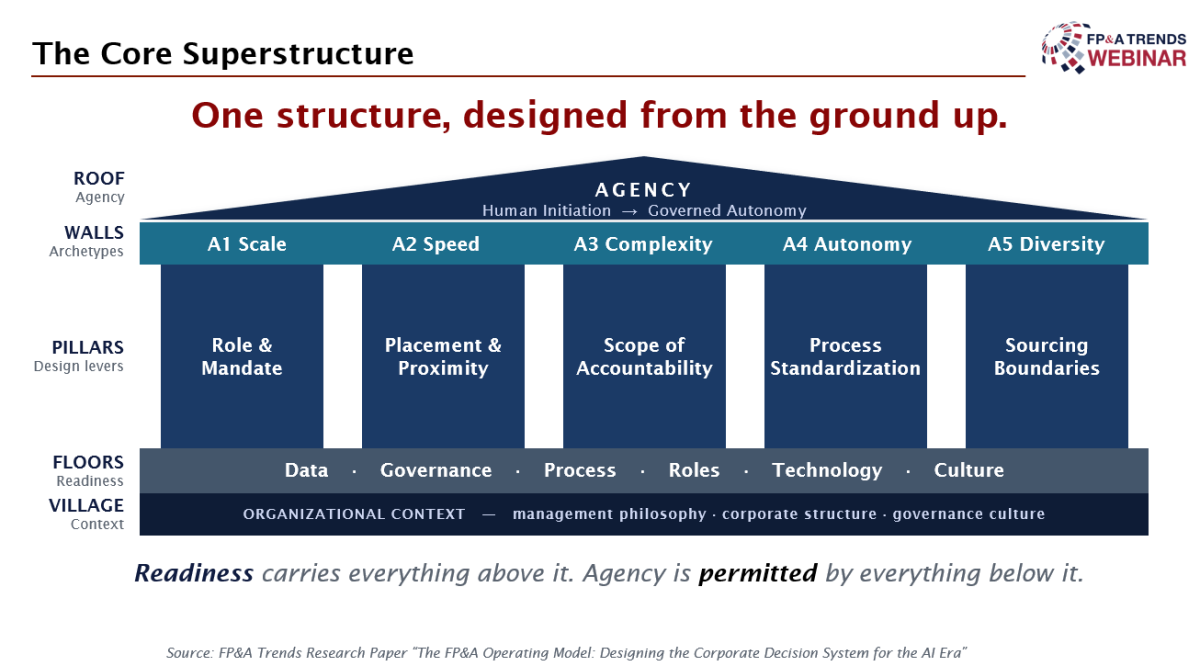
Figure 3
Organisational context forms the ground; readiness provides the foundation; design levers support the archetype; and agency sits at the top. The central rule is that readiness carries everything above it, while agency is permitted by everything below it. Leaders should therefore resist starting with the most advanced technology and work upwards from context, data, governance, process and accountability.
Agency itself progresses from human initiation, through structured human and system-assisted initiation, to supervised system initiation and governed autonomy. The key threshold lies between system assistance and system initiation. At that point, the finance leader’s role shifts from doing the work to governing the system that does it. Accountability does not disappear; it relocates from the operator to the architect of the rules, parameters and controls.
Atif also described three failure modes:
over-ambition, when agency is set above readiness;
under-utilisation, when capabilities are built, but systems are not permitted to initiate work;
structural conflict, when incompatible design choices are combined.
A practical diagnostic is the governance gap - the difference between the level at which technology can operate and the level governance can manage. A gap greater than one level signals immediate structural risk.
How Is FP&A Work Initiated Today?
The second audience poll revealed that most organisations remain early in the agency shift. A majority (56%) said that every FP&A activity is still manually triggered. A further 30% use structured human initiation, where people set the rules and systems execute. Only 7% reported system-assisted initiation and 4% supervised system initiation, while 4% were unsure or considered it too early to assess. Percentages reflect rounded webinar results.
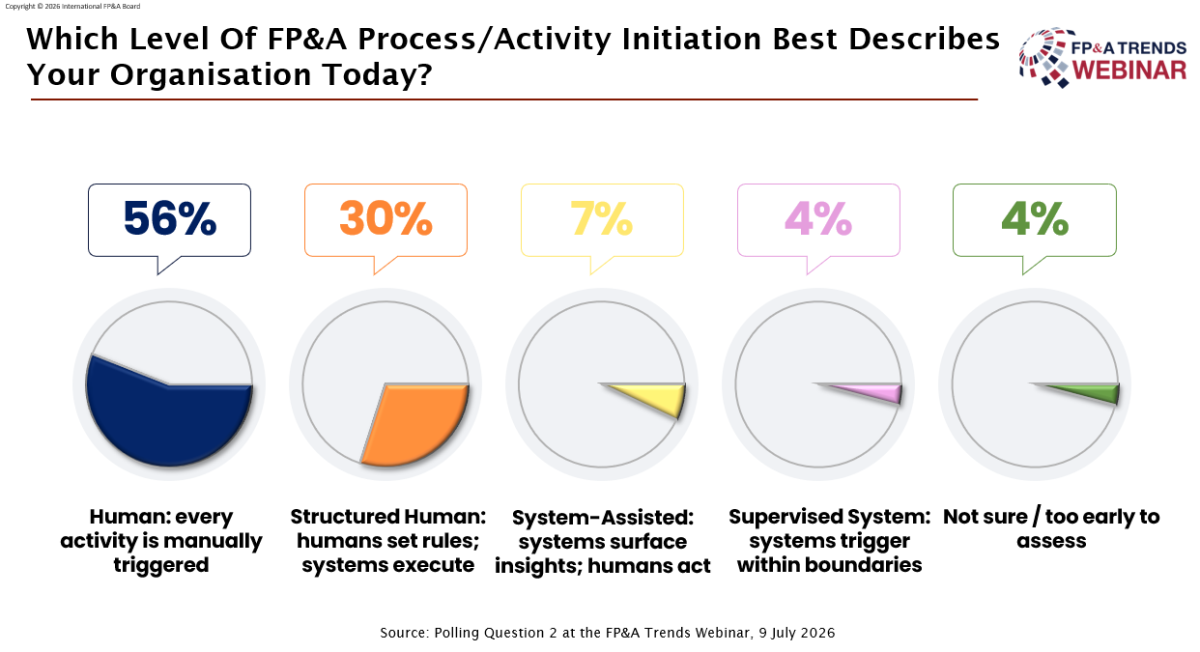
Figure 4
In other words, 86% of respondents remain predominantly human-initiated. This does not mean that finance should pursue autonomy everywhere. It suggests that many organisations are paying for modern technology without redesigning who or what initiates the work.
Use Cases for the AI-Enabled Operating Model
Fernanda Noronha, Director of Finance, Process Optimization at Grainger, translated the framework into two practical examples. Her first use case was fully automated daily sales reporting. In a traditional model, analysts arrive early, extract data from several systems, reconcile figures, investigate exceptions, prepare reports and distribute them. The deeper cost is not just manual effort; it is that skilled finance professionals spend the most valuable part of the morning producing information while business decisions are already being made.
In an AI-enabled operating model, data can be integrated, validated and checked overnight. KPIs are calculated, dashboards refreshed and alerts delivered before employees log in. Leaders begin the day with trusted insight, while FP&A begins with discussion, challenge and action. AI is not replacing finance expertise; it is replacing the repetitive initiation of work and increasing the time available to create decision alpha.
The second use case was a finance chatbot. Instead of sending a question to an analyst and waiting hours or days for a report, a business leader asks in natural language and receives an immediate answer with charts, explanations and governed KPI definitions. Routine level-one and level-two questions become self-service, while FP&A concentrates on judgment, assumptions, trade-offs and strategic conversations.
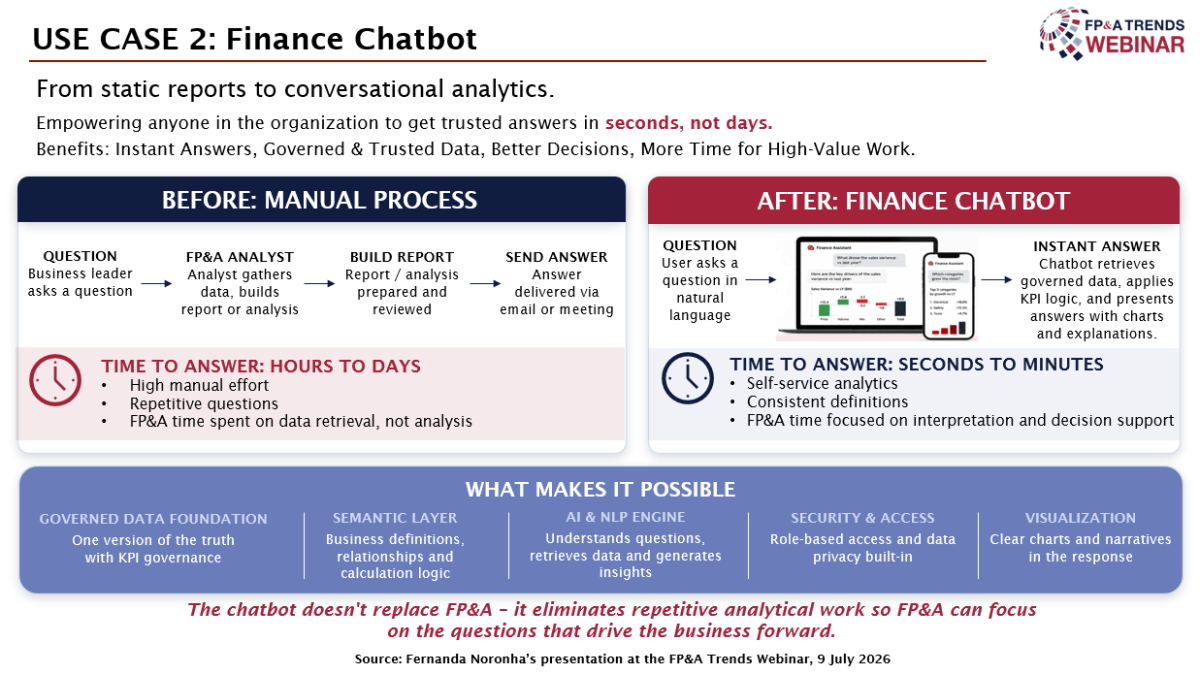
Figure 5
Fernanda stressed that this model only works with the right foundations: governed and trusted data, a semantic layer that understands business definitions and KPI logic, AI capable of interpreting natural language, and security controls that ensure answers are appropriate. The chatbot is therefore not simply a technology implementation. It is an operating model redesign that brings data engineering, data science, process design and visualisation together around finance’s decision-support mandate.
Conclusion
The webinar highlighted a shift in the AI agenda. Large language models, copilots and autonomous agents are becoming increasingly accessible, so access to AI alone will not create a lasting advantage. The differentiator will be the organisation’s ability to scale these tools within a coherent operating model.
The AI era does not reduce the importance of the FP&A operating model; it exposes its weaknesses. Finance leaders should begin by diagnosing the decisions they need to influence, the governance they can sustain and the readiness of their data, processes and people. They can then select the archetype and level of agency that fit their context rather than pursuing automation as an end in itself.
The future advantage will not come from having more AI than competitors. It will come from designing a better decision system - one in which machines support action and finance remains accountable.
To watch the full webinar recording, visit the FP&A Trends webinars page. To explore the framework, archetypes and implementation guidance in more detail, read the 2026 FP&A Operating Model research paper.
The full text is available for registered users. Please register to view the rest of the article.
Related articles

AI in FP&A creates value when earlier analytical signals are connected to governance, ownership, escalation, and...

FP&A leaders must redesign talent pipelines before AI automates the early-career tasks where finance judgement was...

FP&A Agent Managers will become essential as AI agents move from task automation into forecasting, scenario...

Agentic AI may remove Finance from the decision chain. Explore how FP&A can shift from insight...

In this article, the author explains why agentic AI adoption in FP&A depends less on technology...
+
Subscribe to
FP&A Trends Digest

We will regularly update you on the latest trends and developments in FP&A. Take the opportunity to have articles written by finance thought leaders delivered directly to your inbox; watch compelling webinars; connect with like-minded professionals; and become a part of our global community.