
An AI-enabled FP&A operating model aligns technology, governance and organisational readiness so automation improves decisions rather...

AI Does the Heavy Lifting, Business Still Owns the Decision
November 10, 2026
When AI can complete a recurring review in seconds, what should finance do with the capacity it releases? The 2026 FP&A Trends Survey, presented during the webinar, found that 98% of respondents expect AI to affect their role, while 41% expect more capacity for value-added work and business partnering. Turning that expectation into better business outcomes requires finance to decide which work to automate, how to control it and where to invest the time returned.
These questions shaped the FP&A Trends webinar “From AI Efficiency to Finance Value: The FP&A Value Architect in Action”, held on 4 November 2026. With more than 360 registrations from 48 countries, the session brought together Jeremy Hall of Catalyst Acoustics Group and James Glau of Board. Their examples linked a repeatable payroll review to a broader question: how can FP&A help the business make better decisions while keeping people accountable for the results?
Encoding Finance Judgement into a Repeatable Review
Jeremy Hall, Group Director of Finance at Catalyst Acoustics Group, began with a familiar interruption: the payroll team needs approval, several registers arrive, and someone has to check what changed before payment is released. The reports are difficult to read, with employees spread across multiple rows. Across four payroll runs every two weeks, the review consumed substantial time and depended heavily on the reviewer's memory.
Jeremy turned that process into a reusable AI skill combining business rules with code. The inputs are the previous and current payroll registers. The output is an auditable Excel workbook highlighting new hires, employees missing from the latest run, changes in pay rates and deductions, overtime movements and commission payments. Finance can then concentrate on the changes that need explanation or approval.
The difficult work lay in defining what those changes meant. An employee missing from a register might have left the company or be on leave. A bank routing code should not be treated as a deduction. Gross pay split across several lines must be added correctly, and employees with zero-dollar pay must remain visible. Where information is absent from the source, the limitation needs to be stated. These are judgements that finance has to supply before the automation can be trusted.
The skill is also developed through use. A suffix in a filename turned out to indicate a revised payroll version rather than a separate pay cycle. Commission payments initially triggered unexpected flags, prompting Jeremy to incorporate the relevant incentive plans. Each clarification became a reusable rule, available to colleagues using the shared skill.
Jeremy reported that a review previously taking 30–45 minutes per entity now involved a 17-second automated comparison followed by around three minutes of human review. His presentation used a 45-minute baseline to illustrate approximately 42 minutes returned per entity per pay period. Further investigation of flagged items still requires time, but that effort goes towards exceptions rather than reading every line.
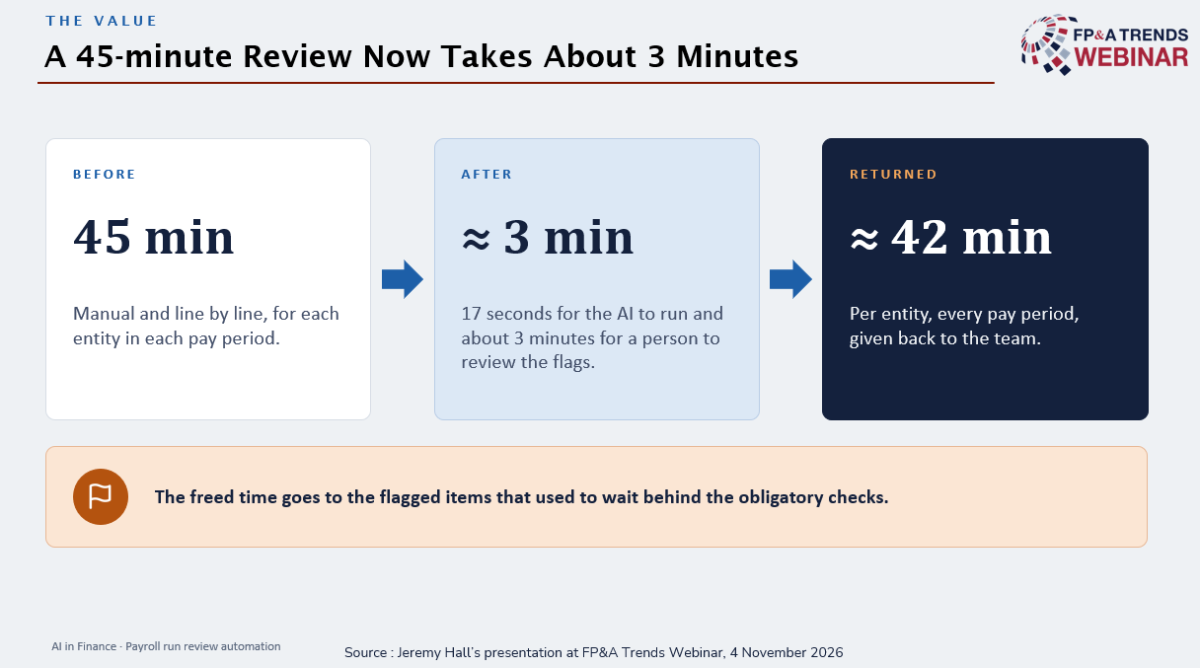
Figure 1
The control benefits mattered alongside the time saving. The same checks cover every employee each period, outputs reconcile to control totals, and the workbook provides an audit trail. Jeremy's suggested starting point was practical: choose a recurring review, document its rules as if teaching a new analyst, add a hard reconciliation check and retain a person responsible for approval.
Poll Results on Moving Beyond Individual Prompts
The first audience poll asked: “How far has your finance team progressed from individual AI use to reusable automation?” A majority (51%) were still exploring individual prompts. Another 32% had a few reusable tools or workflows, 14% had embedded AI in selected finance processes, and 3% had scaled AI across finance with common governance.
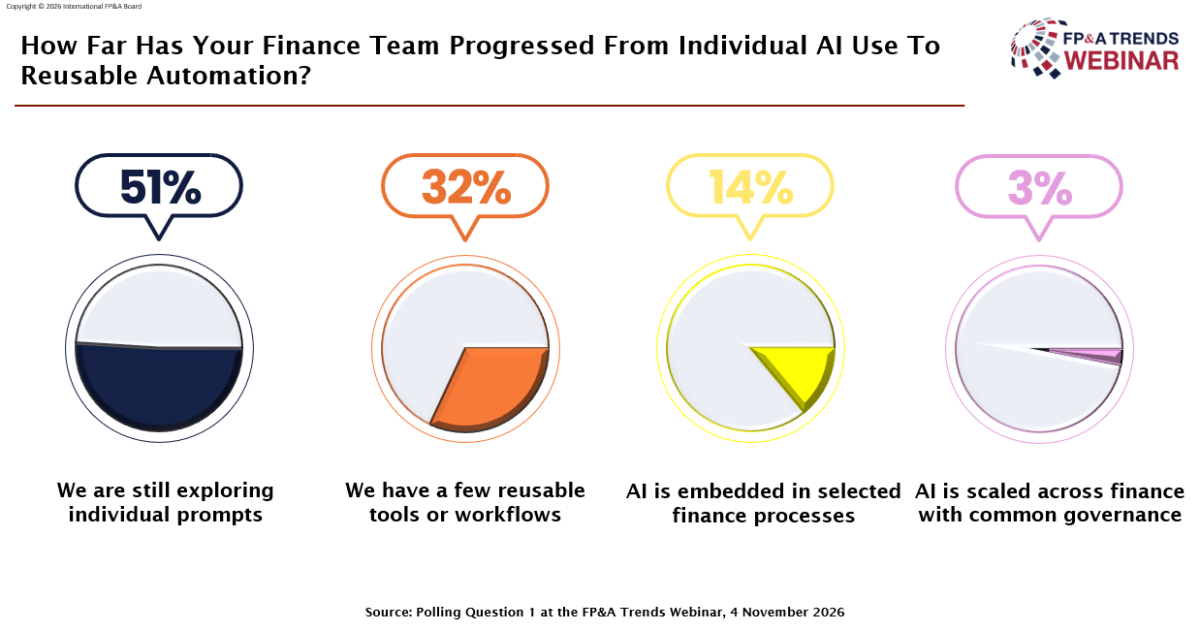
Figure 2
For this audience, reusable automation was still developing. Jeremy described individual prompting as a useful place to learn, with shared tools and workflows providing the next step towards embedding AI into regular processes. His payroll example showed how a useful experiment could become a repeatable review that colleagues can run and improve together.
Bringing Business Context into AI Planning
James Glau, Director, Solutions Consulting – Office of Finance at Board, extended the discussion from checking a completed payroll run to deciding what the business should do next. Time returned is one side of the business case. Finance also needs to understand the cost of running the automation and whether the resulting capacity improves business performance.
James described continuous planning as a response to changes that happen between reporting cycles. Finance senses relevant internal and external signals, updates the forecast, explains the difference from the base case, and tests possible responses with business partners. People then approve the action and monitor its outcome. AI can support much of the analysis within that cycle, provided it operates within defined boundaries.
For this to work reliably, AI needs the company's financial models, business drivers and operational knowledge. Customer behaviour, capacity constraints and important trade-offs cannot simply remain in people's heads. Finance must document that context and keep it current as the business changes.
Governance makes the resulting recommendations reviewable. James highlighted tested prompts, traceable inputs and outputs, and a clear approval process. Business partners should be able to inspect the assumptions and reasoning behind a recommendation. Planning platforms bring together the models, context and controls needed to run that workflow consistently.
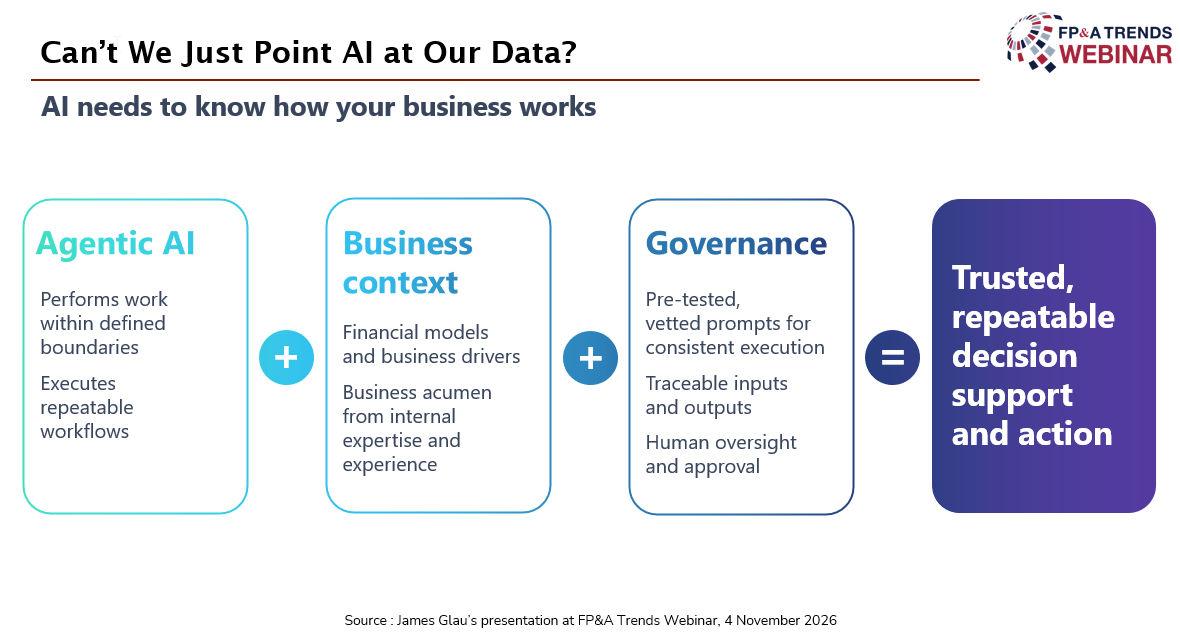
Figure 3
James illustrated the approach through a manufacturer scenario. Orders soften and an external market indicator confirms the direction. Finance updates demand assumptions, reruns volume and margin, and traces the gap against plan to the underlying drivers. The team can then compare production, inventory, and shift options, assessing the effects on cost, service, and cash before finance and operations approve a revised plan. This was an illustration of the decision process, rather than a reported customer result.
The value assessment must also include the full cost of AI. James identified platform costs, usage consumption, setup, maintenance and ongoing governance. Teams should connect the proposed benefit to revenue, margin or cash where possible, while establishing what the existing process costs. A faster output becomes useful when it gives the business reliable evidence early enough to change an outcome.
Poll Results on Proving the Value of AI
The second poll asked: “What is the biggest obstacle to proving the value of AI in finance?” Benefits beyond time savings were difficult to quantify for 32% of respondents. Another 30% lacked a reliable baseline for the current process, 22% said pilots were not integrated into real workflows, and 16% found the total cost of automation unclear.
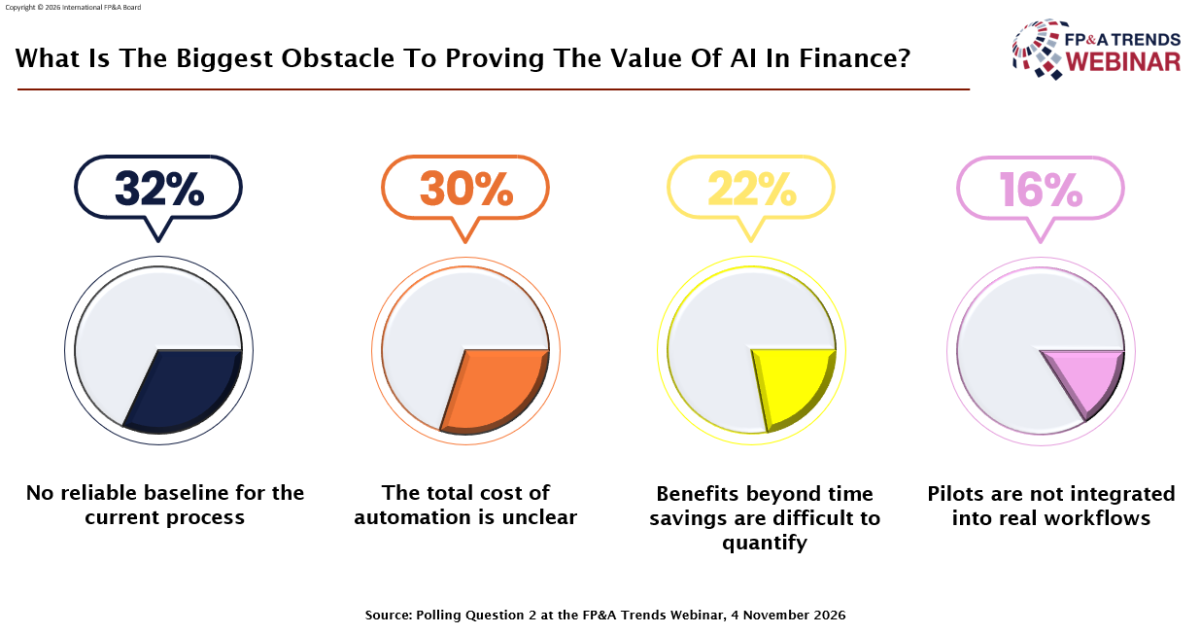
Figure 4 
The results suggest that this audience faced challenges in measuring both the starting point and the outcome. James recommended benchmarking the current process before a team initiative begins, then agreeing the target and timeline. Without that baseline, even a useful automation can leave finance struggling to explain what improved and whether the investment was justified.
Conclusion
The webinar connected a small, repeatable finance task with the wider role of FP&A as a Value Architect. Jeremy's payroll example showed how documented judgement and reconciliation checks can make automation faster and more consistent. James carried the same discipline into planning, where the purpose is to help the business respond while there is still time to influence the outcome.
For finance leaders, the practical starting point is to select a recurring process, establish its baseline and write down the logic that makes a good review possible. The next step is to measure what the released capacity achieves, including stronger controls, deeper analysis and more informed business conversations, alongside the full cost of the automation.
AI does the heavy lifting. The business still owns the decision. FP&A's responsibility is to validate the evidence, challenge assumptions and work with business partners on the response. That responsibility becomes more important as analysis accelerates: the value lies in what people choose to do with the insight.
We would like to take this opportunity to thank Board for sponsoring the event.
For details of the session and recording availability, visit the webinar page.
The full text is available for registered users. Please register to view the rest of the article.
Related articles


AI in FP&A creates value when earlier analytical signals are connected to governance, ownership, escalation, and...

In this article, the author explains how AI in FP&A can evolve from automation to a...

AI-enabled forecasting will expose weak KPI logic. Learn how FP&A can connect drivers, decision routines and...

Why FP&A should measure AI investment through predictive value, governance, and strategic impact rather than headcount...

AI improves FP&A efficiency, but real value still depends on human judgment, business context, and accountability.
+
Subscribe to
FP&A Trends Digest

We will regularly update you on the latest trends and developments in FP&A. Take the opportunity to have articles written by finance thought leaders delivered directly to your inbox; watch compelling webinars; connect with like-minded professionals; and become a part of our global community.