

In this article, the author, an experienced FP&A veteran, focuses on the seamless integration of supply...

From Scorekeeper to Navigator: How Finance Can Shape Supply Chain Decisions
August 4, 2026

There is a question I now ask finance teams when I first work with them on a supply chain programme: if you left the room, would the decision change?
More often than we’d like, the honest answer is no, not because the analysis isn’t strong, but because finance is still set up to explain decisions after they are made, rather than shape them while they are being made.
That was a manageable limitation when the environment was stable, but it is not manageable anymore.
The Environment Changed. Finance Needs to Change With It.
The 2021 semiconductor shortage was estimated to cost the global automotive industry $110 billion in lost revenue in a single year [1]. Companies that had spent a decade optimising their lean inventory models discovered that the entire model was built on an assumption of supply stability that no longer held. In consumer goods, we saw the same pattern recur - packaging shortages, commodity spikes, carrier capacity disappearing overnight.
Then tariffs arrived at a completely different scale. In April 2025, U.S. tariffs on many Chinese imports rose to 145%, sharply compressing the time available for supply chain teams to reassess sourcing, pricing, and network decisions [2]. The Strait of Hormuz, through which oil flows averaged 20 million barrels per day in 2024, equivalent to about 20% of global petroleum liquids consumption, is not a footnote in a risk register. It is a live supply chain exposure with real cost consequences if disruption risk escalates [3].
In that environment, the traditional supply chain finance model does not work very well. Validating savings targets and explaining monthly variance is not enough when the decision that needs to be made is whether to nearshore manufacturing, how much safety stock to carry or whether to lock in a freight contract today or wait. Those decisions need finance in the room before they are made and not after.
The Gap Between Reporting and Partnering Is Wider Than Most Finance Leaders Think
What does genuine business partnering look like in practice? A logistics network redesign programme proposes closing three regional distribution centres and consolidating into a single automated national DC, promising $40M in annual savings. A reporting finance team validates the methodology and approves or challenges the headline number, but the partnering finance team asks different questions. What is the working capital impact of centralising inventory, given that replenishment cycles to regional customers will lengthen by three to four days? What is the disruption cost if this single national DC experiences a weather event or a labour dispute and what is the realistic probability of that? What does this model look like at the 90th percentile of freight rate scenarios, rather than the base case assumption?
When those questions are worked through, the $40M in savings often reduces materially on a risk-adjusted basis, and the payback period extends. The decision may still be the right one, but the organisation makes it with clear eyes rather than discovering the gap eighteen months into delivery.
Three Things Finance Must Do Differently
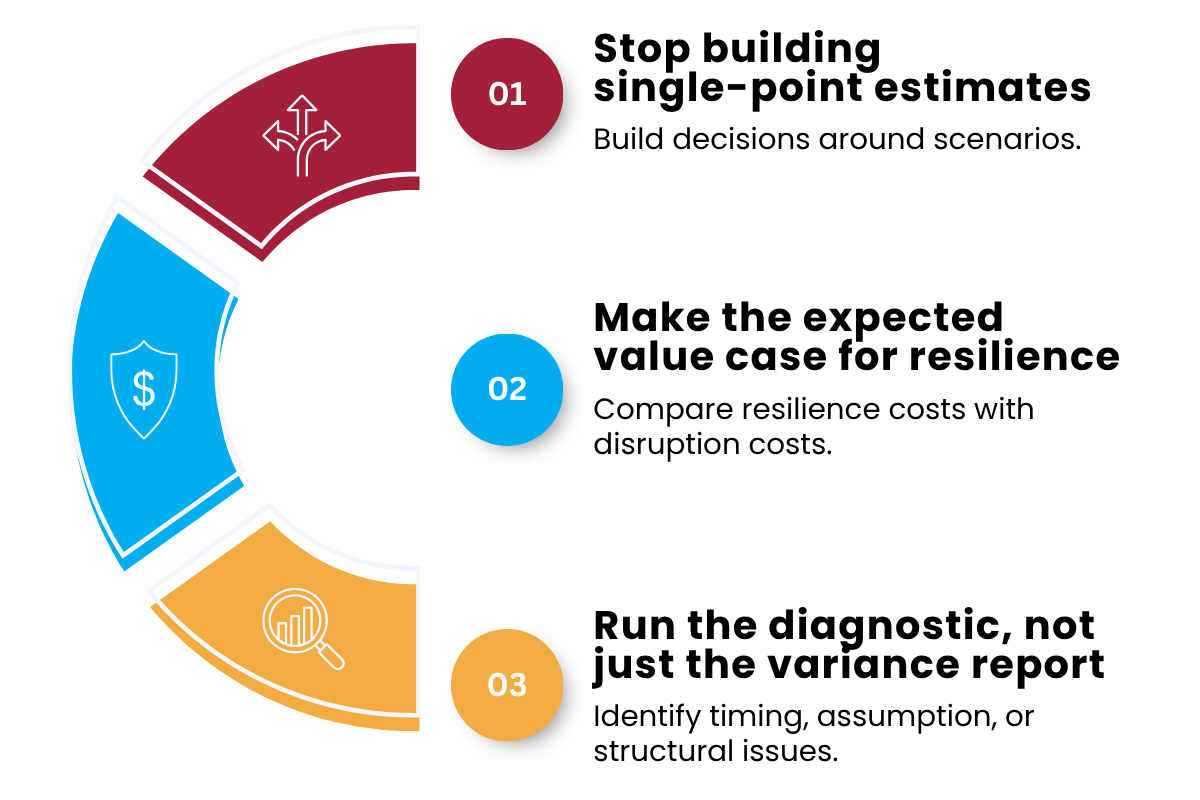
1. Stop building single-point estimates
In an environment where tariff policy can reverse, shipping lanes can be disrupted for months, and industrial policy can reshape supplier economics without warning, a single base case is not a model. The finance teams navigating this well are building decision frameworks around scenarios. When evaluating whether to nearshore manufacturing from Asia to Mexico, the right question is not what tariffs will be, but at what tariff level does nearshoring become NPV-positive, and how likely is it that we cross that threshold? That is a question that finance and operations can both engage with honestly. It produces a decision robust to a range of outcomes.
2. Start making the expected value case for resilience
One of the most consequential conversations finance is not having is what the absence of resilience actually costs. Resilience has a price: buffer stock, redundant carrier relationships, distributed warehouse networks. But the absence of resilience also has a price, the probability-weighted impact of a disruption multiplied by its financial consequence.
If a network disruption has a 15% annual probability and costs $200M in lost sales and recovery costs, the expected annual cost of carrying no resilience buffer is $30M. If maintaining those buffers costs $20M per year, it is a positive-NPV decision. Finance has the tools to build that model. The reason it has not been built is that the probability and impact estimates require supply chain input, and the financial framework requires finance input, but the two functions have not been working closely enough to produce it together. That is exactly the gap business partnering is supposed to close.
3. Run the diagnostic, not just the variance report
When a transformation programme is six months in and savings are not materialising, most finance teams apply more pressure to the original numbers. That is the wrong response and it actively damages programmes by pushing operations towards short-term decisions that undermine long-term outcomes. The more useful response is diagnostic. Is this a timing delay? The savings are real, but deferred? Has an assumption changed, or has the external environment moved, and does the model need refreshing? Or is it a structural issue? The savings were never achievable, and the organisation needs an honest conversation about redesign. Each of these requires a completely different response. Finance is the function best placed to run that diagnosis and to bring leadership forward-looking decisions rather than backwards-looking explanations.
Together, these shifts require FP&A teams to move beyond reporting discipline and build stronger capability in scenario modelling, risk-adjusted decision support, and cross-functional challenge.
What This Means for CFOs and FP&A Leaders
For CFOs and FP&A leaders, the shift to a true “navigator” role is not just about better analysis - it requires a change in how finance operates day to day. In practice, this means embedding finance earlier into supply chain decisions, particularly in transformation governance and network design discussions, rather than engaging only at the point of business case approval.
Planning routines also need to evolve, moving beyond fixed annual budgets and backwards-looking variance cycles toward more dynamic, scenario-based reviews with clear decision triggers linked to external factors such as tariffs or commodity movements.
At the same time, finance teams need to work much more closely with supply chain partners to build joint models that incorporate risk, probability, and expected value, rather than parallel views of the same decision.
Perhaps most importantly, organisations should begin to measure decision quality, not just delivery against plan, by explicitly asking whether decisions were robust across different scenarios and capturing those learnings for future cycles.
Taken together, these shifts move finance from reporting outcomes to actively shaping them.
The Organisations That Figure This Out First Will Have a Structural Advantage
The macroeconomic environment is not going to simplify. Trade policy will remain unpredictable, energy markets will remain volatile, and geopolitical risk has become a permanent supply chain variable, not an exceptional one.
In that environment, the supply chain finance function has a clear choice. It can remain structured around the monthly close, the variance explanation, and the annual budget cycle, or it can build the scenario modelling capability, the expected value frameworks, and the cross-functional credibility to be a genuine co-designer of supply chain strategy.
The organisations that make that investment will not just have lower costs. They will make better decisions, faster, when the next disruption hits.
The supply chain is where the economics of consumer goods are determined; finance is where those economics need to be designed.
References
1. CNBC. (2021, May 14). Chip shortage expected to cost auto industry $110 billion in revenue in 2021. CNBC. https://www.cnbc.com/2021/05/14/chip-shortage-expected-to-cost-auto-industry-110-billion-in-2021.html
2. Durkee, A. (2025, April 10). Trump’s tariffs on China are now at least 145%, White House confirms — higher than he previously claimed. Forbes. https://www.forbes.com/sites/alisondurkee/2025/04/10/trumps-tariffs-on-china-are-now-at-least-145-white-house-confirms-higher-than-he-previously-claimed/
3. U.S. Energy Information Administration. (2025, June 16). Amid regional conflict, the Strait of Hormuz remains a critical oil chokepoint. U.S. Energy Information Administration. https://www.eia.gov/todayinenergy/detail.php?id=65504
The full text is available for registered users. Please register to view the rest of the article.
Related articles
In this series of blogs, based on the recent webinar “XP&A in action: Enhancing FP&A Agility with...

In two articles, based on the recent webinar "XP&A in action: Enhancing FP&A Agility with Supply Chain...

This article explores how leading finance teams are rethinking JIT, adopting AI scenario planning, and doubling...

In this article, discover how FP&A strategic business partnering helps finance professionals challenge assumptions, expand decision...

This article covers the key insights from the FP&A Trends webinar on September 25, 2024, where...
+
Subscribe to
FP&A Trends Digest

We will regularly update you on the latest trends and developments in FP&A. Take the opportunity to have articles written by finance thought leaders delivered directly to your inbox; watch compelling webinars; connect with like-minded professionals; and become a part of our global community.