

How FP&A thinking transforms treasury from liquidity reporting into a driver-based, insight-led function that explains and...

How to Move from Static Budgets to Agentic Planning
June 22, 2026
Introduction
Imagine that forecasting is no longer a finance calendar exercise and becomes a real reflection of how the business really works?
FP&A Trends webinar “The Power of Driver-Based Planning in the Age of AI”, held on June 10th, 2026, discussed exactly that. How can finance teams move from static annual budgeting towards more dynamic, driver-based, and AI-enabled planning models? Our panellists examined the topic from several perspectives: a practical journey from annual budgeting to driver-based planning, a new concept of agentic planning, and practical steps on AI adoption without overcomplicating the transformation.
There was a clear message from the webinar: driver-based planning helps understand the business more deeply and better connects to stakeholders, and, in the age of AI, is becoming a foundation for strategic velocity and faster, more accurate decision-making.
Moving from Annual Budgeting to Monthly Driver-Based Plans
Mike Uvarov, Head of FP&A, brought the topic to life through a practical example from a global manufacturing environment. The organisation operates in a specialised industrial sector serving food-related markets, with a multi-country manufacturing footprint and a complex cost structure shaped by raw materials, production efficiency, capacity utilisation, logistics, pricing, and product mix.
The business had faced several external pressures, including the emergence of a new low-cost competitor, supply chain disruption, raw material price volatility, corporate transaction activity, and increased reporting requirements. These developments raised expectations of the FP&A team. Finance was asked to provide more frequent forecasting, stronger cash visibility, scenario analysis, and clearer communication with senior leadership, lenders, auditors, internal stakeholders, and transaction-related parties.
The starting point was a traditional annual budget process with a mid-year revision. The desired state was a monthly rolling forecast supported by driver-based logic. To bridge that gap, the team began with basic drivers such as volume, price, and headcount. However, the scale and complexity of the business meant that spreadsheet-based planning was no longer sufficient. A new EPM implementation required clean metadata, consistent account and cost centre structures, reliable product hierarchies, and disciplined data extraction and transformation. Mike made an important point: the same foundations required for an EPM implementation are also required for effective AI use in FP&A.
The next step was to identify relationships between operational drivers and P&L line items. This is where AI helped. The team redesigned the P&L into more meaningful buckets, each linked to a specific driver and a responsible business owner. Sales and operations owned volume assumptions; procurement owned supplier price inputs; plant finance teams owned waste percentages and absorption; regional finance owned manufacturing headcount; pricing teams owned price assumptions; product management owned product margins; and logistics owned shipping rates linked to volume.
This more granular structure helped finance move beyond forecasting revenue and cost of goods sold in aggregate. It enabled the team to understand the operational causes behind financial outcomes and to improve both forecast accuracy and variance analysis. AI supported the identification of additional drivers, such as demand seasonality by product and customer, machine hours for absorption, and waste percentages for production variances.
The key lesson from the case was practical and highly transferable: driver-based planning works best when FP&A looks beyond financial data. Non-financial indicators, such as production volumes, machine hours, waste levels, supplier inputs, logistics rates, and capacity utilisation, often explain financial performance more effectively than general ledger data alone. By redesigning the P&L around these drivers, organisations can create a stronger feedback loop between planning, forecasting, variance analysis, and decision-making.
Poll Results: Forecasting Still Starts with the Budget
During the webinar, participants were asked:
“What is the main basis of your current forecasting process?”
The leading answer was an annual budget with periodic updates, followed by a rolling forecast. Only 10% of respondents selected a driver-based forecast, and 0% selected an AI/ML-enhanced predictive forecast.
These results reinforce a key theme from the discussion. Many finance teams are still anchored in the annual budgeting cycle (61%), even as the business environment demands faster and more dynamic responses. The fact that only one in ten respondents selected driver-based forecasting shows that the shift from static to causal planning is still at an early stage. The absence of AI/ML-enhanced predictive forecasting in the poll does not mean the ambition is missing; rather, it suggests that most organisations still need to build the data, driver, and governance foundations before AI can deliver value at scale.
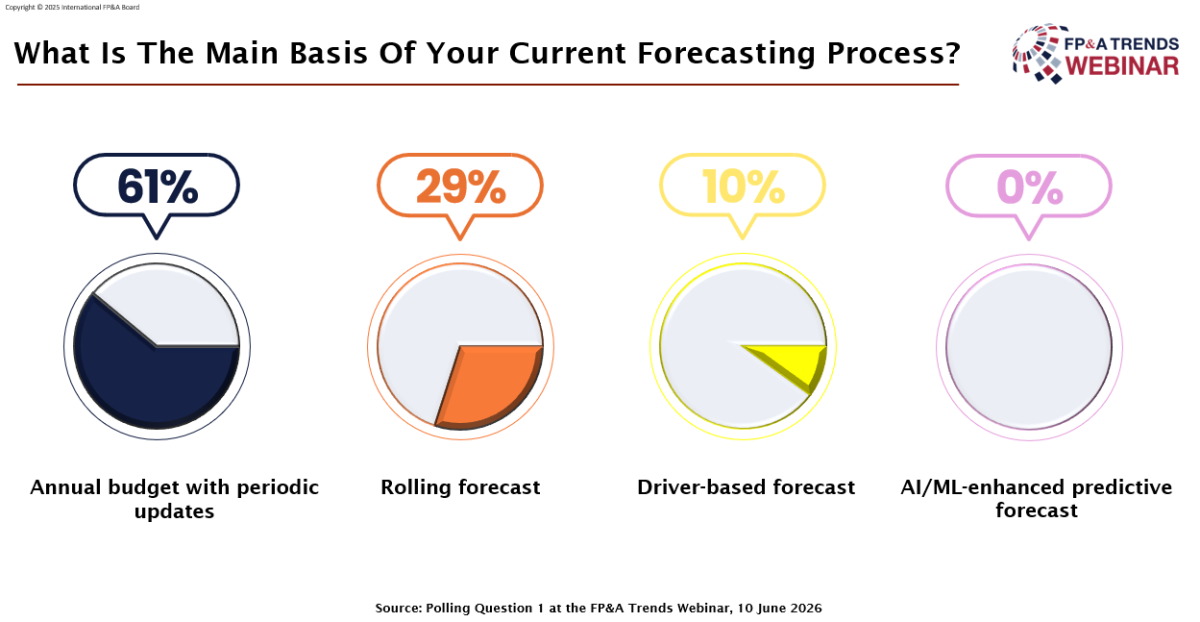
Figure 1
From Excel Drivers to Agentic Planning
Vignesh Dumonceau, CFO at WAGO Contact SA, expanded the discussion from driver-based forecasting to strategic velocity. His central argument was that modern finance is moving from a reporting function to a continuous orchestration engine. FP&A’s mandate is no longer only to document the past. It is to help the business sense change, reason through options, and act before financial outcomes deteriorate.
Vignesh described the evolution from traditional run-rate forecasting to driver-based orchestration. A simple sales forecast might begin with last year’s monthly revenue, a price increase, and judgmental adjustments. A driver-based forecast goes deeper by breaking revenue into volume and price, then analysing how those drivers behave by geography, product, customer group, and market context. This deepens causal analysis and brings finance closer to the business reality behind the numbers.
The next step is agentic planning. In this model, drivers are not maintained manually in isolated spreadsheets. Instead, AI agents continuously monitor, refresh, validate, and improve the drivers. A volume agent might detect changes in demand. A capacity agent might assess the operational impact. A headcount agent might calculate staffing implications. Together, they create an orchestration loop that moves finance from fragmented spreadsheet updates to a more integrated dialogue about scenarios, risks, and decisions.
Vignesh illustrated this with the example of under-absorption. When volume falls over a fixed-cost base, unit economics can deteriorate quietly. In a traditional Excel process, the damage may only become visible once profitability and cash flow have already been affected. In an agentic model, AI can detect divergence earlier, assess whether the volume change is structural or cyclical, and recommend actions such as redeploying capacity, adjusting inventory, or initiating a pricing discussion.
The real-life impact described in the webinar was significant. In a Retailco case study, the assumption refresh moved from three to five days per cycle to under two hours, with AI-enabled autonomous refresh. Forecast accuracy improved from a MAPE of 12–15% to 5–7%, representing roughly a 50% error reduction. Manual FP&A time spent on driver refresh and validation fell by 95%, while the data-to-decision window reduced from 30 days to under 48 hours.
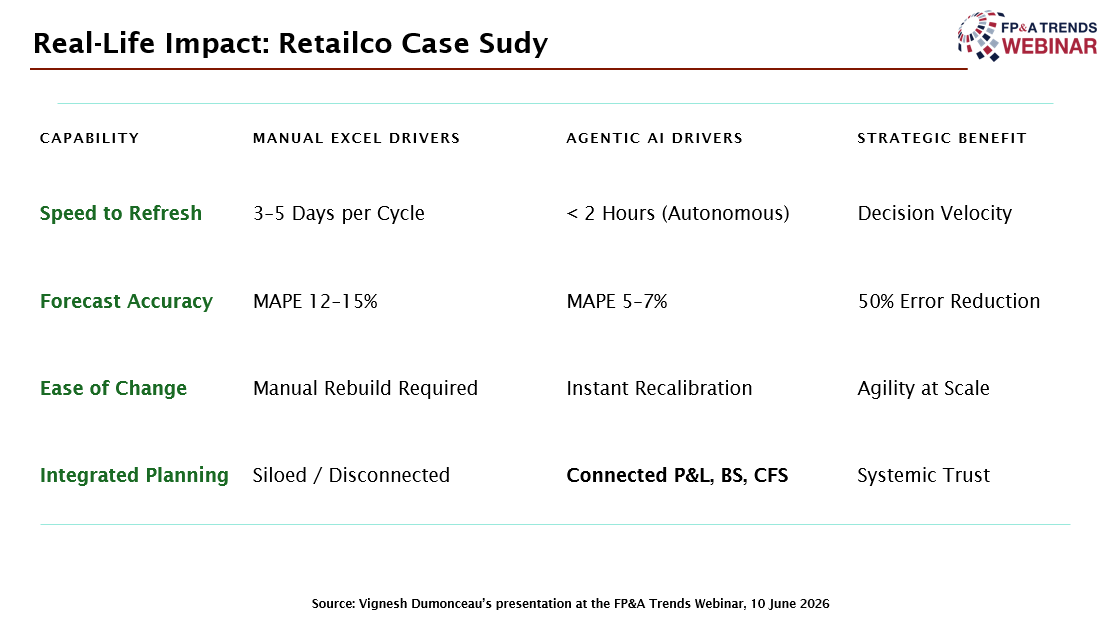
Figure 2
The broader implication is that the role of FP&A business partnering changes. Instead of presenting static reports, finance can enter a richer dialogue with the business: what is changing, why it matters, what actions are available, and how each option affects the P&L, balance sheet, cash flow, and strategic priorities. As Vignesh put it, AI-enriched business partner dialogue becomes the new reporting.
Poll Results: Planning Drivers Are Still Managed Manually
The second polling question asked:
“How are planning drivers primarily managed in your organisation today?”
The results showed that manual methods still dominate. 51% of respondents manage planning drivers manually in spreadsheets, while 46% use partially automated planning systems. Only 4% reported centrally governed driver models, and no respondents selected AI-supported or agent-assisted driver management.
This result is especially revealing because it shows that many organisations are in transition. Nearly half have moved beyond purely manual spreadsheets into partially automated planning systems, but very few have reached a governed driver model where assumptions are consistently owned, maintained, and connected across the enterprise. The absence of AI-supported or agent-assisted driver management also confirms that agentic FP&A remains more aspirational than standard practice today.
For FP&A leaders, the practical takeaway is not to dismiss the ambition, but to sequence it carefully. A team cannot jump straight from disconnected spreadsheets to autonomous driver orchestration. It first needs common definitions, clean data, accountable driver owners, and an operating rhythm that connects finance with sales, operations, procurement, HR, and supply chain.
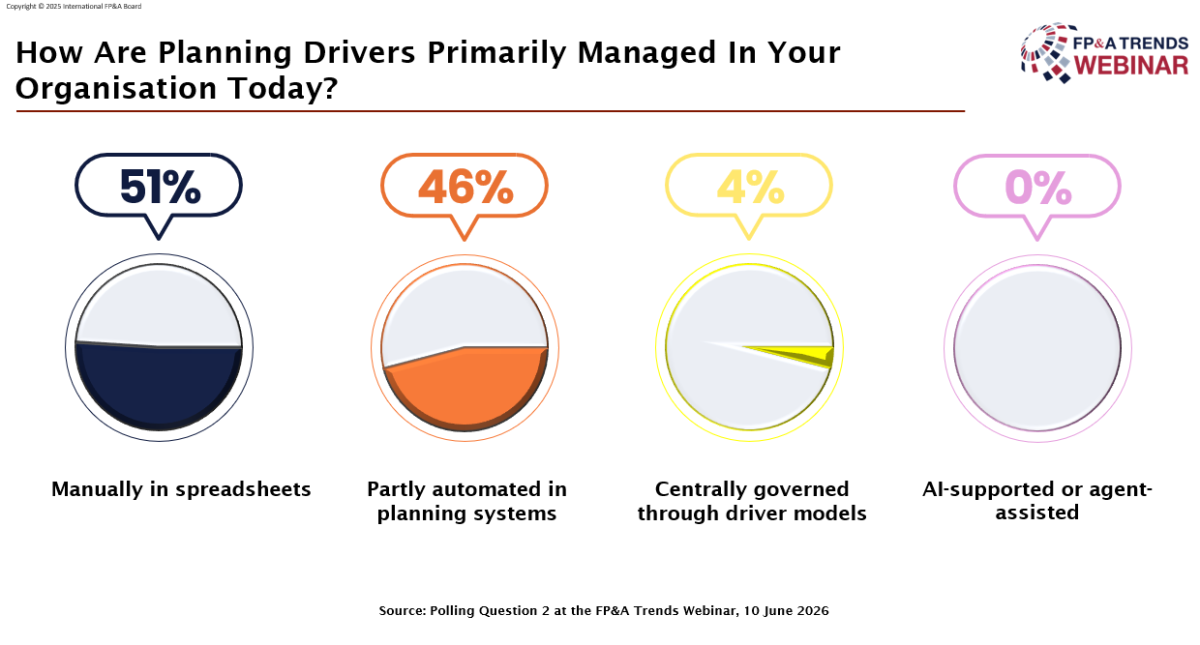
Figure 3
Practical Adoption of AI in Driver-Based Planning
Graham Hunter, AI/ML Solution Architect at Wolters Kluwer CCH Tagetik, closed the speaker insights with a practical adoption framework. His first message was that driver-based planning has always involved transformation. Even before AI, implementing driver-based planning required changes to systems, processes, data ownership, and business partnering. AI adds powerful new capabilities, but it also introduces new risks, expectations, and enablement gaps.
He identified several challenges that organisations need to manage. Accountability is one: how much change will be required in systems and processes? Transparency is another: business teams may ask whether they need to give finance all their data. Integration also raises questions about time, money, ownership, and which budget covers the work. Finally, agility itself can become political because faster planning can expose misalignment, latency, and conflicting assumptions across functions.
Graham recommended two simple but powerful recipes for getting started. The first is the minimum viable product mindset. Rather than designing the perfect end-state model, finance should ask: what is the minimum we can deliver that creates measurable value and allows us to gather feedback? The second is a crawl, walk, run roadmap. The “crawl” stage should be specific and near-term; the “walk” stage should describe the next logical expansion; and the “run” stage should remain deliberately high-level to avoid overdesigning too early.
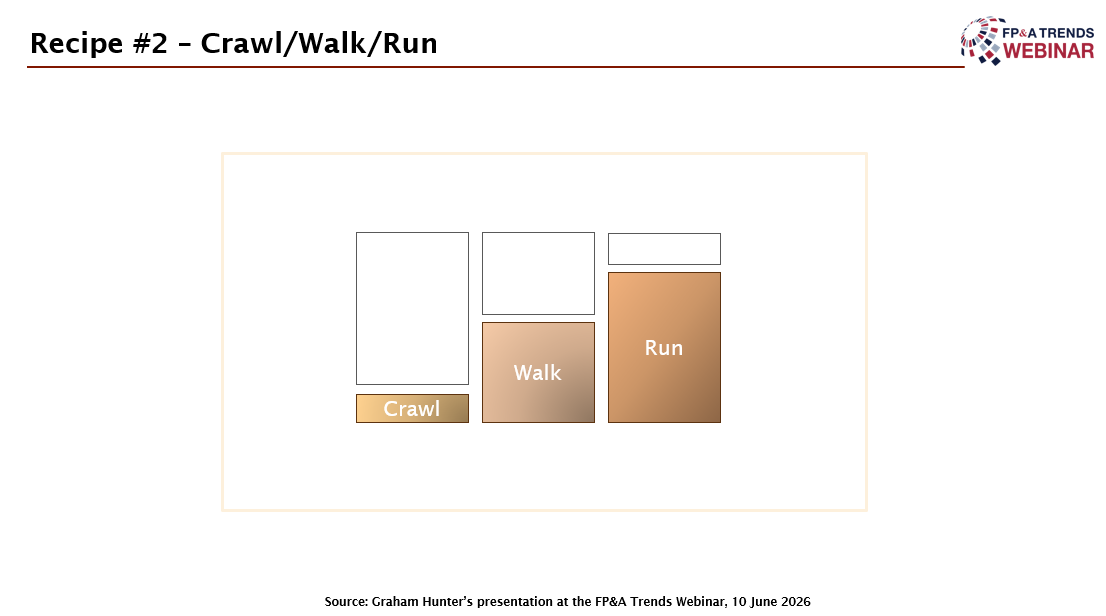
Figure 4
A practical “crawl” example is a simple revenue projection. Finance can start with monthly general ledger summaries, run a basic machine learning prediction such as linear regression, and add selected input variables to forecast the year-end income statement. Graham noted that in some pilots, this simple approach came within two to three per cent of actual results. It is not a multi-year strategic model, but it helps finance teams learn quickly and build confidence.
A “walk” example is integrated revenue planning. CRM systems often contain a wealth of data that can improve revenue forecasting. AI can support stage validation, win prediction, slippage risk, health scoring, and anomaly detection. For example, if a sales representative assigns an 80% probability to a major deal, an algorithm can challenge the assumption based on whether the buyer has been identified, a quote has been issued, or similar deals have historically converted at that stage.
The “run” stage is a broader reference architecture. This brings together sales, HR, operations, R&D, customer data, IT, marketing, macroeconomic indicators, vendor information, weather, finance variables, transactional systems, data integration platforms, AI/ML foundations, and CPM platforms. The goal is not technology for its own sake. It is predictable revenue, predictable spend, planning agility, and a finance function that becomes genuinely strategic.
Conclusion
The central takeaway from the webinar was clear: driver-based planning in the age of AI is not only a technical upgrade. It is a shift in how organisations understand performance, assign accountability, and make decisions.
The journey starts with foundations: clean metadata, consistent data structures, meaningful P&L buckets, strong driver ownership, and non-financial operational data. From there, AI can help identify hidden relationships, refresh assumptions faster, detect early warning signals, and support more dynamic scenarios. However, AI will not compensate for weak business logic or unclear ownership. It will amplify the planning model that already exists.
For FP&A professionals, the opportunity is to move from explaining variances after the event to shaping business decisions before outcomes are locked in. The practical advice is to start small, prove value, run old and new methods in parallel where useful, and build towards a future where finance is not only reporting performance, but actively orchestrating it.
To watch the full webinar recording, please check out this link.
Thank you, Wolters Kluwer CCH Tagetik, for sponsoring the webinar.
The full text is available for registered users. Please register to view the rest of the article.
Related articles
Driver-Based Forecasting in FP&A: Common Pitfalls and Practical Solutions
In this article, we explore how driver-based forecasting differs from consolidation, why it enables more meaningful...

In this article, Tanbir Jasimuddin reflects upon a recent London FP&A Board meeting where Agile FP&A...

In this article, the author outlines how customer returns can profoundly impact financial forecasting and reveals...

In this article, the author reveals four forecasting hacks that can help us enhance business value...

AI improves FP&A efficiency, but real value still depends on human judgment, business context, and accountability.
+
Subscribe to
FP&A Trends Digest

We will regularly update you on the latest trends and developments in FP&A. Take the opportunity to have articles written by finance thought leaders delivered directly to your inbox; watch compelling webinars; connect with like-minded professionals; and become a part of our global community.