

AI fluency is becoming a critical FP&A skill. Learn how finance teams can build capability across...

FP&A Business Partnering: From AI-Enabled Capacity to Business Impact
November 25, 2026
AI can help FP&A teams get to the numbers faster. So, what should they do with the time they get back? At the FP&A Trends webinar “FP&A Business Partnering in the Age of AI” on 28 October 2026, the speakers made a case for spending more of it with the business, while there’s still a chance to shape a decision.
The webinar opened with two questions from the FP&A Trends Decision Imprint Matrix.
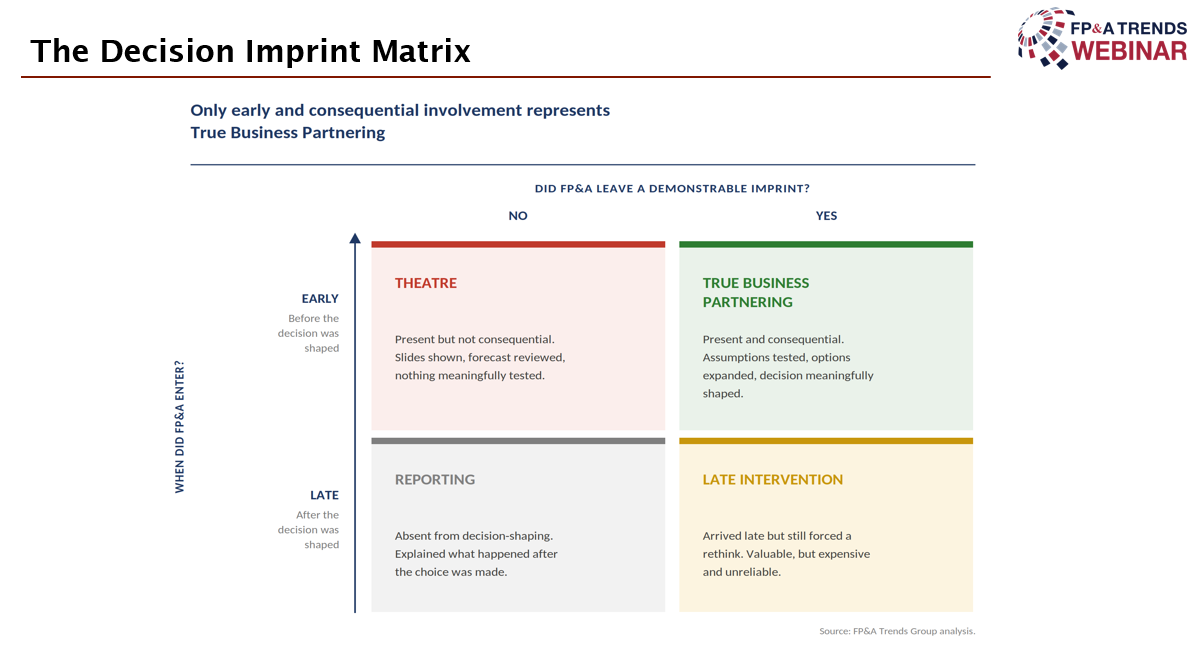
Figure 1
When did finance get involved, and what changed because it was there? The earlier finance joins the conversation, the more room it has to test an assumption, suggest an option or help the business think through a trade-off.
Start With the Decision
Harsh Amarasuriya, Global Head of FP&A, Finance Transformation and Data Strategy at Clyde & Co, looked at how the role has changed. Finance teams used to spend much of their time reporting what had happened. Over time, they took on more of the work of explaining the numbers and challenging the assumptions behind them. AI can now do some of the legwork involved in pulling the numbers together and running scenarios. That gives finance more time to work out which scenarios are worth exploring.
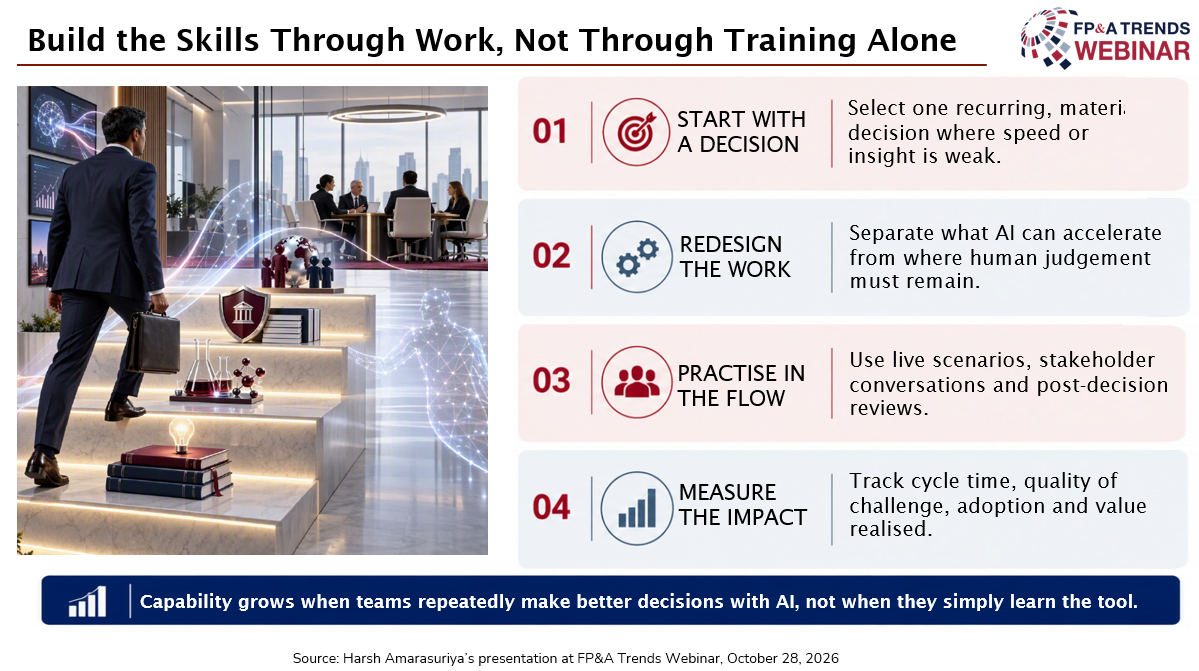
Figure 2
Harsh gave an example from professional services. The way people at different levels spend their time can make a real difference to margins. Finance can model that more quickly and see sooner whether a change has helped. The place to start is with the decision itself. What are we trying to work out? What would we need to see to change our minds?
That takes a good understanding of both the data and the business. Where did the numbers come from? Does the result fit with what people are seeing on the ground? And if a scenario looks plausible, would it actually change the decision? Harsh pointed out that the ability to run more scenarios makes those questions more important. Someone still has to decide which possibilities deserve the business’s attention.
Harsh suggested starting with a decision the business makes regularly. Work through a real example with the people who will use the analysis, check what the AI comes back with, and see what happens once the business acts. He recalled building Power BI reports on his own earlier in his career. Looking back, he saw how much better it would have been to involve the people using them while there was still time for their input to shape the work.
It’s easy to move straight on to the next forecast. Harsh encouraged teams to take a moment to look back. Did finance bring a new option into the discussion or challenge an assumption that mattered? Did the team reach a decision sooner? Once the decision was made, did performance change in the way people expected?
The first poll asked attendees where their teams sat on the FP&A Business Partnering Maturity Model. The most common answer was developing (45%), followed by defined (21%), basic (18%), advanced (13%) and leading (3%). Harsh made an interesting observation about those results. As the tools improve, teams can see more clearly where they could do better. That can change how they rate their own progress.
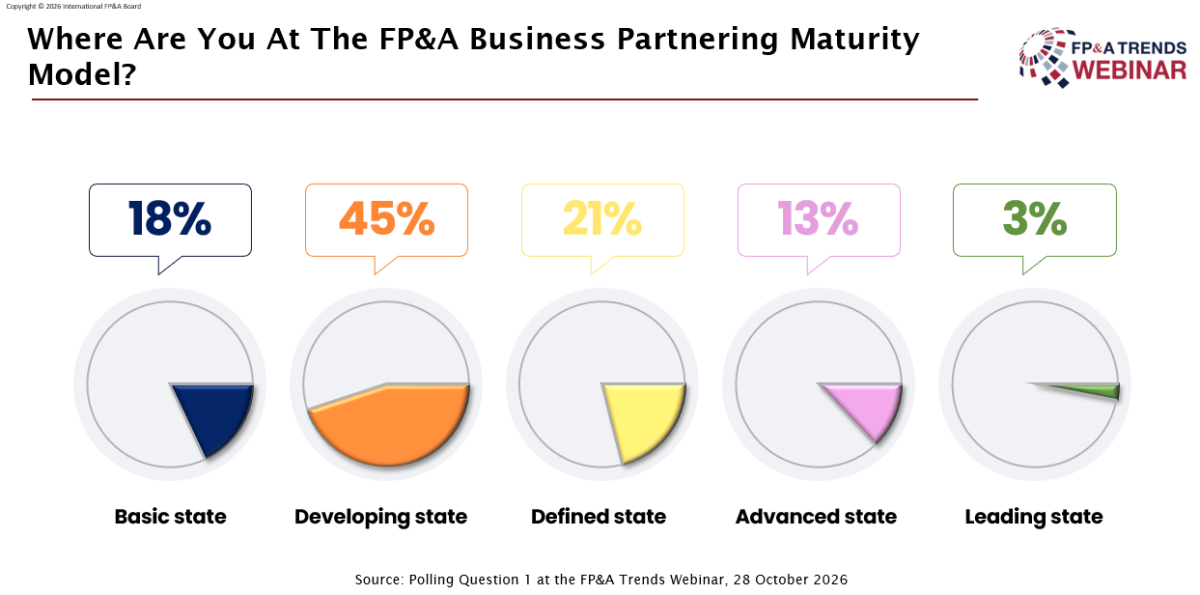
Figure 3
Getting Into the Conversation Earlier
Henning Rehmstedt, Head of Commercial Finance at Michael Page, talked about how finance earns a place in those early conversations. His advice was to get to know people before you need their backing. Take an interest in how their part of the business works and build a reputation for doing what you say you’ll do.
There’s also a knack to picking the right moment. A well-prepared proposal can get lost if someone is just out of a board meeting or dealing with an urgent problem. Henning mentioned a group of people who can help here. The people who manage senior leaders’ diaries often have a good sense of when a conversation will get a fair hearing.
When the conversation happens, keep the case simple. Explain the problem, what a change could be worth and which options are open. Henning’s advice on board papers was equally practical. Put the few numbers that matter in the main paper and save the supporting detail for the appendix.
It’s worth thinking about the next meeting, too. If leaders agree to go ahead, how will they know whether the change worked? Henning suggested carrying the measures from the original case into the follow-up, so everyone can see how the result compares with what was promised.
Henning summed up his approach in four parts. He focused on trust and relationships, timing, storyline and simplicity.
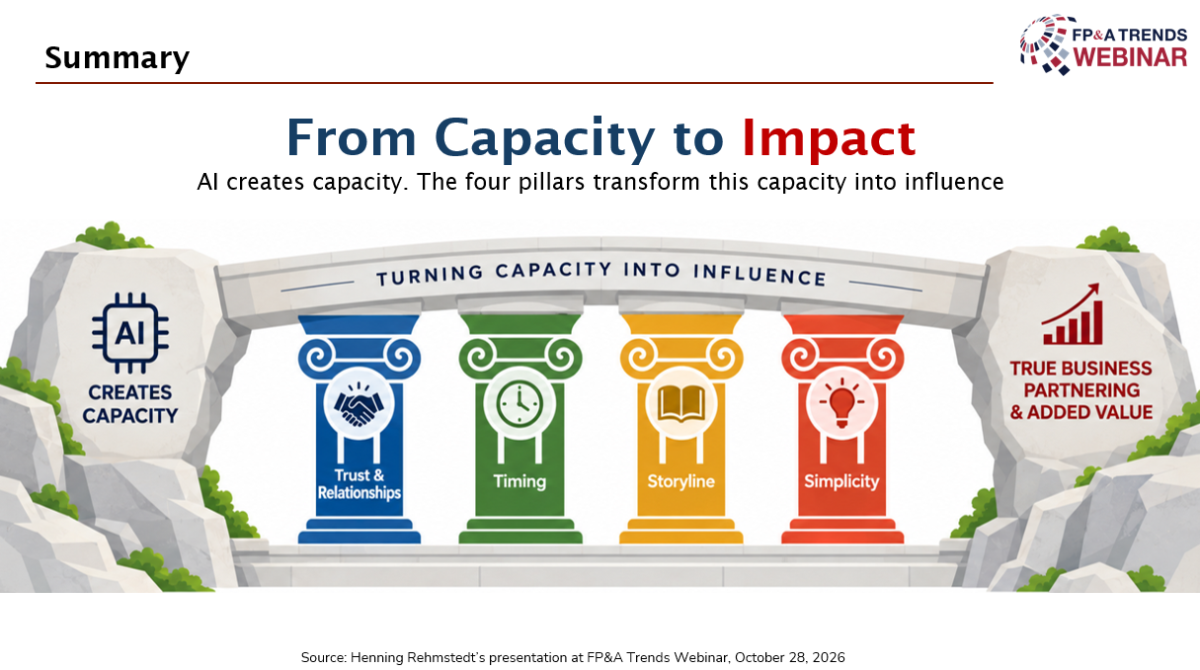
Figure 4
The second poll asked which FP&A skill would still depend most on people as AI use grows. Stakeholder management and relationship building came first. Strategic thinking and decision-making drew 25% of responses, innovation and creative problem-solving 12%, and communication and storytelling 10%. That result fits with Henning’s advice. The more time finance spends with the people running the business, the more likely it is to hear about a decision early enough to help.
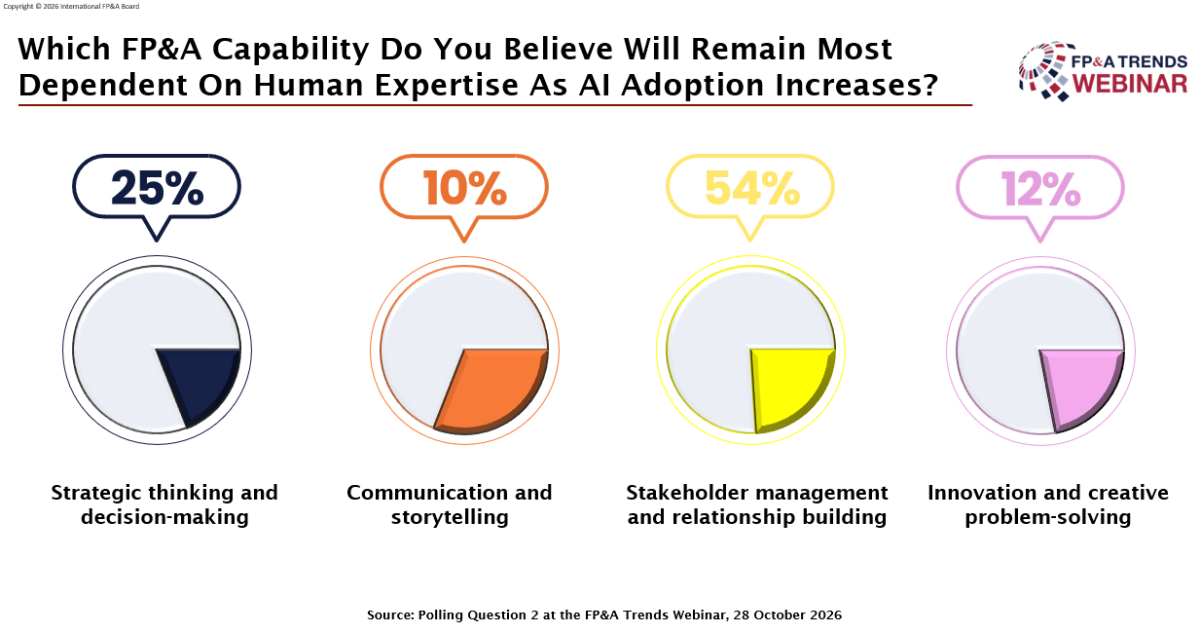
Figure 5
From Planning to Continuous Decision Making
Yan Lau, Finance Strategy and Transformation Director at Anaplan, picked up the discussion with a question. What happens once the plan has been agreed? Markets keep moving, and finance teams can spend a good part of the time between reviews reconciling inputs and checking assumptions. By the time everyone agrees on what has changed, some options may already have gone.
His second slide showed how that could work differently. In a traditional planning cycle, each function works from a snapshot, and decisions often happen away from the planning tools. Yan described teams using fresh information to update scenarios together and weigh their options in the tools they already use. Think of a change in the sales outlook. Finance can sit down with the teams affected and work through what it might mean for costs and staffing before anyone commits to a response.
For FP&A, there’s a practical difference between refreshing a forecast and talking through what the new numbers mean with the people who have to act on them. Putting live data and scenarios into the same workflow gives teams a shared starting point. They can see where one department’s assumptions affect another and discuss what to do while there’s still time to act.
AI agents could help with the work of gathering inputs and running scenarios. Yan’s point was that those agents need shared data and agreed calculation rules, so finance can follow the numbers back to their source. People still need to decide whether the assumptions make sense and what to do with the result.
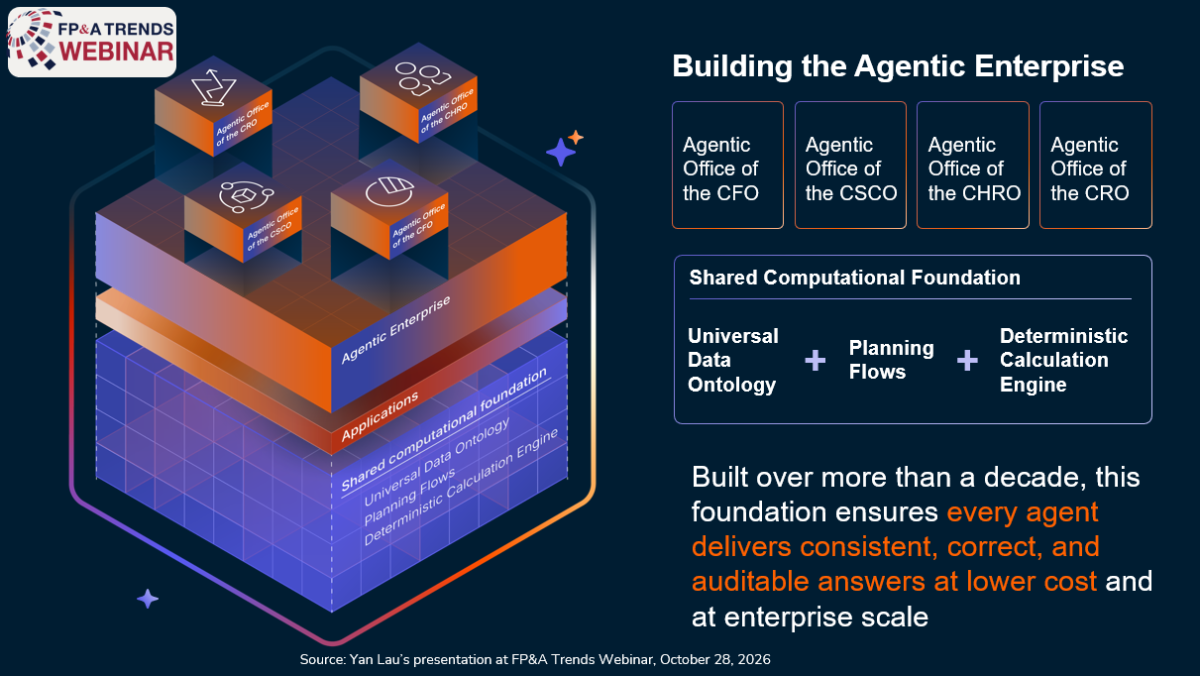
Figure 6
Yan closed with three questions about trust. Do people trust the answer, do they trust the controls, and what will help them build confidence through use?
He described giving the language model and the calculation engine different jobs. The model helps interpret the question. The engine does the maths using agreed rules, so finance can check how the answer was worked out. Yan also stressed that people need to know which data an agent can use and who is responsible for checking its work.
His advice was to start with a task people already know well. They’ll have a feel for when a result looks wrong and whether the tool is saving any time. Once they’ve seen it work in a familiar setting, they’ll have a better idea of where else it might help.
Conclusion
There were four things FP&A teams could take back to their own work.
Choose a decision that comes up regularly and agree with the business what it needs to know before making it.
Spend some of the time saved with the people making the decision. Find out what they’re weighing up before preparing the numbers.
Give AI a clear task, use data the team trusts and agree who will check the result.
Go back to the decision once it’s been made. See what happened and ask what the team would do differently next time.
We would like to thank Anaplan for sponsoring the event.
The full text is available for registered users. Please register to view the rest of the article.
Related articles

Kevin Phillips explains why AI-driven planning still needs human debate and named owners for critical assumptions.

Suneet explains how AI-assisted contract review helps finance business partners uncover overlooked financial obligations and ask...

A practical Lean Finance framework for reducing complexity and reallocating FP&A capacity towards higher-value decisions.

How FP&A can make mid-year budget reallocation faster, evidence-based and less political by agreeing the rules...

Effective scenario planning starts by defining the business decision before Finance builds the model.
+
Subscribe to
FP&A Trends Digest

We will regularly update you on the latest trends and developments in FP&A. Take the opportunity to have articles written by finance thought leaders delivered directly to your inbox; watch compelling webinars; connect with like-minded professionals; and become a part of our global community.