

In this article, the author explains three key strategies for fostering a data-driven culture in your...

Dashboards Aren't Dead: FP&A Needs Them, and This Is Why
April 7, 2026
 The End of Dashboarding?
Management dashboards receive a lot of criticism lately. The main weakness, as critics point out, is that most dashboards cannot support decision-making directly. They might look good and provide some level of information, but they often require manual updates, and their oversimplification of business logic makes them incapable of providing meaningful decision-making support. The list goes on, as do the conclusions. Some even say that a chart that drives no decision should be deleted.
These are valid concerns, and as a user and creator of several financial dashboards, I’m well aware that many are used simply for reporting purposes rather than for decision support. And once management gets the taste, quantity often overwhelms quality, and you end up with lots of colourful charts that don't increase clarity but block it. However, I wouldn't be so quick to give dashboards the cold shoulder; I would even go further to argue that dashboards are important assets to FP&A, even if they don't directly support decision-making.
Let me explain.
The Data Analytics Marathon (© Brent Dykes)
The importance of data-driven decision-making in finance and FP&A cannot be overemphasised. There are tons of publications out there supporting it, and an army of finance professionals is advising this on your LinkedIn wall every day (if you work in the field). But when you look into the actual daily work of FP&A, it turns out that data-driven decision-making accounts for only a small part of these teams’ time. The lion's share of the issues concerns core deliverables: unreliable and inconsistent data, timely reporting, incorrect or unstructured master data, and a lack of organisational support.
Among others, FP&A Trends Group has conducted numerous surveys on the topic, and the results are quite clear. According to the 2025 FP&A Trends Survey, while data-readiness across FP&A teams is gradually improving (data-driven decisions increased by about 10% from 2024 to 2025), significant structural challenges remain. Despite this progress, much of FP&A’s effort is still absorbed by foundational activities, with teams spending, on average, about half their time on data collection and validation, rather than value-added activities.
Other external research further highlights the scale of this complexity. For example, the 2025 AFP FP&A Benchmarking Survey shows that spreadsheets continue to dominate planning and reporting processes, with nearly all organisations relying on them regularly. It also indicates that half of them have to work through 8-10 different data sources and reporting systems to get what they need.
In such an environment, it is perhaps not surprising that, as highlighted in the FP&A Trends Survey, only about 20% of companies operate with a single, structured data source, and just one-third of FP&A work time is dedicated to driving actions and generating insights.
For most organisations, building data-driven decision-making capabilities does not happen overnight. It is a gradual journey that starts with improving the fundamentals of data and reporting.
It's About the Journey
When starting a BI project with a management dashboard on the horizon, you often aim to reduce the remaining two-thirds to arrive at a dashboard that visualises financial metrics in an understandable, clear way, with data that is accurate, comparable, and filterable. This journey includes several preparation steps that bring you closer to a data-driven FP&A function.
- You structure transactional as well as master data, and review your data management disciplines
- You think about core KPIs and how best to visualise them
- You collaborate with other business areas, make FP&A more visible and accessible for the whole organisation
One example, I frequently cite on the data analysis journey, and the importance of dashboards in it, is an analysis model that we’ve designed for a European sales office of a consumer electronics company. The dashboard visualises departmental operational costs, decomposes them into cost categories (to see their contribution), links them to FTE data for analysis, and compares them with previous periods and planning data.
The journey that led to this model is also a good example of the above-mentioned work on the fundamentals, showing how we move from setting objectives in accordance with management needs to implementing the results into business processes.
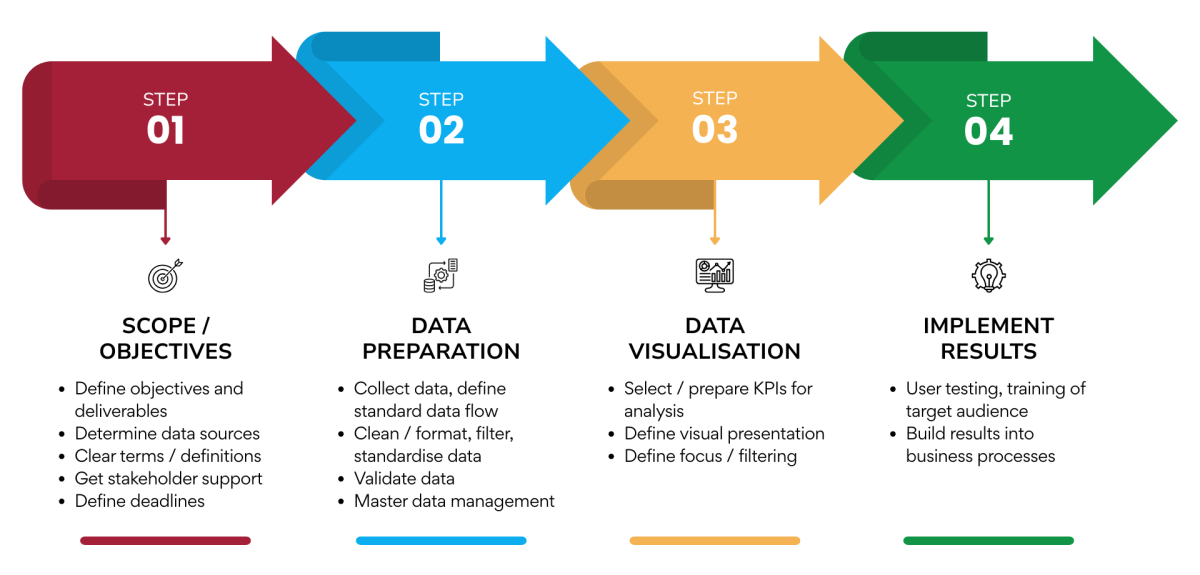
Figure 1. A Four-Step Journey to Building Effective FP&A Dashboards
At the end, the path that resulted in a detailed analysis dashboard forced the organisation to review its processes and master data management. It saved dozens of work hours per month, made periodic reporting a structured routine that freed up resources for more value-added activities, and fostered collaboration not only in FP&A but across the company, from front to back office.
So, the conclusion is that yes, in some cases, a dashboard is indeed not more than a reporting tool, helping you with your monthly management review meeting. But no dashboard is ever “complete”, most of them evolve over time. Visualisation helps FP&A to identify more specific needs, shows underlying trends, and fosters open communication within the organisation. They frequently go hand in hand with a process automation project that shortens update times, increases accuracy, and democratises data.
Aren't these, by themselves, values that all of us embrace?
Sources:
1. FP&A Trends Survey 2025, From Ambition to Execution: How Leading FP&A Teams Turn Insights into Impact
https://fpa-trends.com/fp-research/fpa-trends-survey-2025-ambition-execution-how-leading-fpa-teams-turn-insights-impact
2. FP&A Trends, 2024 FP&A Trends Survey Results Unveiled
https://fpa-trends.com/article/2024-fpa-trends-survey-results-unveiled
3. FP&A Trends, 2025 FP&A Benchmarks and Trends
https://fpa-trends.com/article/2025-fpa-benchmarks-and-trends
4. FP&A Trends Insights Paper 2024, Top Five Trends Shaping FP&A in 202 and Beyond
https://fpa-trends.com/fp-research/fpa-trends-insights-paper-top-five-trends-shaping-fpa-2025-and-beyond
5. Brent Dykes, The Data Analytics Marathon
https://www.brentdykes.com/post/the-data-analytics-marathon
6. AFP (Association for Financial Professionals), 2025 FP&A Benchmarking Survey Report: Technology and Data
https://7185359.fs1.hubspotusercontent-na1.net/hubfs/7185359/Research%20Surveys/SURVEYS/2025%20AFP%20FP%26A%20Benchmarking%20Survey%20Report.pdf
The full text is available for registered users. Please register to view the rest of the article.
Related articles

This article explores frameworks for developing FP&A dashboards and tells us how FP&A professionals can design...

In this article, the author explores how the evolution of dashboards and AI-powered business intelligence mirrors...

In this article, the author covers the importance of establishing a Reporting Factory within an organisation...

The promise of global dashboards is simplicity — one version of the truth. But truth without...
+
Subscribe to
FP&A Trends Digest

We will regularly update you on the latest trends and developments in FP&A. Take the opportunity to have articles written by finance thought leaders delivered directly to your inbox; watch compelling webinars; connect with like-minded professionals; and become a part of our global community.