

Planning has always involved uncertainty. What has changed is the speed at which a sensible forecast can become stale. That tension sat at the heart of the FP&A Trends webinar "From Reactive to Proactive FP&A: Real-Time Scenario Planning", held on 21 July 2026.
The opening data gave the discussion some urgency. Only 29% of organisations in the 2026 FP&A Trends Survey could plan beyond six months. Just 5% could produce a forecast on demand, and only 19% could run a scenario in real time or in less than a day. The window for prediction is getting shorter, but the machinery of planning is not speeding up at the same rate.
Elena Perron of Yelp, Rohit Gupta of Philip Morris International and James O'Leary of Anaplan approached the issue from different positions. Their common thread was practical: proactive FP&A is not another reporting layer. It is a way of organising decisions before the pressure arrives.
The Strategic Architect: Directional Accuracy over False Precision
Elena Perron, Vice President of FP&A at Yelp, described our role as moving from scorekeeper to navigator. Finance still has to explain what happened, but its greater value now lies in modelling what could happen and helping the business act before certainty is available.
That changes the standard for a good plan. In a volatile market, chasing 100% accuracy can become a form of delay: by the time the model is perfect, the market has shifted. Elena argued for directional accuracy instead, using the familiar 80/20 principle. An 80% answer today can be far more useful than a flawless answer next month if it gives leaders enough confidence to move forward.
Her case study came from Redfin, where a post-pandemic housing boom was followed by a sharp market freeze as interest rates rose. The company's detailed annual budget had previously been reliable, but a single consolidated view could no longer keep pace. FP&A first built segment-level visibility, including shared-cost allocations and segment-level net income, so leaders could see the operational levers behind the headline numbers.
The team then stopped presenting one supposedly precise future. Working with the internal economics team, it built bull, base and bear cases, each tied to business drivers and an agreed operational response. Board conversations moved away from debating a single number and towards agreeing on the signals that would trigger a change in hiring, spending, or capital allocation.
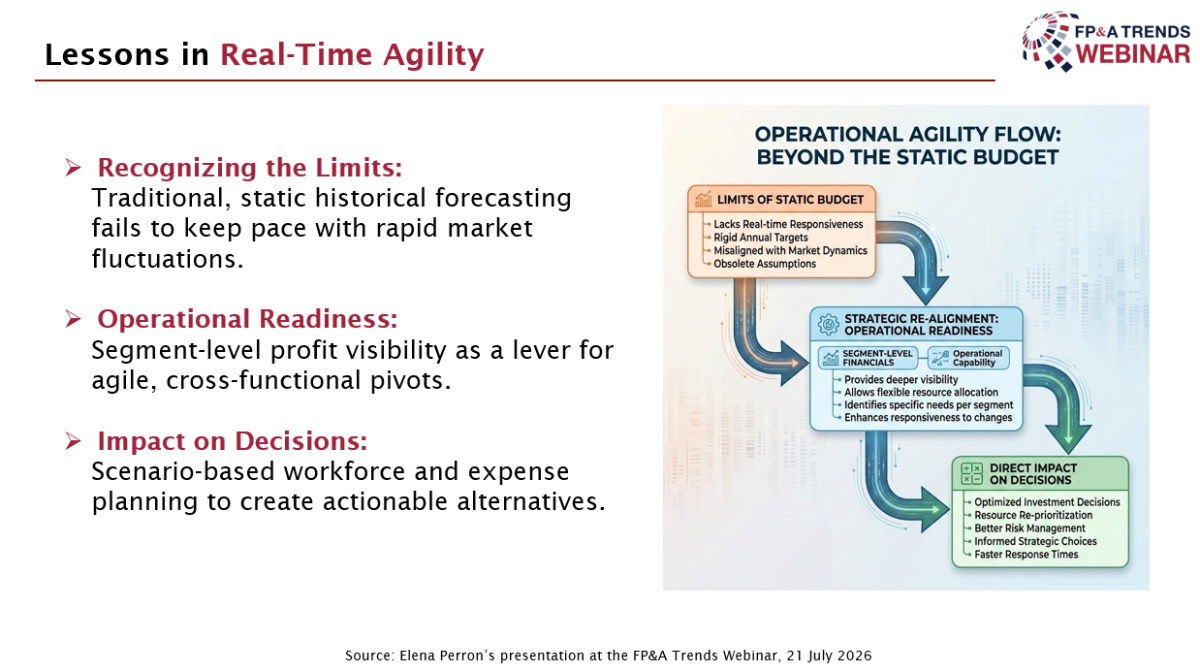
Figure 1
The practical benefit was speed. Because the responses had been discussed and approved in advance, the organisation could move from one playbook to another in days rather than weeks.
In our first polling question of the webinar, we asked: “How advanced is your Scenario Management?" The majority (52%) said they used Simple Excel-based scenario planning, and 24% used Excel-based and/or automated driver-based models. Only 11% use Multidimensional Scenario Management and 13% do not use Scenarios at all.
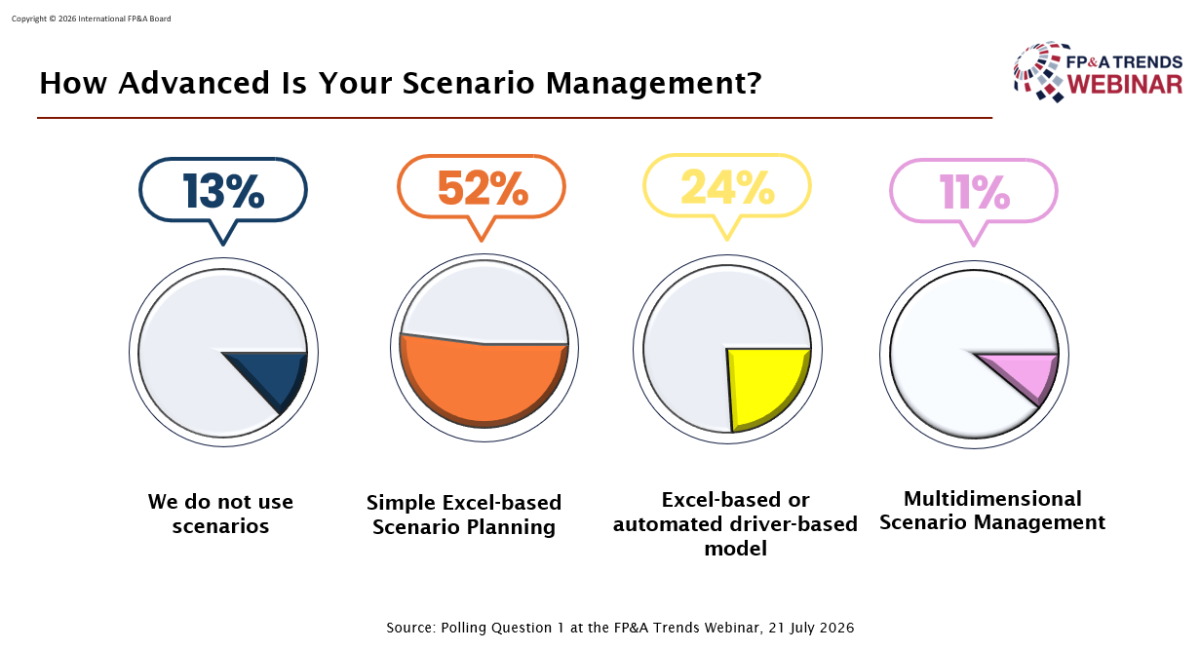
Figure 2
The main takeaway was that scenario planning is widely understood, but most organisations still execute it manually. Elena described automation as the key step towards faster, concurrent what-if analysis.
Real Time Scenario Planning in Action
Rohit Gupta, Head of Program Delivery - Global Supply Chain Inventory at Philip Morris International, picked up the same idea from an operating perspective. He traced FP&A's evolution from reporting, through business partnering, to decision intelligence. The shift sounds simple, but it requires finance to begin with a different question: not 'What data do we have?' but 'What decision are we trying to make?'
Rohit's example began with a request to assess year-end cash exposure arising from a geopolitical disruption. On the surface, it looked like an inventory calculation. Once the decision was framed properly, the real questions appeared: did cash mean inventory or net working capital; was the team considering only the worst case or also a normal depletion path; and which supply-chain planning assumptions were aligned with the latest forecast?
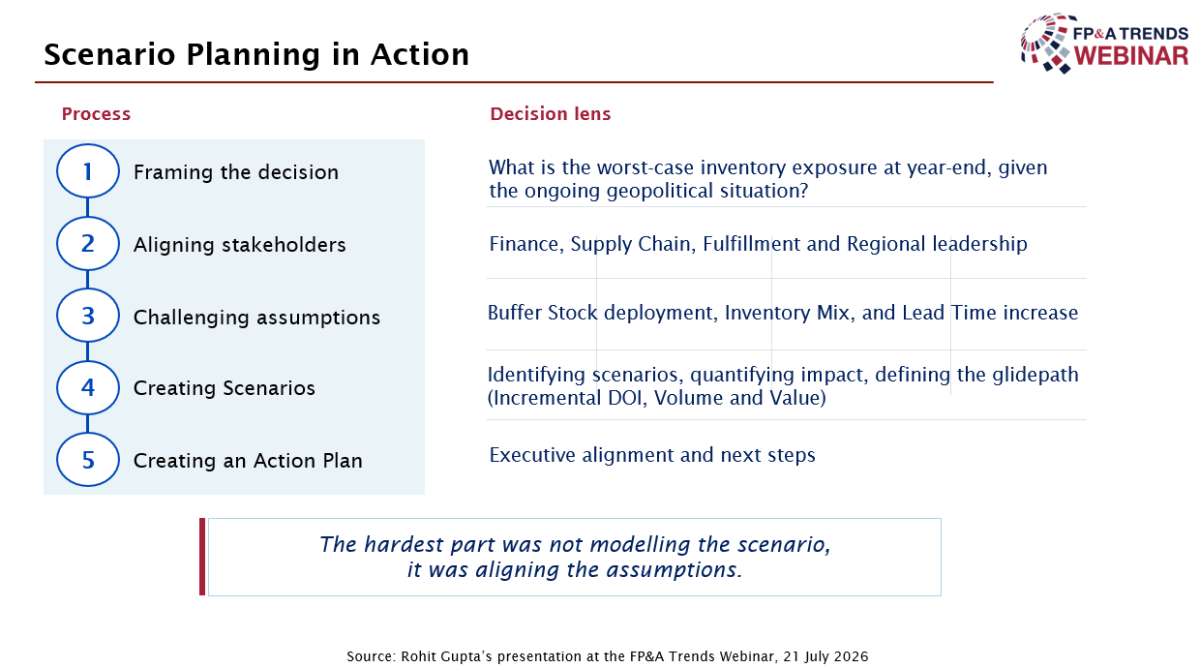
Figure 3
The work followed five practical steps:
- frame the decision
- align the right stakeholders
- challenge assumptions
- create scenarios
- agree an action plan
Finance, supply chain, fulfilment and regional leadership all had a role. The discussion covered buffer stock, inventory mix and longer lead times, then translated those assumptions into base and worst-case scenarios with a quarter-by-quarter glide path.
One detail captured the value of thinking first. Rohit received an Excel file containing 3,000 line items on potential lead-time changes. Because the team had already identified the relevant product categories, valuation basis and downside case, he could reduce the analysis to what mattered in about 15 minutes. The spreadsheet was not the hard part. As he put it, the hardest part was aligning the assumptions.
The second polling question was around the time it takes to run a scenario plan. 4% run it in real time, 28% in less than a day, 53% said a scenario took about a week or more to run and 15% could not run scenarios at all. Rohit's advice was not to wait for perfect technology. The biggest opportunity was with the 53% and how to get them to improve the Scenario Planning process. Rohit’s point of view was to start with the decision, bring the right people into the room and use judgment to define the triggers that move the business from one scenario to another.
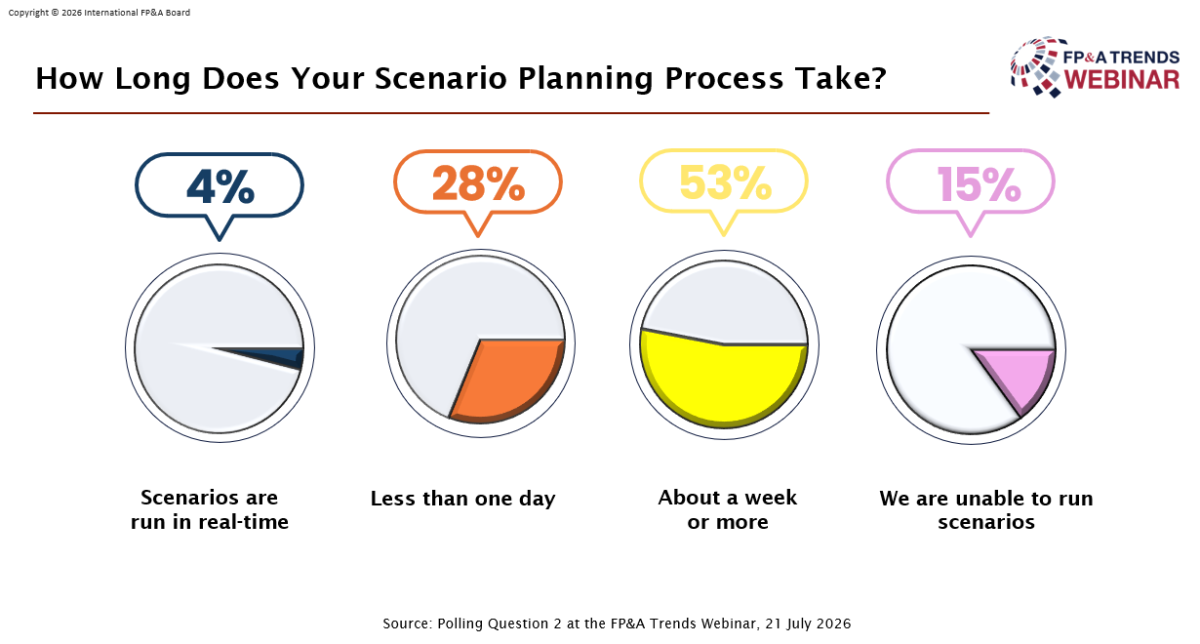
Figure 4
A Trusted Foundation for Faster Decisions
James O'Leary, Vice President of Customer Success at Anaplan, looked at what technology needs to do for those habits to work at scale. His phrase for the goal was 'decision excellence': bringing together good information, speed and the ability to execute with as little friction as possible.
The obstacle is familiar. Businesses are naturally siloed, processes grow around spreadsheets and individual know-how, and systems accumulate through acquisitions and years of change. James was blunt about it: business is messy. That mess slows planning inside each function and becomes an even larger barrier when finance needs to connect commercial, supply-chain, workforce and operational decisions.
A planning platform helps by encoding recurring processes and business logic, making them durable rather than dependent on a particular file or person. James used integrated business planning as an example: even small improvements in production, inventory, pricing or supplier terms can create material gains in revenue, working capital and margin.
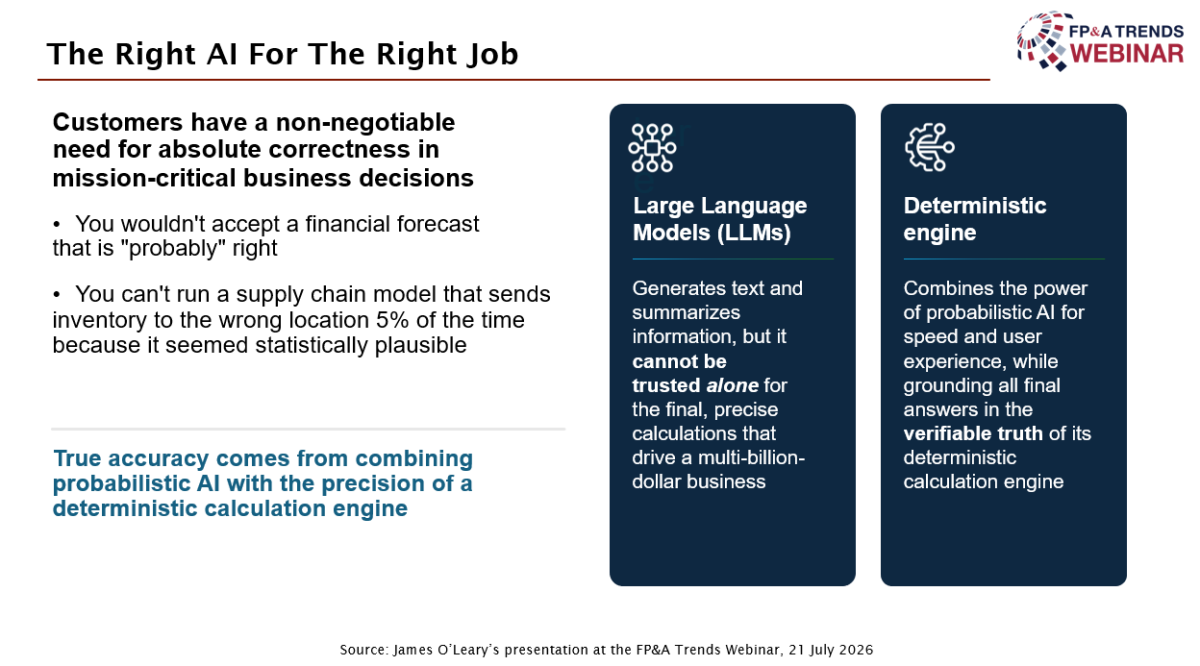
Figure 5
He also drew a necessary line between the two kinds of technology now being combined. Large language models are probabilistic: they interpret questions, summarise information and provide a natural interface. Mission-critical calculations need a deterministic layer underneath, built from trusted data and rules that return the expected answer every time. AI can then surface insight and generate scenarios without becoming the system of record.
Conclusion
The key conclusions of the session are summarised below:
Begin with the decision. Clarify the business question before gathering data or reopening a model.
Plan the response as well as the scenario. Agree the triggers, owners and operational playbooks while there is still time to think.
Treat alignment as part of the analysis. The difficult work is often reconciling assumptions across functions, not calculating the answer.
Measure speed to action. A scenario earns its value by shortening the distance from signal to decision.
Build AI on something finance can trust. Use probabilistic tools for interaction and acceleration, grounded in deterministic data and logic.
We would like to take this opportunity to thank Anaplan for sponsoring the event.
Subscribe to
FP&A Trends Digest

We will regularly update you on the latest trends and developments in FP&A. Take the opportunity to have articles written by finance thought leaders delivered directly to your inbox; watch compelling webinars; connect with like-minded professionals; and become a part of our global community.