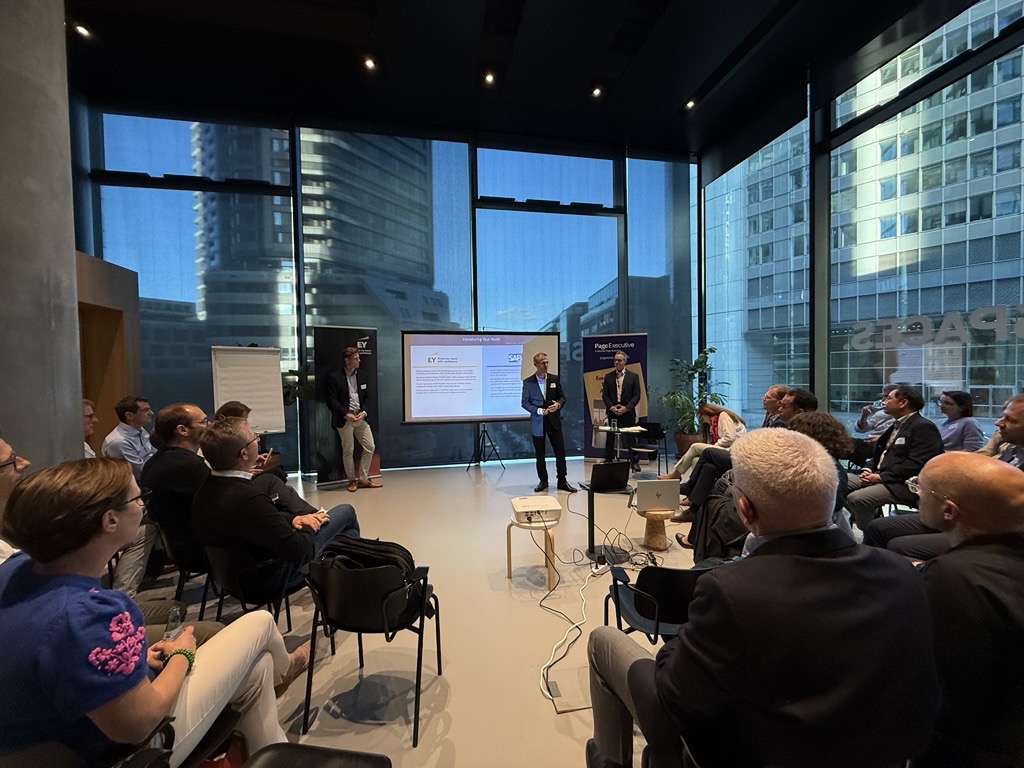

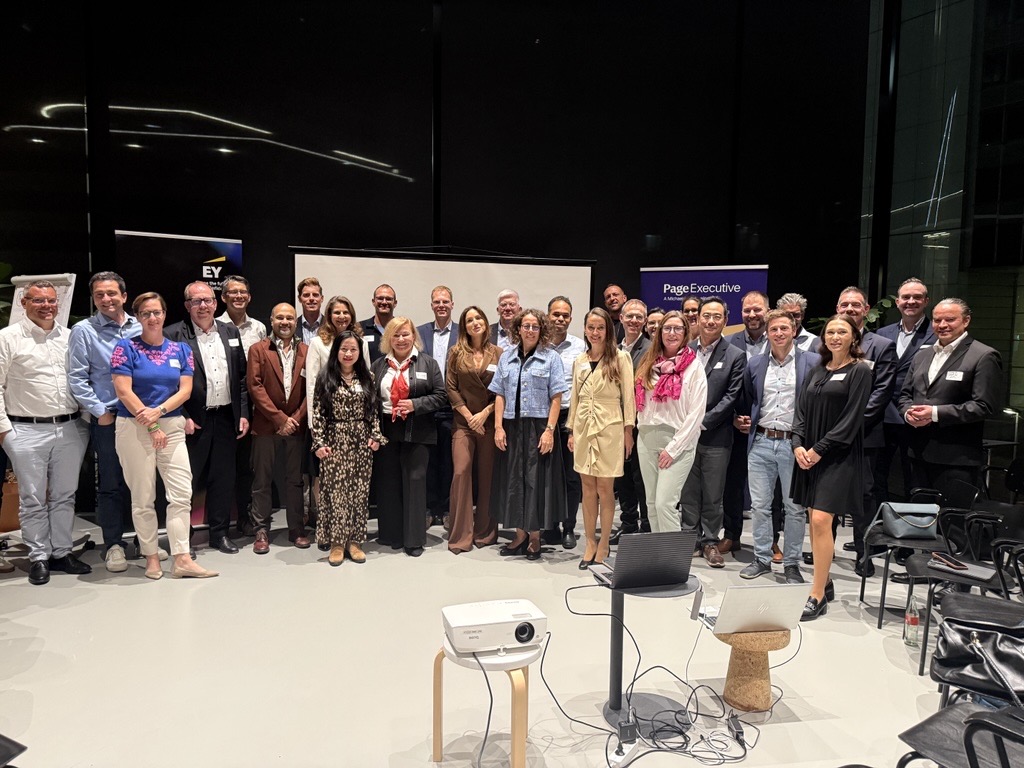
On 24 September 2026, senior finance leaders met at Spaces Omniturm in Frankfurt for the 11th Frankfurt FP&A Board and the 305th International FP&A Board meeting. The session, “Leading FP&A Change in the AI Era”, was facilitated by Larysa Melnychuk, CEO and Founder of FP&A Trends Group and the International FP&A Board. The event was sponsored by EY and SAP, with Page Executive and IWG as partners.
The timing gave the meeting an extra sense of perspective. The Frankfurt chapter was launched on 13 October 2016, so this discussion took place just weeks before its tenth anniversary. Much has changed in FP&A during that period, but the evening quickly showed that one challenge has remained stubbornly human: getting change to stick.
Relevance of Adoption Gap
The meeting opened with a simple question: in one word, what most often stops change from sticking? Participants answered: vision, attitude, leadership, glossary, execution, people discomfort, uncertainty, persistence, fear and habits. The one word that stuck in my mind and in everyone's in the group was “Glossary,” which, from a purely relevance perspective, is the most important in the current Adoption era of AI.
Why This Topic Matters
In an eye-opener and thought-provoking discussion, Larysa shared the results of The 2026 FP&A Trends Survey, displaying a transformation paradox where a whopping 47% of FP&A time still goes into data collection and validation and the percentage has not changed since 2020. That simply means that despite so many technological advancements, companies tend to struggle with data collection and validation due to number of reasons and that brought us to most pertinent question of “What must be in place before we start to adopt the change?”.
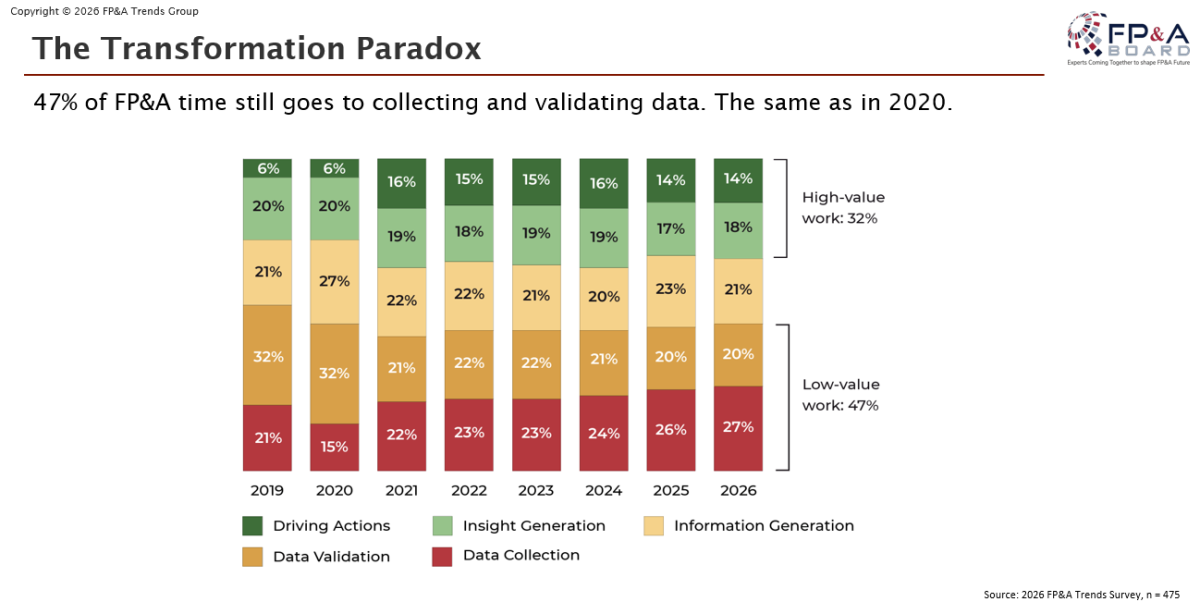
Figure 1
The “Tip of the Iceberg” chart below describes the best explanation. It is unanimously agreed across the group that adoption is far broader than what is visualised and paid attention to, which in turn confirms the rationale for why data collection and validation have not shifted since 2020, or why they still remain the key transformation paradox in the current AI era.
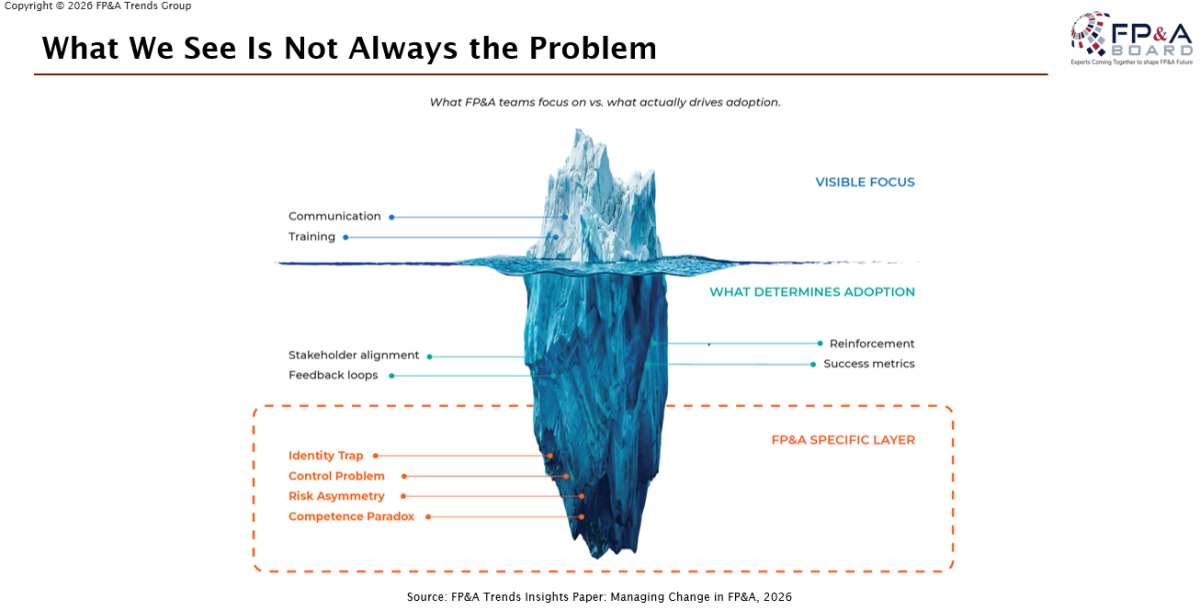
Figure 2
From Change Intent to Adoption
With us fully engaged in the discussion as we moved into the “change framework”, it was extremely interesting to explore why organisations fail during transformation and what is needed to take the leap and advance toward adopting effectively, embracing the change, and leaving the old behind.
Astonishingly, 75% of failures occur because organisations do not “enable people & their capabilities” to step into change execution and build confidence in their ownership and commitment.
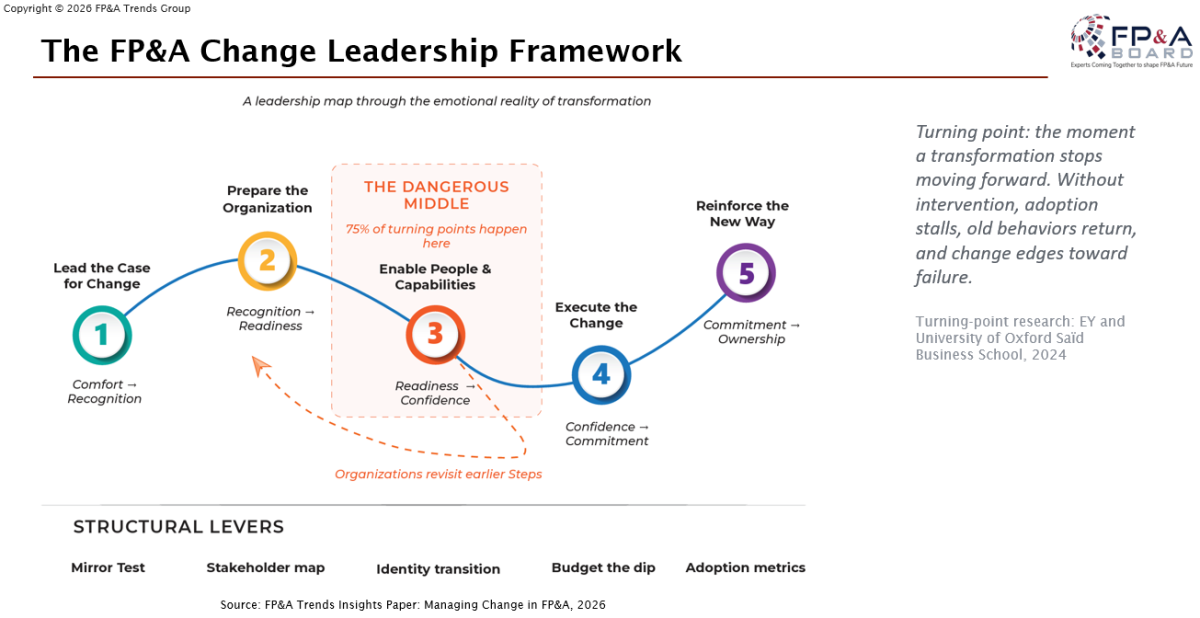
Figure 3
It is worth noting that 96% of transformations hit one turning point, and 75% of those turning points occur during the planning or early implementation phase. The research discussed at the meeting also showed that transformations are nearly 12 times more likely to come through stronger when leaders act early and systematically. This made the leadership role in the “dangerous middle” especially important.
AI made this discussion even more relevant. Cross-city FP&A Board polling from five meetings in 2025 found that 41% of respondents were not using AI in their Finance/FP&A function. The 2026 FP&A Trends Survey also found that 96% expect AI agents to be adopted eventually, but only 15% expect this within six months. This suggests that many organisations are still evaluating how AI should fit into Finance before moving at scale.
Implementation
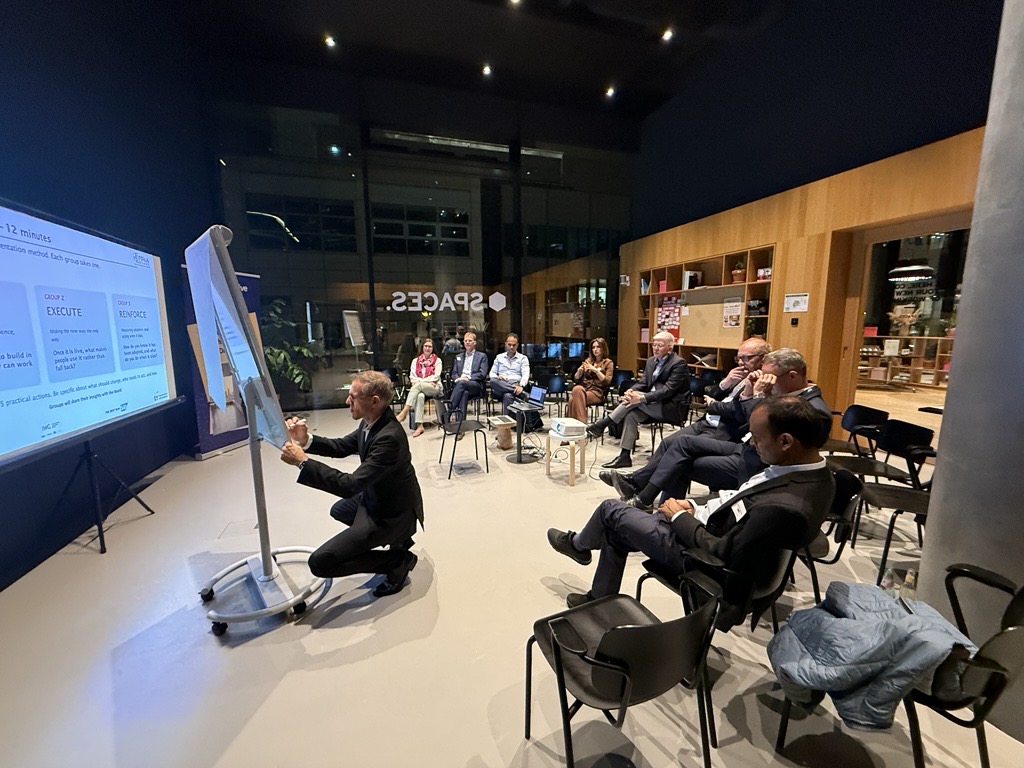
As part of learning different perspectives along with implementing change, Larysa introduced a lovely group activity where we divided the whole group into 3 sub-groups: ENABLE, EXECUTE and REINFORCE as teams. The groups were allocated 12 minutes to think, debate, summarise, and present their work to the whole group, which made the event super engaging and interactive. The summary is beautifully captured in the image below, which largely reflects the opinion.
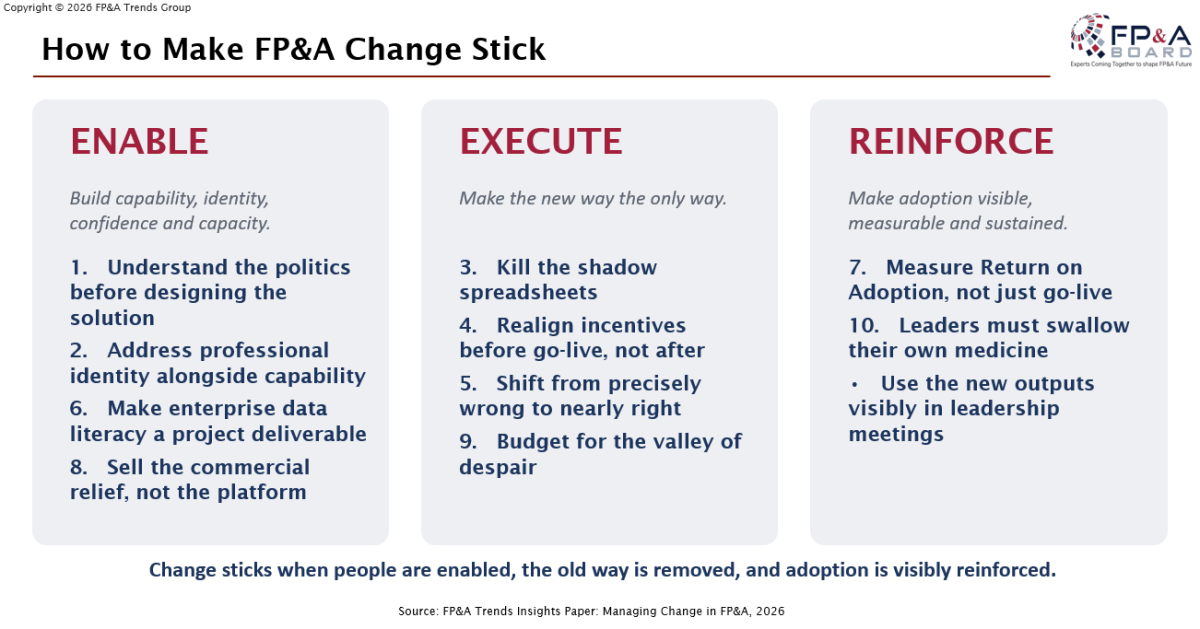
Figure 4
The group work brought the discussion to life.
The ENABLE group described successful change as passing a “point of no return”. Their flipchart connected this with feeling comfortable, proof points, incentives, an outcome focus, clear roles, empowerment and a very practical question: “What’s in it for me?” The message was that people need to see both the evidence and the personal relevance of the new way before they can commit to it.
The EXECUTE group focused on vision, communication, alignment, training, evaluation, fast support and visible action. One phrase stood out: “disable old-way”. The group recognised that if the old process remains available and easier, adoption will always be fragile. Celebrating achievements and showing progress also mattered because people need to see that the change is working.
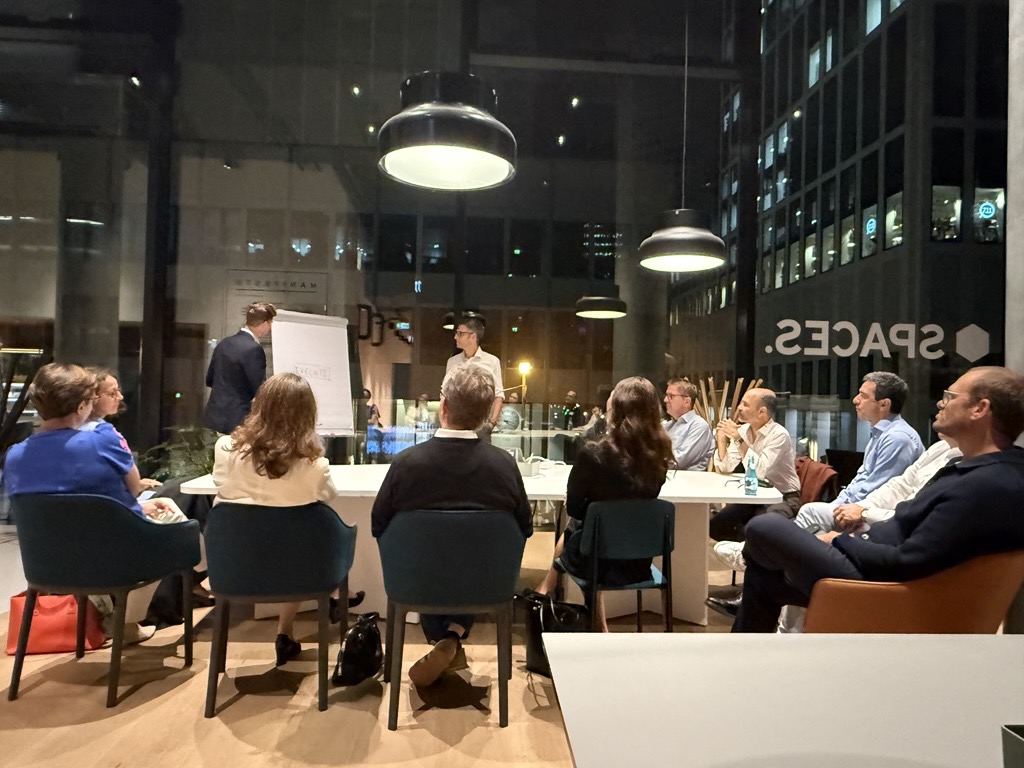
The REINFORCE group reached a similar conclusion from another angle. They highlighted sticking with the new process, taking away old tools, monitoring KPIs, coordination, communication, feedback, setting expectations, involving both supporters and non-supporters, and providing technical support. Reinforcement, therefore, means much more than checking whether a system is live. It means watching whether behaviour has actually changed and acting when it starts to slip.
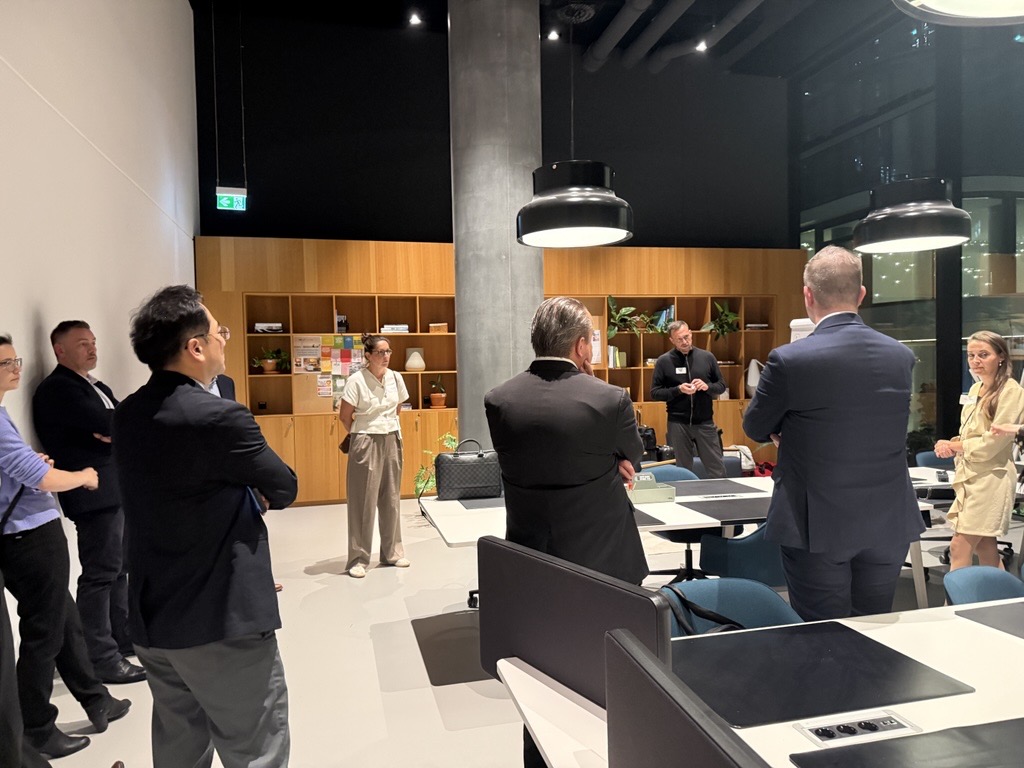
What was especially interesting was the overlap across the three groups. “What’s in it for me?” appeared more than once, and so did the need to remove the old way. Together, the groups showed that adoption becomes real when people understand the reason for change, see proof that it works, feel supported through the transition, and no longer find the old route easier.
In an amazingly structured, engaged and active discussion, the evening brought together the practical realities of FP&A transformation in the AI era. Larysa summarised the learning from nearly 150 minutes of discussion: implementation is not adoption, trust is built through proof and involvement, and reinforcement is what turns a new process into normal behaviour.
Perhaps the strongest phrase of the evening was also the simplest: the real milestone is not go-live. It is the point of no return.
A special thank you to Pascal Prassol and Sven Bauszus from SAP, and Oliver Precht and Bjoern Lange from EY, for their practical demonstration, “Navigating the New Normal with Autonomous Finance”. Thank you to EY and SAP for sponsoring the Frankfurt FP&A Board, to IWG for hosting us at Spaces Omniturm, and to Page Executive for their continued partnership and support.