

The 9th Singapore International FP&A Board brought together senior finance professionals at Asia Square Tower 1 for an engaging face-to-face meeting on Leading FP&A Change in the AI Era. The event also marked ten years of the FP&A Board journey in Singapore, providing an opportunity to reflect on how the finance function has evolved and the challenges ahead.
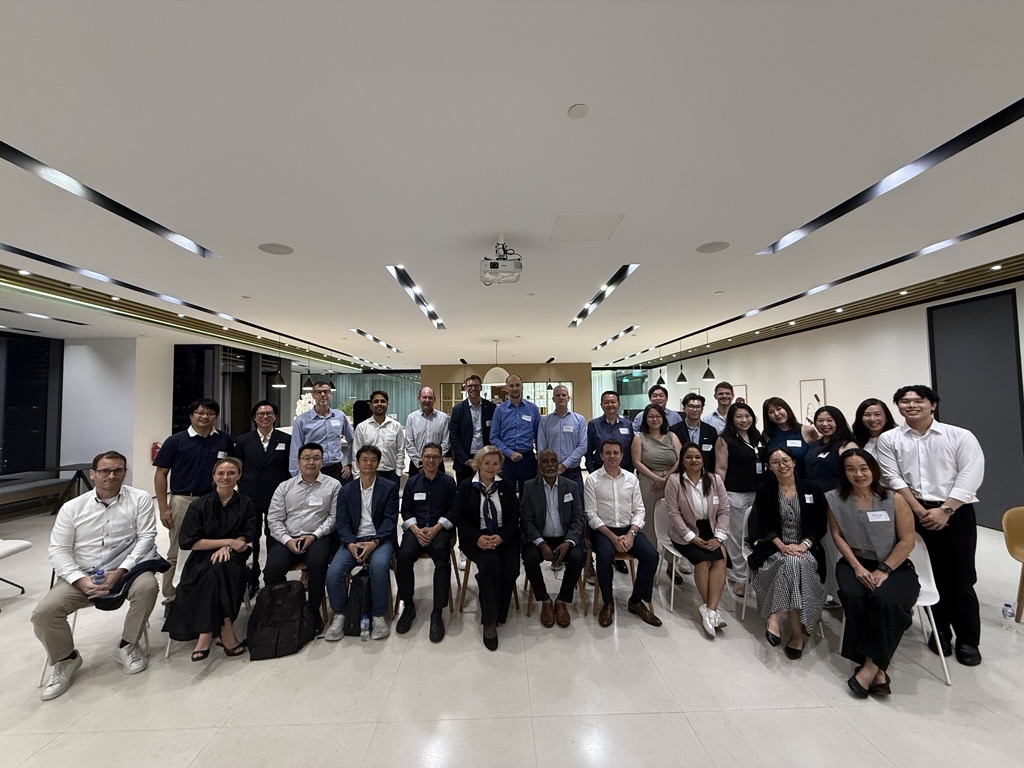
The session was facilitated by Larysa Melnychuk, Founder and CEO of the International FP&A Board, and SAP, the event sponsor, along with our partners Michael Page and International Workplace Group plc.
While AI and digital transformation were central to the discussion, one message stood out throughout the evening. Technology alone does not deliver meaningful change. The real challenge is helping people embrace new ways of working and ensuring that these changes become part of everyday business practice.
Moving Beyond Technology Implementation
The discussion opened with a familiar challenge for many finance leaders. Organisations continue to invest in technology, automation and AI, yet successful implementation does not always lead to effective adoption.
Participants were invited to reflect on one question:
“What most often stops change from sticking?”
Participants shared their perspectives on the challenges of introducing new technology, particularly when established processes and working habits are deeply embedded in an organisation.
Resistance to change, uncertainty about new technology and the need for stronger leadership support were among the broader themes explored.
The challenge is also reflected in FP&A Trends research. According to the 2026 FP&A Trends Survey, 47% of FP&A time is still spent collecting and validating data, while only 32% goes to insights and action. Meanwhile, a June 2025 FP&A Trends webinar poll found that 62% of identified AI adoption barriers were people-related, including skills gaps, resistance and unclear accountability.
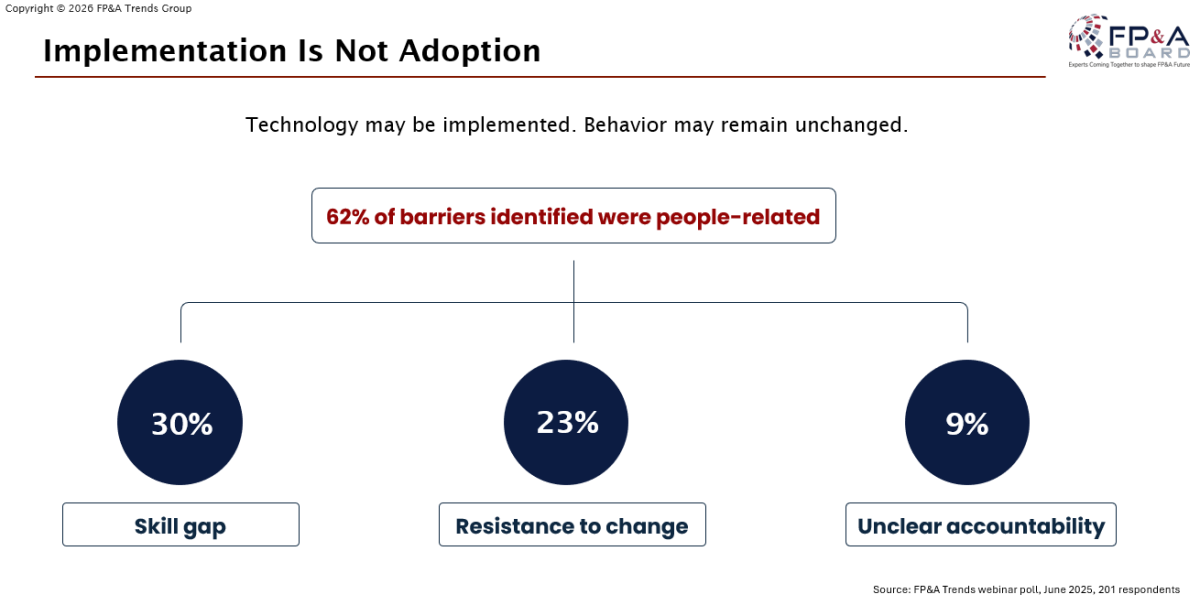
Figure 1.
The discussion highlighted that implementing a system is only one part of the transformation journey. Equally important is ensuring that employees understand its purpose, feel confident using it and recognise how it can improve their work.
For FP&A professionals, this is particularly relevant as AI creates new opportunities to improve forecasting, scenario planning and business decision support.
The FP&A Change Leadership Framework offers a useful perspective on this transition. It identifies five stages — Recognition, Readiness, Confidence, Commitment and Ownership — showing why successful transformation requires more than technical readiness. The ultimate goal is for people to take ownership of the new way of working.
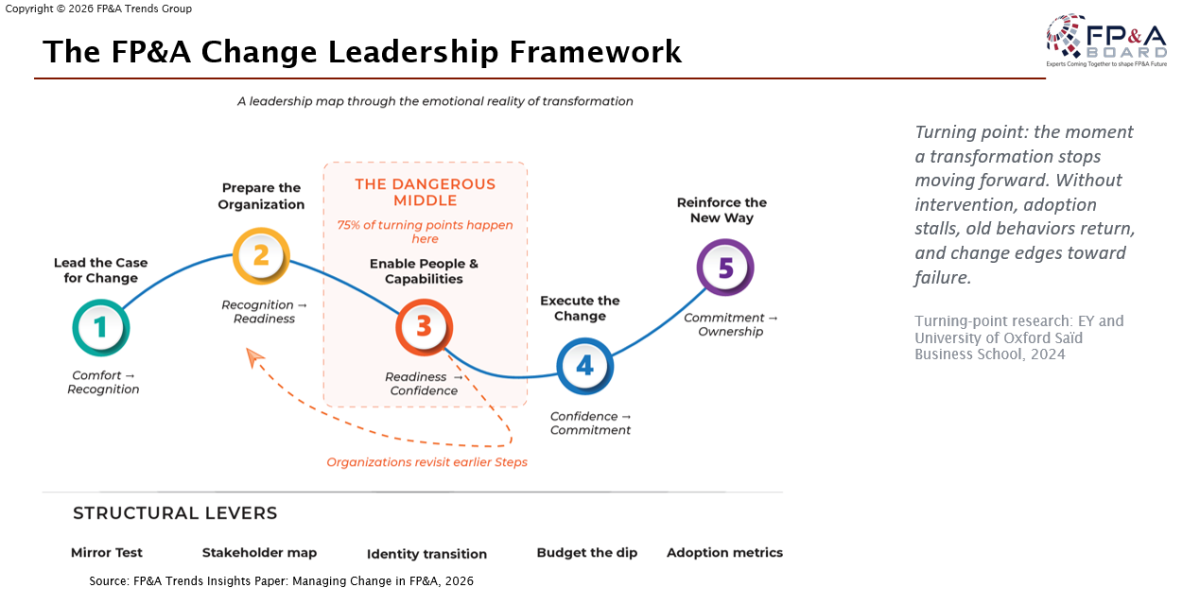
Figure 2.
Highlights of the Evening: Interactive Group Discussions and Networking
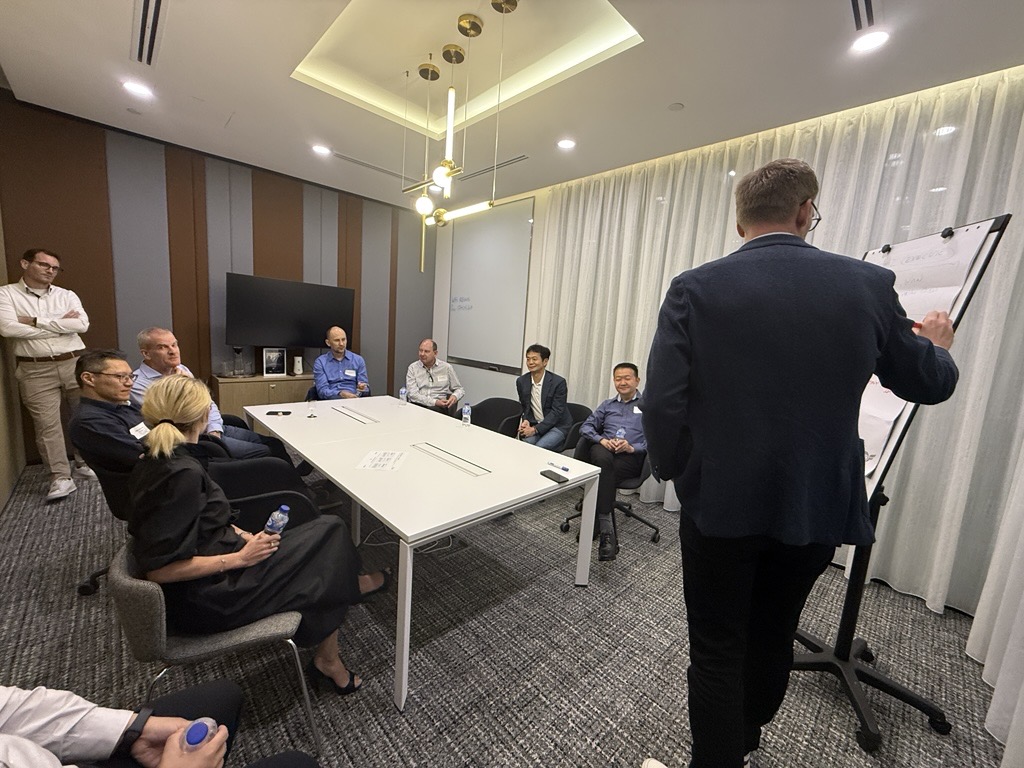
One of the highlights of the evening was the interactive group discussion facilitated by Hendrik Selent and Jyotika Mishra from SAP, who also contributed a session on Autonomous Finance.
Participants were divided into three groups to explore the practical considerations involved in leading AI initiatives, focusing on Enable, Execute and Reinforce.
The exercise encouraged participants to exchange views, share experiences and consider how organisations can manage change more effectively.
Enable: Preparing People for Change
The Enable discussion focused on creating the right environment for people to adopt AI and new ways of working.
Key considerations included communication, building awareness, developing the necessary skills and helping employees feel more confident with technology.
The broader message was that successful adoption begins with preparing people for change, rather than simply introducing new tools.
Execute: Putting Change into Practice
The Execute discussion considered how organisations can translate AI initiatives into practical improvements in day-to-day activities.
Participants explored the importance of clear implementation plans, collaboration, training and ongoing support.
The discussion also recognised that adopting new technology takes time. Employees need opportunities to learn, experiment and adjust before new processes become familiar.
The key consideration was how to move beyond implementation and encourage meaningful use of the technology.
Reinforce: Sustaining Change
The Reinforce discussion focused on how organisations can maintain momentum and ensure that new ways of working become part of normal business practice.
Leadership commitment, accountability, monitoring progress and reinforcing expectations were among the general considerations.
The discussion highlighted the importance of continued management support after implementation, particularly in encouraging consistent adoption across teams.
The overall message was that sustainable change requires ongoing attention rather than ending when a project goes live.
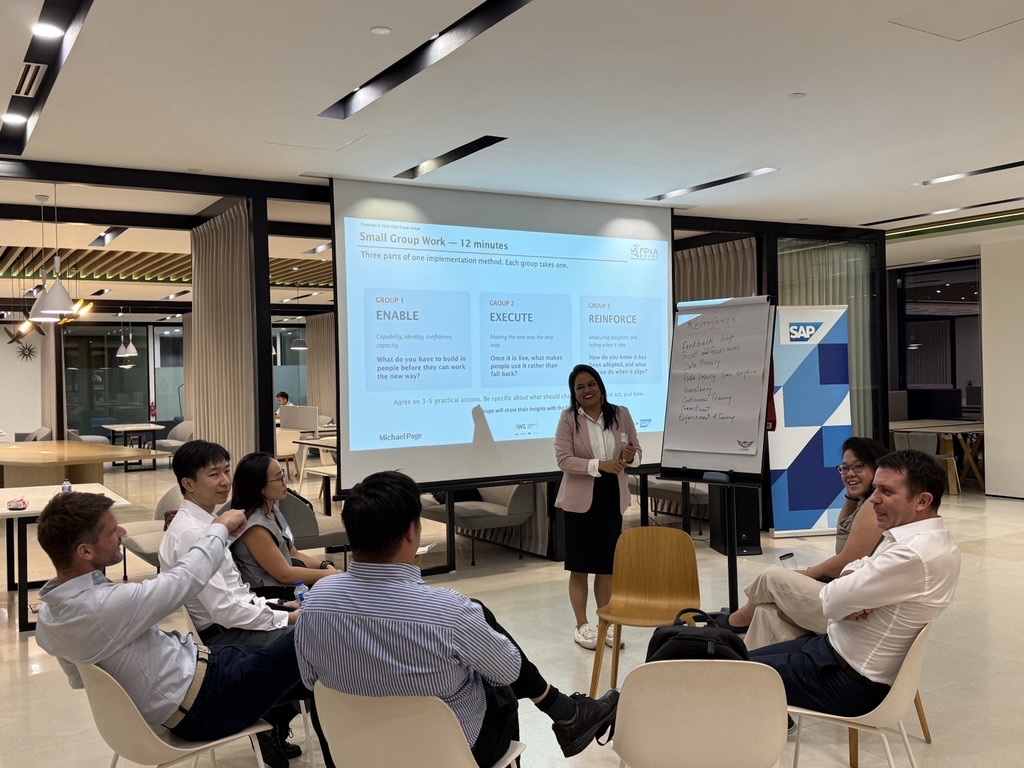
These three areas also reflect the practical approach outlined in the FP&A Trends research: build people's capability and confidence, make the new way of working the normal way, and measure adoption so that progress can be sustained.
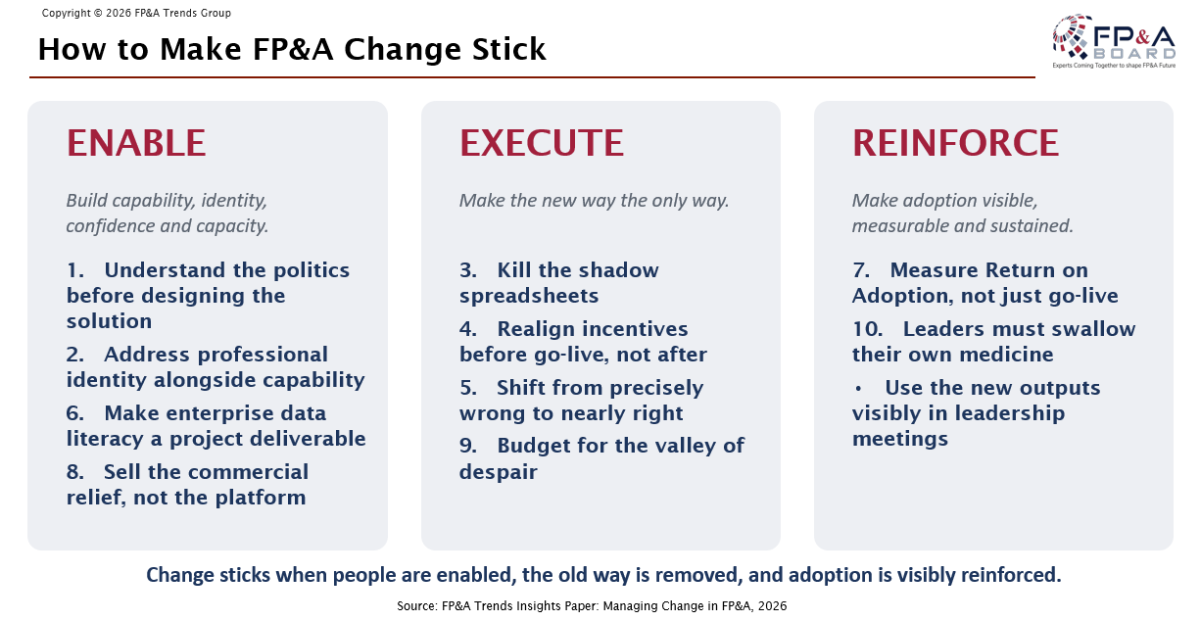
Figure 3.
A Lively Networking Session
Another memorable part of the evening was the lively networking session, which provided an excellent opportunity for participants to reconnect with familiar faces and meet fellow finance professionals from different industries.
The conversations extended beyond the formal group discussions, with participants exchanging experiences, perspectives and ideas on the evolving role of FP&A.
It was encouraging to see the level of engagement and willingness to share practical experiences. These informal conversations added a valuable dimension to the meeting and reinforced the importance of professional networking and knowledge sharing within the Singapore FP&A community.
Key Takeaways from the Discussions
Across the evening's discussions, several common themes emerged.
People remain central to successful AI adoption. Technology can provide new capabilities, but its effectiveness depends on how confidently and consistently people use it.
Leadership support is essential. Finance leaders play an important role in communicating the purpose of change, setting expectations and supporting their teams throughout the transition.
Change requires time and patience. Organisations need to allow employees sufficient time to learn, adapt and become comfortable with new processes.
Implementation is not the same as adoption. The real value of technology comes when it improves everyday work, strengthens analysis and supports better business decisions.
These themes were relevant to many of the challenges finance professionals face as organisations continue to explore the opportunities presented by AI.
Measuring Success Beyond Go-Live
Two lessons from FP&A Trends research were particularly relevant to the discussion.
The first was the importance of measuring Return on Adoption, rather than focusing only on whether a system has been successfully implemented.
A technology project may be completed on time, but its real value depends on whether people use the new capabilities and whether these lead to improvements in efficiency, analysis and decision-making.
For FP&A leaders, this means looking beyond implementation milestones and considering whether manual processes are being reduced, whether reporting is becoming more effective and whether business stakeholders are benefiting from better financial insights.
The second lesson was the temporary decline in productivity that can occur during a period of change.
As employees adjust to unfamiliar systems and processes, it is natural for some activities to take longer initially. Recognising this transition period and providing appropriate support can help organisations achieve more sustainable results.
Both lessons reinforced the importance of treating transformation as an ongoing journey rather than a one-off technology project.
What This Means for FP&A Leaders
My main takeaway from the evening was that successful AI transformation is as much about people and leadership as it is about technology.
AI offers significant opportunities for FP&A professionals to improve forecasting, enhance analysis and provide more forward-looking business insights. However, achieving these benefits requires finance leaders to manage change effectively and bring their teams along the journey.
The discussions were also a useful reminder that technology implementation should not be viewed as the final objective.
What matters is whether the technology helps finance teams work more effectively, improves collaboration with the business and contributes to better decisions.
As the role of FP&A continues to evolve, the ability to lead change will become increasingly important alongside traditional financial and analytical capabilities.
Conclusion
The combination of practical discussions, different perspectives and lively networking made it a valuable evening for the Singapore FP&A community.
The meeting left us with a simple but important message: successful AI transformation is not just about introducing new technology. It is about helping people adopt it, use it effectively and sustain the change over time.