

Businesses need trusted, timely, and complete data to make better decisions. Yet for many FP&A teams, data remains fragmented, inconsistent, and difficult to turn into insight.
The FP&A Trends Survey 2025 found that only 17% of organisations have high-quality, AI-ready data. As AI adoption grows, this matters more than ever. AI can only deliver value when it is built on a reliable data foundation.
FP&A Trends held a webinar on 18 June 2026 to explore how finance teams can improve data quality, strengthen governance, and move towards an AI-ready foundation.
Below is a summary of the key points discussed.
Information Strategy: Starting With the Right Question
The first speaker, Tanbir Jasimuddin, FP&A Thought Leader, FP&A Trends Author and Ambassador, focused on information strategy.
Technology is not the main issue when data projects fail to deliver. The problem is usually the way the project is approached. Tanbir explained that many organisations start with a “push approach,” which often means gathering all the available data, putting it into a data lake, and then trying to create every possible report from it. Instead, use a “pull approach”. This starts with the business question and works backwards.
What drives performance?
What are the key value drivers?
What decisions need to be made?
What information is needed to support those decisions?
If the business wants to grow sales, it first needs to understand where that growth will come from: existing customers or new customers? If the focus is on new customers, then they need to understand acquisition costs, channel performance, conversion rates, and profitability.
This is where data becomes useful. It is not just being collected for the sake of it. It is being linked directly to the decisions the business needs to make.
The decision calendar is very important. And it involves asking senior leaders what decisions they make daily, weekly, monthly, and quarterly, and what information they need to make those decisions properly. If a piece of data does not support a decision, it probably should not be in the model.
Data strategy is about how information flows through the organisation. It considers questions such as:
Where does the data come from?
How clean is it?
How is it stored?
How is it modelled?
How does it reach the people who need it?
Tanbir then went on to talk about data governance, which is summarised in the slide below:
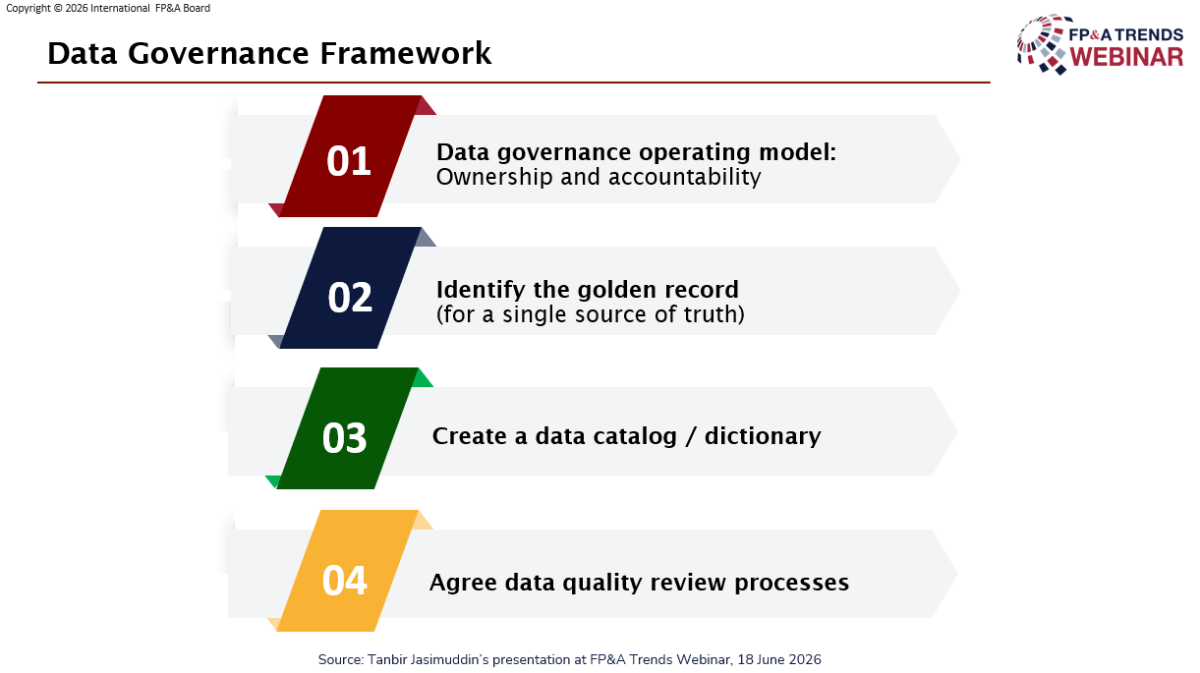
Figure 1
Tanbir closed with a practical reminder: FP&A is not there to produce endless reports. It is there to help the business act.
Balt’s Data Transformation Journey
The second speaker was Orli Shvartzman, Head of Corporate FP&A at Balt.
Orli started with: Balt is a global neurosurgery medical device company, with around 16 sites and approximately 1,000 employees. This creates real complexity. The business has multiple systems, multiple entities, different reporting needs, and a range of stakeholder requirements.
We already use several financial systems for different purposes. As those systems begin to include more AI capability, our approach is to use AI within its existing technology stack rather than treating AI as a separate project.
One of the main lessons from Balt’s journey is that AI cannot function properly without a single source of truth. With multiple local ERP systems, different providers, and different data structures, Balt recognised the need for a data lake or data hub where information can be stored, harmonised, and then used by different systems.
Orli was open about how complex this can be. Different systems often need different types of data. For example:
Consolidation may need year-to-date data
EPM may need month-to-date data
Some users need general ledger data
Others need sub-ledger revenue data
This means there is rarely a simple answer. The data architecture has to be designed around real business use cases.
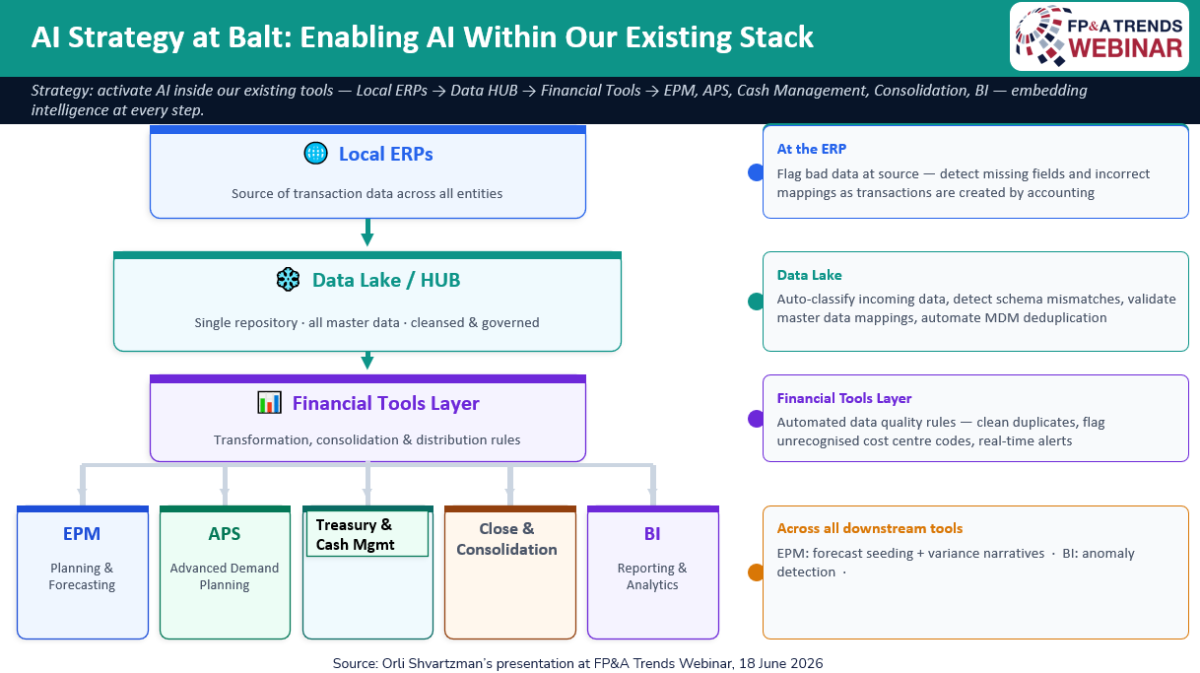
Figure 2
Balt is also always looking at where AI can add value during the process. For example:
At the ERP level, AI could help flag poor-quality data at source
In the data lake, AI could support classification and master data management
In finance tools, AI could help with commentary, variance analysis, and reporting
Balt is not starting with AI and expecting it to solve the data problem. It is improving the data foundation first, then identifying where AI can add value. AI does not fix bad data. Good data is what makes AI useful.
Flattening the AI J Curve
The final speaker was Roger Copleston, Director, Business Value and Strategy at Anaplan.
Roger focused on what becomes possible once the right foundations are in place.
His main point was that clean data on a platform has potential, but AI can help turn that potential into better decisions. However, AI needs to be built into the planning process. It cannot simply be added on afterwards and expected to transform everything.
Roger referred to the AI J Curve. Many AI projects take a dip before they create value because they are introduced before the data and process work has been done.
He used a memorable phrase: one plus one plus one can equal one and a half. In other words, separate AI tools may improve individual tasks, but that does not always mean the whole organisation improves.
He gave a practical example. A CFO asks why EMEA margins are down two points against the forecast. In the old world, the analyst might have to open several spreadsheets, check the data, send emails, find inconsistencies, and present later with caveats! That is not really a strategic conversation. It is more of a sign that the process is not working properly.
In a better world, the foundations are already in place. There is a trusted, driver-based forecast connected to actuals. Finance, sales, and supply chain are working from one version of the truth. An anomaly detector has been running overnight and flags:
One data entry error
One real business signal, showing possible over-discounting in Germany
This means the analyst starts the day with a prioritised list of issues, rather than a pile of data to fix. They can quickly build a margin bridge by product, price, volume, mix, and discounting. The FD can then go to the CFO with options and recommendations, rather than just explanations.
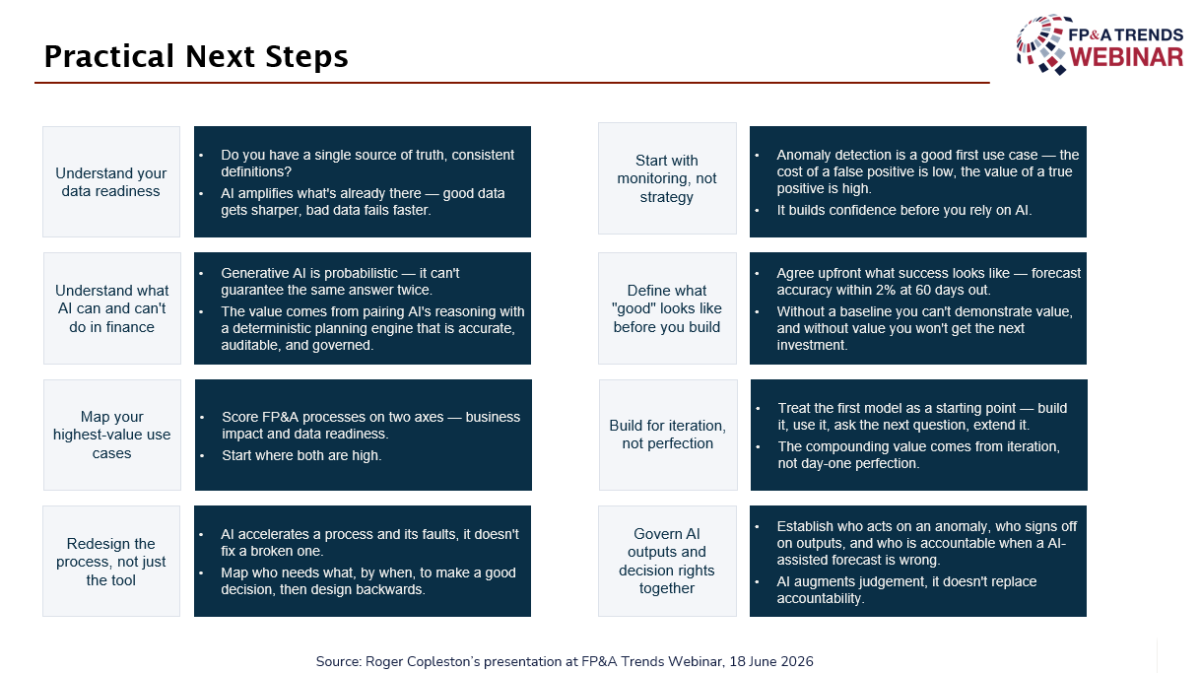
Figure 3
This is where FP&A starts to change. Finance moves from explaining what happened to helping shape what happens next. The value is not just about saving time. It is about spotting risks earlier, acting faster, and supporting better business decisions.
Key Takeaways
The key message from the webinar was clear: successful AI in FP&A starts with strong foundations.
Tanbir
Data projects should start with an information strategy, not technology.
FP&A teams need to understand the decisions they are trying to support before building the data model.
Orli
Data transformation is not easy, especially in complex global organisations.
However, the principles are clear: map who needs the data, understand how it will be used, assign ownership, build governance, and create a trusted foundation before expecting AI to deliver value.
Roger
AI can help detect anomalies, support modelling, improve scenario analysis, and bring finance closer to real-time decision support.
AI does not remove the need for good data, strong processes, and effective governance. It makes them even more important.
We would like to thank our technology sponsor, Anaplan, for bringing this webinar to our FP&A community.
Subscribe to
FP&A Trends Digest

We will regularly update you on the latest trends and developments in FP&A. Take the opportunity to have articles written by finance thought leaders delivered directly to your inbox; watch compelling webinars; connect with like-minded professionals; and become a part of our global community.